Satellite Propellant Tank
ProductOverview
A satellite propellant tank is a pressurized vessel storing the chemical energy (in the form of hydrazine or other mono-propellants) that powers thrusters during mission operations. Unlike ground vehicles, which use gravity to settle fuel and can employ complex fuel management systems, satellites in microgravity require sophisticated fluid management: a propellant management device (PMD) that physically separates liquid propellant from pressurant gas, ensuring every drop can be expelled into the thruster feed lines.
The satellite propellant tank combines a high-strength seamless titanium sphere, an integrated bladder-type PMD, precision fill and isolation valves, and a helium pressurization subsystem. The result is a self-contained fluid storage and regulation system that can cycle propellant thousands of times over a 15-year mission without moving parts or active power (except for solenoid isolation valves).
Tank Structure and Materials
The tank vessel is a seamless titanium Grade 2 sphere 600 mm in diameter with 10 mm wall thickness, rated for 200 psi burst pressure, roughly 1.43× the normal operating pressure of 140 psi, providing ample safety margin.
Titanium was selected over aluminum for three reasons:
- Corrosion resistance: Hydrazine is corrosive to aluminum; titanium is immune even after prolonged contact.
- Strength-to-weight: Titanium's yield strength (483 MPa) is higher than 6061-T6 aluminum (275 MPa), allowing thinner walls and lower mass for the same pressure rating.
- Thermal stability: Titanium's Young's modulus changes little with temperature, critical for pressure control in the extreme thermal environment of space (±50 °C swing between sun-facing and shadowed sides).
The sphere is created by forging or hot-spinning a titanium blank, then stress-relieved (annealed at 700 °C for 30 minutes) to remove residual forge stresses. A single welded seam (if the sphere is assembled from two hemispheres) is post-weld heat-treated to restore material properties.
Propellant Management Device (PMD)
The propellant management device is a soft-walled positive expulsion mechanism. A flexible Teflon elastomer bladder inside the tank physically separates liquid propellant from pressurant helium gas. As the spacecraft fires its thrusters, propellant is drawn out of the tank via a dip tube that sits below the bladder. The bladder collapses inward as propellant is withdrawn, and helium from the pressurant supply pushes the bladder, maintaining constant tank pressure even as propellant volume decreases.
This mechanism solves a critical problem in microgravity: without gravity, propellant doesn't settle to the bottom. A bubble-fed system (in which the dip tube can draw gas) would shut off the engine prematurely. The PMD guarantees that every thruster firing draws liquid, not gas, until the tank is empty.
The titanium wire cage around the bladder prevents it from collapsing too far and blocking the dip tube. The cage has perforations allowing helium to flow around the bladder but keeping it centered.
Typical PMD performance:
- Initial propellant volume: 113 liters (600 mm sphere)
- Usable propellant: ~110 liters (3 liters reserved in bladder folds to prevent damage)
- Compliance loss: <5% from mission start to end (minimal volume loss to residual propellant films)
Pressurization System
The pressurization subsystem maintains tank pressure at 40 psi nominal. This pressure is chosen as a compromise:
- Too low (<20 psi): Pressure drop during high-flow thrusting (50–200 g/s propellant) risks cavitation in the engine feed lines.
- Too high (>60 psi): Tank and component stresses increase; pressurant gas consumption rises; system becomes heavier.
The system comprises a small helium bottle (2 liters, 300 bar charged) with a pilot-operated pressure regulator reducing inlet pressure to ~40 bar (58 psi) outlet. This regulated helium flows through a solenoid isolation valve into the tank above the PMD.
The check valve on the pressurization line prevents tank back-pressure from flowing back into the regulator during thruster firings. A main relief valve set to 45 psi protects against thermal expansion or regulator failure.
Pressurant consumption: Over a 15-year mission with ~50 thruster firings per year (typical for orbit maintenance), the helium pressurant consumption is surprisingly small, typically 50–100 grams out of the 2-kilogram charge. The helium mainly compensates for temperature swings and maintains ullage pressure as propellant is consumed.
Fill and Drain Architecture
The fill and drain system handles ground loading and in-flight propellant isolation. Key components:
- Fill coupling: A large-diameter (1.5 inch) quick-disconnect coupler on the tank nozzle. Ground crews connect this to a propellant supply cart at the launch pad, and pressurized nitrogen forces hydrazine into the tank.
- Inlet isolation valve: A solenoid check valve downstream of the fill coupling that closes once loading is complete, preventing backflow into the fill line.
- Drain coupling: A slightly smaller QD on a separate nozzle, used to evacuate residual propellant post-mission.
- Vent line: Routed to the spacecraft vent manifold, allowing air to escape during filling and preventing over-pressurization.
The tank outlet check valve ensures one-way flow during engine firings. Once propellant is drawn out, if pressure drops momentarily (engine transient), the check valve prevents tank pressure from dropping too far and slowing thruster response.
Thermal Management and Insulation
In space, a satellite experiences large thermal swings: sun-facing surfaces reach ~80 °C; shadowed surfaces drop to -50 °C or lower. An uninsulated propellant tank would experience temperature cycling that stresses all fluid systems and risks thermal shock to the PMD bladder.
The multi-layer insulation (MLI) blanket mitigates this. A stack of ~25–30 alternating aluminized Mylar and Kapton foil layers with Dacron net spacers reduces radiative heat transfer. The blanket covers the tank, mounting skirt, and plumbing.
Typical MLI performance:
- Solar absorption: <0.1 (white Kapton outer surface reflects 90% of incident sunlight).
- Thermal emissivity: <0.02 (aluminized foil reflects nearly all internally-radiated heat).
- Net effect: Tank temperature is maintained within ±10 °C of the spacecraft bus average, rather than experiencing full ±130 °C swings.
Periodic conductive straps embedded in the MLI prevent static charge accumulation between foil layers, avoiding potential electrical discharge.
Safety and Overpressure Protection
A main pressure relief valve set to 45 psi protects the tank from overpressure due to thermal expansion or regulator malfunction. If pressure rises above 45 psi, the valve cracks open, venting excess gas to a safe location (typically a spacecraft vent manifold leading overboard).
Backup protection is provided by a rupture disk set at 50 psi. If the main relief fails (e.g., corrosion freezes the valve), the burst disk ruptures as a last-ditch safeguard, venting the tank and preventing catastrophic failure.
The solenoid inlet isolation valve is a critical safety device. Should a fill-line coupling rupture during ground operations, the solenoid closes within milliseconds, sealing the tank. A PMD pressurant isolation valve similarly protects the helium supply line.
Operational Constraints
Propellant expulsion: The PMD ensures liquid-only draw down to ~3 liters residual (bladder folds prevent complete expulsion). A satellite cannot use the final 3 liters, so usable capacity is ~110 of 113 liters. This is accounted for in mission design.
Thermal cycling: Each orbit (~90 minutes for LEO) introduces a thermal cycle. Over 15 years, a satellite experiences ~5700 cycles. PMD bladder materials (PTFE, butyl elastomer) are selected for fatigue life; rupture risk is <1% over mission life.
Propellant purity: Hydrazine can decompose if contaminated or heated; it degrades at temperatures above 60 °C. Tank and plumbing materials are passivated stainless steel or titanium to prevent catalytic decomposition. Propellant is vacuum-degassed before loading to remove dissolved air.
Pressure transients: When a thruster fires at high thrust (200 g/s flow), tank pressure can drop >5 psi in 100 milliseconds. The PMD must respond quickly (bladder collapse driving helium into the tank). This is tuned by choice of helium inlet orifice size and regulator dynamics.
Modern Satellites and Variants
Contemporary satellites (Intelsat, SES, Planet Labs constellation) use tanks ranging from 10 to 300 liters. The design principle, titanium sphere, PMD bladder, regulated helium pressurant, is universal.
Variants:
- Cryogenic tanks (for LN₂ or LH₂): Require multilayer insulation and larger surface area radiators. Helium is replaced by the cryogenic fluid as pressurant (pressurized but separate from main tank).
- Dual-tank systems: Some satellites use two tanks in parallel for redundancy, each sized for 50% of the mission ΔV requirement. If one tank develops a leak, the other provides full capability.
- High-pressure fuel-cell stacks: Next-generation satellites may use hydrogen/oxygen fuel cells instead of ion or chemical thrusters, requiring larger cryogenic storage.
Current propellant tank technology is mature, with demonstrated lifetimes >20 years and leak-free performance across thousands of mission cycles.
Satellite Propellant Tank parts and their functions
7 top-level parts · 54 parts in total · full bill of materials below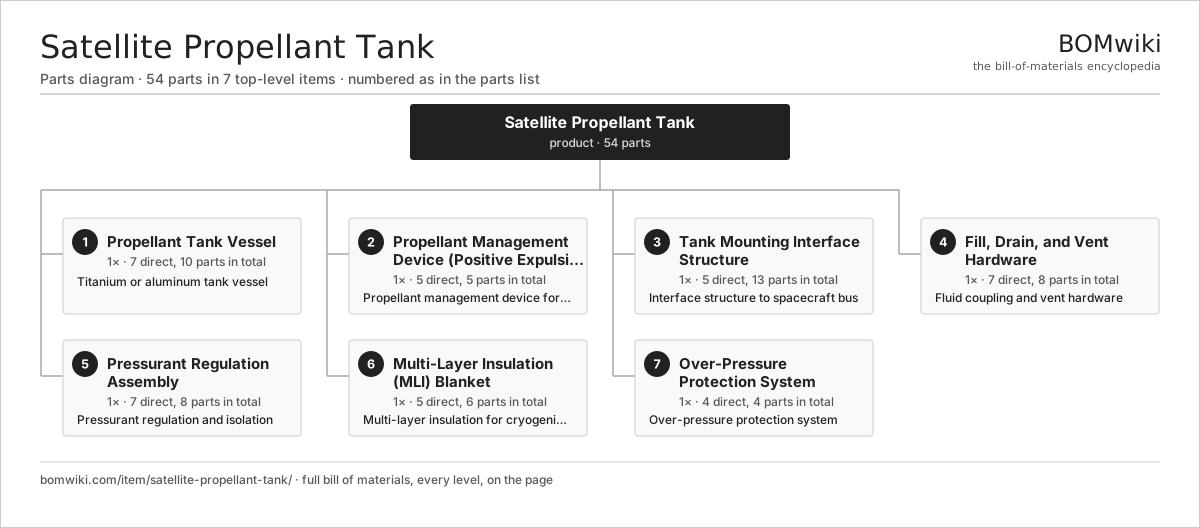
| # | Part | Qty | What it does |
|---|---|---|---|
| 1 | Propellant Tank Vessel 7 parts | 1× | Titanium or aluminum tank vessel |
| 2 | Propellant Management Device (Positive Expulsion) 5 parts | 1× | Propellant management device for microgravity settling |
| 3 | Tank Mounting Interface Structure 5 parts | 1× | Interface structure to spacecraft bus |
| 4 | Fill, Drain, and Vent Hardware 7 parts | 1× | Fluid coupling and vent hardware |
| 5 | Pressurant Regulation Assembly 7 parts | 1× | Pressurant regulation and isolation |
| 6 | Multi-Layer Insulation (MLI) Blanket 5 parts | 1× | Multi-layer insulation for cryogenic tanks |
| 7 | Over-Pressure Protection System 4 parts | 1× | Over-pressure protection system |
3D model
No 3D model yet. Have a CAD file of this? Add a 3D model. STL renders right on this page; STEP, FreeCAD, and OpenSCAD sources are welcome too (openly licensed, like all 3D models on BOMwiki).
Build & assembly graph
expand / collapse · shared sub-assemblies converge · links to related products · est. labourTap an assembly to expand/collapse · tap a part to open it · use “Open page” for any node · drag to pan, scroll to zoom.
Bill of materials for Satellite Propellant Tank
7 top-level lines · 47 rows shown · 54 parts total · indented to 3 levels| # | Item / sub-assembly | Part no. | Qty/assy | Ext. qty | Parts | Type |
|---|---|---|---|---|---|---|
| 1 | Propellant Tank Vessel 7 parts | spt-tank-shell | 1× | 1 | 10 | assembly |
| 1.1 | Titanium Seamless Sphere Blank | spt-sphere-blank | 1× | 1 | · | part |
| 1.2 | Hemispherical Bulkhead Dome | spt-hemispherical-bulkhead | 2× | 2 | · | part |
| 1.3 | Tank Equatorial Weld | spt-weld-zone | 1× | 1 | · | part |
| 1.4 | Internal Slosh Baffle | spt-internal-baffle | 2× | 2 | · | part |
| 1.5 | Tank Access Port Nozzle | spt-access-port | 1× | 1 | · | part |
| 1.6 | Fastener Set | fastener-set | 2× | 2 | · | part |
| 1.7 | Silicone Sealing Gaskets | gasket-set | 1× | 1 | · | part |
| 2 | Propellant Management Device (Positive Expulsion) 5 parts | spt-pmd-assembly | 1× | 1 | 5 | assembly |
| 2.1 | Teflon Elastomer Bladder | spt-bladder-material | 1× | 1 | · | part |
| 2.2 | Bladder Support Cage | spt-bladder-support-cage | 1× | 1 | · | part |
| 2.3 | Tank Outlet Dip Tube Adapter | spt-outlet-adapter | 1× | 1 | · | part |
| 2.4 | PMD Pressurant Isolation Valve | spt-pmd-isolation-valve | 1× | 1 | · | part |
| 2.5 | Fastener Set | fastener-set | 1× | 1 | · | part |
| 3 | Tank Mounting Interface Structure 5 parts | spt-mounting-skirt | 1× | 1 | 13 | assembly |
| 3.1 | Tank Mounting Skirt Frame | spt-skirt-frame | 1× | 1 | · | part |
| 3.2 | Spring-Isolated Flexure Joint | spt-flexure-joint | 3× | 3 | · | part |
| 3.3 | Spt Fastener Interface | satellite-propellant-tank-spt-fastener-interface | 1× | 1 | · | part |
| 3.4 | Fiberglass G-10 Thermal Standoff | spt-thermal-standoff | 6× | 6 | · | part |
| 3.5 | Fastener Set | fastener-set | 2× | 2 | · | part |
| 4 | Fill, Drain, and Vent Hardware 7 parts | spt-fill-drain-ports | 1× | 1 | 8 | assembly |
| 4.1 | Fill Quick-Disconnect Coupling | spt-fill-coupling | 1× | 1 | · | part |
| 4.2 | Drain Quick-Disconnect Coupling | spt-drain-coupling | 1× | 1 | · | part |
| 4.3 | Propellant Tank Vent Line | spt-vent-line | 1× | 1 | · | part |
| 4.4 | Solenoid Inlet Isolation Valve | spt-isolation-valve-inlet | 1× | 1 | · | part |
| 4.5 | Tank Outlet Check Valve | spt-check-valve-outlet | 1× | 1 | · | part |
| 4.6 | Tank Pressure Relief Valve | spt-relief-valve | 1× | 1 | · | part |
| 4.7 | Connector | connector | 2× | 2 | · | part |
| 5 | Pressurant Regulation Assembly 7 parts | spt-pressurant-supply | 1× | 1 | 8 | assembly |
| 5.1 | Helium Pressurant Bottle | spt-pressurant-bottle | 1× | 1 | · | part |
| 5.2 | Pressurant Bottle Isolation Valve | spt-bottle-isolation-valve | 1× | 1 | · | part |
| 5.3 | Pilot-Operated Pressure Regulator | spt-pressurant-regulator | 1× | 1 | · | part |
| 5.4 | Pressurization Check Valve | spt-check-valve-pressurization | 1× | 1 | · | part |
| 5.5 | Tank Pressurization Solenoid Valve | spt-filler-valve | 1× | 1 | · | part |
| 5.6 | Connector | connector | 2× | 2 | · | part |
| 5.7 | Fastener Set | fastener-set | 1× | 1 | · | part |
| 6 | Multi-Layer Insulation (MLI) Blanket 5 parts | spt-thermal-insulation | 1× | 1 | 6 | assembly |
| 6.1 | Multi-Layer Insulation Blanket | spt-mli-blanket | 1× | 1 | · | part |
| 6.2 | MLI Dacron Net Spacer | spt-mli-spacer | 1× | 1 | · | part |
| 6.3 | MLI Conductive Ground Strap | spt-mli-ground-straps | 2× | 2 | · | part |
| 6.4 | Fastener Set | fastener-set | 1× | 1 | · | part |
| 6.5 | Silicone Sealing Gaskets | gasket-set | 1× | 1 | · | part |
| 7 | Over-Pressure Protection System 4 parts | spt-pressure-relief | 1× | 1 | 4 | assembly |
| 7.1 | Main Pressure Relief Valve | spt-relief-valve-main | 1× | 1 | · | part |
| 7.2 | Rupture Disk Safety Element | spt-burst-disk | 1× | 1 | · | part |
| 7.3 | Relief Vent Discharge Line | spt-relief-outlet-line | 1× | 1 | · | part |
| 7.4 | Fastener Set | fastener-set | 1× | 1 | · | part |
Something wrong in this list? Report a problem with this BOM.
Related products
same domain, ranked by shared parts


Sourcing: possible vendors
Browse the supplier directory → Prices, MOQ, and lead times are algorithmic estimates, not quotes, and not claims about these companies. Company mappings are curated by keyword; est. price band $50k–$500M. How estimates work| Vendor | HQ | Specialty | MOQ | Lead time |
|---|---|---|---|---|
|
🇺🇸SpaceX
spacex.com ↗
|
Hawthorne, US | Launch & spacecraft | made to order | 52–104 wks |
| northropgrumman.com ↗ | Falls Church, US | Space & defense | made to order | 52–104 wks |
|
🇫🇷Airbus
airbus.com ↗
|
Toulouse, FR | Aerospace OEM | made to order | 52–104 wks |
| rocketlabusa.com ↗ | Long Beach, US | Launch & spacecraft | made to order | 52–104 wks |
| thalesaleniaspace.com ↗ | Cannes, FR | Satellites | made to order | 52–104 wks |
1,537-word article