Satellite Internet User Terminal
ProductOverview
A satellite user terminal brings broadband to homes and businesses via geostationary orbit, eliminating the need for fiber or cellular infrastructure in rural areas. The system consists of a flat electronically-steered antenna, a modem and router, RF up/downconversion stages, and motorized tracking. Unlike parabolic dishes (which mechanically point), a phased array can electronically aim its beam using phase shifters on dozens of antenna elements, enabling rapid satellite handoff and multibeam operation.
The terminal acquires a satellite by electronically scanning the beam across the orbit until it finds signal, then locks beam angle to track the satellite as Earth rotates. All data, down from satellite and up to satellite, flows through the on-premises modem/router, which hands off to local Wi-Fi or Ethernet devices.
Architecture and operation
The phased-array antenna is the key innovation. Instead of a large parabolic dish, dozens of small patch antenna elements are arranged in an X×Y grid. Each element has its own phase shifter IC. By commanding each phase shifter to introduce a different delay, the beamformer processor creates constructive and destructive interference, "steering" the beam electronically to point at the desired satellite.
The satellite downlink (RX path) starts with a low-noise LNB (low-noise block) amplifier mounted at the antenna feed, boosting the weak 11.7–12.2 GHz signal by 20 dB. The local oscillator in the LNB shifts the signal down to an intermediate frequency (IF), typically 950–2150 MHz, which is easier to cable through the Mounting Mast to the modem box. The modem further downconverts to baseband and demodulates DVB-S2 (digital video broadcast satellite), extracting IP packets for local delivery.
Uplink (TX path) is the reverse: the modem encodes IP packets into DVB-S2X, upconverts to IF via the block upconverter (BUC), the BUC shifts to the 14.0–14.5 GHz Ku uplink band, the transmit amplifier boosts to a few watts, and the antenna radiates upward. The satellite receives, stores if necessary, and rebroadcasts to the receiver's satellite, closing the circuit.
Motorized tracking
Geostationary satellites appear stationary from Earth, but owing to slight orbital perturbations and spacecraft drift, they move slightly (±0.1° over hours). The dual-axis motor system tracks these changes. The modem processor computes the satellite position (using the satellite's ephemeris, transmitted in the downlink signal), sends drive commands to the motor controller, which energizes the azimuth and elevation motors to update the antenna pointing every few seconds.
The motors are slow (2–4 seconds to slew 10°) but precise: mechanical and optical position encoders provide feedback so the pointing is accurate to better than 0.1°. This gradual correction is invisible to users but essential for stable link.
Modulation and link adaptation
DVB-S2 uses adaptive modulation and coding (ACM). When weather is clear and SNR is high, the satellite uses 32-APSK (32-ary amplitude and phase shift keying), packing more bits per symbol and achieving higher throughput. When clouds attenuate the signal, the satellite steps back to QPSK (quadrature phase shift keying), which is more robust to noise, but at lower throughput. The modem measures receiver SNR and feeds it back to the gateway via telemetry, which adjusts its transmission format accordingly. This feedback loop adapts link speed to weather in seconds, automatically trading throughput for reliability.
IP routing and integration
The modem box is a complete router. It terminates the satellite link on the RF side and presents a Gigabit Ethernet port on the user side. The modem runs a routing protocol (often just DHCP and NAT for residential use, or BGP for enterprise), assigns local IP addresses, and forwards packets. From the user's perspective, it looks like any other router, Wi-Fi available on board, Ethernet ports, web management interface.
The only inconvenience is latency: satellites are ~36,000 km away, so the signal takes ~120 ms to go up and ~120 ms to come back (240 ms round-trip), roughly 2–3× higher than terrestrial broadband. Real-time applications like online gaming or VoIP notice this, but web browsing, downloads, and video streaming adapt with TCP's congestion control.
Installation and setup
A technician installs the mast on the roof, mounts the antenna and motors, runs the single PoE cable down to the modem box indoors. The PoE injector at the bottom supplies 48–90 V to the RF chain, motors, and modem processor over a twist-pair telephone-style cable. Once powered, the modem performs satellite acquisition: it electronically sweeps the beam, listening for the configured satellite's beacon. When found, it locks and synchronizes to the downlink signal. The user then registers with the satellite network (using a web interface), and the gateway activates the uplink. Within minutes, IP service is active.
Weather resilience and redundancy
Rain fade is the main impairment: heavy rain increases atmospheric absorption, reducing the downlink power budget and forcing the satellite to use a more robust (but slower) modulation. Some operators deploy multiple terminals or hybrid configurations (satellite + cellular backup) to ensure service continuity.
Satellite Internet User Terminal parts and their functions
7 top-level parts · 400 parts in total · full bill of materials below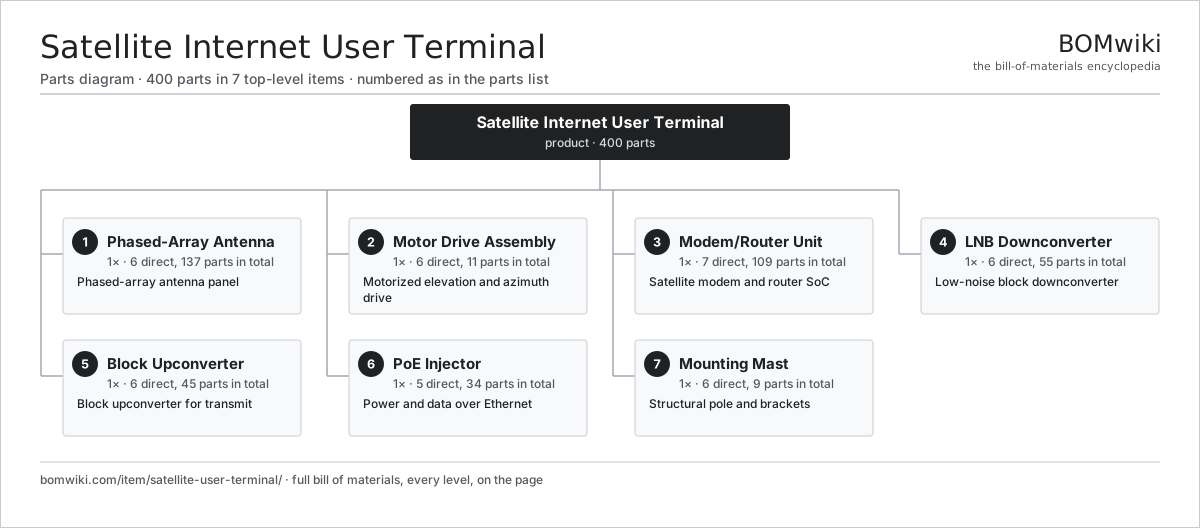
| # | Part | Qty | What it does |
|---|---|---|---|
| 1 | Phased-Array Antenna 6 parts | 1× | Phased-array antenna panel |
| 2 | Motor Drive Assembly 6 parts | 1× | Motorized elevation and azimuth drive |
| 3 | Modem/Router Unit 7 parts | 1× | Satellite modem and router SoC |
| 4 | LNB Downconverter 6 parts | 1× | Low-noise block downconverter |
| 5 | Block Upconverter 6 parts | 1× | Block upconverter for transmit |
| 6 | PoE Injector 5 parts | 1× | Power and data over Ethernet |
| 7 | Mounting Mast 6 parts | 1× | Structural pole and brackets |
3D model
No 3D model yet. Have a CAD file of this? Add a 3D model. STL renders right on this page; STEP, FreeCAD, and OpenSCAD sources are welcome too (openly licensed, like all 3D models on BOMwiki).
Build & assembly graph
expand / collapse · shared sub-assemblies converge · links to related products · est. labourTap an assembly to expand/collapse · tap a part to open it · use “Open page” for any node · drag to pan, scroll to zoom.
Bill of materials for Satellite Internet User Terminal
7 top-level lines · 49 rows shown · 400 parts total · indented to 3 levels| # | Item / sub-assembly | Part no. | Qty/assy | Ext. qty | Parts | Type |
|---|---|---|---|---|---|---|
| 1 | Phased-Array Antenna 6 parts | sat-phased-array | 1× | 1 | 137 | assembly |
| 1.1 | Array Substrate | sat-array-substrate | 1× | 1 | · | part |
| 1.2 | Patch Element | sat-patch-elements | 32× | 32 | · | part |
| 1.3 | Phase Shifter | sat-phase-shifter | 32× | 32 | · | part |
| 1.4 | Beamformer IC | sat-beamformer-ic | 1× | 1 | · | part |
| 1.5 | Feed Network | sat-feed-network | 1× | 1 | · | part |
| 1.6 | SMD Passive (R/C/L) | smd-passives | 70× | 70 | · | part |
| 2 | Motor Drive Assembly 6 parts | sat-motor-assembly | 1× | 1 | 11 | assembly |
| 2.1 | Azimuth Motor | sat-azimuth-motor | 1× | 1 | · | part |
| 2.2 | Elevation Motor | sat-elevation-motor | 1× | 1 | · | part |
| 2.3 | Gearbox | sat-motor-gearbox | 2× | 2 | · | part |
| 2.4 | Position Encoder | sat-motor-encoder | 2× | 2 | · | part |
| 2.5 | Motor Controller | sat-motor-controller | 1× | 1 | · | part |
| 2.6 | Gimbal Bearing | sat-motor-bearing | 4× | 4 | · | part |
| 3 | Modem/Router Unit 7 parts | sat-modem-unit | 1× | 1 | 109 | assembly |
| 3.1 | Modem SoC | sat-modem-soc | 1× | 1 | · | part |
| 3.2 | Router SoC | sat-router-soc | 1× | 1 | · | part |
| 3.3 | System Memory | sat-modem-memory | 1× | 1 | · | part |
| 3.4 | Storage | sat-modem-flash | 1× | 1 | · | part |
| 3.5 | Ethernet Port | sat-modem-ethernet | 4× | 4 | · | part |
| 3.6 | Heatsink | sat-modem-cooling | 1× | 1 | · | part |
| 3.7 | SMD Passive (R/C/L) | smd-passives | 100× | 100 | · | part |
| 4 | LNB Downconverter 6 parts | sat-lnb-lna | 1× | 1 | 55 | assembly |
| 4.1 | LNA MMIC | sat-lna-core | 1× | 1 | · | part |
| 4.2 | Mixer | sat-downconvert-mixer | 1× | 1 | · | part |
| 4.3 | Local Oscillator | sat-local-oscillator | 1× | 1 | · | part |
| 4.4 | IF Filter | sat-bandpass-filter | 1× | 1 | · | part |
| 4.5 | Input Connector | sat-lnb-connector | 1× | 1 | · | part |
| 4.6 | SMD Passive (R/C/L) | smd-passives | 50× | 50 | · | part |
| 5 | Block Upconverter 6 parts | sat-buc | 1× | 1 | 45 | assembly |
| 5.1 | Driver Amplifier | sat-buc-driver | 1× | 1 | · | part |
| 5.2 | Upconverter | sat-upconvert-mixer | 1× | 1 | · | part |
| 5.3 | TX Oscillator | sat-buc-oscillator | 1× | 1 | · | part |
| 5.4 | TX Filter | sat-buc-filter | 1× | 1 | · | part |
| 5.5 | Power Attenuator | sat-buc-attenuator | 1× | 1 | · | part |
| 5.6 | SMD Passive (R/C/L) | smd-passives | 40× | 40 | · | part |
| 6 | PoE Injector 5 parts | sat-poe-injector | 1× | 1 | 34 | assembly |
| 6.1 | PoE Splitter | sat-poe-splitter | 1× | 1 | · | part |
| 6.2 | Input PoE Jack | sat-poe-input-jack | 1× | 1 | · | part |
| 6.3 | Output Jack | sat-poe-cable-jack | 1× | 1 | · | part |
| 6.4 | PoE DC/DC | sat-poe-dcdc | 1× | 1 | · | part |
| 6.5 | SMD Passive (R/C/L) | smd-passives | 30× | 30 | · | part |
| 7 | Mounting Mast 6 parts | sat-mounting-mast | 1× | 1 | 9 | assembly |
| 7.1 | Mast Pole | sat-mast-pole | 1× | 1 | · | part |
| 7.2 | Antenna Bracket | sat-antenna-bracket | 1× | 1 | · | part |
| 7.3 | Motor Platform | sat-motor-mount | 1× | 1 | · | part |
| 7.4 | Cable Duct | sat-cable-conduit | 1× | 1 | · | part |
| 7.5 | Cable Boot | sat-weatherseal-boots | 4× | 4 | · | part |
| 7.6 | Fastener Set | fastener-set | 1× | 1 | · | part |
Something wrong in this list? Report a problem with this BOM.
Sourcing: possible vendors
Browse the supplier directory → Prices, MOQ, and lead times are algorithmic estimates, not quotes, and not claims about these companies. Company mappings are curated by keyword; est. price band $30–$50k. How estimates work| Vendor | HQ | Specialty | MOQ | Lead time |
|---|---|---|---|---|
|
🇺🇸Cisco
cisco.com ↗
|
San Jose, US | Networking | 500 units | 8–14 wks |
|
🇺🇸Juniper
juniper.net ↗
|
Sunnyvale, US | Networking | 500 units | 8–14 wks |
| arista.com ↗ | Santa Clara, US | Networking | 500 units | 8–14 wks |
|
🇫🇮Nokia
nokia.com ↗
|
Espoo, FI | Telecom equipment | 500 units | 8–14 wks |
|
🇨🇳Huawei
huawei.com ↗
|
Shenzhen, CN | Networking & telecom | 500 units | 8–14 wks |
912-word article