Aluminum Scaffold Tower
ProductOverview
The aluminum scaffold tower (or mobile scaffold tower) is a lightweight, modular access platform system designed for interior work, painting, maintenance, and light facade operations. Unlike heavy steel scaffolding, which requires multiple workers and significant time to assemble, aluminum towers are manufactured as prefabricated modules that lock together tool-free or with single-hand quick-pins, allowing a single worker to build a 2–4 m tall platform in 15–30 minutes.
The system is widely deployed in commercial buildings, industrial facilities, airports, and maintenance environments where portability, speed, and minimal floor footprint are critical. A typical tower is 0.75–1.5 m × 0.75–1.5 m in base footprint, rolls on casters, and reaches 2–12 m in height. Because of its light weight (40–60 kg per 2 m height for aluminum), two workers can safely move and reposition a tower without mechanical assistance, making it ideal for interior spaces with limited equipment access.
Frame Design & Modular Architecture
The Frame Section Assembly are the structural core, comprising Vertical Frame Members (uprights) and Horizontal Ledger Beams (ledgers) that form the load-carrying skeleton. Each frame section is typically 0.75–2.0 m tall (the most common being 0.75 m and 1.0 m), and adjacent sections connect via Frame Connection System, quick-lock or push-pin systems that eliminate the need for bolts, tools, or trained assemblers.
The vertical frames are aluminum extrusions or welded tubes, typically 40–50 mm diameter with 2–3 mm wall thickness. These uprights are designed for slenderness ratio L/D ≈ 20–30, meaning buckling is not the primary limit. Instead, the design is governed by combined stresses: vertical load from the platform and workers (typically 15–30 kN per side), lateral wind load (1–2 kN), and bending moment from eccentric loading.
The horizontal ledger beams support platform decking and typically span 0.75–1.5 m between uprights. They are sized for a deflection limit of L/250 under full platform load (2–5 person occupancy), ensuring the platform is visibly flat and does not sag noticeably during work.
Quick-Connect Frame Fastening
The Frame Connection System are the enabling technology for rapid assembly. Common connection types include:
Push-pin connectors: Ledger beams have a lug at each end that inserts into a notch or pocket on the vertical frame. A spring-loaded pin, thumb-operated, locks the beam in position with a satisfying click. No wrench is required, and the connection can be made or broken in 5 seconds.
Wedge-lock connectors: A similar principle, but the beam ends are pressed into a tapered slot on the upright, and a wedge is hammered into place, creating a friction-locked joint rated for the full design load.
Pinned connections: Older designs use drilled holes with cotter pins or split-pins through matching holes. Assembly requires a hammer and pliers but is still faster than bolting.
Modern push-pin systems are the industry standard because they require zero tools and are intuitive enough for untrained workers to assemble correctly. The connections are inherently positive, they cannot slip or come loose under vibration, because the pin mechanism is spring-loaded and resists extraction without deliberate manual action.
Base Assembly & Stability
The Base & Stabilization is critical for preventing tipping, the most common failure mode. The base provides a wide, low footprint that resists overturning moment from eccentric loading (e.g., a worker leaning outward at height).
The base includes:
Base Plate: A large aluminum or steel pad, typically 0.75–1.5 m square, distributing tower weight and providing mechanical advantage against tipping.
Adjustable Leveling Feet: Screw-type leveling feet with 0–200 mm adjustment range, allowing the tower to be level even on slightly uneven floors. Each foot is independently adjustable, ensuring all four corners are weighted equally.
Outrigger Diagonal Braces: Diagonal aluminum tubes extending from the lower frame sections outward and downward to the floor, typically at 45° angle. These outriggers act as anti-tipping arms, resisting lateral loads and overturning moment. Outrigger arms typically extend 0.5–1.0 m beyond the base, increasing the overturning resistance by a factor of 2–3× compared to a tower without outriggers.
For a tower 4 m tall and 0.8 m wide (base + outrigger = 1.8 m effective width), the overturning moment capacity is approximately M = (total weight) × (effective width / 2) = 30 kN × 0.9 m = 27 kN⋅m. A worker 4 m high creating 1 kN lateral load (pushing or leaning) generates a moment of 1 kN × 4 m = 4 kN⋅m, well within capacity with a safety factor of 6–7×.
Platform Decking & Access
The Working Platforms & Decks are the work surfaces. Typical platforms are 0.6–1.2 m wide (platform width matching the tower width) and 0.75–2.0 m long (front to back), providing 0.5–2.4 m² of working area per section.
Platforms typically consist of:
Deck Boards: Aluminum grating, expanded metal, or plywood boards, typically 18–25 mm thick, providing comfortable footing and good drainage. Grating is preferred in wet environments (allowing water to flow through); plywood is preferred for interior work (reducing noise and providing a smooth surface). Platform load rating is typically 150–300 kPa distributed, or 100–150 kg concentrated per point.
Access Hatch Covers: Removable or hinged openings allowing tools and materials to pass vertically between platform levels without requiring removal of the entire deck. Typical hatch dimensions are 0.3–0.5 m × 0.3–0.5 m, fitted with hinged aluminum frames and safety latches to prevent accidental closure on fingers or tools.
Deck Fastening Clips: Clip systems or bolts securing the platform boards to the ledger beams, preventing lateral sliding or tipping. Spring clamps are typical, they grip the ledger beam and are tightened with a hand lever, requiring no tools.
Access & Egress
The Internal Access Stairs integrate a stairway into the tower frame, eliminating the need for external ladders. This is critical for health and safety: climbing external ladders on a moving, shifting structure is high-risk; internal stairs provide three-point contact and psychological security.
The stair assembly typically includes:
Stair Frame: Aluminum stringers and treads, forming a 1.0–1.2 m wide stairway. The stairway is integrated into the upright frames, either by pinning the treads directly to the uprights or by creating a separate stair tower that fits alongside the main scaffold frame.
Stair Treads: Each step is typically 0.3–0.4 m deep (tread) and 0.2–0.25 m tall (rise), conforming to building codes for stair safety. Treads are coated with slip-resistant grit tape or rubber, essential because worker boots may be muddy or wet.
Handrails: A continuous handrail at 1000–1100 mm height, running the full stairway length, providing hand-hold security and fall protection.
Guardrails & Fall Protection
The Platform Guardrails & Protection are mandatory on all platform edges above 2 m height. They typically comprise:
Safety Rail Tubes: Two horizontal aluminum tubes at 500 mm and 1100 mm heights, providing upper and mid-rail protection. The gap between rails is designed so a 150 mm sphere (simulating a child's head) cannot pass through, meeting safety standards.
Guardrail Posts: Vertical 40×40 mm aluminum members welded or pinned at each platform corner and at 2 m spacing along platform edges.
Toe Board: A 150–200 mm high steel or aluminum sheet at the base of the guardrail, preventing tools and materials from rolling off during work or wind gusts.
Guardrails are rated for 1.1 kN horizontal push, meeting occupational safety standards across most jurisdictions. Testing is performed using a padded battering ram applied at mid-height.
Lateral Bracing & Wind Resistance
The Lateral Bracing & Wind Resistance system resists lateral sway from wind or worker movement. Typical bracing includes:
Diagonal Braces: Aluminum or steel tubes at 45° angles, installed on two perpendicular faces of the tower (or all four faces for maximum stiffness). The diagonals connect lower and upper frame nodes, creating a truss-like structure that resists racking.
Bracing density: Tower height and environmental wind loading determine bracing frequency. For interior work with no wind load, bracing every 3–4 m is typical. For exterior work or windy sites, bracing every 1–2 m is recommended.
The first natural frequency (sway frequency) of an unbraced tower is typically 0.3–0.5 Hz. With diagonal bracing, the frequency increases to 1.0–1.5 Hz, reducing amplitude of any rhythmic disturbance (vibration from machinery, worker movement, etc.) that might excite resonance.
Casters & Mobility
The Mobility & Caster System enable rapid repositioning without disassembly. Each caster is typically 100–200 mm diameter rubber or polyurethane wheel, rated for 2–5 tonnes load. Four casters (one per corner of the base) are standard.
Caster details include:
Caster Wheels: Swivel casters (rotating 360°) are typical, providing omnidirectional mobility. Wheel material is chosen for floor protection, rubber or soft polyurethane for tile or concrete, avoiding hard wheels that can damage floors.
Caster Locks & Brakes: Brake pedals or hand levers lock each caster in place once the tower is positioned. Locking is critical: a tower with free-rolling casters is unstable and can drift, especially if workers climb or shift weight. Both the vertical stem (preventing rotation) and the wheel (preventing rolling) are locked.
Typical deployment: two workers roll the tower to position, engage all brakes, level the adjustable feet, and assemble the next frame section. The entire process takes 5–10 minutes.
Variants & Specialized Towers
- Wide towers: 1.5–2.0 m wide platforms for task-specific work areas, at the cost of increased weight and reduced portability.
- Non-mobile towers: Bolted to concrete or structure, used for semi-permanent support in factories or warehouses.
- Cantilever towers: Platform extending beyond the tower base, supported by external tie-backs, used for facade or exterior work.
- Folding towers: Telescoping uprights and collapsible platforms, compressing to ~0.5 m length, ideal for storage and transport in confined spaces.
Aluminum scaffold towers have become the global standard for interior access, with estimates of 100 million+ units in active service across rental companies, educational institutions, and industrial operators. The combination of speed, safety, portability, and cost-effectiveness (rental cost ~USD 30–60 per week) makes them the preferred choice over alternative systems like ladder stands, step ladders, or custom-built wood scaffolding.
Aluminum Scaffold Tower parts and their functions
7 top-level parts · 21 parts in total · full bill of materials below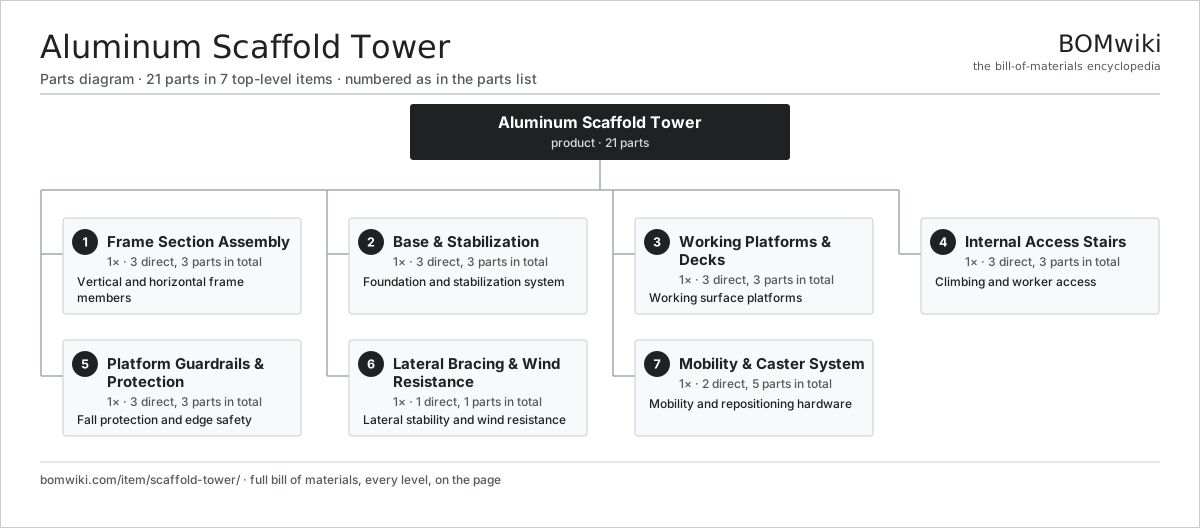
| # | Part | Qty | What it does |
|---|---|---|---|
| 1 | Frame Section Assembly 3 parts | 1× | Vertical and horizontal frame members |
| 2 | Base & Stabilization 3 parts | 1× | Foundation and stabilization system |
| 3 | Working Platforms & Decks 3 parts | 1× | Working surface platforms |
| 4 | Internal Access Stairs 3 parts | 1× | Climbing and worker access |
| 5 | Platform Guardrails & Protection 3 parts | 1× | Fall protection and edge safety |
| 6 | Lateral Bracing & Wind Resistance 1 parts | 1× | Lateral stability and wind resistance |
| 7 | Mobility & Caster System 2 parts | 1× | Mobility and repositioning hardware |
3D model
No 3D model yet. Have a CAD file of this? Add a 3D model. STL renders right on this page; STEP, FreeCAD, and OpenSCAD sources are welcome too (openly licensed, like all 3D models on BOMwiki).
Build & assembly graph
expand / collapse · shared sub-assemblies converge · links to related products · est. labourTap an assembly to expand/collapse · tap a part to open it · use “Open page” for any node · drag to pan, scroll to zoom.
Bill of materials for Aluminum Scaffold Tower
7 top-level lines · 25 rows shown · 21 parts total · indented to 3 levels| # | Item / sub-assembly | Part no. | Qty/assy | Ext. qty | Parts | Type |
|---|---|---|---|---|---|---|
| 1 | Frame Section Assembly 3 parts | scaffold-tower-frame-sections | 1× | 1 | 3 | assembly |
| 1.1 | Vertical Frame Members | scaffold-tower-vertical-frames | 1× | 1 | · | part |
| 1.2 | Horizontal Ledger Beams | scaffold-tower-horizontal-beams | 1× | 1 | · | part |
| 1.3 | Frame Connection System | scaffold-tower-frame-connectors | 1× | 1 | · | part |
| 2 | Base & Stabilization 3 parts | scaffold-tower-base-assembly | 1× | 1 | 3 | assembly |
| 2.1 | Base Plate | scaffold-tower-base-plate | 1× | 1 | · | part |
| 2.2 | Adjustable Leveling Feet | scaffold-tower-adjustable-feet | 1× | 1 | · | part |
| 2.3 | Outrigger Diagonal Braces | scaffold-tower-outrigger-braces | 1× | 1 | · | part |
| 3 | Working Platforms & Decks 3 parts | scaffold-tower-platform-decks | 1× | 1 | 3 | assembly |
| 3.1 | Deck Boards | scaffold-tower-deck-boards | 1× | 1 | · | part |
| 3.2 | Access Hatch Covers | scaffold-tower-hatch-covers | 1× | 1 | · | part |
| 3.3 | Deck Fastening Clips | scaffold-tower-deck-fastening | 1× | 1 | · | part |
| 4 | Internal Access Stairs 3 parts | scaffold-tower-access-stairs | 1× | 1 | 3 | assembly |
| 4.1 | Stair Frame | scaffold-tower-stair-frames | 1× | 1 | · | part |
| 4.2 | Stair Treads | scaffold-tower-stair-treads | 1× | 1 | · | part |
| 4.3 | Handrails | scaffold-tower-stair-handrails | 1× | 1 | · | part |
| 5 | Platform Guardrails & Protection 3 parts | scaffold-tower-guardrails | 1× | 1 | 3 | assembly |
| 5.1 | Guardrail Posts | scaffold-tower-guardrail-posts | 1× | 1 | · | part |
| 5.2 | Safety Rail Tubes | scaffold-tower-guardrail-tubes | 1× | 1 | · | part |
| 5.3 | Toe Board | scaffold-tower-toe-board | 1× | 1 | · | part |
| 6 | Lateral Bracing & Wind Resistance 1 parts | scaffold-tower-bracing | 1× | 1 | 1 | assembly |
| 6.1 | Diagonal Braces | scaffold-tower-diagonal-braces | 1× | 1 | · | part |
| 7 | Mobility & Caster System 2 parts | scaffold-tower-casters-wheels | 1× | 1 | 5 | assembly |
| 7.1 | Caster Wheels | scaffold-tower-caster-wheels | 4× | 4 | · | part |
| 7.2 | Caster Locks & Brakes | scaffold-tower-wheel-locking | 1× | 1 | · | part |
Something wrong in this list? Report a problem with this BOM.
Sourcing: possible vendors
Browse the supplier directory → Prices, MOQ, and lead times are algorithmic estimates, not quotes, and not claims about these companies. Company mappings are curated by keyword; est. price band $15k–$2M. How estimates work| Vendor | HQ | Specialty | MOQ | Lead time |
|---|---|---|---|---|
| caterpillar.com ↗ | Irving, US | Construction & mining equipment | made to order | 16–28 wks |
|
🇯🇵Komatsu
komatsu.com ↗
|
Tokyo, JP | Construction & mining equipment | made to order | 16–28 wks |
|
🇸🇪Volvo CE
volvoce.com ↗
|
Gothenburg, SE | Construction equipment | made to order | 16–28 wks |
|
🇨🇭Liebherr
liebherr.com ↗
|
Bulle, CH | Cranes & heavy equipment | made to order | 16–28 wks |
|
🇨🇳XCMG
xcmg.com ↗
|
Xuzhou, CN | Construction machinery | made to order | 16–28 wks |
1,783-word article