Scenery Automation Winch
ProductOverview
Theatrical scenery automation winches are motorized lifting systems designed to raise, lower, and position heavy stage sets with precision and safety. The core mechanism consists of a powered drum that spools or unspools wire rope under closed-loop control. A servo motor provides variable-speed operation, while a planetary gearbox multiplies torque to handle loads from 500 to 5000 kg depending on motor size and rope diameter. Modern winches incorporate load cells for real-time tension monitoring, rotary encoders for position feedback, and safety brakes that hold the load if power is lost.
These systems are essential in large theaters, opera houses, and production facilities where manual rigging is impractical or unsafe. Unlike chain hoists that hang from above, theatrical winches often sit stage-floor or in the fly loft, spooling rope to drop or raise scenery. The closed-loop architecture allows cue operators to stop mid-travel and recall the exact position of each piece of scenery, enabling repeatable blocking across hundreds of performances.
How it works
The operator initiates a cue through the control pendant or DMX console, sending a speed and direction command to the servo drive. The servo amplifier energizes the motor, rotating the Drum Spool at a rate proportional to the command voltage. As the rope winds or unwinds, the Rotary Encoder continuously transmits drum rotation to the Motion Controller, which calculates the rope position in meters or feet.
Simultaneously, the Load Cell measures cable tension, confirming the load is being supported correctly. If tension spikes (indicating a snag or overload), the controller can automatically reduce speed or halt motion before rope breakage occurs. The Safety Brake remains de-energized during normal operation, held open by a solenoid. If the servo loses power or an emergency stop is pressed, the solenoid releases, and a heavy compression spring clamps the brake pads onto a drum, locking the load instantly.
The Motor Drive Unit converts the logical speed command into proportional current through the servo coils. Modern servo systems use internal commutation (Hall sensors or back-EMF) to maintain smooth, low-speed torque without speed ripple, critical for avoiding jerky motion visible to the audience. The Planetary Gearbox then steps down motor speed, typically 1500–3000 rpm input to 50–300 rpm drum output, and concentrates torque for the heavy lift.
Control & Integration
Stage lighting consoles increasingly integrate winch cues into their show control sequences. The Motion Controller accepts RS-485 DMX, Ethernet OSC (Open Sound Control), or analog 0–10 V inputs from the main control desk. This allows the lighting designer to trigger scenery moves precisely timed with lighting effects and music. Advanced controllers also log all motions to a database, supporting playback analysis and safety audits.
Maintenance & Safety
The Cable Assembly must be inspected regularly for fraying, corrosion, and fatigue at attachment points. Rope life typically spans 5–10 years with proper care. The Ball Bearing pairs in the drum shaft should be regreased annually or per manufacturer schedule. The Safety Brake pad friction material wears gradually; periodic testing under no-load conditions ensures it can still hold the maximum rated load.
Safety interlocks prevent accidental motor start if the brake release solenoid has failed. The system must trip an emergency stop if tension exceeds 110% of the load cell's rated capacity for more than 500 milliseconds. All moving rope and drum surfaces are guarded with netting or solid shrouding to prevent entanglement.
Variants & Scaling
Small, low-budget productions may use a single 3 kW winch for lightweight props. Large opera houses often deploy a fleet of 5–10 winches, each rated 5–7.5 kW, coordinated by a central show control system. Some theaters employ redundant winches on critical flown pieces (chandeliers, orchestra shells) so that if one fails, the backup can safely lower the load. Multi-line rigs (two or three ropes supporting one load) are used when a single winch rope diameter would become unwieldy or when load symmetry requires distributed support.
The Control Enclosure houses all electrical components in a weatherproof cabinet mounted backstage or in the machine room. In outdoor or spray-intensive venues, stainless steel enclosures and corrosion-resistant fasteners replace standard powder coat. Modern installations integrate the enclosure with climate control, cooling fans, and surge protection to extend component life in high-humidity or temperature-extreme environments.
Scenery Automation Winch parts and their functions
8 top-level parts · 59 parts in total · full bill of materials below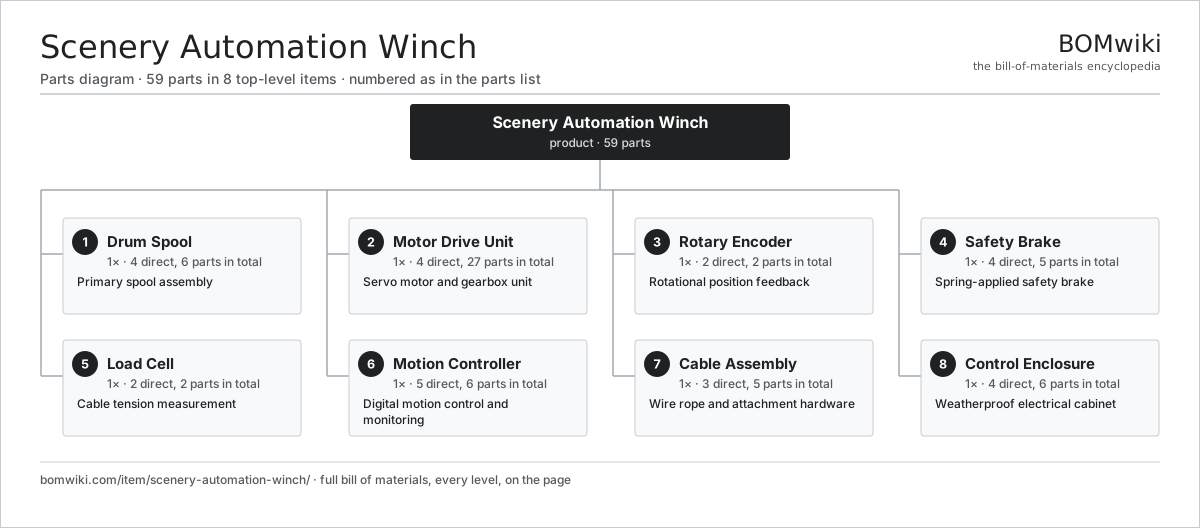
| # | Part | Qty | What it does |
|---|---|---|---|
| 1 | Drum Spool 4 parts | 1× | Primary spool assembly |
| 2 | Motor Drive Unit 4 parts | 1× | Servo motor and gearbox unit |
| 3 | Rotary Encoder 2 parts | 1× | Rotational position feedback |
| 4 | Safety Brake 4 parts | 1× | Spring-applied safety brake |
| 5 | Load Cell 2 parts | 1× | Cable tension measurement |
| 6 | Motion Controller 5 parts | 1× | Digital motion control and monitoring |
| 7 | Cable Assembly 3 parts | 1× | Wire rope and attachment hardware |
| 8 | Control Enclosure 4 parts | 1× | Weatherproof electrical cabinet |
3D model
No 3D model yet. Have a CAD file of this? Add a 3D model. STL renders right on this page; STEP, FreeCAD, and OpenSCAD sources are welcome too (openly licensed, like all 3D models on BOMwiki).
Build & assembly graph
expand / collapse · shared sub-assemblies converge · links to related products · est. labourTap an assembly to expand/collapse · tap a part to open it · use “Open page” for any node · drag to pan, scroll to zoom.
Bill of materials for Scenery Automation Winch
8 top-level lines · 40 rows shown · 59 parts total · indented to 3 levels| # | Item / sub-assembly | Part no. | Qty/assy | Ext. qty | Parts | Type |
|---|---|---|---|---|---|---|
| 1 | Drum Spool 4 parts | scenery-automation-winch-drum | 1× | 1 | 6 | assembly |
| 1.1 | Drum Barrel | scenery-automation-winch-drum-barrel | 1× | 1 | · | part |
| 1.2 | Drum Shaft | scenery-automation-winch-drum-shaft | 1× | 1 | · | part |
| 1.3 | Ball Bearing | ball-bearing | 2× | 2 | · | part |
| 1.4 | Drum Flange | scenery-automation-winch-drum-flange | 2× | 2 | · | part |
| 2 | Motor Drive Unit 4 parts | scenery-automation-winch-motor-drive | 1× | 1 | 27 | assembly |
| 2.1 | Servo Motor 4 parts | servo-motor | 1× | 1 | 24 | assembly |
| 2.1.1 | Stator Assembly 3 parts + deeper › | stator-assembly | 1× | 1 | 3 | assembly |
| 2.1.2 | Rotor Assembly 4 parts + deeper › | rotor-assembly | 1× | 1 | 19 | assembly |
| 2.1.3 | Encoder | encoder | 1× | 1 | · | part |
| 2.1.4 | Motor Housing | motor-housing | 1× | 1 | · | part |
| 2.2 | Planetary Gearbox | scenery-automation-winch-gearbox | 1× | 1 | · | part |
| 2.3 | Shaft Coupler | scenery-automation-winch-coupling | 1× | 1 | · | part |
| 2.4 | Motor Mount Frame | scenery-automation-winch-motor-mount | 1× | 1 | · | part |
| 3 | Rotary Encoder 2 parts | scenery-automation-winch-encoder | 1× | 1 | 2 | assembly |
| 3.1 | Encoder | encoder | 1× | 1 | · | part |
| 3.2 | Encoder Mount | scenery-automation-winch-encoder-mount | 1× | 1 | · | part |
| 4 | Safety Brake 4 parts | scenery-automation-winch-brake | 1× | 1 | 5 | assembly |
| 4.1 | Brake Friction Surface | scenery-automation-winch-brake-drum | 1× | 1 | · | part |
| 4.2 | Brake Pad | scenery-automation-winch-brake-pad | 2× | 2 | · | part |
| 4.3 | Brake Spring | scenery-automation-winch-brake-spring | 1× | 1 | · | part |
| 4.4 | Brake Release Solenoid | scenery-automation-winch-brake-solenoid | 1× | 1 | · | part |
| 5 | Load Cell 2 parts | scenery-automation-winch-load-cell | 1× | 1 | 2 | assembly |
| 5.1 | Pressure Sensor | pressure-sensor | 1× | 1 | · | part |
| 5.2 | Load Cell Tensioner | scenery-automation-winch-load-cell-mount | 1× | 1 | · | part |
| 6 | Motion Controller 5 parts | scenery-automation-winch-controller | 1× | 1 | 6 | assembly |
| 6.1 | Microcontroller | mcu | 1× | 1 | · | part |
| 6.2 | Servo Drive Module | scenery-automation-winch-servo-drive | 1× | 1 | · | part |
| 6.3 | Control Pendant | scenery-automation-winch-hmi | 1× | 1 | · | part |
| 6.4 | Power Supply | power-supply | 1× | 1 | · | part |
| 6.5 | Relay | relay | 2× | 2 | · | part |
| 7 | Cable Assembly 3 parts | scenery-automation-winch-cable-assembly | 1× | 1 | 5 | assembly |
| 7.1 | Wire Rope | scenery-automation-winch-wire-rope | 1× | 1 | · | part |
| 7.2 | Rope Termination | scenery-automation-winch-rope-termination | 2× | 2 | · | part |
| 7.3 | Cable Guide Pulley | scenery-automation-winch-cable-guide | 2× | 2 | · | part |
| 8 | Control Enclosure 4 parts | scenery-automation-winch-enclosure | 1× | 1 | 6 | assembly |
| 8.1 | Enclosure Cabinet | scenery-automation-winch-enclosure-box | 1× | 1 | · | part |
| 8.2 | Cooling Fan | scenery-automation-winch-cooling-fan | 1× | 1 | · | part |
| 8.3 | Terminal Block | scenery-automation-winch-terminal-block | 3× | 3 | · | part |
| 8.4 | Fastener Set | fastener-set | 1× | 1 | · | part |
Something wrong in this list? Report a problem with this BOM.
Related products
same domain, ranked by shared parts Fiber Cement Sheet Machine
819 parts · shares 14 with this page
Insulated Sandwich Panel Line
1,856 parts · shares 14 with this page
 Precast Concrete Mold
493 parts · shares 14 with this page
 Rigging Chain Hoist
55 parts · shares 13 with this page
Acoustic Banner Hoist
90 parts · shares 13 with this page
Stage Deck Lift
107 parts · shares 13 with this page
Sourcing: possible vendors
Browse the supplier directory → Prices, MOQ, and lead times are algorithmic estimates, not quotes, and not claims about these companies. Company mappings are curated by keyword; est. price band $50–$10k. How estimates work| Vendor | HQ | Specialty | MOQ | Lead time |
|---|---|---|---|---|
| assaabloy.com ↗ | Stockholm, SE | Locks & access | 1,000 units | 8–12 wks |
|
🇺🇸Allegion
allegion.com ↗
|
Dublin, US | Security products (Schlage) | 1,000 units | 8–12 wks |
| dormakaba.com ↗ | Rümlang, CH | Access & door systems | 1,000 units | 8–12 wks |
| honeywell.com ↗ | Charlotte, US | Building & safety tech | 1,000 units | 8–12 wks |
| hikvision.com ↗ | Hangzhou, CN | Surveillance & security | 1,000 units | 8–12 wks |
746-word article