School Desk
ProductOverview
A school desk is a single-student study unit combining a work surface, seat, and storage into one compact, durable assembly. The Frame Assembly is welded structural steel, two side rails running the full length, joined by front and back rails, with diagonal X-bracing for rigidity. The Work Surface is a laminated plywood top, typically 1.2 m wide and 0.6 m deep, mounted on the frame via quick-release clips, allowing fast assembly and disassembly. Below the work surface sits the Book Box Assembly, a partially enclosed storage compartment with an open front for textbooks and supplies. A flip-up Seat Assembly is hinged to the frame, locking down when lowered for sitting or flipping up to reveal the book box when standing. A Footrest Bar at the rear, 30 cm above the floor, supports the student's feet to reduce leg fatigue during long study sessions. Four plastic feet allow the desk to slide smoothly across the floor and, critically, to nest with other desks for compact storage, a key design requirement in schools with limited space.
The design targets educational institutions and has remained largely unchanged for 60+ years because it balances durability, repairability, cost, and functionality. A school may purchase 200–300 desks and need to store or move them as classroom layouts change; nesting and modular construction are non-negotiable.
Frame and structural design
The Frame Assembly is the skeleton. Welded 25 × 25 mm square-tube steel, powder-coated gray or black, provides the foundation. The side rails run the full 1.2 m length and ~0.75 m height (desk height plus the back of the work surface). The Front Rail and Back Rail connect the sides at the top and bottom, forming a rectangular perimeter. Diagonal X-bracing on each side, running from top-front to bottom-rear, resists the twisting loads that occur when students lean on the desk or bump it while moving between rows.
The frame is designed to nest: the diagonal braces slope outward, so when one desk is inverted and placed on top of another, the frames interlock without damage. Eight to twelve desks can stack to a height of 1.5 m, fitting a typical classroom storage cart. The glide feet (molded plastic with nylon bottoms) allow the desk to slide smoothly on tile, concrete, or gym floors without noise or floor damage, a critical feature in a 6-hour school day with 30–40 desk moves.
Work surface and storage
The Work Surface is an 18 mm plywood panel, faced with high-pressure laminate in tan, gray, or natural wood grain, a finish chosen for its resistance to pencil marking, marker erasure, and the everyday wear of sharpeners and erasers. The edge band is thermofused PVC, mitered at corners, protecting the ply core from chipping when desks collide or are stacked. Four spring clips or screws hold the top to the frame; removal takes 30 seconds, useful when replacing a damaged top or deep-cleaning under it.
The Book Box Assembly sits directly under the work surface, forming a 0.3 m deep enclosed compartment with an open front. A plywood floor and back panel define the space; an optional Box Divider partitions it into two sections. Most students use the box to store textbooks, notebooks, and pencils, keeping the desk surface clear for active work. The box is accessible while standing (a student can reach in and pull a book) or while seated with the seat flipped up.
Seating and ergonomics
The Seat Assembly is a hinged assembly bolted to a bracket welded to the side rails. The seat itself is typically a molded polypropylene shell (most durable, wipe-clean) or, in padded variants, a plywood core with vinyl upholstery and thin foam. The shell is roughly 0.4 m wide and 0.35 m deep, enough for a student to sit facing the desk, but deliberately compact to encourage posture and prevent sprawling.
The hinge pin has rubber or nylon bushings on each end, allowing the seat to flip smoothly without noise or wear. A simple friction catch or spring stop locks the seat in the down position when seated, preventing accidental flip-up if a student shifts weight suddenly. When the student stands and flips the seat up, it locks in the fully raised position against the desk frame, clearing the book box for access.
Height is calibrated for the typical 11–17 year-old body: desk height is 70 cm (standard for writing while seated), seat height is 40 cm (knee angle roughly 90 degrees), and the footrest at 30 cm provides support for shorter students or those with long legs who would otherwise dangle. Foot support is critical for concentration, a dangling foot causes restlessness and distraction.
Storage and logistics
The nesting design is a game-changer for school facilities. At the end of the school year, desks are stacked, shrink-wrapped in groups of 8–12, and moved to a storage area or the next classroom. No need for a large inventory: a school can use 200 desks in classrooms and rotate them to different rooms as schedules change. If a single desk is damaged, it can be repaired or replaced without affecting others, the top and Seat Assembly are modular components, each costing 10–20% of the total desk price.
The frame is the most expensive component and is designed to be rebuilt. If a side rail cracks (rare, but possible from decades of stacking), a welder can cut and splice a new section. The top clips hold parts together without welding, so parts can be removed and replaced in any order. Most school districts have a technician or partnership with a local fabricator who services desks on a two-year rotating basis, repainting, re-laminating tops, replacing seats, extending the life of the furniture to 20–30 years.
Classroom layout and accessibility
The 1.2 m width and 0.6 m depth of each desk fit neatly into standard classroom grids. A 7 m × 9 m classroom can hold 30–36 desks in 6–7 rows of 5–6 columns, allowing a teacher to walk between rows and supervise. The footrest and compact seat ensure students of varying heights can sit comfortably; the low profile of the frame (compared to standalone chair-desk combos) does not obstruct the teacher's sightline from the front of the room.
Wheelchair accessibility is sometimes accommodated by providing height-adjustable tables alongside traditional school desks, or by specifying desks without the seat (work surface only on a frame), allowing a wheelchair to roll underneath. The glide feet are removable casters on some institutional variants, enabling motorized movement for custodial staff, though this adds cost and complicates nesting.
School Desk parts and their functions
7 top-level parts · 57 parts in total · full bill of materials below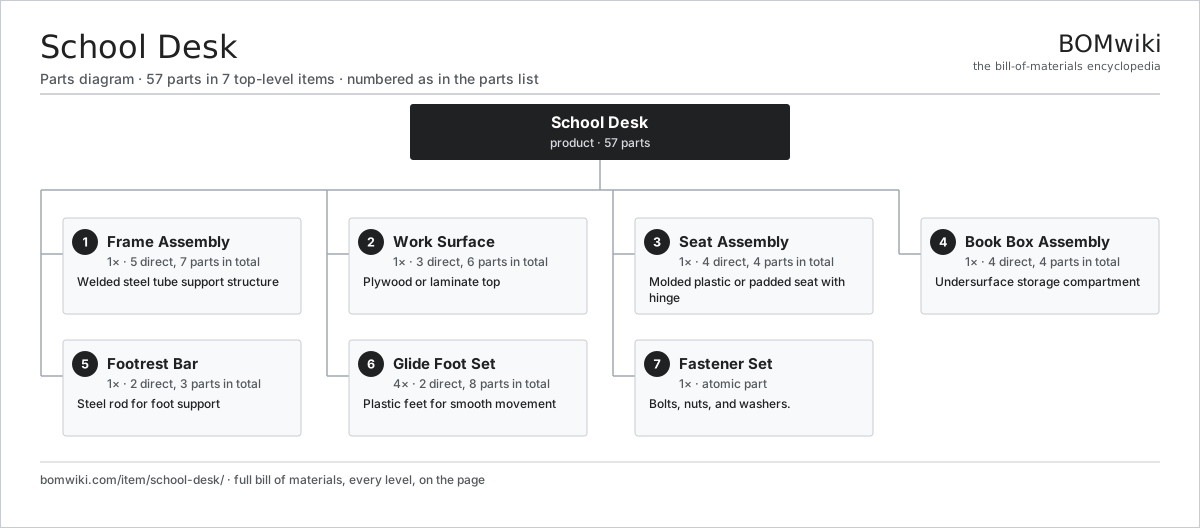
| # | Part | Qty | What it does |
|---|---|---|---|
| 1 | Frame Assembly 5 parts | 1× | Welded steel tube support structure |
| 2 | Work Surface 3 parts | 1× | Plywood or laminate top |
| 3 | Seat Assembly 4 parts | 1× | Molded plastic or padded seat with hinge |
| 4 | Book Box Assembly 4 parts | 1× | Undersurface storage compartment |
| 5 | Footrest Bar 2 parts | 1× | Steel rod for foot support |
| 6 | Glide Foot Set 2 parts | 4× | Plastic feet for smooth movement |
| 7 | Fastener Set | 1× | Bolts, nuts, and washers. |
3D model
No 3D model yet. Have a CAD file of this? Add a 3D model. STL renders right on this page; STEP, FreeCAD, and OpenSCAD sources are welcome too (openly licensed, like all 3D models on BOMwiki).
Build & assembly graph
expand / collapse · shared sub-assemblies converge · links to related products · est. labourTap an assembly to expand/collapse · tap a part to open it · use “Open page” for any node · drag to pan, scroll to zoom.
Bill of materials for School Desk
7 top-level lines · 27 rows shown · 57 parts total · indented to 3 levels| # | Item / sub-assembly | Part no. | Qty/assy | Ext. qty | Parts | Type |
|---|---|---|---|---|---|---|
| 1 | Frame Assembly 5 parts | school-desk-frame | 1× | 1 | 7 | assembly |
| 1.1 | Side Rail | school-desk-side-rail | 2× | 2 | · | part |
| 1.2 | Front Rail | school-desk-front-rail | 1× | 1 | · | part |
| 1.3 | Back Rail | school-desk-back-rail | 1× | 1 | · | part |
| 1.4 | Seat Hinge Bracket | school-desk-seat-bracket | 1× | 1 | · | part |
| 1.5 | Frame Brace | school-desk-frame-brace | 2× | 2 | · | part |
| 2 | Work Surface 3 parts | school-desk-work-surface | 1× | 1 | 6 | assembly |
| 2.1 | Top Panel | school-desk-top-panel | 1× | 1 | · | part |
| 2.2 | Edge Band | school-desk-top-edge-band | 1× | 1 | · | part |
| 2.3 | Top Clip | school-desk-mounting-clip | 4× | 4 | · | part |
| 3 | Seat Assembly 4 parts | school-desk-seat | 1× | 1 | 4 | assembly |
| 3.1 | Seat Shell | school-desk-seat-shell | 1× | 1 | · | part |
| 3.2 | Seat Hinge Pin | school-desk-seat-hinge-pin | 1× | 1 | · | part |
| 3.3 | Seat Latch | school-desk-seat-latch | 1× | 1 | · | part |
| 3.4 | Seat Pad | school-desk-seat-pad | 1× | 1 | · | part |
| 4 | Book Box Assembly 4 parts | school-desk-book-box | 1× | 1 | 4 | assembly |
| 4.1 | Book Box Frame | school-desk-book-box-frame | 1× | 1 | · | part |
| 4.2 | Box Base | school-desk-book-box-base | 1× | 1 | · | part |
| 4.3 | Box Back Panel | school-desk-book-box-back | 1× | 1 | · | part |
| 4.4 | Box Divider | school-desk-book-box-divider | 1× | 1 | · | part |
| 5 | Footrest Bar 2 parts | school-desk-footrest-bar | 1× | 1 | 3 | assembly |
| 5.1 | Footrest Rod | school-desk-footrest-rod | 1× | 1 | · | part |
| 5.2 | Footrest Bracket | school-desk-footrest-bracket | 2× | 2 | · | part |
| 6 | Glide Foot Set 2 parts | school-desk-glides | 4× | 4 | 8 | assembly |
| 6.1 | Glide Foot | school-desk-glide-foot | 4× | 16 | · | part |
| 6.2 | Glide Sleeve | school-desk-glide-sleeve | 4× | 16 | · | part |
| 7 | Fastener Set | fastener-set | 1× | 1 | · | part |
Something wrong in this list? Report a problem with this BOM.
Sourcing: possible vendors
Browse the supplier directory → Prices, MOQ, and lead times are algorithmic estimates, not quotes, and not claims about these companies. Company mappings are curated by keyword; est. price band $50–$3k. How estimates work| Vendor | HQ | Specialty | MOQ | Lead time |
|---|---|---|---|---|
| steelcase.com ↗ | Grand Rapids, US | Office furniture | 200 units | 6–12 wks |
| millerknoll.com ↗ | Zeeland, US | Furniture (Herman Miller) | 200 units | 6–12 wks |
|
🇺🇸Haworth
haworth.com ↗
|
Holland, US | Office furniture | 200 units | 6–12 wks |
|
🇺🇸HNI
hnicorp.com ↗
|
Muscatine, US | Furniture & hearth | 200 units | 6–12 wks |
| ikea.com ↗ | Älmhult, SE | Furniture manufacturing | 200 units | 6–12 wks |
1,247-word article