Three-Screw Pump
ProductOverview
A three-screw pump is a rotary positive-displacement pump built around a single driven Power Rotor meshing with two undriven Idler Rotors inside the close-fitting trefoil bore of a Liner Sleeve. The intermeshing screw threads divide the liquid into a series of sealed cavities that travel axially from the suction end to the discharge end at constant velocity. Because the cavities neither expand nor contract during transit, delivery is continuous and essentially free of pulsation, which is why three-screw pumps dominate lube-oil circulation, fuel-oil transfer and burner feed, hydraulic elevator drives, and crude-oil pipeline boosting where smooth flow and low noise matter.
The architecture dates to the Imo pump patented by Carl Montelius in the 1930s, and the geometry is still often called an Imo-type profile. Sizes range from small cartridge pumps delivering under 1 m³/h to pipeline units above 250 m³/h at differential pressures of 40 bar and more.
How it works
Torque enters through the Shaft Key on the Power Rotor Assembly. Only the power rotor is mechanically driven; the two idler screws in the Idler Rotor Set are rotated by the hydraulic pressure of the liquid acting on their flanks. The rotor profile is designed so the idlers carry almost no metal-to-metal contact load: they float on a hydrodynamic film of the pumped liquid, which is why the pump can only handle media with some lubricity and must never run dry.
As the screws turn, the meshing line between power-rotor flanks, idler flanks, and the Liner Cartridge bore forms a chain of closed cavities. Each shaft revolution advances every cavity by one lead, so flow is directly proportional to speed. Slip back through the 0.03–0.08 mm running clearances is the only internal loss; it grows with differential pressure and falls steeply with viscosity, giving volumetric efficiencies above 90% on typical lube oils.
Axial hydraulic thrust is the dominant rotor load. On the power rotor it is cancelled by the Balance Piston, a stepped extension that exposes discharge pressure to a balancing area; the small residue is carried by the Thrust Washer and the angular-contact Ball Bearing in the Bearing Housing Assembly. Each idler is floated by its Idler Balance Cup, which feeds discharge pressure under the rotor end; a bronze Idler Thrust Shoe supports the face only during start-up before the hydrostatic film builds.
A useful side effect of the balance piston is that the seal chamber behind it sees only suction pressure. The Mechanical Seal Assembly can therefore be a simple single seal: a carbon Seal Rotating Face spring-loaded against a silicon-carbide Seal Stationary Seat retained by the Seal Gland.
Construction
The Casing Assembly is the pressure boundary. The Casing Body is typically EN-GJL-250 cast iron rated to 40 bar, with an axial suction inlet and a top discharge port; nodular iron or cast steel is used for API 676 builds. The rotor bores are not machined into the casing directly. Instead a replaceable Liner Sleeve with three honed intersecting bores slides into the casing, located angularly by Liner Dowel Pins and sealed with an O-Ring Set. When clearances wear open, overhaul means exchanging the liner cartridge and rotor set rather than scrapping the casing.
Rotors are case-hardened or nitrided steel, ground on the flanks; the power rotor carries a double-start thread, the idlers single-start threads of opposite hand. The Bearing Housing sits outside the pumped liquid, with an Oil Seal on the atmospheric side and a locknut clamping the bearing.
Most units carry an Integral Relief Valve machined into the casing: a spring-loaded Relief Valve Poppet on a hardened Relief Valve Seat that bypasses flow back to suction if discharge is blocked. It is a safety device, not a control valve; sustained bypassing overheats the pump within minutes.
Operating limits and failure modes
The pump is self-priming once wetted, drawing suction lifts to about 5 m. Dry running destroys the hydrodynamic films and gallls the idler flanks within seconds, so low-level and low-pressure interlocks are standard. Abrasive solids wear the liner bore and rotor flanks, opening the slip path; three-screw pumps are unsuitable for slurries. At very high viscosity, speed must be reduced to keep cavity filling complete and avoid cavitation noise; manufacturers publish speed-viscosity derating curves for this purpose. Typical service life between liner-and-rotor overhauls on clean lube oil exceeds 40,000 hours.
Three-Screw Pump parts and their functions
7 top-level parts · 42 parts in total · full bill of materials below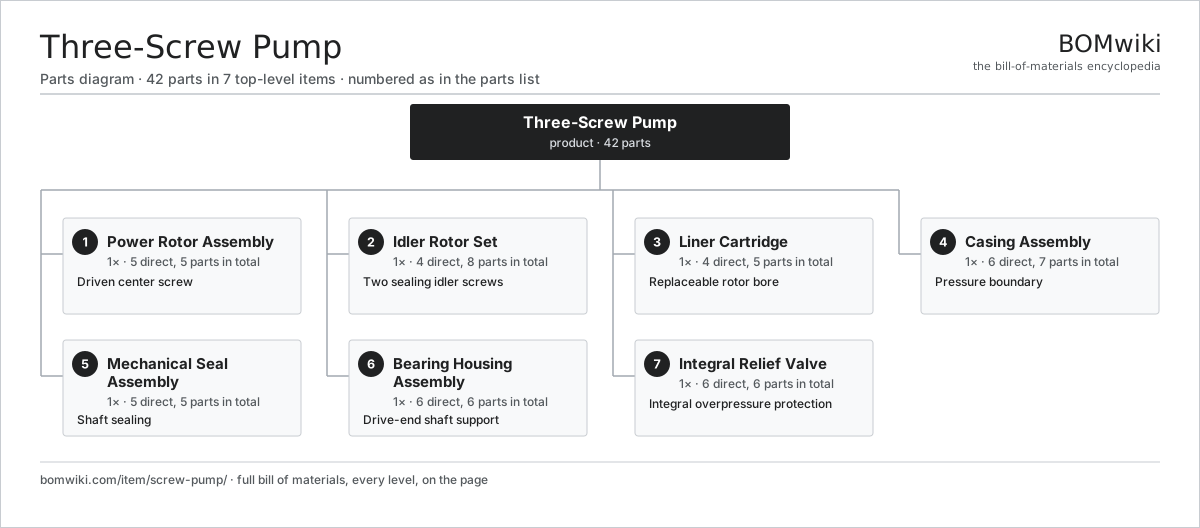
| # | Part | Qty | What it does |
|---|---|---|---|
| 1 | Power Rotor Assembly 5 parts | 1× | Driven center screw |
| 2 | Idler Rotor Set 4 parts | 1× | Two sealing idler screws |
| 3 | Liner Cartridge 4 parts | 1× | Replaceable rotor bore |
| 4 | Casing Assembly 6 parts | 1× | Pressure boundary |
| 5 | Mechanical Seal Assembly 5 parts | 1× | Shaft sealing |
| 6 | Bearing Housing Assembly 6 parts | 1× | Drive-end shaft support |
| 7 | Integral Relief Valve 6 parts | 1× | Integral overpressure protection |
3D model
No 3D model yet. Have a CAD file of this? Add a 3D model. STL renders right on this page; STEP, FreeCAD, and OpenSCAD sources are welcome too (openly licensed, like all 3D models on BOMwiki).
Build & assembly graph
expand / collapse · shared sub-assemblies converge · links to related products · est. labourTap an assembly to expand/collapse · tap a part to open it · use “Open page” for any node · drag to pan, scroll to zoom.
Bill of materials for Three-Screw Pump
7 top-level lines · 43 rows shown · 42 parts total · indented to 3 levels| # | Item / sub-assembly | Part no. | Qty/assy | Ext. qty | Parts | Type |
|---|---|---|---|---|---|---|
| 1 | Power Rotor Assembly 5 parts | screw-pump-power-rotor-assy | 1× | 1 | 5 | assembly |
| 1.1 | Power Rotor | screw-pump-power-rotor | 1× | 1 | · | part |
| 1.2 | Balance Piston | screw-pump-balance-piston | 1× | 1 | · | part |
| 1.3 | Shaft Key | screw-pump-shaft-key | 1× | 1 | · | part |
| 1.4 | Thrust Washer | screw-pump-thrust-washer | 1× | 1 | · | part |
| 1.5 | Oil Seal | oil-seal | 1× | 1 | · | part |
| 2 | Idler Rotor Set 4 parts | screw-pump-idler-rotor-set | 1× | 1 | 8 | assembly |
| 2.1 | Idler Rotor | screw-pump-idler-rotor | 2× | 2 | · | part |
| 2.2 | Idler Balance Cup | screw-pump-idler-balance-cup | 2× | 2 | · | part |
| 2.3 | Idler Thrust Shoe | screw-pump-idler-thrust-shoe | 2× | 2 | · | part |
| 2.4 | Idler Stop Pin | screw-pump-idler-stop-pin | 2× | 2 | · | part |
| 3 | Liner Cartridge 4 parts | screw-pump-liner-cartridge | 1× | 1 | 5 | assembly |
| 3.1 | Liner Sleeve | screw-pump-liner-sleeve | 1× | 1 | · | part |
| 3.2 | Liner Dowel Pin | screw-pump-liner-pin | 2× | 2 | · | part |
| 3.3 | O-Ring Set | oring-set | 1× | 1 | · | part |
| 3.4 | Fastener Set | fastener-set | 1× | 1 | · | part |
| 4 | Casing Assembly 6 parts | screw-pump-casing-assy | 1× | 1 | 7 | assembly |
| 4.1 | Casing Body | screw-pump-casing-body | 1× | 1 | · | part |
| 4.2 | Suction Cover | screw-pump-suction-cover | 1× | 1 | · | part |
| 4.3 | Discharge Cover | screw-pump-discharge-cover | 1× | 1 | · | part |
| 4.4 | Mounting Foot | screw-pump-mounting-foot | 2× | 2 | · | part |
| 4.5 | O-Ring Set | oring-set | 1× | 1 | · | part |
| 4.6 | Fastener Set | fastener-set | 1× | 1 | · | part |
| 5 | Mechanical Seal Assembly 5 parts | screw-pump-mech-seal | 1× | 1 | 5 | assembly |
| 5.1 | Seal Rotating Face | screw-pump-seal-rotating-face | 1× | 1 | · | part |
| 5.2 | Seal Stationary Seat | screw-pump-seal-stationary-seat | 1× | 1 | · | part |
| 5.3 | Coil Spring | coil-spring | 1× | 1 | · | part |
| 5.4 | Seal Gland | screw-pump-seal-gland | 1× | 1 | · | part |
| 5.5 | O-Ring Set | oring-set | 1× | 1 | · | part |
| 6 | Bearing Housing Assembly 6 parts | screw-pump-bearing-assy | 1× | 1 | 6 | assembly |
| 6.1 | Bearing Housing | screw-pump-bearing-housing | 1× | 1 | · | part |
| 6.2 | Ball Bearing | ball-bearing | 1× | 1 | · | part |
| 6.3 | Bearing Locknut | screw-pump-bearing-locknut | 1× | 1 | · | part |
| 6.4 | Bearing Circlip | screw-pump-bearing-circlip | 1× | 1 | · | part |
| 6.5 | Oil Seal | oil-seal | 1× | 1 | · | part |
| 6.6 | Fastener Set | fastener-set | 1× | 1 | · | part |
| 7 | Integral Relief Valve 6 parts | screw-pump-relief-valve | 1× | 1 | 6 | assembly |
| 7.1 | Relief Valve Poppet | screw-pump-relief-poppet | 1× | 1 | · | part |
| 7.2 | Relief Valve Seat | screw-pump-relief-seat | 1× | 1 | · | part |
| 7.3 | Coil Spring | coil-spring | 1× | 1 | · | part |
| 7.4 | Relief Adjusting Screw | screw-pump-relief-adjuster | 1× | 1 | · | part |
| 7.5 | Relief Valve Cap | screw-pump-relief-cap | 1× | 1 | · | part |
| 7.6 | O-Ring Set | oring-set | 1× | 1 | · | part |
Something wrong in this list? Report a problem with this BOM.
Related products
same domain, ranked by shared parts High-Pressure Plunger Pump
115 parts · shares 2 with this page
High-Pressure Plunger Pump
115 parts · shares 2 with this page
 Hydraulic Power Unit
91 parts · shares 2 with this page
Hydraulic Power Unit
91 parts · shares 2 with this page
 Irrigation Pump Station
1,881 parts · shares 2 with this page
Irrigation Pump Station
1,881 parts · shares 2 with this page
 Mainline Pipeline Pump
166 parts · shares 2 with this page
Mainline Pipeline Pump
166 parts · shares 2 with this page
 Rotary Vane Pump
57 parts · shares 2 with this page
Air Vane Motor
47 parts · shares 1 with this page
Rotary Vane Pump
57 parts · shares 2 with this page
Air Vane Motor
47 parts · shares 1 with this page
Sourcing: possible vendors
Browse the supplier directory → Prices, MOQ, and lead times are algorithmic estimates, not quotes, and not claims about these companies. Company mappings are curated by keyword; est. price band $50–$50k. How estimates work| Vendor | HQ | Specialty | MOQ | Lead time |
|---|---|---|---|---|
|
🇩🇰Grundfos
grundfos.com ↗
|
Bjerringbro, DK | Pumps | 200 units | 6–12 wks |
|
🇺🇸Xylem
xylem.com ↗
|
Washington, US | Water technology | 200 units | 6–12 wks |
| flowserve.com ↗ | Irving, US | Pumps & valves | 200 units | 6–12 wks |
|
🇩🇪KSB
ksb.com ↗
|
Frankenthal, DE | Pumps & valves | 200 units | 6–12 wks |
| parker.com ↗ | Cleveland, US | Motion & fluid control | 200 units | 6–12 wks |
796-word article