Scuba Regulator
ProductOverview
A scuba regulator is a pressure-reducing system converting high-pressure tank gas (200–250 bar) into breathable pressure (approximately 1 ata or one bar above ambient water pressure). The two-stage design first reduces tank pressure to an intermediate level (~9 bar) in the First Stage - High Pressure Reducer, then allows the diver to breathe on-demand via the Second Stage - Demand Valve.
Regulators are critical to diver safety. A failed regulator or free-flow condition can exhaust tank gas rapidly, leading to out-of-air situations underwater. Modern regulators are designed for reliability, incorporating redundant safety features and rugged construction.
First Stage Operation
The First Stage - High Pressure Reducer contains a Diaphragm or Piston Element exposed to tank pressure on one side and internal chamber pressure on the other. As tank pressure rises and attempts to expand the chamber, the diaphragm flexes inward, moving the Intermediate Valve Seat seat closer to the valve orifice, restricting flow.
A Pressure Calibration Spring tuned to ~9 bar maintains equilibrium. When a diver inhales via the Second Stage - Demand Valve, internal pressure drops momentarily, the diaphragm flexes outward, the valve opens, and high-pressure gas flows into the intermediate chamber. This balanced design is sensitive and responds to small pressure changes, enabling smooth regulation across depths.
Alternative piston-style first stages use a mechanically-driven piston instead of a diaphragm, offering slightly different response characteristics. Both designs are widely used.
Second Stage Demand System
The Second Stage - Demand Valve sits in the diver's mouth. At rest, an internal Inhalation Lever holds the Demand Valve Seat closed. When the diver inhales, negative pressure in the mouth chamber pulls the lever, opening the seat. Intermediate pressure gas flows directly into the mouth.
At the end of exhalation, the diver pushes gas outward through the Exhaust One-Way Valve, a one-way mushroom valve preventing water backflow. This exhaust valve is critical; if it fails or becomes stuck, water can enter the breathing chamber.
The Silicone Mouthpiece is soft silicone for comfort. Many divers have multiple regulators (primary and backup), with the backup hidden under an arm or mounted on the Second Stage - Demand Valve body as an alternate air source.
Depth Rating & Performance
Regulators are rated for maximum depth (40, 50, 70 meters, etc.). At depth, ambient water pressure increases, compressing the diaphragm of the first stage. A well-designed balanced regulator compensates, maintaining consistent intermediate pressure across depths. A poorly balanced unit may over-deliver gas at depth (free-flow risk) or under-deliver (hard breathing).
Breathing resistance, the effort required to inhale, increases with depth and flow rate. Cold-water regulators are designed to minimize ice formation in the intermediate valve, using special lubricants and housing insulation.
Hose Configuration
The High-Pressure & Intermediate Hose Bundle comprises three main runs:
- High-pressure (HP) hose: Connects tank valve to first stage inlet and branches to the Submersible Pressure Gauge. Rated 250+ bar.
- Intermediate-pressure (IP) hose: Carries 9 bar gas from first stage to second stage and optional secondary regs (spare, drysuit inflator, etc.).
- Breather hose: Large-bore tubing from first stage to second stage, enabling low-resistance breathing.
Hose lengths are standardized. Longer hoses accommodate different body sizes and diving configurations (sidemount, backmount rebreather, etc.).
Maintenance & Service
Regulators require annual servicing, inspection of O-rings, valve seats, and moving parts, with replacement of seals as needed. Saltwater corrosion and sand damage are common failure modes. Divers must rinse regulators in fresh water after every saltwater dive, store them dry, and never pressurize a regulator out of water (risk of internal water entry if the second stage is submerged).
The Maintenance & Service Kit kit contains O-rings, diaphragms, and springs enabling field repairs in remote locations. Most divers carry backup regulators as a safety practice.
Scuba Regulator parts and their functions
6 top-level parts · 25 parts in total · full bill of materials below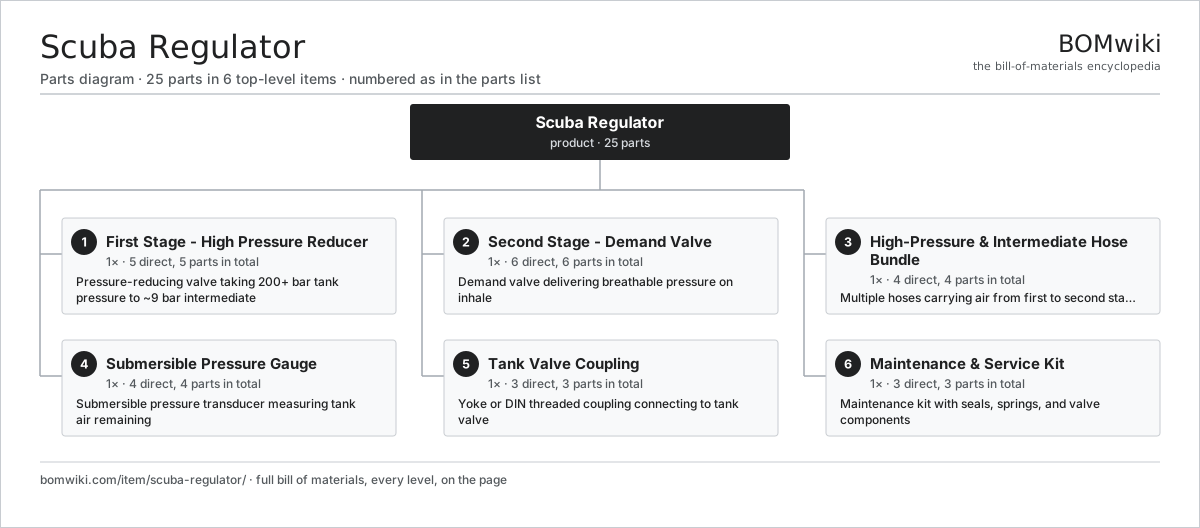
| # | Part | Qty | What it does |
|---|---|---|---|
| 1 | First Stage - High Pressure Reducer 5 parts | 1× | Pressure-reducing valve taking 200+ bar tank pressure to ~9 bar intermediate |
| 2 | Second Stage - Demand Valve 6 parts | 1× | Demand valve delivering breathable pressure on inhale |
| 3 | High-Pressure & Intermediate Hose Bundle 4 parts | 1× | Multiple hoses carrying air from first to second stage and gauge |
| 4 | Submersible Pressure Gauge 4 parts | 1× | Submersible pressure transducer measuring tank air remaining |
| 5 | Tank Valve Coupling 3 parts | 1× | Yoke or DIN threaded coupling connecting to tank valve |
| 6 | Maintenance & Service Kit 3 parts | 1× | Maintenance kit with seals, springs, and valve components |
3D model
No 3D model yet. Have a CAD file of this? Add a 3D model. STL renders right on this page; STEP, FreeCAD, and OpenSCAD sources are welcome too (openly licensed, like all 3D models on BOMwiki).
Build & assembly graph
expand / collapse · shared sub-assemblies converge · links to related products · est. labourTap an assembly to expand/collapse · tap a part to open it · use “Open page” for any node · drag to pan, scroll to zoom.
Bill of materials for Scuba Regulator
6 top-level lines · 31 rows shown · 25 parts total · indented to 3 levels| # | Item / sub-assembly | Part no. | Qty/assy | Ext. qty | Parts | Type |
|---|---|---|---|---|---|---|
| 1 | First Stage - High Pressure Reducer 5 parts | scuba-regulator-first-stage | 1× | 1 | 5 | assembly |
| 1.1 | First Stage Housing | scuba-regulator-first-stage-body | 1× | 1 | · | part |
| 1.2 | Diaphragm or Piston Element | scuba-regulator-diaphragm-piston | 1× | 1 | · | part |
| 1.3 | Intermediate Valve Seat | scuba-regulator-intermediate-valve | 1× | 1 | · | part |
| 1.4 | Pressure Calibration Spring | scuba-regulator-spring-assembly | 1× | 1 | · | part |
| 1.5 | First Stage Seals | scuba-regulator-first-stage-seal | 1× | 1 | · | part |
| 2 | Second Stage - Demand Valve 6 parts | scuba-regulator-second-stage | 1× | 1 | 6 | assembly |
| 2.1 | Second Stage Housing | scuba-regulator-second-stage-body | 1× | 1 | · | part |
| 2.2 | Inhalation Lever | scuba-regulator-demand-lever | 1× | 1 | · | part |
| 2.3 | Demand Valve Seat | scuba-regulator-valve-seat | 1× | 1 | · | part |
| 2.4 | Exhaust One-Way Valve | scuba-regulator-exhaust-valve | 1× | 1 | · | part |
| 2.5 | Silicone Mouthpiece | scuba-regulator-mouthpiece | 1× | 1 | · | part |
| 2.6 | Second Stage O-Rings & Diaphragm | scuba-regulator-second-stage-seal | 1× | 1 | · | part |
| 3 | High-Pressure & Intermediate Hose Bundle 4 parts | scuba-regulator-hose-assembly | 1× | 1 | 4 | assembly |
| 3.1 | High-Pressure Hose | scuba-regulator-hp-hose | 1× | 1 | · | part |
| 3.2 | Intermediate-Pressure Hose | scuba-regulator-ip-hose | 1× | 1 | · | part |
| 3.3 | Large-Diameter Breather Hose | scuba-regulator-breather-hose | 1× | 1 | · | part |
| 3.4 | DIN or Yoke Hose Fitting | scuba-regulator-hose-connector | 1× | 1 | · | part |
| 4 | Submersible Pressure Gauge 4 parts | scuba-regulator-pressure-gauge | 1× | 1 | 4 | assembly |
| 4.1 | Pressure-Sensitive Bourdon Tube | scuba-regulator-bourdon-tube | 1× | 1 | · | part |
| 4.2 | Pressure Gauge Dial Face | scuba-regulator-gauge-dial | 1× | 1 | · | part |
| 4.3 | Gauge Protective Dome | scuba-regulator-gauge-housing | 1× | 1 | · | part |
| 4.4 | Gauge Low-Pressure Port | scuba-regulator-gauge-connector | 1× | 1 | · | part |
| 5 | Tank Valve Coupling 3 parts | scuba-regulator-valve-connector | 1× | 1 | 3 | assembly |
| 5.1 | Tank Valve Coupling Body | scuba-regulator-yoke-or-din | 1× | 1 | · | part |
| 5.2 | Tank Inlet O-Ring Seat | scuba-regulator-inlet-seat | 1× | 1 | · | part |
| 5.3 | Connector Washer Seal | scuba-regulator-connector-seal | 1× | 1 | · | part |
| 6 | Maintenance & Service Kit 3 parts | scuba-regulator-spare-parts | 1× | 1 | 3 | assembly |
| 6.1 | O-Ring Set | oring-set | 1× | 1 | · | part |
| 6.2 | Spare Calibration Spring | scuba-regulator-spring-replacement | 1× | 1 | · | part |
| 6.3 | Spare Diaphragm Assembly | scuba-regulator-diaphragm-kit | 1× | 1 | · | part |
Something wrong in this list? Report a problem with this BOM.
Related products
same domain, ranked by shared parts Backpacking Stove
32 parts · shares 1 with this page
Backpacking Stove
32 parts · shares 1 with this page
 Inflatable Kayak
71 parts · shares 1 with this page
LED Headlamp
33 parts · shares 1 with this page
Inflatable Kayak
71 parts · shares 1 with this page
LED Headlamp
33 parts · shares 1 with this page
 Packraft
32 parts · shares 1 with this page
Packraft
32 parts · shares 1 with this page
 Portable Gas Grill
44 parts · shares 1 with this page
Portable Gas Grill
44 parts · shares 1 with this page
 Portable Water Filter
23 parts · shares 1 with this page
Portable Water Filter
23 parts · shares 1 with this page
Sourcing: possible vendors
Browse the supplier directory → Prices, MOQ, and lead times are algorithmic estimates, not quotes, and not claims about these companies. Company mappings are curated by keyword; est. price band $20–$2k. How estimates work| Vendor | HQ | Specialty | MOQ | Lead time |
|---|---|---|---|---|
|
🇺🇸Coleman
coleman.com ↗
|
Chicago, US | Camping gear | 1,000 units | 6–10 wks |
| thenorthface.com ↗ | Denver, US | Outdoor apparel & gear | 1,000 units | 6–10 wks |
|
🇺🇸YETI
yeti.com ↗
|
Austin, US | Coolers & drinkware | 1,000 units | 6–10 wks |
| decathlon.com ↗ | Villeneuve-d'Ascq, FR | Sporting goods | 1,000 units | 6–10 wks |
|
🇺🇸Garmin
garmin.com ↗
|
Olathe, US | GPS & wearables | 1,000 units | 6–10 wks |
641-word article