Double Seamer
ProductOverview
A double seamer is the workhorse machine of canned-food production, rolling a metal lid onto a can body in two distinct operations. The first operation folds the lid down and rolls the edge of the can body up and under the lid flange, forming a loose but complete wrap. The second operation (positioned below and with lighter pressure) tightens this wrap, squeezing any remaining air out of the seam and forming the airtight double-seam that prevents re-contamination after sterilization.
The term "double seam" refers to the structure: two layers of metal (the body flange and lid rim), each bent and interlocked, creating a narrow (0.8–1.0 mm) but exceptionally robust closure. This seam is so reliable that it has become the industry standard for shelf-stable (non-refrigerated) canned goods worldwide, soft-drink cans, food cans, even aerosol products. Speeds range from 50 cans/minute (small specialty operations) to 200+ cans/minute (high-volume beverage lines), with changeover parts allowing machine flexibility across can sizes within a family (e.g., #300 through #10 sizes).
How it works
Chuck expansion: A can body sits on an overhead conveyor, traveling horizontally. When it reaches the seaming head, an expanding chuck (pneumatically actuated) engages from below, expanding radially to grip the interior wall of the can. This centers the can and holds it firmly against lift motion and lateral forces. The chuck is spring-centered so that when air pressure is released, it retracts safely.
Lid placement: Simultaneously, a vibratory feeder bowl delivers lids (one per cycle) down a chute, landing on the can's open top. An escapement arm (driven by a master cam) releases exactly one lid per cycle. The lid sits loosely on the can, resting on the rim.
First operation (body flange fold): The machine lifts the can (chuck expanded) so that the can body and resting lid come up into the first-operation seaming rolls. These two rolls rotate at 400–600 RPM with a grooved profile that catches the lid and body flange and begins rolling them together. Rotational friction between the can body and lid causes the body to rotate while the lid (pinched between the rolls) stays stationary. The can's outer flange curls upward and under the lid's inner flange, forming the loose "body hook" (the bottom layer of the double seam). Roll pressure (1,000–2,000 lbs total) and profile geometry control the hook depth; cool water constantly sprays the roll grooves to prevent galling (adhesion/tearing of lid or body).
Index dwell: After the first operation completes (5–10 can rotations), a mechanical lifter cam briefly lowers the chuck slightly. During this dwell, the escapement mechanism places the next can, and the main drive prepares for the second operation.
Second operation (seam crimp): The can rises further, bringing the now-wrapped seam into the second-operation rolls. These rolls are positioned below the first-op rolls and have a slightly tighter (finisher) profile. They squeeze the already-folded flange tighter, compressing air out of the seam gap and forming the final airtight lock. Pressure is lower (400–1,200 lbs) because the metal is already folded; excessive force would deform the lid or body. The seam gap (the space between body flange and lid at the seam O.D.) is the critical dimension: too wide, and the seam leaks; too tight, and the lid wrinkles or cracks. Shimming (inserting calibrated shims between roll cartridges) fine-tunes this gap to ±0.002 inch.
Unload: After the second operation, the chuck pressure releases and retracts. The can (now sealed) falls by gravity or is lifted by a downstream conveyor onto the next station (usually label or case packing).
Cycle synchronization: All motions are cam-driven from a single output shaft, mechanically synchronized. The main drive motor (3–7 kW) and VFD set the overall speed; internal sprocket and chain ratios keep the cam timing, roll speeds, chuck actuation, and lid feed perfectly phased. No software synchronization is needed, a profound reliability advantage over soft-automation systems.
Critical adjustments and changeover
Gap adjustment: The seam gap is set by placing precision shims (thickness 0.001–0.005 inch) under the second-op roll cartridge. Measurements are taken with a seam micrometer (a specialized tool) on production cans; the gap is adjusted and re-measured iteratively until specification is met. Too wide (>0.028 inch) and side-seam leakage rates rise; too tight (<0.018 inch) and can bodies wrinkle.
Can changeover: Switching can sizes requires replacing the chuck (different size collet), first-op and second-op roll sets (different diameters and profiles), and lid-chute bore. This can take 30–60 minutes and requires a skilled technician familiar with the machine. Most high-speed lines are dedicated to one can size to avoid frequent changeover losses.
Roll pressure balance: Uneven pressure across the roll face causes skewed seams. Pressure is checked by placing carbon paper and lead foil behind cans as they seam; the imprint pattern shows pressure distribution. Spring preload is adjusted (by turning adjustment bolts on the pressure springs) until pressure is balanced.
Common failure modes
Roll galling (adhesion): When coolant flow drops or the rolls are worn, the lid or body surface sticks to the roll grooves, tearing the metal. Galling produces an incomplete seam and a rough, chewed-up surface. Remedy: verify coolant flow (5–10 GPM), replace clogged filter, inspect rolls for wear and replace if worn thin (rolls are consumable items, typically lasting 2–10 million cans).
Chuck slipping: If air pressure falls below 50 psi or the chuck is worn, the can may slip during first-op, producing an off-center or incomplete seam. Remedy: check air-pressure gauge and upstream regulator, inspect chuck expanding segments for wear, replace if worn.
Escapement jams: Sticky can lids (coated, damp, or contaminated) may fail to drop cleanly, causing jams. Remedy: ensure lids are dry, inspect vibratory bowl spiral track for debris, clean track and increase bowl amplitude if needed.
Synchronization loss: If a chain breaks or a sprocket tooth shears, the timing between cam, rolls, and escapement is lost, causing mangled cans. Remedy: replace chain or sprocket, verify alignment and tension, and re-run a few test cans to confirm correct phasing.
Seam quality and leak testing
Sealed cans are typically tested for leaks downstream (in a vacuum-chamber tester or pressure-drop bath) before case-packing. Leak rates of <0.05% are target for a well-maintained seamer. Seam structure is also destructively tested: periodic samples are cross-sectioned and microscopically inspected to measure hook depth, overlap, and seam gap. Seam thickness (combined flange and lid thickness) should be 0.040–0.050 inch.
Lubrication and maintenance
The seamer's camshaft, chain, bearings, and roll shafts are oil-lubricated via splash or gravity feed. Oil level is checked daily; oil change interval is typically 500–1,000 operating hours or 6 months. Lint traps and breather filters must be cleaned weekly to prevent oil degradation. The roll and chuck cartridges are removable for inspection and replacement; most shops keep spare sets on hand for quick changeover.
Double Seamer parts and their functions
8 top-level parts · 48 parts in total · full bill of materials below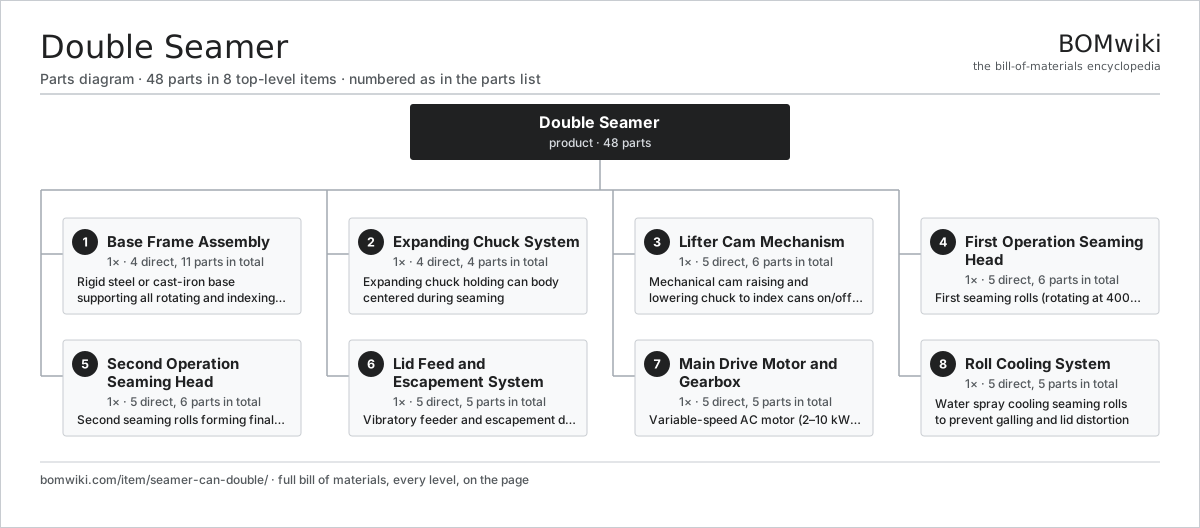
| # | Part | Qty | What it does |
|---|---|---|---|
| 1 | Base Frame Assembly 4 parts | 1× | Rigid steel or cast-iron base supporting all rotating and indexing components |
| 2 | Expanding Chuck System 4 parts | 1× | Expanding chuck holding can body centered during seaming |
| 3 | Lifter Cam Mechanism 5 parts | 1× | Mechanical cam raising and lowering chuck to index cans on/off conveyor |
| 4 | First Operation Seaming Head 5 parts | 1× | First seaming rolls (rotating at 400–600 RPM) folding lid onto can body |
| 5 | Second Operation Seaming Head 5 parts | 1× | Second seaming rolls forming final airtight crimp |
| 6 | Lid Feed and Escapement System 5 parts | 1× | Vibratory feeder and escapement delivering lids onto can tops |
| 7 | Main Drive Motor and Gearbox 5 parts | 1× | Variable-speed AC motor (2–10 kW) indexing entire machine via gearbox |
| 8 | Roll Cooling System 5 parts | 1× | Water spray cooling seaming rolls to prevent galling and lid distortion |
3D model
No 3D model yet. Have a CAD file of this? Add a 3D model. STL renders right on this page; STEP, FreeCAD, and OpenSCAD sources are welcome too (openly licensed, like all 3D models on BOMwiki).
Build & assembly graph
expand / collapse · shared sub-assemblies converge · links to related products · est. labourTap an assembly to expand/collapse · tap a part to open it · use “Open page” for any node · drag to pan, scroll to zoom.
Bill of materials for Double Seamer
8 top-level lines · 46 rows shown · 48 parts total · indented to 3 levels| # | Item / sub-assembly | Part no. | Qty/assy | Ext. qty | Parts | Type |
|---|---|---|---|---|---|---|
| 1 | Base Frame Assembly 4 parts | seamer-can-double-base-frame | 1× | 1 | 11 | assembly |
| 1.1 | Frame Casting | seamer-can-double-frame-casting | 1× | 1 | · | part |
| 1.2 | Vertical Posts | seamer-can-double-vertical-posts | 2× | 2 | · | part |
| 1.3 | Alignment Dowels | seamer-can-double-alignment-dowels | 4× | 4 | · | part |
| 1.4 | Vibration Isolators | seamer-can-double-vibration-mounts | 4× | 4 | · | part |
| 2 | Expanding Chuck System 4 parts | seamer-can-double-chuck-system | 1× | 1 | 4 | assembly |
| 2.1 | Chuck Body | seamer-can-double-chuck-body | 1× | 1 | · | part |
| 2.2 | Chuck Solenoid Valve | seamer-can-double-chuck-solenoid | 1× | 1 | · | part |
| 2.3 | Chuck Return Spring | seamer-can-double-chuck-positioning-spring | 1× | 1 | · | part |
| 2.4 | Air Supply Lines | seamer-can-double-air-distribution | 1× | 1 | · | part |
| 3 | Lifter Cam Mechanism 5 parts | seamer-can-double-lifter-cam | 1× | 1 | 6 | assembly |
| 3.1 | Cam Follower Roller | seamer-can-double-cam-follower-roller | 1× | 1 | · | part |
| 3.2 | Egg-Profile Cam | seamer-can-double-eccentric-cam | 1× | 1 | · | part |
| 3.3 | Lifter Rod | seamer-can-double-lifter-rod | 1× | 1 | · | part |
| 3.4 | Linear Guide Bushing | seamer-can-double-guide-bushing | 2× | 2 | · | part |
| 3.5 | Cam Timing Sprocket | seamer-can-double-cam-timing-gear | 1× | 1 | · | part |
| 4 | First Operation Seaming Head 5 parts | seamer-can-double-first-op-head | 1× | 1 | 6 | assembly |
| 4.1 | First Op Roll Pair | seamer-can-double-first-roll-pair | 1× | 1 | · | part |
| 4.2 | Roll Bearing | seamer-can-double-first-roll-bearing | 2× | 2 | · | part |
| 4.3 | Roll Drive Gearmotor | seamer-can-double-first-roll-motor | 1× | 1 | · | part |
| 4.4 | Roll Pressure Spring | seamer-can-double-first-pressure-spring | 1× | 1 | · | part |
| 4.5 | Roll Shield and Coolant Channel | seamer-can-double-roll-shield | 1× | 1 | · | part |
| 5 | Second Operation Seaming Head 5 parts | seamer-can-double-second-op-head | 1× | 1 | 6 | assembly |
| 5.1 | Second Op Roll Pair | seamer-can-double-second-roll-pair | 1× | 1 | · | part |
| 5.2 | Second Op Bearing | seamer-can-double-second-roll-bearing | 2× | 2 | · | part |
| 5.3 | Second Op Gearmotor | seamer-can-double-second-roll-motor | 1× | 1 | · | part |
| 5.4 | Second Op Pressure Spring | seamer-can-double-second-pressure-spring | 1× | 1 | · | part |
| 5.5 | Seam Gap Shim Pack | seamer-can-double-gap-shim-set | 1× | 1 | · | part |
| 6 | Lid Feed and Escapement System 5 parts | seamer-can-double-feed-system | 1× | 1 | 5 | assembly |
| 6.1 | Vibratory Feeder Bowl | seamer-can-double-vibrator-bowl | 1× | 1 | · | part |
| 6.2 | Vibratory Motor | seamer-can-double-vibrator-motor | 1× | 1 | · | part |
| 6.3 | Escapement Arm | seamer-can-double-escapement-arm | 1× | 1 | · | part |
| 6.4 | Lid Chute | seamer-can-double-lid-chute | 1× | 1 | · | part |
| 6.5 | Orientation Sensor | seamer-can-double-orientation-sensor | 1× | 1 | · | part |
| 7 | Main Drive Motor and Gearbox 5 parts | seamer-can-double-drive-motor | 1× | 1 | 5 | assembly |
| 7.1 | AC Drive Motor | seamer-can-double-ac-motor | 1× | 1 | · | part |
| 7.2 | Reduction Gearbox | seamer-can-double-gearbox | 1× | 1 | · | part |
| 7.3 | Main Drive Sprocket | seamer-can-double-main-sprocket | 1× | 1 | · | part |
| 7.4 | Drive Chain | seamer-can-double-timing-chain | 1× | 1 | · | part |
| 7.5 | Variable-Frequency Drive | seamer-can-double-speed-controller | 1× | 1 | · | part |
| 8 | Roll Cooling System 5 parts | seamer-can-double-cooling-system | 1× | 1 | 5 | assembly |
| 8.1 | Coolant Pump | seamer-can-double-coolant-pump | 1× | 1 | · | part |
| 8.2 | Coolant Manifold | seamer-can-double-coolant-manifold | 1× | 1 | · | part |
| 8.3 | Coolant Filter | seamer-can-double-coolant-filter | 1× | 1 | · | part |
| 8.4 | Coolant Cooler | seamer-can-double-coolant-cooler | 1× | 1 | · | part |
| 8.5 | Overflow Sump | seamer-can-double-overflow-drain | 1× | 1 | · | part |
Something wrong in this list? Report a problem with this BOM.
Used in 1 assembly
Sourcing: possible vendors
Browse the supplier directory → Prices, MOQ, and lead times are algorithmic estimates, not quotes, and not claims about these companies. Company mappings are curated by keyword; est. price band $1k–$500k. How estimates work| Vendor | HQ | Specialty | MOQ | Lead time |
|---|---|---|---|---|
| gea.com ↗ | Düsseldorf, DE | Process technology | 20 units | 12–20 wks |
| buhlergroup.com ↗ | Uzwil, CH | Food & materials processing | 20 units | 12–20 wks |
| tetrapak.com ↗ | Pully, CH | Food packaging & processing | 20 units | 12–20 wks |
| jbtc.com ↗ | Chicago, US | Food processing equipment | 20 units | 12–20 wks |
| alfalaval.com ↗ | Lund, SE | Heat transfer & separation | 20 units | 12–20 wks |
1,195-word article