Amphibious Seaplane
ProductOverview
An amphibious seaplane is two vehicles sharing one structure: below the waterline it is a planing boat, above it a light aircraft. This class, the ICON A5 and Searey are current examples, uses a stepped Boat Hull Fuselage as the fuselage itself rather than hanging floats under a landplane, then adds Retractable Landing Gear that retracts fully clear of the water so the same airframe uses runways and lakes interchangeably. The configuration choices all trace back to one enemy: water, which strikes harder than air, corrodes everything, and punishes any geometry error at touchdown.
The hull
A boat hull that must fly has to solve a problem boats do not have: leaving the water. A displacement hull is held down by suction over its wetted surface, and no light-aircraft engine can drag it to flying speed. The solution, unchanged since the 1920s, is the transverse step in the Hull Shell, a sharp break in the bottom about amidships. As speed builds, the hull rises onto the plane; at the step the flow separates, ventilating the after-body so only a small area ahead of the step stays wetted. "On the step", drag collapses and the aircraft accelerates to rotation speed in about 250 m.
The V bottom with around 15 degrees of deadrise softens impact, but water landings still feed loads of several g through the Keel Beam, a 650 kg aircraft touching down on water decelerates far more abruptly than on a runway, and hull structure is sized by these slamming cases, not flight loads. Spray Rail chines throw spray down and outward, away from the Propeller (water droplets erode blades, hence the nickel guards on each Propeller Blade), and the Bulkhead Set divides the bilge into watertight compartments so a holed hull stays afloat. A Bilge Pump handles the water that always finds its way in.
Keeping everything dry
The rest of the configuration is spray management. The Wing mounts high with a sealed Wing Float at each tip, on water the hull alone is laterally unstable, like any narrow boat, and the floats catch the roll before a wingtip digs in. The Piston Engine sits on a Engine Pylon above the fuselage driving a pusher propeller: highest practical position, behind the spray sheet, and pusher so the blades work in air the hull has already passed under. The Horizontal Stabiliser rides partway up the Fin for the same reason.
The engine is a Rotax-pattern flat four: 1.35 L, 75 kW at 5,800 rpm, with air-cooled barrels and liquid-cooled heads served by a Radiator and Coolant Pump. It revs like a motorcycle engine, so a 2.43:1 Reduction Drive keeps propeller tip speed subsonic. Fuel must climb from the 95 L hull tank up the pylon, which is why the Fuel System carries two electric Fuel Pump units, one as hot standby, and a Fuel Filter with water separator, condensation is a way of life in a machine that lives on lakes.
The amphibian's one fatal error
Amphibious operation adds the gear, and with it the accident mode that defines the type: landing on water with the wheels down. A wheels-down hull touching water at 100 km/h trips over its own gear and flips inverted in about a second; it is the leading cause of fatal seaplane accidents. The defences are layered. Each Gear Leg folds into the hull side well above the waterline, driven by a Gear Actuator with Hall Sensor position switches at both ends of travel, and the Gear Advisory Unit speaks the gear state on every approach, "gear is up, for water landing", because checklists alone have proven insufficient. The Instrument Display shows gear position continuously.
On the water, control authority changes with speed. Below planing speed the air Air Rudder is useless, so a small retractable Water Rudder at the stern steers displacement taxiing; on the step, the air rudder takes over. The Rudder Pedals drive both together, plus the wheel brakes ashore.
Operations
Glassy water, a dead-calm mirror surface, is the seaplane's counterintuitive hazard: with no texture, height judgement fails, and the technique is to set a shallow powered descent on instruments until the hull touches. Waves above about 0.3 m close the other end of the envelope for an aircraft this size. Between those limits the amphibian does what nothing else can: leave a paved airport, land in a wilderness lake twenty minutes later, shut down, and step onto a dock through the openable windows of the Canopy. The price is paid in maintenance, tinned Wire Bundle looms, sacrificial anodes, fresh-water washdowns after every salt exposure, because the corrosion clock starts the moment the Hull Shell first touches the sea.
Amphibious Seaplane parts and their functions
8 top-level parts · 163 parts in total · full bill of materials below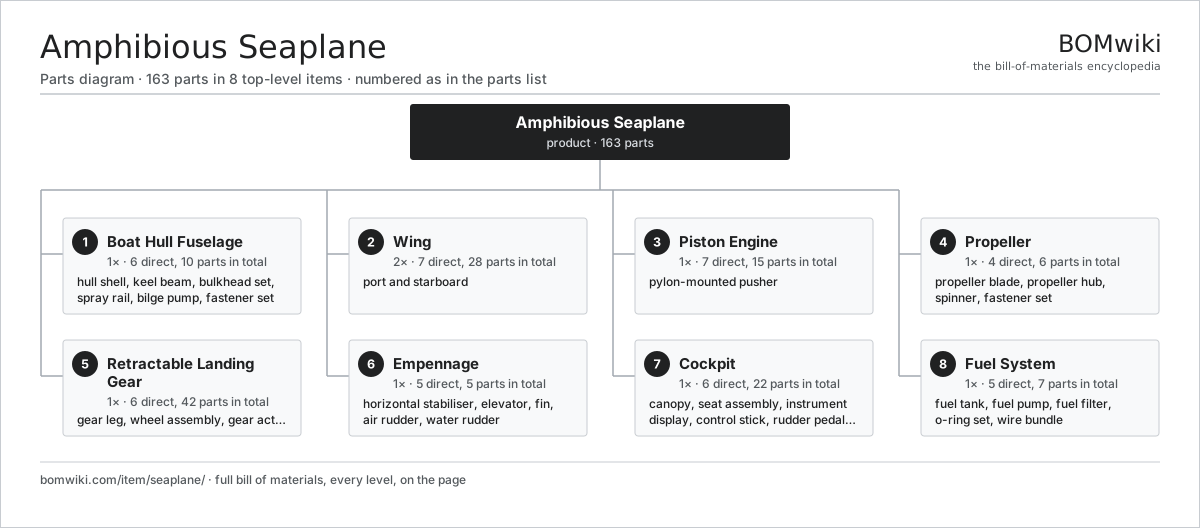
| # | Part | Qty | What it does |
|---|---|---|---|
| 1 | Boat Hull Fuselage 6 parts | 1× | Planing hull with a transverse step that lets the aircraft break water suction and rotate for takeoff. |
| 2 | Wing 7 parts | 2× | port and starboard |
| 3 | Piston Engine 7 parts | 1× | pylon-mounted pusher |
| 4 | Propeller 4 parts | 1× | Three-blade composite pusher propeller positioned aft of the wing, where spray erosion is least. |
| 5 | Retractable Landing Gear 6 parts | 1× | Electrically retracted tricycle gear folding fully clear of the waterline; gear position is the critical pre-landing check. |
| 6 | Empennage 5 parts | 1× | Tail surfaces mounted high to stay dry, plus a retractable water rudder for taxiing. |
| 7 | Cockpit 6 parts | 1× | Side-by-side two-seat cabin with overhead visibility for docking and marine-grade corrosion protection. |
| 8 | Fuel System 5 parts | 1× | Single hull tank of 95 L feeding the pylon-mounted engine through redundant electric pumps. |
3D model
No 3D model yet. Have a CAD file of this? Add a 3D model. STL renders right on this page; STEP, FreeCAD, and OpenSCAD sources are welcome too (openly licensed, like all 3D models on BOMwiki).
Build & assembly graph
expand / collapse · shared sub-assemblies converge · links to related products · est. labourTap an assembly to expand/collapse · tap a part to open it · use “Open page” for any node · drag to pan, scroll to zoom.
Bill of materials for Amphibious Seaplane
8 top-level lines · 68 rows shown · 163 parts total · indented to 3 levels| # | Item / sub-assembly | Part no. | Qty/assy | Ext. qty | Parts | Type |
|---|---|---|---|---|---|---|
| 1 | Boat Hull Fuselage 6 parts | seaplane-hull | 1× | 1 | 10 | assembly |
| 1.1 | Hull Shell | seaplane-hull-shell | 1× | 1 | · | part |
| 1.2 | Keel Beam | seaplane-keel-beam | 1× | 1 | · | part |
| 1.3 | Bulkhead Set | seaplane-bulkhead-set | 1× | 1 | · | part |
| 1.4 | Spray Rail | seaplane-spray-rail | 2× | 2 | · | part |
| 1.5 | Bilge Pump | seaplane-bilge-pump | 1× | 1 | · | part |
| 1.6 | Fastener Set | fastener-set | 4× | 4 | · | part |
| 2 | Wing 7 parts | seaplane-wing | 2× | 2 | 28 | assembly |
| 2.1 | Wing Spar | seaplane-wing-spar | 2× | 4 | · | part |
| 2.2 | Wing Rib | seaplane-wing-rib | 14× | 28 | · | part |
| 2.3 | Sheet Metal Panel | sheet-panel | 6× | 12 | · | part |
| 2.4 | Aileron | seaplane-aileron | 1× | 2 | · | part |
| 2.5 | Flap | seaplane-flap | 1× | 2 | · | part |
| 2.6 | Wing Float | seaplane-wing-float | 1× | 2 | · | part |
| 2.7 | Fastener Set | fastener-set | 3× | 6 | · | part |
| 3 | Piston Engine 7 parts | seaplane-engine | 1× | 1 | 15 | assembly |
| 3.1 | Crankcase | seaplane-crankcase | 1× | 1 | · | part |
| 3.2 | Cylinder | seaplane-cylinder | 4× | 4 | · | part |
| 3.3 | Crankshaft | seaplane-crankshaft | 1× | 1 | · | part |
| 3.4 | Reduction Drive 4 parts | seaplane-reduction-drive | 1× | 1 | 6 | assembly |
| 3.4.1 | Gearbox Housing | gearbox-housing | 1× | 1 | · | part |
| 3.4.2 | Helical Gear Pair | gear-pair | 1× | 1 | · | part |
| 3.4.3 | Ball Bearing | ball-bearing | 2× | 2 | · | part |
| 3.4.4 | Oil Seal | oil-seal | 2× | 2 | · | part |
| 3.5 | Radiator | radiator | 1× | 1 | · | part |
| 3.6 | Coolant Pump | coolant-pump | 1× | 1 | · | part |
| 3.7 | Engine Pylon | seaplane-engine-pylon | 1× | 1 | · | part |
| 4 | Propeller 4 parts | seaplane-propeller | 1× | 1 | 6 | assembly |
| 4.1 | Propeller Blade | seaplane-prop-blade | 3× | 3 | · | part |
| 4.2 | Propeller Hub | seaplane-prop-hub | 1× | 1 | · | part |
| 4.3 | Spinner | seaplane-spinner | 1× | 1 | · | part |
| 4.4 | Fastener Set | fastener-set | 1× | 1 | · | part |
| 5 | Retractable Landing Gear 6 parts | seaplane-landing-gear | 1× | 1 | 42 | assembly |
| 5.1 | Gear Leg | seaplane-gear-leg | 3× | 3 | · | part |
| 5.2 | Wheel Assembly 5 parts | wheel-assembly | 3× | 3 | 9 | assembly |
| 5.2.1 | Alloy Wheel | alloy-wheel | 1× | 3 | · | part |
| 5.2.2 | Tire | tire | 1× | 3 | · | part |
| 5.2.3 | TPMS Sensor | tpms-sensor | 1× | 3 | · | part |
| 5.2.4 | Lug Nut | lug-nut | 5× | 15 | · | part |
| 5.2.5 | Valve Stem | valve-stem | 1× | 3 | · | part |
| 5.3 | Gear Actuator | seaplane-gear-actuator | 3× | 3 | · | part |
| 5.4 | Hall Sensor | hall-sensor | 6× | 6 | · | part |
| 5.5 | Gear Advisory Unit | seaplane-gear-advisory-unit | 1× | 1 | · | part |
| 5.6 | Relay | relay | 2× | 2 | · | part |
| 6 | Empennage 5 parts | seaplane-empennage | 1× | 1 | 5 | assembly |
| 6.1 | Horizontal Stabiliser | seaplane-stabilizer | 1× | 1 | · | part |
| 6.2 | Elevator | seaplane-elevator | 1× | 1 | · | part |
| 6.3 | Fin | seaplane-fin | 1× | 1 | · | part |
| 6.4 | Air Rudder | seaplane-air-rudder | 1× | 1 | · | part |
| 6.5 | Water Rudder | seaplane-water-rudder | 1× | 1 | · | part |
| 7 | Cockpit 6 parts | seaplane-cockpit | 1× | 1 | 22 | assembly |
| 7.1 | Canopy | seaplane-canopy | 1× | 1 | · | part |
| 7.2 | Seat Assembly 5 parts | seat-assembly | 2× | 2 | 7 | assembly |
| 7.2.1 | Seat Frame | seat-frame | 1× | 2 | · | part |
| 7.2.2 | Seat Foam | seat-foam | 2× | 4 | · | part |
| 7.2.3 | Seat Cover | seat-cover | 1× | 2 | · | part |
| 7.2.4 | Seat Motor | seat-motor | 2× | 4 | · | part |
| 7.2.5 | Seat Heater Mat | seat-heater | 1× | 2 | · | part |
| 7.3 | Instrument Display | seaplane-instrument-display | 1× | 1 | · | part |
| 7.4 | Control Stick | seaplane-control-stick | 2× | 2 | · | part |
| 7.5 | Rudder Pedals | seaplane-rudder-pedals | 2× | 2 | · | part |
| 7.6 | Wire Bundle | wire-bundle | 2× | 2 | · | part |
| 8 | Fuel System 5 parts | seaplane-fuel-system | 1× | 1 | 7 | assembly |
| 8.1 | Fuel Tank | seaplane-fuel-tank | 1× | 1 | · | part |
| 8.2 | Fuel Pump | seaplane-fuel-pump | 2× | 2 | · | part |
| 8.3 | Fuel Filter | seaplane-fuel-filter | 1× | 1 | · | part |
| 8.4 | O-Ring Set | oring-set | 2× | 2 | · | part |
| 8.5 | Wire Bundle | wire-bundle | 1× | 1 | · | part |
Something wrong in this list? Report a problem with this BOM.
Related products
same domain, ranked by shared parts Gyroplane
168 parts · shares 18 with this page
Gyroplane
168 parts · shares 18 with this page
 Ultralight Aircraft
455 parts · shares 16 with this page
Ultralight Aircraft
455 parts · shares 16 with this page
 Agricultural Aircraft
233 parts · shares 17 with this page
Agricultural Aircraft
233 parts · shares 17 with this page
 Business Jet
1,654 parts · shares 14 with this page
Business Jet
1,654 parts · shares 14 with this page
 Jumbo Jet (747-class)
5,643,733 parts · shares 14 with this page
Jumbo Jet (747-class)
5,643,733 parts · shares 14 with this page
 Sailplane Glider
139 parts · shares 13 with this page
Sailplane Glider
139 parts · shares 13 with this page
Sourcing: possible vendors
Browse the supplier directory → Prices, MOQ, and lead times are algorithmic estimates, not quotes, and not claims about these companies. Company mappings are curated by keyword; est. price band $50k–$300M. How estimates work| Vendor | HQ | Specialty | MOQ | Lead time |
|---|---|---|---|---|
|
🇺🇸Boeing
boeing.com ↗
|
Arlington, US | Aerospace OEM | made to order | 40–80 wks |
|
🇫🇷Airbus
airbus.com ↗
|
Toulouse, FR | Aerospace OEM | made to order | 40–80 wks |
| lockheedmartin.com ↗ | Bethesda, US | Aerospace & defense | made to order | 40–80 wks |
|
🇧🇷Embraer
embraer.com ↗
|
São José dos Campos, BR | Aircraft OEM | made to order | 40–80 wks |
| txtav.com ↗ | Wichita, US | Aircraft OEM | made to order | 40–80 wks |
817-word article