Security Tag Detacher
ProductOverview
The security tag detacher is a passive or active release device found at checkout lanes and customer service desks in retail stores. Hard security tags (plastic shells with locking pins) are attached to merchandise during stocking to prevent shoplifting. Once a customer has purchased an item and paid, authorized staff use the detacher to release the tag, removing it from the product. The device uses magnetic force to withdraw an internal locking pin, allowing the tag shell to separate.
Modern detachers range from simple purely mechanical devices (magnet + spring) to smart systems with RFID authorization, logging each detachment for loss prevention. All operate on the same principle: a strong magnetic field exerts force on an internal pin, releasing a mechanical lock.
How it Works
A customer purchases an item that still has a hard security tag attached. The cashier takes the tagged item and places the tag's locking mechanism directly over the Security Tag Detacher's hook. The tag rests in a molded Tag Hook & Guide that positions the tag precisely above the detacher's Magnetic Release Assembly.
The Magnetic Release Assembly contains two or more high-strength N52 Neodymium Magnet elements housed in a soft steel keeper block. These magnets produce a focused magnetic field on the order of 14,800 Gauss (1.48 Tesla), one of the strongest permanent magnetic fields achievable without active electromagnets.
The hard tag contains an internal Locking Pin, a hardened steel pin held in a retracted position by the magnetic field of the tag's own internal magnet. When the tag is positioned above the detacher, the strong external magnet field from the Magnetic Release Assembly pulls this internal pin outward (or resets its magnetic state). Simultaneously, the cashier pushes down on the tag with 50–100 lbf of force, compressing a Slider Spring.
This downward motion actuates a mechanical Release Mechanism. A Clutch Cam attached to the moving magnet block rotates, engaging a Release Pawl that disengages the tag's internal locking pin. The pin is driven outward by the magnetic field and a small Pin Return Spring, allowing the tag's two plastic shell halves to separate.
The cashier removes the detached tag shell and hands the now-untagged merchandise to the customer. The cashier lifts their hand, and the slider block and magnet assembly spring back to neutral position, reset and ready for the next tag.
Key Subsystems
The Magnetic Release Assembly is the core. N52 neodymium magnets are chosen for their extremely high magnetic energy density, roughly 50 megajoules per cubic meter (MGOe). A pair of 25 mm × 15 mm × 10 mm N52 magnets can produce a focused field strong enough to manipulate internal ferrous components inside a hard tag from distances of 30–50 mm. The magnets are housed in a soft steel keeper block that shapes and directs the magnetic field, preventing stray magnetization of nearby metal objects (like checkout register components).
Over time, neodymium magnets lose strength, approximately 5–10% over 5–10 years at room temperature. Stores operating high-volume checkout lanes periodically test magnet strength with a gauss meter and replace magnets when field strength drops below 80% of original (typically around year 7–10). Replacement involves unbolting the keeper block, carefully extracting the old magnets (they are strongly attracted to ferrous tools), and pressing in new magnets.
The Release Mechanism translates the magnetic pull into mechanical motion. As the tag is pushed downward, the Slider Block (a machined aluminum piece) moves upward under the opposing spring force. A Clutch Cam attached to the slider rotates, engaging the Release Pawl. The pawl pushes the internal locking pin outward, breaking the mechanical lock that holds the tag closed. Once the pin is released, the tag shell separates.
Different hard tag designs (Sensormatic, Checkpoint, Universal) have slightly different internal lock geometries. Detachers are often sold with interchangeable hooks or adjustable pin positions to accommodate multiple tag types. Staff must ensure they are using the correct hook for the tag type in use; using an incompatible hook can result in failed detachments or customer frustration.
The Housing & Enclosure is typically molded from ABS or polycarbonate and color-coded (red or black) for rapid staff identification. The housing contains the magnet keeper, slider block, and mechanical linkage, keeping them protected from daily wear and cleaning. The outer surface is smooth and easy to wipe down with cleaning solution, critical in retail environments where produce juice and debris accumulate on all counter surfaces.
The optional Electrical Lock (Optional) system adds access control. A Release Solenoid is wired to a Control PCB that monitors an RFID Reader. When a staff member scans their employee badge near the reader, the microcontroller verifies the badge is authorized (checking an internal database) and momentarily energizes the solenoid, unlocking the detacher. The unlock window is typically 5–10 seconds, after which the solenoid de-energizes and the detacher re-locks. This prevents unauthorized use and logs each detachment event (badge ID, timestamp) for loss prevention audits.
Installation & Maintenance
Detachers are mounted on a Bracket Arm bolted to the checkout counter or to a nearby pole. The mounting height is typically 36–42 inches, ergonomic for standing staff. Power (120VAC for electrical models) is routed through conduit down the bracket arm to the electrical panel. Installation is straightforward and takes 30 minutes.
Weekly maintenance involves wiping the detacher housing clean with a damp cloth and visually inspecting the Tag Hook & Guide for cracks or wear. The hook pad may wear smooth after 2–3 years of use; replacement pads are inexpensive and bolt on in 5 minutes.
Magnet strength is checked semi-annually using a digital gauss meter. The meter probe is held near the detacher surface, and a baseline reading is recorded. When readings drop more than 10–15% from the original value, magnets should be replaced. Replacement requires opening the housing (typically 4–6 bolts), removing the keeper block, and extracting the old magnets. Care must be taken: two strong N52 magnets can pinch a finger severely if allowed to slam together.
If a detacher fails to release tags despite normal magnet strength, the mechanical clutch cam or pawl may be stuck. This usually resolves with careful cleaning of the moving parts and application of light machine oil. If the clutch is bent or worn, the entire Release Mechanism assembly is replaced.
Related Products
Security tag detachers work in concert with hard tags themselves (not shown as separate products in BOMwiki) and with EAS Security Gate systems. The gate reads tags as customers exit, while detachers remove tags at checkout. Together, they form a complete loss prevention system: all merchandise is tagged, detachers remove tags from sold merchandise, and gates alarm if untagged items leave the store or if someone attempts to leave with a tag still attached.
Some stores integrate detachers with point-of-sale software, automatically logging detachments by SKU for inventory accuracy. High-end systems cross-reference the scanned transaction (which items were paid for) against the detachment log, detecting if staff attempt to remove tags from unpurchased items.
Detacher placement is strategic: they are positioned only at authorized checkouts, preventing customer self-service removal. In self-checkout environments, a staff member with RFID access stands nearby to manually detach tags after customers scan and pay.
Security Tag Detacher parts and their functions
6 top-level parts · 29 parts in total · full bill of materials below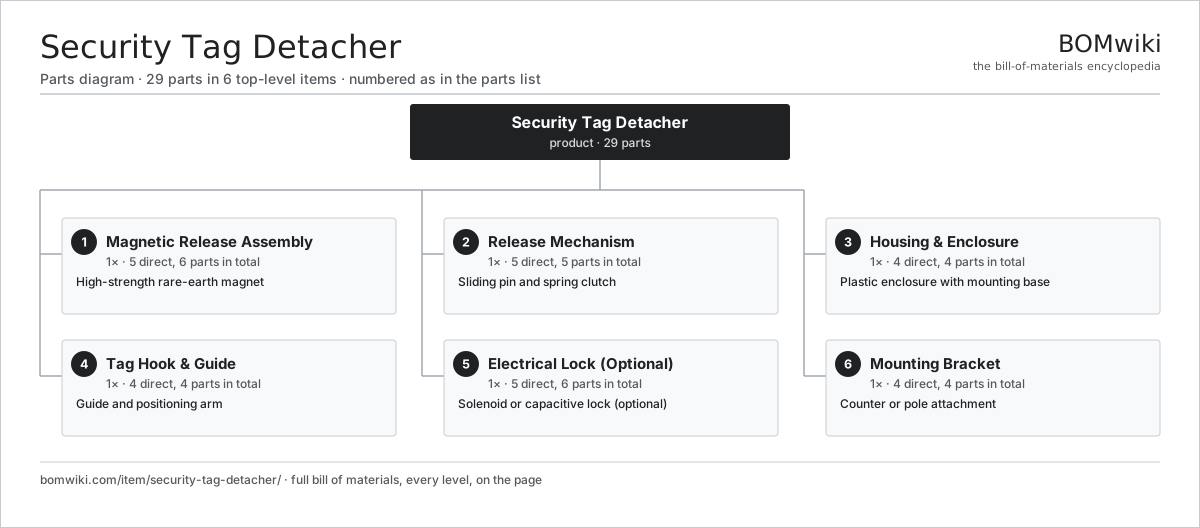
| # | Part | Qty | What it does |
|---|---|---|---|
| 1 | Magnetic Release Assembly 5 parts | 1× | High-strength rare-earth magnet |
| 2 | Release Mechanism 5 parts | 1× | Sliding pin and spring clutch |
| 3 | Housing & Enclosure 4 parts | 1× | Plastic enclosure with mounting base |
| 4 | Tag Hook & Guide 4 parts | 1× | Guide and positioning arm |
| 5 | Electrical Lock (Optional) 5 parts | 1× | Solenoid or capacitive lock (optional) |
| 6 | Mounting Bracket 4 parts | 1× | Counter or pole attachment |
3D model
No 3D model yet. Have a CAD file of this? Add a 3D model. STL renders right on this page; STEP, FreeCAD, and OpenSCAD sources are welcome too (openly licensed, like all 3D models on BOMwiki).
Build & assembly graph
expand / collapse · shared sub-assemblies converge · links to related products · est. labourTap an assembly to expand/collapse · tap a part to open it · use “Open page” for any node · drag to pan, scroll to zoom.
Bill of materials for Security Tag Detacher
6 top-level lines · 33 rows shown · 29 parts total · indented to 3 levels| # | Item / sub-assembly | Part no. | Qty/assy | Ext. qty | Parts | Type |
|---|---|---|---|---|---|---|
| 1 | Magnetic Release Assembly 5 parts | security-tag-detacher-magnet-assembly | 1× | 1 | 6 | assembly |
| 1.1 | Neodymium Magnet | security-tag-detacher-neodymium-magnet | 2× | 2 | · | part |
| 1.2 | Magnet Holder Block | security-tag-detacher-magnet-holder | 1× | 1 | · | part |
| 1.3 | Slider Spring | security-tag-detacher-slider-spring | 1× | 1 | · | part |
| 1.4 | Slider Block | security-tag-detacher-slider-block | 1× | 1 | · | part |
| 1.5 | Fastener Set | fastener-set | 1× | 1 | · | part |
| 2 | Release Mechanism 5 parts | security-tag-detacher-release-mechanism | 1× | 1 | 5 | assembly |
| 2.1 | Locking Pin | security-tag-detacher-locking-pin | 1× | 1 | · | part |
| 2.2 | Pin Return Spring | security-tag-detacher-pin-spring | 1× | 1 | · | part |
| 2.3 | Clutch Cam | security-tag-detacher-clutch-cam | 1× | 1 | · | part |
| 2.4 | Release Pawl | security-tag-detacher-release-pawl | 1× | 1 | · | part |
| 2.5 | Fastener Set | fastener-set | 1× | 1 | · | part |
| 3 | Housing & Enclosure 4 parts | security-tag-detacher-housing | 1× | 1 | 4 | assembly |
| 3.1 | Plastic Enclosure Shell | security-tag-detacher-plastic-shell | 1× | 1 | · | part |
| 3.2 | Backing Plate | security-tag-detacher-mounting-plate | 1× | 1 | · | part |
| 3.3 | Instruction Label | security-tag-detacher-cover-label | 1× | 1 | · | part |
| 3.4 | Fastener Set | fastener-set | 1× | 1 | · | part |
| 4 | Tag Hook & Guide 4 parts | security-tag-detacher-tag-hook | 1× | 1 | 4 | assembly |
| 4.1 | Hook Arm | security-tag-detacher-hook-arm | 1× | 1 | · | part |
| 4.2 | Hook Friction Pad | security-tag-detacher-hook-pad | 1× | 1 | · | part |
| 4.3 | Guide Ridge | security-tag-detacher-guide-ridge | 1× | 1 | · | part |
| 4.4 | Fastener Set | fastener-set | 1× | 1 | · | part |
| 5 | Electrical Lock (Optional) 5 parts | security-tag-detacher-electrical-reset | 1× | 1 | 6 | assembly |
| 5.1 | Release Solenoid | security-tag-detacher-solenoid | 1× | 1 | · | part |
| 5.2 | RFID Reader | security-tag-detacher-rfid-reader | 1× | 1 | · | part |
| 5.3 | Control PCB | security-tag-detacher-control-pcb | 1× | 1 | · | part |
| 5.4 | Power Supply | power-supply | 1× | 1 | · | part |
| 5.5 | Connector | connector | 2× | 2 | · | part |
| 6 | Mounting Bracket 4 parts | security-tag-detacher-mounting-bracket | 1× | 1 | 4 | assembly |
| 6.1 | Bracket Arm | security-tag-detacher-bracket-arm | 1× | 1 | · | part |
| 6.2 | Counter Clamp | security-tag-detacher-counter-clamp | 1× | 1 | · | part |
| 6.3 | Cable Conduit Tray | security-tag-detacher-cable-tray | 1× | 1 | · | part |
| 6.4 | Fastener Set | fastener-set | 1× | 1 | · | part |
Something wrong in this list? Report a problem with this BOM.
Related products
same domain, ranked by shared parts Cash Deposit Machine
64 parts · shares 1 with this page
Check Scanner
83 parts · shares 1 with this page
Cash Deposit Machine
64 parts · shares 1 with this page
Check Scanner
83 parts · shares 1 with this page
 Checkout Lane Conveyor
63 parts · shares 1 with this page
Checkout Lane Conveyor
63 parts · shares 1 with this page
Sourcing: possible vendors
Browse the supplier directory → Prices, MOQ, and lead times are algorithmic estimates, not quotes, and not claims about these companies. Company mappings are curated by keyword; est. price band $50–$15k. How estimates work| Vendor | HQ | Specialty | MOQ | Lead time |
|---|---|---|---|---|
|
🇯🇵Canon
canon.com ↗
|
Tokyo, JP | Imaging & optics | 500 units | 8–12 wks |
|
🇯🇵Ricoh
ricoh.com ↗
|
Tokyo, JP | Office imaging | 500 units | 8–12 wks |
|
🇺🇸Xerox
xerox.com ↗
|
Norwalk, US | Printers & copiers | 500 units | 8–12 wks |
|
🇯🇵Epson
epson.com ↗
|
Suwa, JP | Printers & projectors | 500 units | 8–12 wks |
|
🇯🇵Brother
brother.com ↗
|
Nagoya, JP | Printers & sewing | 500 units | 8–12 wks |
1,280-word article