Tunnel Segment Erector
ProductOverview
A tunnel segment erector is a robotic arm mounted on the rear of a TBM shield that automatically grabs precast concrete tunnel lining segments from a staging area and positions them in the erection ring. The erector eliminates the hazards of manual segment handling (crush injuries, slips) and dramatically accelerates ring build rate, reducing down-time and boosting project economics.
Modern segment erectors use either vacuum grippers for smooth concrete surfaces or mechanical jaws for segments with lifting lugs. The arm is a multi-jointed articulated boom with a Slewing Ring Bearing Assembly base that enables 360-degree rotation and full-envelope positioning of segments inside the shield rear frame.
Gripper Technology
Two competing approaches dominate:
Vacuum Gripper: A set of 4–12 elastomer suction pads (typically 150–300 mm diameter) contact the top smooth surface of a precast segment. A Vacuum Generation System draws vacuum to 0.8–0.9 bar below atmospheric; each pad generates 8–12 kN adhesive force, totaling 100–150 kN. Advantages include gentle handling, elimination of segment lifting lugs, and flexibility with different segment types. Disadvantages are vulnerability to water spray and incompatibility with rough or damaged surfaces.
Mechanical Gripper: A pair of hardened-steel clamping jaws with V-grooves engages lifting lugs cast into opposite sides of each segment. A Gripper Actuation Cylinder proportionally clamps with 150–250 kN grip force per jaw. Mechanical grippers are robust, all-weather, and independent of surface condition but require dedicated segment geometry with lugs spaced at exact erector jaw width (typically 2–3 m).
Most modern tunnels use vacuum for its flexibility and cleaner material handling; Vacuum Suction Pads require periodic replacement (every 1–2 years) due to wear and atmospheric-pressure cycling fatigue.
Arm Kinematics
The Articulated Arm Boom typically comprises:
- Base link Base Boom Link bolted to the Slewing Ring Bearing Assembly on the shield rear
- First boom section (0.5–1.5 m), articulating via a hydraulic cylinder
- Second boom section (1–2 m), bending downward via a second cylinder
- Telescoping section Intermediate Boom Sections (1–2 m extension), hydraulic or screw-driven
- End-effector link End-Effector Arm Link (0.3–0.5 m), rotating the gripper face
Typical reach is 4–6 m horizontally and 2–3 m vertically, sufficient to cover the full segment ring and staging area. All joints use Pivot Joint Bearings, heavy-duty tapered or spherical roller bearings, to support the 10–15 tonne segment load plus arm dead-load (3–5 tonnes) during extension.
Hydraulic Actuation
The Hydraulic Power System comprises:
- Central pump on the TBM main drive: a variable-displacement pump provides proportional flow to seven independent circuits, slew, base-link, bend-link, telescoping, gripper open/close, and steering pads
- Proportional valve manifold Proportional Valve Manifold: seven proportional directional control valves with integral pressure compensators ensure smooth, coordinated motion
- Joystick control Proportional Multi-Axis Joystick: the operator (inside TBM cabin or at remote pendant) uses multi-axis proportional input to command simultaneous arm motions
- Position feedback Position Encoder Sensors: rotary encoders at each joint report boom angles to the Control Logic Unit (PLC) PLC, enabling closed-loop positioning
Typical cycle time from pick-up to full placement is 90–180 seconds per segment, meaning 6–7 minutes per complete ring in optimal conditions.
Guidance and Alignment
Modern erectors use:
- Segment Positioning Guide fixed to the shield rear: provides passive alignment features, dowel holes and stop blocks that guide the segment into the erection ring
- Load Cell Force Sensor on the gripper: measures segment weight and grip force; signals the Control Logic Unit (PLC) when the segment is fully seated and safe to release
- Operator vision: TBM cabin view through camera or direct line of sight; operator monitors real-time alignment and confirms placement before gripper release
Modern TBMs employ RFID tagging of segments to verify ring build sequence automatically, the Control Logic Unit (PLC) reads segment ID as it grips and confirms ring count before advance.
Maintenance and Reliability
Segment erectors operate 24/7 during active TBM advance (8–16 hour shifts) and must be highly reliable:
- Vacuum pads: wear pads replaced every 200–500 segments (1–2 years); total pad life ~1 million segment placements
- Hydraulic seals: rod seals on Intermediate Boom Sections telescoping cylinders require annual replacement due to constant motion and dust exposure
- Proportional valves Proportional Valve Manifold: spool stiction cleaned annually; fluid changes every 1000 operating hours
- Slewing ring bearings Large Slewing Ring Bearing: lubricated via grease fittings every 500 segments; bearing life typically 5–10 years
A segment erector failure mid-ring build forces manual segment placement (6–8 hours lost time) or complete ring disassembly, critical to maintain spare parts inventory and preventative maintenance schedules.
Modern Automation
Advanced systems integrate:
- Automated ring counting: RFID or barcode reader confirms correct ring sequence and alerts crew to placement errors
- Load cell feedback: segments sorted by weight; undersized or cracked segments rejected before gripper engagement
- Real-time alignment: laser or vision systems guide arm trajectory; errors >50 mm trigger operator alert
- Telemetry: hydraulic pressures, gripper force, and cycle times logged continuously for performance trending and predictive maintenance
These features reduce manual labor, improve consistency, and provide data for drive performance analysis.
Tunnel Segment Erector parts and their functions
6 top-level parts · 35 parts in total · full bill of materials below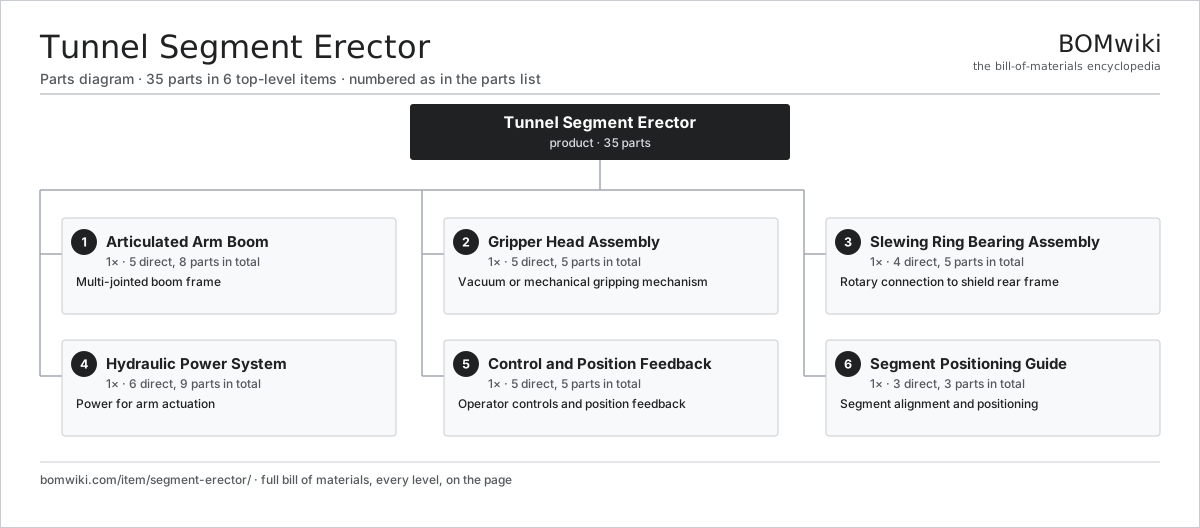
| # | Part | Qty | What it does |
|---|---|---|---|
| 1 | Articulated Arm Boom 5 parts | 1× | Multi-jointed boom frame |
| 2 | Gripper Head Assembly 5 parts | 1× | Vacuum or mechanical gripping mechanism |
| 3 | Slewing Ring Bearing Assembly 4 parts | 1× | Rotary connection to shield rear frame |
| 4 | Hydraulic Power System 6 parts | 1× | Power for arm actuation |
| 5 | Control and Position Feedback 5 parts | 1× | Operator controls and position feedback |
| 6 | Segment Positioning Guide 3 parts | 1× | Segment alignment and positioning |
3D model
No 3D model yet. Have a CAD file of this? Add a 3D model. STL renders right on this page; STEP, FreeCAD, and OpenSCAD sources are welcome too (openly licensed, like all 3D models on BOMwiki).
Build & assembly graph
expand / collapse · shared sub-assemblies converge · links to related products · est. labourTap an assembly to expand/collapse · tap a part to open it · use “Open page” for any node · drag to pan, scroll to zoom.
Bill of materials for Tunnel Segment Erector
6 top-level lines · 34 rows shown · 35 parts total · indented to 3 levels| # | Item / sub-assembly | Part no. | Qty/assy | Ext. qty | Parts | Type |
|---|---|---|---|---|---|---|
| 1 | Articulated Arm Boom 5 parts | segment-erector-arm-structure | 1× | 1 | 8 | assembly |
| 1.1 | Base Boom Link | segment-erector-base-link | 1× | 1 | · | part |
| 1.2 | Intermediate Boom Sections | segment-erector-middle-links | 1× | 1 | · | part |
| 1.3 | End-Effector Arm Link | segment-erector-end-effector-link | 1× | 1 | · | part |
| 1.4 | Pivot Joint Bearings | segment-erector-joint-bearings | 1× | 1 | · | part |
| 1.5 | Ball Bearing | ball-bearing | 4× | 4 | · | part |
| 2 | Gripper Head Assembly 5 parts | segment-erector-gripper-head | 1× | 1 | 5 | assembly |
| 2.1 | Vacuum Suction Pads | segment-erector-vacuum-pads | 1× | 1 | · | part |
| 2.2 | Vacuum Generation System | segment-erector-vacuum-pump | 1× | 1 | · | part |
| 2.3 | Mechanical Gripper Jaws | segment-erector-mechanical-jaws | 1× | 1 | · | part |
| 2.4 | Gripper Actuation Cylinder | segment-erector-gripper-actuator | 1× | 1 | · | part |
| 2.5 | Gripper Pressure Relief | segment-erector-pressure-relief | 1× | 1 | · | part |
| 3 | Slewing Ring Bearing Assembly 4 parts | segment-erector-slewing-ring | 1× | 1 | 5 | assembly |
| 3.1 | Large Slewing Ring Bearing | segment-erector-slewing-bearing | 1× | 1 | · | part |
| 3.2 | Slewing Drive Motor | segment-erector-slew-motor | 1× | 1 | · | part |
| 3.3 | Slewing Ring Mounting Flange | segment-erector-mounting-flange | 1× | 1 | · | part |
| 3.4 | Fastener Set | fastener-set | 2× | 2 | · | part |
| 4 | Hydraulic Power System 6 parts | segment-erector-hydraulic-system | 1× | 1 | 9 | assembly |
| 4.1 | Main Hydraulic Pump | segment-erector-pump | 1× | 1 | · | part |
| 4.2 | Pump Drive Motor | segment-erector-motor | 1× | 1 | · | part |
| 4.3 | Proportional Valve Manifold | segment-erector-valve-manifold | 1× | 1 | · | part |
| 4.4 | Hydraulic Accumulator | segment-erector-accumulator | 1× | 1 | · | part |
| 4.5 | Pressure Sensor | pressure-sensor | 3× | 3 | · | part |
| 4.6 | Oil Seal | oil-seal | 2× | 2 | · | part |
| 5 | Control and Position Feedback 5 parts | segment-erector-control-system | 1× | 1 | 5 | assembly |
| 5.1 | Control Logic Unit (PLC) | segment-erector-control-unit | 1× | 1 | · | part |
| 5.2 | Proportional Multi-Axis Joystick | segment-erector-joystick | 1× | 1 | · | part |
| 5.3 | Position Encoder Sensors | segment-erector-position-encoders | 1× | 1 | · | part |
| 5.4 | Load Cell Force Sensor | segment-erector-load-cell | 1× | 1 | · | part |
| 5.5 | LCD Panel | lcd-panel | 1× | 1 | · | part |
| 6 | Segment Positioning Guide 3 parts | segment-erector-guide-frame | 1× | 1 | 3 | assembly |
| 6.1 | Guide Frame Structure | segment-erector-guide-structure | 1× | 1 | · | part |
| 6.2 | Alignment Guide Pegs | segment-erector-guide-pegs | 1× | 1 | · | part |
| 6.3 | Positioning Stop Blocks | segment-erector-stop-blocks | 1× | 1 | · | part |
Something wrong in this list? Report a problem with this BOM.
Related products
same domain, ranked by shared parts All-Terrain Mobile Crane
594 parts · shares 2 with this page
All-Terrain Mobile Crane
594 parts · shares 2 with this page
 Articulated Haul Truck
128 parts · shares 2 with this page
Articulated Haul Truck
128 parts · shares 2 with this page
 Asphalt Milling Machine
1,134 parts · shares 2 with this page
Asphalt Milling Machine
1,134 parts · shares 2 with this page
 Asphalt Recycler
226 parts · shares 2 with this page
Bridge Form Traveler
405 parts · shares 2 with this page
Asphalt Recycler
226 parts · shares 2 with this page
Bridge Form Traveler
405 parts · shares 2 with this page
 Bridge Girder Launching Gantry
1,542 parts · shares 2 with this page
Bridge Girder Launching Gantry
1,542 parts · shares 2 with this page
Sourcing: possible vendors
Browse the supplier directory → Prices, MOQ, and lead times are algorithmic estimates, not quotes, and not claims about these companies. Company mappings are curated by keyword; est. price band $15k–$2M. How estimates work| Vendor | HQ | Specialty | MOQ | Lead time |
|---|---|---|---|---|
| caterpillar.com ↗ | Irving, US | Construction & mining equipment | made to order | 16–28 wks |
|
🇯🇵Komatsu
komatsu.com ↗
|
Tokyo, JP | Construction & mining equipment | made to order | 16–28 wks |
|
🇸🇪Volvo CE
volvoce.com ↗
|
Gothenburg, SE | Construction equipment | made to order | 16–28 wks |
|
🇨🇭Liebherr
liebherr.com ↗
|
Bulle, CH | Cranes & heavy equipment | made to order | 16–28 wks |
|
🇨🇳XCMG
xcmg.com ↗
|
Xuzhou, CN | Construction machinery | made to order | 16–28 wks |
891-word article