Sewage Lift Station
ProductOverview
A sewage lift station is a self-contained system that raises raw sewage or greywater from below-grade fixtures, typically basement bathrooms, underground laundries, or storm sumps, to an elevation sufficient to reach municipal gravity sewer lines or above-ground treatment systems. The heart of the system is a submersible grinder pump mounted inside a wet well basin that automatically activates when sewage level rises, grinds solids to prevent line blockages, and discharges via check valve to the upper drain.
Sewage lift stations became standard in residential basements and commercial kitchens once building codes mandated drainage capability below public sewer grade. Without a lift station, these spaces cannot drain against gravity and remain unsuitable for plumbing fixtures. Modern systems are fully automatic and rarely require intervention; float switches trigger pump start and stop, and alarm contacts alert building occupants or facility managers to overflow conditions or pump failure.
How it works
Sewage enters the wet well basin through the inlet, where the baffle reduces turbulence and settles grit. As liquid level rises, a float switch closes and sends a signal to the control panel, which energizes a contactor to start the grinder pump.
The pump impeller rotates at 1,750–3,450 RPM, grinding solids against a fixed blade and generating pressure sufficient to push sewage up a discharge line against gravity and friction losses. The check valve prevents backflow; the isolation ball valve allows manual shutdown for maintenance.
As the basin empties, a second float switch opens at low level, de-energizing the contactor and stopping the pump. A third alarm float independent of the operating circuit triggers an audible and visual alert if the basin overfills, signaling pump failure, blockage, or excessive inflow.
Components & Design
Motor & Pump Head
The submersible motor is typically a single-phase 1.5–3 HP induction motor with Class F insulation and thermal overload built into the winding. Water-cooled design allows the motor to sit submerged inside the basin; oil-filled motor cavity provides both lubrication and thermal dissipation. The impeller is a rotating cutting assembly with sharp blade teeth that shear solids into slurry. Typical performance is 35–50 GPM @ 2 inch discharge, with dynamic head capacity of 25–50 feet depending on motor HP and impeller trim.
Basin & Access
The wet well is a 25–50 gallon polyethylene or fiberglass-reinforced plastic tank with internal ribs for rigidity. The hinged access cover allows service entry; the basin drain at the sump allows gravity dewatering during maintenance. Inlet ports are typically 2–4 inch NPT to accept gravity feed lines. A submerged baffle slows incoming flow and promotes settling of rags and solids before they reach the pump intake.
Level Control
Float switches are the simplest and most reliable level sensing in sewage systems. A start float rides a vertical rod or stainless cable; at approximately 60% basin fill, its contact closes, energizing the pump. A stop float at ~20% fill opens the circuit, stopping the pump. Both are normally installed in a watertight junction box mounted to the basin exterior, eliminating submersed electrical penetrations.
An independent alarm float at ~90% capacity provides a normally-open contact that bypasses all pump logic; any overfill condition energizes the alarm regardless of pump state, warning of catastrophic failure.
Discharge Piping
The discharge assembly combines a spring-loaded check valve (preventing backflow), a shutoff valve for isolation, and a gauge port on the manifold. All fittings downstream are typically Schedule 40 PVC or cast iron (for aboveground runs). The cleanout tee just downstream of the pump allows rodding if the discharge line becomes blocked.
Control Panel
The control enclosure is a Type 4X (IP66) stainless steel cabinet (typically 18×24 inches) mounted adjacent to the lift station. Inside is a motor contactor rated for the pump motor, an overload relay set to motor nameplate current, and a control transformer stepping 240V AC down to 24V for indicator lamps and alarm circuits. A piezo or solenoid buzzer sounds at 85+ dB when high-level or alarm conditions occur. All wiring is color-coded and labeled per electrical code; grounding is bonded to the pump frame and basin via low-impedance conductor.
Pump Sizing & Selection
Pump capacity is chosen based on worst-case inflow rate and allowable basin refill time. If a basement bathroom can generate 50 GPM during heavy use, the pump must discharge at least 50 GPM to keep the basin from overflowing. A single 2 HP grinder pump discharges ~45 GPM at 2 inch; for higher flow demands, duplex systems (two pumps in one basin) with alternating duty are installed.
Dynamic head (elevation rise plus friction loss) determines motor HP. Lifting sewage 30 feet vertically and pushing through 100 feet of 2 inch discharge line at 45 GPM incurs roughly 25 feet of friction head; total head ~55 feet typically requires a 2–3 HP motor.
Maintenance & Troubleshooting
Float switches require annual inspection and occasional cleaning of the guide rod or cable to ensure smooth operation. The pump impeller can jam with rags or stiff solids; if pump starts but does not discharge (cavitation noise), the check valve or cleanout must be cleared by rodding.
Motor thermal overload trips are often misdiagnosed as bearing failure; in reality, excessive head (clogged discharge line) or high ambient temperature (unventilated basin in summer) forces the motor to draw locked-rotor current and trigger protection. Verify discharge line is clear and basin is not in direct sun.
Battery-backed alarm systems are available as add-ons; they continue sounding the alarm during a power outage, allowing the occupant to call a service technician before the basin overflows.
Standards & Regulations
Most jurisdictions require sewage lift stations to meet NFPA (National Fire Protection Association) electrical code and have a backup power system or alarm for failure notification. Submersible grinder pumps are tested per ASME B73.1 for centrifugal pump performance and NEMA MG-1 for motor design. Capacity sizing must meet local plumbing code inflow assumptions (typically 3–5 fixture units for a basement bathroom).
Odor control is often mandated; an activated carbon or enzymatic vent filter on the basin breather reduces odor escape while allowing pressure equalization as the basin drains.
Sewage Lift Station parts and their functions
7 top-level parts · 37 parts in total · full bill of materials below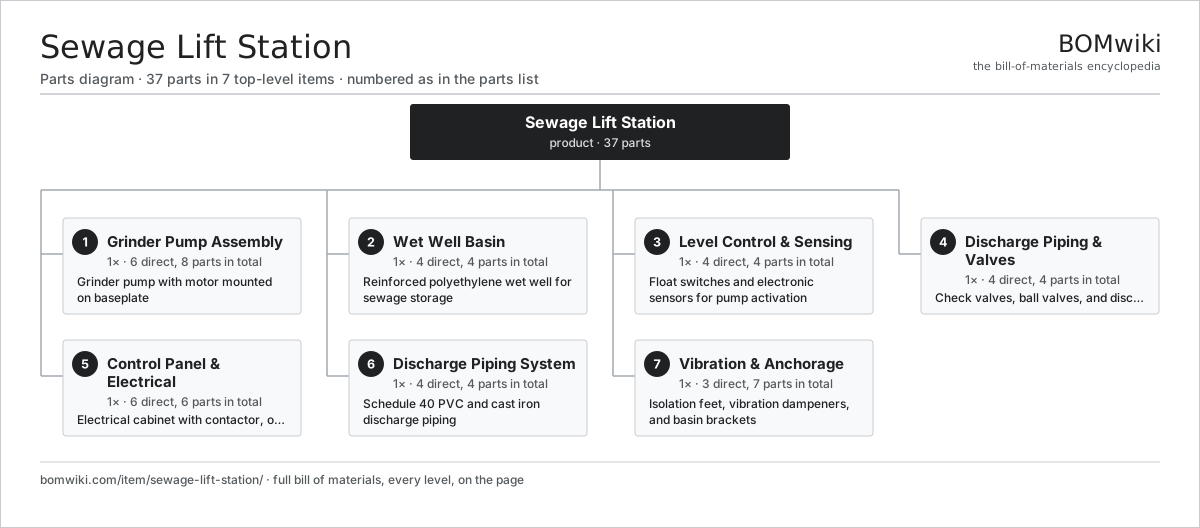
| # | Part | Qty | What it does |
|---|---|---|---|
| 1 | Grinder Pump Assembly 6 parts | 1× | Grinder pump with motor mounted on baseplate |
| 2 | Wet Well Basin 4 parts | 1× | Reinforced polyethylene wet well for sewage storage |
| 3 | Level Control & Sensing 4 parts | 1× | Float switches and electronic sensors for pump activation |
| 4 | Discharge Piping & Valves 4 parts | 1× | Check valves, ball valves, and discharge manifold |
| 5 | Control Panel & Electrical 6 parts | 1× | Electrical cabinet with contactor, overload protection, and alarms |
| 6 | Discharge Piping System 4 parts | 1× | Schedule 40 PVC and cast iron discharge piping |
| 7 | Vibration & Anchorage 3 parts | 1× | Isolation feet, vibration dampeners, and basin brackets |
3D model
No 3D model yet. Have a CAD file of this? Add a 3D model. STL renders right on this page; STEP, FreeCAD, and OpenSCAD sources are welcome too (openly licensed, like all 3D models on BOMwiki).
Build & assembly graph
expand / collapse · shared sub-assemblies converge · links to related products · est. labourTap an assembly to expand/collapse · tap a part to open it · use “Open page” for any node · drag to pan, scroll to zoom.
Bill of materials for Sewage Lift Station
7 top-level lines · 38 rows shown · 37 parts total · indented to 3 levels| # | Item / sub-assembly | Part no. | Qty/assy | Ext. qty | Parts | Type |
|---|---|---|---|---|---|---|
| 1 | Grinder Pump Assembly 6 parts | sewage-lift-station-pump-assembly | 1× | 1 | 8 | assembly |
| 1.1 | Submersible Motor | sewage-lift-station-motor | 1× | 1 | · | part |
| 1.2 | Grinder Impeller | sewage-lift-station-grinder-head | 1× | 1 | · | part |
| 1.3 | Motor Housing | motor-housing | 1× | 1 | · | part |
| 1.4 | Ball Bearing | ball-bearing | 2× | 2 | · | part |
| 1.5 | Oil Seal | oil-seal | 2× | 2 | · | part |
| 1.6 | Pump Baseplate | sewage-lift-station-baseplate | 1× | 1 | · | part |
| 2 | Wet Well Basin 4 parts | sewage-lift-station-basin | 1× | 1 | 4 | assembly |
| 2.1 | Tank Body | sewage-lift-station-tank-body | 1× | 1 | · | part |
| 2.2 | Inlet Baffle | sewage-lift-station-inlet-baffle | 1× | 1 | · | part |
| 2.3 | Access Cover | sewage-lift-station-access-cover | 1× | 1 | · | part |
| 2.4 | Drain Plug Valve | sewage-lift-station-drain-plug | 1× | 1 | · | part |
| 3 | Level Control & Sensing 4 parts | sewage-lift-station-level-controls | 1× | 1 | 4 | assembly |
| 3.1 | Pump Start Float | sewage-lift-station-float-switch-on | 1× | 1 | · | part |
| 3.2 | Pump Stop Float | sewage-lift-station-float-switch-off | 1× | 1 | · | part |
| 3.3 | Alarm Float | sewage-lift-station-alarm-float | 1× | 1 | · | part |
| 3.4 | Watertight Junction Box | sewage-lift-station-junction-box | 1× | 1 | · | part |
| 4 | Discharge Piping & Valves 4 parts | sewage-lift-station-discharge-assembly | 1× | 1 | 4 | assembly |
| 4.1 | Check Valve | sewage-lift-station-check-valve | 1× | 1 | · | part |
| 4.2 | Isolation Ball Valve | sewage-lift-station-ball-valve | 1× | 1 | · | part |
| 4.3 | Pressure Gauge | sewage-lift-station-pressure-gauge | 1× | 1 | · | part |
| 4.4 | Discharge Tee Manifold | sewage-lift-station-discharge-tee | 1× | 1 | · | part |
| 5 | Control Panel & Electrical 6 parts | sewage-lift-station-control-panel | 1× | 1 | 6 | assembly |
| 5.1 | Control Panel Enclosure | sewage-lift-station-panel-enclosure | 1× | 1 | · | part |
| 5.2 | Relay | relay | 1× | 1 | · | part |
| 5.3 | Overload Protection | sewage-lift-station-overload-relay | 1× | 1 | · | part |
| 5.4 | Control Transformer | sewage-lift-station-transformer | 1× | 1 | · | part |
| 5.5 | Alarm Buzzer | sewage-lift-station-alarm-buzzer | 1× | 1 | · | part |
| 5.6 | Fastener Set | fastener-set | 1× | 1 | · | part |
| 6 | Discharge Piping System 4 parts | sewage-lift-station-pipes-fittings | 1× | 1 | 4 | assembly |
| 6.1 | PVC Discharge Pipe | sewage-lift-station-pvc-pipe | 1× | 1 | · | part |
| 6.2 | Cast Iron Discharge Pipe | sewage-lift-station-cast-iron-pipe | 1× | 1 | · | part |
| 6.3 | Discharge Fittings | sewage-lift-station-fittings | 1× | 1 | · | part |
| 6.4 | Cleanout Tee | sewage-lift-station-cleanout-tee | 1× | 1 | · | part |
| 7 | Vibration & Anchorage 3 parts | sewage-lift-station-mounting | 1× | 1 | 7 | assembly |
| 7.1 | Isolation Feet | sewage-lift-station-isolation-feet | 4× | 4 | · | part |
| 7.2 | Lateral Restraint Strap | sewage-lift-station-restraint-strap | 2× | 2 | · | part |
| 7.3 | Fastener Set | fastener-set | 1× | 1 | · | part |
Something wrong in this list? Report a problem with this BOM.
Related products
same domain, ranked by shared parts HDPE Pipe Butt-Fusion Machine
110 parts · shares 4 with this page
Pipe Threading Machine
79 parts · shares 4 with this page
Sewage/Effluent Pump
47 parts · shares 4 with this page
HDPE Pipe Butt-Fusion Machine
110 parts · shares 4 with this page
Pipe Threading Machine
79 parts · shares 4 with this page
Sewage/Effluent Pump
47 parts · shares 4 with this page
 Shallow-Well Jet Pump
49 parts · shares 3 with this page
Shallow-Well Jet Pump
49 parts · shares 3 with this page
 Sump Pump
51 parts · shares 3 with this page
Sump Pump
51 parts · shares 3 with this page
 Water Booster Pump
151 parts · shares 3 with this page
Water Booster Pump
151 parts · shares 3 with this page
Sourcing: possible vendors
Browse the supplier directory → Prices, MOQ, and lead times are algorithmic estimates, not quotes, and not claims about these companies. Company mappings are curated by keyword; est. price band $20–$3k. How estimates work| Vendor | HQ | Specialty | MOQ | Lead time |
|---|---|---|---|---|
|
🇺🇸Kohler
kohler.com ↗
|
Kohler, US | Plumbing fixtures | 1,000 units | 6–12 wks |
|
🇯🇵TOTO
toto.com ↗
|
Kitakyushu, JP | Sanitaryware | 1,000 units | 6–12 wks |
|
🇯🇵LIXIL
lixil.com ↗
|
Tokyo, JP | Plumbing (Grohe, American Std) | 1,000 units | 6–12 wks |
|
🇺🇸Moen
moen.com ↗
|
North Olmsted, US | Faucets & fixtures | 1,000 units | 6–12 wks |
|
🇨🇭Geberit
geberit.com ↗
|
Rapperswil, CH | Sanitary systems | 1,000 units | 6–12 wks |
1,185-word article