SFP+ Optical Transceiver
ProductOverview
An SFP+ (Small Form-Factor Pluggable Plus) optical transceiver is a finger-sized module that converts electrical 10 Gbps data into optical signal for transmission over fiber, and receives optical signals, converting them back to electricity. It is the workhorse of modern data center and service provider networks: hot-pluggable into a switch or router port, tuned to a specific wavelength (850, 1310, 1550 nm) and distance (short-range to long-range), and managed via a standard digital interface (I2C).
The term "transceiver" means it handles both TX (transmit) and RX (receive) on a single module. The transmit side (TOSA) houses a laser and driver, and the receive side (ROSA) has a photodiode and amplifier. All electronics are housed in a small PCB-based package with 20 gold-plated pins that mate with a slot on the switch line card. This modularity is key: if a customer needs a different distance (upgrading from SR to LR), they pull out the old transceiver and plug in a new one without replacing the switch.
Optical transmission
The DFB laser diode at the heart of the TOSA is a semiconductor laser that emits a narrow beam of light at the target wavelength (e.g., 1310 nm for long-range). The laser is biased with a small DC current and modulated with incoming electrical data: when data is '1', the laser is driven harder, increasing optical output; when data is '0', the laser is backed off, reducing output. The result is an optical signal with intensity modulation, the simplest form of optical modulation.
The laser driver IC receives the 10 Gbps electrical signal (typically LVDS, low-voltage differential signaling) and converts it to the laser's bias and modulation currents. It also compensates for temperature effects: a hotter laser tends to shift wavelength and reduce efficiency, so the driver adjusts bias current to maintain constant output power. Some drivers include a thermoelectric cooler (TEC), a Peltier element that actively cools the laser, keeping it at a precise temperature and stabilizing the wavelength.
The photodiode at the laser's back facet measures the optical power output and feeds it back to the driver, creating a closed loop that holds power constant (typically +3 to +5 dBm) regardless of temperature or aging. This power control is critical: too weak, and the receiver cannot detect the signal; too strong, and noise and nonlinearities degrade performance.
The optical isolator is a Faraday rotator that prevents back-reflected light from the fiber or a nearby reflective surface from coupling back into the laser. If back-reflection reaches the laser, it can destabilize it (mode hopping, linewidth broadening), degrading the signal. The isolator reflects the back-traveling light away (typically absorbed in a dump), cleaning up the feedback. This is especially important in long-range modules like LR and ER, where the fiber can have imperfections.
Optical reception
The receiving side begins with a PIN photodiode, a reverse-biased semiconductor junction that converts photons to photocurrent. A weak incoming signal (say, −10 dBm, about 100 femtowatts of optical power) generates a nanoamp photocurrent. The transimpedance amplifier (TIA) is a low-noise amplifier that converts this tiny current into a millivolt-level voltage signal. It uses operational amplifier feedback to achieve very low input noise, critical for detecting weak signals.
The TIA output is a small, noisy analog signal. A limiting amplifier with ~30 dB of high-frequency gain amplifies this, and its built-in hysteresis (threshold detection) clips the signal to a digital level (0 or 1). The result is a clean 10 Gbps digital signal that matches the electrical standard expected by the host switch.
The output filter is a low-pass network that removes high-frequency noise from the amplifier, shaping the signal to comply with the IEEE 802.3ae eye mask (a standard diagram defining allowable signal shape and timing).
Monitoring and diagnostics
Modern SFP+ modules include a Digital Diagnostics Monitor (DDM) that tracks module health in real-time. A thermistor measures the module temperature, a 10-bit ADC digitizes the TX optical power (from the laser monitor photodiode) and the RX received power (from a tap on the incoming signal), and the results are accessible via the host's management interface.
The host switch polls the module's I2C address every few seconds, reading temperature and power levels. If TX power drops below threshold (sign of laser aging or misalignment), an alarm is raised. If RX power drops (indication of dirty fiber or broken link), the switch can preemptively alert the operator or switch traffic to a backup path.
The EEPROM is programmed at the factory with module type, wavelength, vendor, and calibration coefficients for the ADC. When a module is inserted, the host reads this and configures the appropriate driver behavior. If the module is a 10G-SR (850 nm short-range), the host knows not to enable long-range optics or expect very low RX sensitivity.
Wavelength and distance variants
SFP+ transceivers come in many flavors, standardized by multi-source agreements (MSAs):
- 10G-SR (short-range): 850 nm, ~300 m on multimode fiber. Cheapest, used in data centers.
- 10G-LR (long-range): 1310 nm, ~10 km on single-mode fiber. Standard for metro and long-haul links.
- 10G-ER (extended-range): 1550 nm, ~40 km. Uses higher TX power and RX sensitivity; sometimes includes an EDFA-compatible link budget.
- 10G-ZR (ultra-long-range): 1550 nm, ~80 km. Rare, requires external amplifiers.
Each variant uses a different laser wavelength, TEC tuning range, and receiver sensitivity, optimized for its distance. A 10G-LR module plugged into a switch port automatically informs the host (via the EEPROM) that it supports 10 km, and the switch configures alarms accordingly.
Reliability and thermal management
The aluminum top cover and plastic housing are designed for thermal coupling: the laser TEC generates heat when actively cooling the laser, and this heat is conducted away through the top cover to the switch's heatsink. Some data center switches have dedicated TEC coolers in the SFP slot to handle high-power modules running at high speed continuously.
SFP+ modules are typically rated for 5–10 years of continuous operation in a data center. In service-provider networks, modules are often run at 80–90% of maximum power budget to extend lifespan and reduce thermal stress. The DDM monitoring helps operators retire a module before catastrophic failure: as TX power drifts down with age, the trend is visible in the monitoring data, and the module is replaced proactively.
Hot-plugging and upgrades
One of the greatest advantages of the SFP+ form factor is hot-pluggability: a module can be inserted or removed while the switch is powered on, without interrupting other ports. The switch detects the insertion via a presence pin, reads the EEPROM, and enables the port. This makes upgrades trivial: an operator can upgrade a port from 10G-SR to 10G-LR (increasing distance) by simply pulling and replacing the module, usually during maintenance windows but potentially even live (though vendors caution against this).
The dust cap is provided to protect the connector when not in use, preventing contamination of the fiber ferrule end-face, which can introduce reflection and loss.
SFP+ Optical Transceiver parts and their functions
8 top-level parts · 196 parts in total · full bill of materials below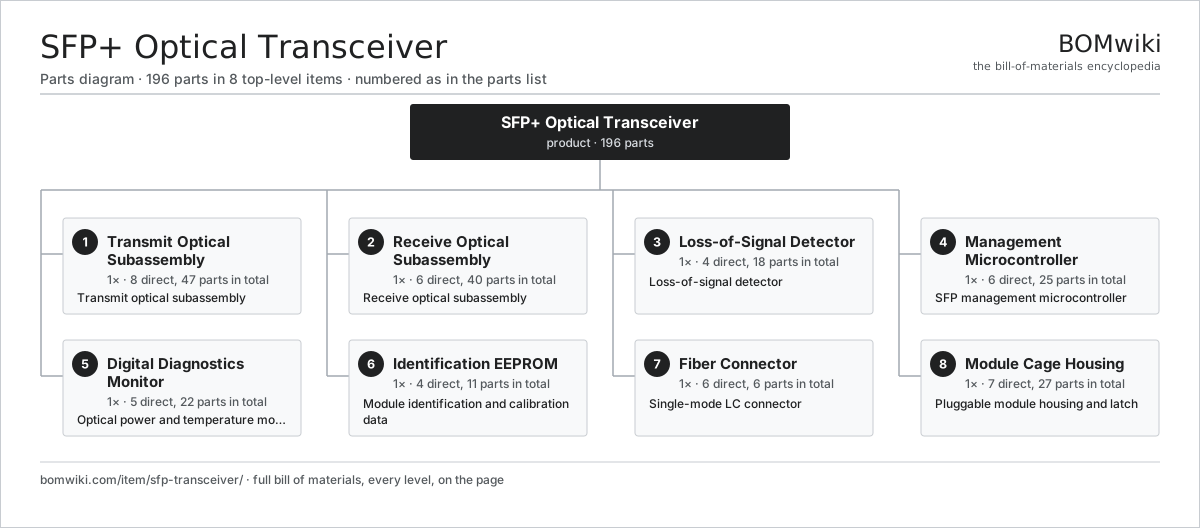
| # | Part | Qty | What it does |
|---|---|---|---|
| 1 | Transmit Optical Subassembly 8 parts | 1× | Transmit optical subassembly |
| 2 | Receive Optical Subassembly 6 parts | 1× | Receive optical subassembly |
| 3 | Loss-of-Signal Detector 4 parts | 1× | Loss-of-signal detector |
| 4 | Management Microcontroller 6 parts | 1× | SFP management microcontroller |
| 5 | Digital Diagnostics Monitor 5 parts | 1× | Optical power and temperature monitor |
| 6 | Identification EEPROM 4 parts | 1× | Module identification and calibration data |
| 7 | Fiber Connector 6 parts | 1× | Single-mode LC connector |
| 8 | Module Cage Housing 7 parts | 1× | Pluggable module housing and latch |
3D model
No 3D model yet. Have a CAD file of this? Add a 3D model. STL renders right on this page; STEP, FreeCAD, and OpenSCAD sources are welcome too (openly licensed, like all 3D models on BOMwiki).
Build & assembly graph
expand / collapse · shared sub-assemblies converge · links to related products · est. labourTap an assembly to expand/collapse · tap a part to open it · use “Open page” for any node · drag to pan, scroll to zoom.
Bill of materials for SFP+ Optical Transceiver
8 top-level lines · 54 rows shown · 196 parts total · indented to 3 levels| # | Item / sub-assembly | Part no. | Qty/assy | Ext. qty | Parts | Type |
|---|---|---|---|---|---|---|
| 1 | Transmit Optical Subassembly 8 parts | sfp-tosa-module | 1× | 1 | 47 | assembly |
| 1.1 | DFB Laser | sfp-laser-dfb | 1× | 1 | · | part |
| 1.2 | Laser Driver | sfp-laser-driver-ic | 1× | 1 | · | part |
| 1.3 | Thermoelectric Cooler | sfp-laser-tec | 1× | 1 | · | part |
| 1.4 | Monitor Photodiode | sfp-laser-monitor-pd | 1× | 1 | · | part |
| 1.5 | Optical Isolator | sfp-isolator-optical | 1× | 1 | · | part |
| 1.6 | Attenuator | sfp-attenuator-pad | 1× | 1 | · | part |
| 1.7 | TOSA Board | sfp-tosa-pcb | 1× | 1 | · | part |
| 1.8 | SMD Passive (R/C/L) | smd-passives | 40× | 40 | · | part |
| 2 | Receive Optical Subassembly 6 parts | sfp-rosa-module | 1× | 1 | 40 | assembly |
| 2.1 | PIN Photodiode | sfp-photodiode-pin | 1× | 1 | · | part |
| 2.2 | Transimpedance Amp | sfp-tia-ic | 1× | 1 | · | part |
| 2.3 | Limiting Amplifier | sfp-limiting-amp | 1× | 1 | · | part |
| 2.4 | Output Filter | sfp-rxa-filter | 1× | 1 | · | part |
| 2.5 | ROSA Board | sfp-rosa-pcb | 1× | 1 | · | part |
| 2.6 | SMD Passive (R/C/L) | smd-passives | 35× | 35 | · | part |
| 3 | Loss-of-Signal Detector 4 parts | sfp-los-ic | 1× | 1 | 18 | assembly |
| 3.1 | LOS Comparator | sfp-los-comparator | 1× | 1 | · | part |
| 3.2 | Threshold DAC | sfp-los-threshold-dac | 1× | 1 | · | part |
| 3.3 | Debounce Filter | sfp-los-debounce-filter | 1× | 1 | · | part |
| 3.4 | SMD Passive (R/C/L) | smd-passives | 15× | 15 | · | part |
| 4 | Management Microcontroller 6 parts | sfp-control-mcu | 1× | 1 | 25 | assembly |
| 4.1 | MCU | sfp-mcu-core | 1× | 1 | · | part |
| 4.2 | MCU Flash | sfp-mcu-flash | 1× | 1 | · | part |
| 4.3 | MCU RAM | sfp-mcu-ram | 1× | 1 | · | part |
| 4.4 | I2C Port | sfp-mcu-i2c-interface | 1× | 1 | · | part |
| 4.5 | Oscillator | sfp-mcu-oscillator | 1× | 1 | · | part |
| 4.6 | SMD Passive (R/C/L) | smd-passives | 20× | 20 | · | part |
| 5 | Digital Diagnostics Monitor 5 parts | sfp-ddm-sensor | 1× | 1 | 22 | assembly |
| 5.1 | Temperature Sensor | sfp-ddm-temp-sensor | 1× | 1 | · | part |
| 5.2 | Power ADC | sfp-ddm-power-adc | 1× | 1 | · | part |
| 5.3 | Calibration DAC | sfp-ddm-calibration-dac | 1× | 1 | · | part |
| 5.4 | Voltage Reference | sfp-ddm-reference | 1× | 1 | · | part |
| 5.5 | SMD Passive (R/C/L) | smd-passives | 18× | 18 | · | part |
| 6 | Identification EEPROM 4 parts | sfp-eprom | 1× | 1 | 11 | assembly |
| 6.1 | EEPROM IC | sfp-eprom-memory-ic | 1× | 1 | · | part |
| 6.2 | Write Protect | sfp-eprom-write-protect | 1× | 1 | · | part |
| 6.3 | Address Decode | sfp-eprom-i2c-address | 1× | 1 | · | part |
| 6.4 | SMD Passive (R/C/L) | smd-passives | 8× | 8 | · | part |
| 7 | Fiber Connector 6 parts | sfp-connector-fiber | 1× | 1 | 6 | assembly |
| 7.1 | TX Ferrule | sfp-connector-ferrule-tx | 1× | 1 | · | part |
| 7.2 | RX Ferrule | sfp-connector-ferrule-rx | 1× | 1 | · | part |
| 7.3 | Alignment Sleeve | sfp-connector-sleeve | 1× | 1 | · | part |
| 7.4 | Connector Body | sfp-connector-housing | 1× | 1 | · | part |
| 7.5 | Latch Spring | sfp-connector-spring-latch | 1× | 1 | · | part |
| 7.6 | Dust Cap | sfp-connector-dust-cap | 1× | 1 | · | part |
| 8 | Module Cage Housing 7 parts | sfp-cage-housing | 1× | 1 | 27 | assembly |
| 8.1 | Top Cover | sfp-housing-top-cover | 1× | 1 | · | part |
| 8.2 | Bottom Body | sfp-housing-bottom-body | 1× | 1 | · | part |
| 8.3 | Contact Pin | sfp-housing-connector-pins | 20× | 20 | · | part |
| 8.4 | Ejector Latch | sfp-housing-ejector-latch | 2× | 2 | · | part |
| 8.5 | Keying Notch | sfp-housing-keying-notch | 1× | 1 | · | part |
| 8.6 | Strain Relief | sfp-housing-strain-relief | 1× | 1 | · | part |
| 8.7 | Fastener Set | fastener-set | 1× | 1 | · | part |
Something wrong in this list? Report a problem with this BOM.
Sourcing: possible vendors
Browse the supplier directory → Prices, MOQ, and lead times are algorithmic estimates, not quotes, and not claims about these companies. Company mappings are curated by keyword; est. price band $30–$50k. How estimates work| Vendor | HQ | Specialty | MOQ | Lead time |
|---|---|---|---|---|
|
🇺🇸Cisco
cisco.com ↗
|
San Jose, US | Networking | 500 units | 8–14 wks |
|
🇺🇸Juniper
juniper.net ↗
|
Sunnyvale, US | Networking | 500 units | 8–14 wks |
| arista.com ↗ | Santa Clara, US | Networking | 500 units | 8–14 wks |
|
🇫🇮Nokia
nokia.com ↗
|
Espoo, FI | Telecom equipment | 500 units | 8–14 wks |
|
🇨🇳Huawei
huawei.com ↗
|
Shenzhen, CN | Networking & telecom | 500 units | 8–14 wks |
1,267-word article