Shaking Table
ProductOverview
A shaking table is a gravity concentrator consisting of a riffled steel deck that moves horizontally in a controlled pattern while ore slurry flows across its surface. The combination of the shaking motion and deck geometry causes heavy minerals (gold, cassiterite, magnetite) to stratify laterally across the deck width, while light gangue overflows to the tailings chute. Products are collected at separate discharge points along the deck edge and end.
Shaking tables are the oldest and most widely used fine gravity concentrators, in use since the 1890s. They excel at recovering fine gold (−100 μm), cassiterite, and other heavy minerals from well-sized, gravity-responsive feeds. A single table processes 2–10 t/h; large plants operate 10–50 tables in parallel. Unlike spirals or dense-media separators, tables are robust, require minimal automation, and are tolerant of operational variance, making them ideal for artisanal, small-scale, and remote operations.
How it works
Prepared ore slurry (typically −500 μm to −100 μm, at 40–50% solids) is fed to the feed hopper at the center of the deck via a gentle distribution chute. Simultaneously, the deck begins shaking horizontally at 2–5 Hz (120–300 rpm eccentric) with a controlled amplitude of 10–50 mm.
The shaking motion accelerates particles in the feed direction (typically the downslope direction). During the forward stroke, particles are thrust downslope; during the return stroke, the riffles and deck friction prevent particles from sliding backward, instead "walking" them progressively downslope. This is called the "pinning" effect.
As particles move down the deck, three segregating forces act:
- Horizontal shaking: Heavy particles accelerate faster and move downslope more quickly; light particles lag.
- Gravity (deck tilt): The deck is tilted 2–10°, providing a gentle downslope component.
- Riffles: The parallel riffle bars guide particles laterally. Heavy minerals preferentially settle into rifled valleys and move downslope within them; light gangue tends to climb over riffles and move laterally toward the low-friction edge.
By the time particles reach the discharge end, they have segregated into zones across the deck width:
- Heavy concentrate: Along the lower (inner) riffle valley, discharged into the concentrate chute.
- Middlings: Intermediate products along the deck edge, discharged to the middlings chute.
- Tailings: Light gangue overflowing at the far (high-friction) edge, discharged to the tailings chute.
Water and Particle Mobility
Wash water (10–50 m³/h) is sprayed across the deck via nozzles. This water serves multiple purposes:
- Fluidization: Water reduces inter-particle friction, allowing particles to respond more readily to the shaking motion.
- Mobility: In dry conditions, fine particles can stick and aggregate; water breaks these agglomerations.
- Stratification: Water flow from top to bottom assists light particles moving toward the overflow, while creating a barrier for heavy particles moving downslope.
- Removal of fines: Very fine clay and dust are washed away, preventing them from clogging riffle valleys.
The wash water flow rate is critical, too much water and heavy particles are swept away to tailings; too little and fine particles are not adequately fluidized. Operators adjust water rate empirically for each ore type.
Deck Design and Riffles
The deck is typically 2–4 m long and 1–2 m wide, made of steel plate. The riffles are parallel steel bars, 20–50 mm tall and spaced 50–200 mm center-to-center, running perpendicular to the flow direction. Riffle height and spacing depend on the target particle size and mineral density:
- Fine gold (−100 μm): Tall, close-spaced riffles (40 mm tall, 75 mm spacing) guide fine particles into valleys.
- Cassiterite (−500 μm): Shorter, wider-spaced riffles (30 mm, 150 mm spacing) accommodate larger particles.
The liners, rubber or polyurethane plates bolted under the riffles, protect the steel and provide controlled friction. Worn liners are replaced annually; riffles themselves last 3–5 years before being re-profiled or replaced.
Shaking Mechanism
The shaking mechanism converts motor rotation into horizontal linear motion. Designs vary:
- Eccentric mechanism: An off-center weighted wheel rotates with the motor (1200–1800 rpm); a connecting rod translates this into sinusoidal horizontal motion of the deck. Frequency = motor rpm / number of eccentric lobes.
- Cam mechanism: A rotating cam drives a follower and rod, producing a trapezoidal or square-wave shaking pattern.
The stroke length is adjustable, typically 10–50 mm. Longer strokes increase particle acceleration and throughput but reduce separation sharpness (finer particles oversized and report to concentration). Shorter strokes improve separation but reduce capacity.
The frame guides are steel rails or bronze bushings that carry the deck in smooth, friction-free horizontal motion. Bearing quality is critical; worn guides cause jerky motion and poor separation.
Frame and Isolation
The main frame is welded steel, carrying the full load of the deck, driven mechanism, and ore slurry (~5–20 tonnes total). High-frequency shaking induces vibration that can damage building structure. Modern tables include vibration isolation springs or elastomer pads under the frame to decouple vibration from the building. Without isolation, tables require reinforced concrete foundations.
Operational Control
Operators adjust three main parameters:
- Feed rate: Too fast overloads the table and causes poor separation; too slow underutilizes capacity. Target feed density is 40–50% solids.
- Wash water rate: Increased water mobilizes fines but can sweep heavy minerals to tailings. Optimal rate is found experimentally.
- Deck tilt and shaking frequency: Tilt angles of 2–10° are typical; steeper tilt increases throughput but coarsens the separated products. Shaking frequency (adjusted by motor pulley or VFD if present) affects particle acceleration; 3–5 Hz is typical for fine minerals.
Multivariate optimization is complex; small changes in one parameter affect the others. Experienced table operators can achieve 85–95% recovery with high concentrate grade, but this requires skill and attention.
Advantages and Limitations
Advantages:
- Simplest, most robust gravity separator (fewer moving parts than spirals).
- Excellent recovery of fine particles (−100 μm to −10 μm).
- Flexible adjustment of products (splitter position, frequency, tilt, water rate).
- Low power (0.5–5 kW per table).
- No hydraulics or complex controls; manual operation possible.
- Proven, long-established technology; parts and expertise are widely available.
Limitations:
- Modest capacity per table (2–10 t/h) requires many tables for large plants.
- Sensitive to feed size distribution and density; requires skilled operation.
- Wet process; water recycling necessary for arid regions.
- Concentrate grade typically 50–85% (not ultra-pure); requires follow-up milling or flotation for high-grade products.
- High labor intensity compared to spirals (manual splitter adjustment, product charting).
Typical Applications
Alluvial and eluvial gold: Primary gravity recovery; produces concentrate for smelting or cyanide leaching.
Cassiterite (tin) concentration: From primary or secondary tin deposits, often as primary beneficiation before smelting.
Magnetite iron sand: Beach and river iron sand concentration for iron production.
Diamond recovery: Concentrating diamond-bearing material before formal diamond extraction (recovery by X-ray or density).
Artisanal and small-scale mining: The de facto standard due to low cost ($5,000–$30,000 per table), robustness, and suitability for remote areas.
In regions with significant gold or tin mining, table banks with 10–50 units in parallel are common, occupying a dedicated plant building and producing 50–500 t/h of gravity concentrate.
Shaking Table parts and their functions
8 top-level parts · 27 parts in total · full bill of materials below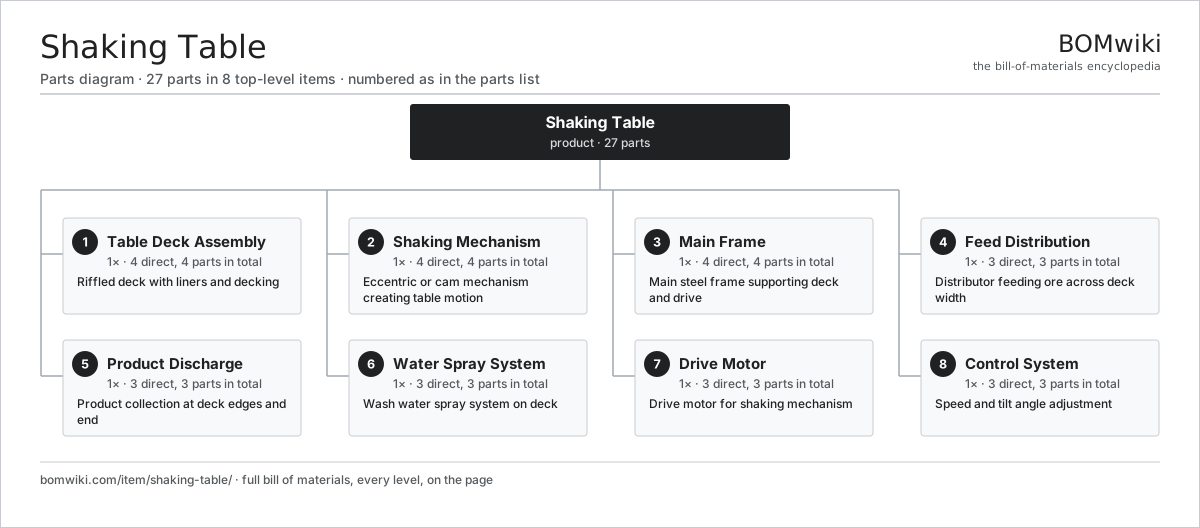
| # | Part | Qty | What it does |
|---|---|---|---|
| 1 | Table Deck Assembly 4 parts | 1× | Riffled deck with liners and decking |
| 2 | Shaking Mechanism 4 parts | 1× | Eccentric or cam mechanism creating table motion |
| 3 | Main Frame 4 parts | 1× | Main steel frame supporting deck and drive |
| 4 | Feed Distribution 3 parts | 1× | Distributor feeding ore across deck width |
| 5 | Product Discharge 3 parts | 1× | Product collection at deck edges and end |
| 6 | Water Spray System 3 parts | 1× | Wash water spray system on deck |
| 7 | Drive Motor 3 parts | 1× | Drive motor for shaking mechanism |
| 8 | Control System 3 parts | 1× | Speed and tilt angle adjustment |
3D model
No 3D model yet. Have a CAD file of this? Add a 3D model. STL renders right on this page; STEP, FreeCAD, and OpenSCAD sources are welcome too (openly licensed, like all 3D models on BOMwiki).
Build & assembly graph
expand / collapse · shared sub-assemblies converge · links to related products · est. labourTap an assembly to expand/collapse · tap a part to open it · use “Open page” for any node · drag to pan, scroll to zoom.
Bill of materials for Shaking Table
8 top-level lines · 35 rows shown · 27 parts total · indented to 3 levels| # | Item / sub-assembly | Part no. | Qty/assy | Ext. qty | Parts | Type |
|---|---|---|---|---|---|---|
| 1 | Table Deck Assembly 4 parts | shaking-table-deck-system | 1× | 1 | 4 | assembly |
| 1.1 | Steel Deck Plate | shaking-table-deck-plate | 1× | 1 | · | part |
| 1.2 | Deck Wear Liners | shaking-table-deck-liners | 1× | 1 | · | part |
| 1.3 | Riffle Bars | shaking-table-riffles | 1× | 1 | · | part |
| 1.4 | Deck Support Frame | shaking-table-deck-frame | 1× | 1 | · | part |
| 2 | Shaking Mechanism 4 parts | shaking-table-motion-drive | 1× | 1 | 4 | assembly |
| 2.1 | Eccentric Weight | shaking-table-eccentric | 1× | 1 | · | part |
| 2.2 | Connecting Rod | shaking-table-connecting-rod | 1× | 1 | · | part |
| 2.3 | Motion Bearings | shaking-table-bearings | 1× | 1 | · | part |
| 2.4 | Stroke Limiter | shaking-table-motion-adjustment | 1× | 1 | · | part |
| 3 | Main Frame 4 parts | shaking-table-frame | 1× | 1 | 4 | assembly |
| 3.1 | Frame Beams | shaking-table-frame-beams | 1× | 1 | · | part |
| 3.2 | Linear Guides | shaking-table-frame-guides | 1× | 1 | · | part |
| 3.3 | Isolation Springs | shaking-table-frame-isolation | 1× | 1 | · | part |
| 3.4 | Structural Fasteners | shaking-table-fasteners | 1× | 1 | · | part |
| 4 | Feed Distribution 3 parts | shaking-table-feed-hopper | 1× | 1 | 3 | assembly |
| 4.1 | Feed Hopper | shaking-table-hopper-body | 1× | 1 | · | part |
| 4.2 | Feed Chute | shaking-table-feed-chute | 1× | 1 | · | part |
| 4.3 | Feed Control Gate | shaking-table-feed-gate | 1× | 1 | · | part |
| 5 | Product Discharge 3 parts | shaking-table-discharge-system | 1× | 1 | 3 | assembly |
| 5.1 | Concentrate Chute | shaking-table-concentrate-chute | 1× | 1 | · | part |
| 5.2 | Middlings Chute | shaking-table-middlings-chute | 1× | 1 | · | part |
| 5.3 | Tailings Chute | shaking-table-tailings-chute | 1× | 1 | · | part |
| 6 | Water Spray System 3 parts | shaking-table-water-system | 1× | 1 | 3 | assembly |
| 6.1 | Wash Water Pump | shaking-table-water-pump | 1× | 1 | · | part |
| 6.2 | Water Manifold | shaking-table-water-manifold | 1× | 1 | · | part |
| 6.3 | Spray Nozzles | shaking-table-spray-nozzles | 1× | 1 | · | part |
| 7 | Drive Motor 3 parts | shaking-table-motor | 1× | 1 | 3 | assembly |
| 7.1 | Drive Motor Unit | shaking-table-motor-unit | 1× | 1 | · | part |
| 7.2 | Motor Mount | shaking-table-motor-mounting | 1× | 1 | · | part |
| 7.3 | Belt Drive System | shaking-table-belt-drive | 1× | 1 | · | part |
| 8 | Control System 3 parts | shaking-table-control-system | 1× | 1 | 3 | assembly |
| 8.1 | Tilt Adjustment Screw | shaking-table-tilt-screw | 1× | 1 | · | part |
| 8.2 | Amplitude Control | shaking-table-stroke-adjustment | 1× | 1 | · | part |
| 8.3 | Frequency Drive | shaking-table-frequency-control | 1× | 1 | · | part |
Something wrong in this list? Report a problem with this BOM.
Sourcing: possible vendors
Browse the supplier directory → Prices, MOQ, and lead times are algorithmic estimates, not quotes, and not claims about these companies. Company mappings are curated by keyword; est. price band $200k–$5M. How estimates work| Vendor | HQ | Specialty | MOQ | Lead time |
|---|---|---|---|---|
| caterpillar.com ↗ | Irving, US | Construction & mining equipment | made to order | 20–36 wks |
|
🇯🇵Komatsu
komatsu.com ↗
|
Tokyo, JP | Construction & mining equipment | made to order | 20–36 wks |
|
🇸🇪Sandvik
rocktechnology.sandvik ↗
|
Stockholm, SE | Mining & rock technology | made to order | 20–36 wks |
|
🇸🇪Epiroc
epiroc.com ↗
|
Stockholm, SE | Mining & drilling equipment | made to order | 20–36 wks |
|
🇫🇮Metso
metso.com ↗
|
Helsinki, FI | Crushing & minerals processing | made to order | 20–36 wks |
1,273-word article