Canal Ship Lift
ProductOverview
A ship lift or caisson lift is a large-scale vertical elevator for raising and lowering entire ships between waterways at different elevations. Unlike traditional locks, which use gravity-fed water chambers and gates, ship lifts employ hydraulic systems and mechanical counterweights to move a sealed water-filled chamber containing the vessel vertically in a matter of minutes. The system is used on major canals and waterways, including the Falkirk Wheel in Scotland, the Three Gorges Dam in China, and the Belgian canals, to overcome elevation differences while drastically reducing transit time and water usage.
The operational principle is straightforward: a ship enters the caisson at one level, gates seal behind it, hydraulic pumps powered by electric motors (typically 2–3 MW) lift the entire caisson via wire ropes passing over sheaves, and counterweights offset much of the load to minimize pump work. The caisson itself is a massive steel cylinder, 15–25 m in diameter and 30–50 m tall, welded from plate steel and designed to hold 3000–5000 tonnes of vessel plus water. A single cycle, loading, lifting, unloading, takes 10–20 minutes, making ship lifts dramatically more efficient than conventional 8–12 hour lock transits.
Modern ship lifts are driven by redundant variable-displacement hydraulic pumps feeding proportional directional control valves in a centralized manifold. Pressure relief and sequence valves ensure safe operation, while a PLC-based control system manages flow rates, gate timing, and safety interlocks. The guide towers are massive steel lattice structures, 30–50 m tall, housing vertical rails that guide the caisson smoothly and prevent tilting.
How it Works
When a ship approaches the ship lift, it enters an approach chamber at the lower level. The captain maneuvers the vessel into the caisson and stops. The bottom gate closes behind the vessel, hydraulic cylinders seal the gate gaskets, and the system begins evacuation. Drain pumps remove water from the caisson's lower sections if needed, lowering the draft, and sensors confirm water level stability.
Once pressurized, the main pump opens a proportional directional valve, routing high-pressure oil at 280–320 bar through the manifold to the main hydraulic circuit. This circuit is connected via large-bore steel pipes to dual hydraulic motors or to a series of large hydraulic cylinders (depending on design). The motors or cylinders drive the pulley sheaves, which pull the wire ropes anchored to the caisson. As the ropes lift, counterweights descend simultaneously, mechanically balancing the caisson mass and dramatically reducing the pump's flow demand.
Pressure sensors and load cells continuously monitor system pressure and cable tension. The PLC adjusts proportional control valves to maintain constant speed (typically 0.3–0.5 m/s), ensuring smooth acceleration and deceleration. Rate-of-descent control is critical; if the load begins to fall faster than the motor can rewind, a fail-safe spring-applied brake engages, holding the caisson suspended.
As the caisson reaches the upper level, the PLC signals the motors to stop, the system reaches neutral, and the upper gate unseals and retracts. The vessel can now exit at the upper waterway. The return journey is simply the reverse: the vessel enters at the upper level, gates close, the system depressurizes, and the caisson descends under controlled hydraulic flow, with the counterweights providing a mechanical assist.
Design Challenges and Standards
The primary engineering challenge is managing the enormous mass and inertia of the caisson, water, and ship, often totaling 3000–5000 tonnes, with smoothness and reliability. The hydraulic system must maintain pressure stability across a wide dynamic range: accelerating a massive load from rest, maintaining constant speed during the lift, and decelerating smoothly to a stop. Oversizing the pump (typical for redundancy) requires robust proportional valve electronics to prevent shock and cavitation.
Cable tension is carefully balanced across all rope lines using load-sensing pressure relief and equalizing manifolds. Uneven tension can cause caisson tilting, jamming guide wheels, or fraying ropes. Modern systems use multiple 40–60 mm diameter wire ropes, each rated for 200+ tonnes of safe working load, with redundancy built in so that loss of a single rope does not compromise safety.
The sealing system at the top and bottom gates must maintain integrity over millions of cycles. Seals are typically EPDM or neoprene strips running the full perimeter of each gate, compressed by hydraulic force to create a water-tight barrier. The seal design is critical; leakage not only wastes water (a resource concern on major canal systems) but also erodes the seal surface and accelerates failure.
Structural design of the guide towers follows conventional steel design practice, but tower dimensions are extreme. A 50 m tall tower with a 4–6 m base width and lateral bracing must support asymmetric loads from the caisson and uneven rope tensions, all while maintaining vertical straightness to within 10–20 mm over the full height. Wind loading and seismic requirements add further complexity; most ship lift installations are dimensioned to survive design-basis earthquakes and 50-year wind speeds.
The hydraulic reservoir is a separate tank holding 100,000–200,000 liters, with integral strainers, coolers (to dissipate heat from pump friction and proportional valve resistance), and accumulators for shock absorption. Nitrogen-charged accumulators (typically 10–20 liters, precharged to 0.6× system pressure) absorb pressure spikes from rapid valve closures and smooth flow ripple from the pump.
Environmental Impact and Modern Adaptations
Ship lifts consume far less water than traditional locks: a single lock cycle typically exchanges 50,000–100,000 m³ of water with the lower waterway, whereas a ship lift cycles only the small amount entrained in the caisson (a few hundred cubic meters). For water-scarce regions, such as the Suez Canal alternatives or inland waterways in arid climates, this efficiency is a major advantage.
Modern ship lifts are increasingly electrified with variable-frequency drives (VFDs) on the electric motors, allowing pump displacement and speed to vary with load demand. Peak power during acceleration is smoothed, and idle cycles consume minimal energy. Some installations pair ship lifts with onboard ship batteries or supercapacitors to recover braking energy, further reducing grid draw.
Safety redundancy is paramount. Dual independent brake systems, redundant pressure sensors, and multiple relief valves ensure that no single component failure can lead to an uncontrolled descent. Most systems also include mechanical locking devices (ratchets or pawls) on the pulleys as an ultimate fail-safe.
Related Systems
The drive machinery, counterweight system, and guide towers together form the kinetic backbone of the lift. The sealing system ensures the caisson remains watertight throughout the cycle. The control system and manifold are the nervous system, managing pressure, flow, timing, and safety interlocks.
For comparison, inclined ship lifts (such as inclined elevators) are used on waterways with smaller elevation changes and narrower channels; they operate on rails at an angle rather than vertically. Traditional locks, while slower, require no power for normal operation and can handle wider vessels; they remain the dominant technology on major rivers.
Canal Ship Lift parts and their functions
8 top-level parts · 169 parts in total · full bill of materials below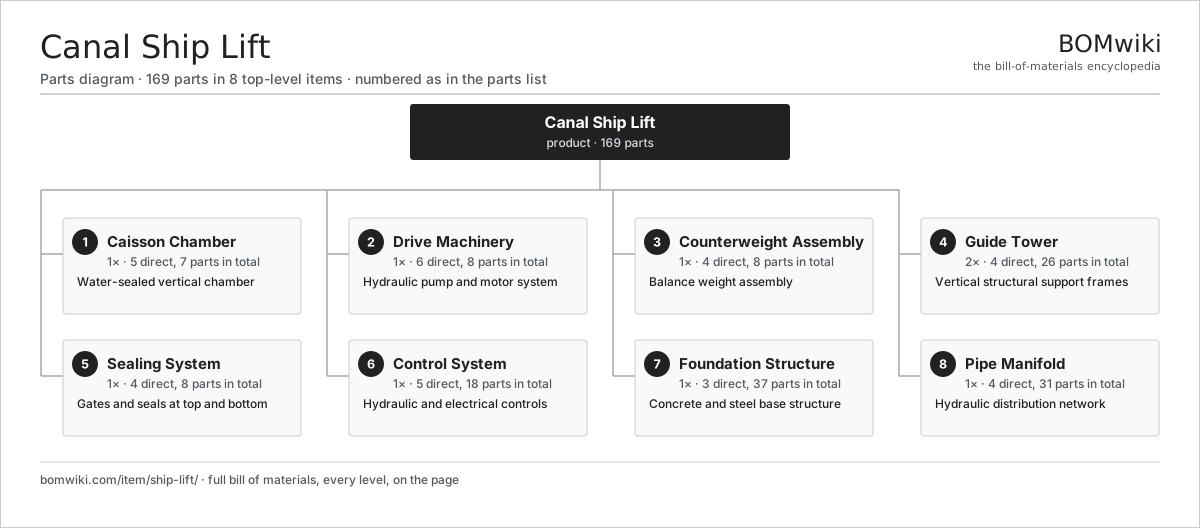
| # | Part | Qty | What it does |
|---|---|---|---|
| 1 | Caisson Chamber 5 parts | 1× | Water-sealed vertical chamber |
| 2 | Drive Machinery 6 parts | 1× | Hydraulic pump and motor system |
| 3 | Counterweight Assembly 4 parts | 1× | Balance weight assembly |
| 4 | Guide Tower 4 parts | 2× | Vertical structural support frames |
| 5 | Sealing System 4 parts | 1× | Gates and seals at top and bottom |
| 6 | Control System 5 parts | 1× | Hydraulic and electrical controls |
| 7 | Foundation Structure 3 parts | 1× | Concrete and steel base structure |
| 8 | Pipe Manifold 4 parts | 1× | Hydraulic distribution network |
3D model
No 3D model yet. Have a CAD file of this? Add a 3D model. STL renders right on this page; STEP, FreeCAD, and OpenSCAD sources are welcome too (openly licensed, like all 3D models on BOMwiki).
Build & assembly graph
expand / collapse · shared sub-assemblies converge · links to related products · est. labourTap an assembly to expand/collapse · tap a part to open it · use “Open page” for any node · drag to pan, scroll to zoom.
Bill of materials for Canal Ship Lift
8 top-level lines · 43 rows shown · 169 parts total · indented to 3 levels| # | Item / sub-assembly | Part no. | Qty/assy | Ext. qty | Parts | Type |
|---|---|---|---|---|---|---|
| 1 | Caisson Chamber 5 parts | ship-lift-caisson | 1× | 1 | 7 | assembly |
| 1.1 | Caisson Steel Walls | ship-lift-caisson-walls | 1× | 1 | · | part |
| 1.2 | Caisson Bottom Plate | ship-lift-caisson-bottom | 1× | 1 | · | part |
| 1.3 | Sheet Metal Panel | sheet-panel | 2× | 2 | · | part |
| 1.4 | Water Drain Valve | ship-lift-water-drain | 1× | 1 | · | part |
| 1.5 | Pressure Sensor | pressure-sensor | 2× | 2 | · | part |
| 2 | Drive Machinery 6 parts | ship-lift-drive-machinery | 1× | 1 | 8 | assembly |
| 2.1 | Hydraulic Pump | ship-lift-hydraulic-pump | 1× | 1 | · | part |
| 2.2 | Blower Motor | blower-motor | 1× | 1 | · | part |
| 2.3 | Hydraulic Motor | ship-lift-hydraulic-motor | 1× | 1 | · | part |
| 2.4 | Cable Pulley Sheave | ship-lift-cable-pulley | 2× | 2 | · | part |
| 2.5 | Wire Bundle | wire-bundle | 2× | 2 | · | part |
| 2.6 | Brake System | ship-lift-brake-system | 1× | 1 | · | part |
| 3 | Counterweight Assembly 4 parts | ship-lift-counterweight-system | 1× | 1 | 8 | assembly |
| 3.1 | Weight Frame | ship-lift-weight-frame | 1× | 1 | · | part |
| 3.2 | Counterweight Blocks | ship-lift-weight-blocks | 1× | 1 | · | part |
| 3.3 | Rope Attachment Point | ship-lift-rope-attachment | 2× | 2 | · | part |
| 3.4 | Fastener Set | fastener-set | 4× | 4 | · | part |
| 4 | Guide Tower 4 parts | ship-lift-guide-towers | 2× | 2 | 26 | assembly |
| 4.1 | Tower Leg Column | ship-lift-tower-legs | 4× | 8 | · | part |
| 4.2 | Tower Cross-Brace | ship-lift-tower-cross-bracing | 8× | 16 | · | part |
| 4.3 | Vertical Guide Rail | ship-lift-guide-rail | 2× | 4 | · | part |
| 4.4 | Ball Bearing | ball-bearing | 12× | 24 | · | part |
| 5 | Sealing System 4 parts | ship-lift-sealing-system | 1× | 1 | 8 | assembly |
| 5.1 | Top Gate | ship-lift-top-gate | 1× | 1 | · | part |
| 5.2 | Bottom Gate | ship-lift-bottom-gate | 1× | 1 | · | part |
| 5.3 | Seal Strip | ship-lift-seal-mechanism | 2× | 2 | · | part |
| 5.4 | O-Ring Set | oring-set | 4× | 4 | · | part |
| 6 | Control System 5 parts | ship-lift-control-system | 1× | 1 | 18 | assembly |
| 6.1 | PLC Control Cabinet | ship-lift-plc-cabinet | 1× | 1 | · | part |
| 6.2 | Solenoid Directional Valve | ship-lift-solenoid-valve | 3× | 3 | · | part |
| 6.3 | Relief Valve | ship-lift-relief-valve | 2× | 2 | · | part |
| 6.4 | Pressure Sensor | pressure-sensor | 4× | 4 | · | part |
| 6.5 | Connector | connector | 8× | 8 | · | part |
| 7 | Foundation Structure 3 parts | ship-lift-foundation | 1× | 1 | 37 | assembly |
| 7.1 | Concrete Foundation Pad | ship-lift-concrete-base | 1× | 1 | · | part |
| 7.2 | Anchor Bolt | ship-lift-anchor-bolts | 20× | 20 | · | part |
| 7.3 | Fastener Set | fastener-set | 16× | 16 | · | part |
| 8 | Pipe Manifold 4 parts | ship-lift-pipe-manifold | 1× | 1 | 31 | assembly |
| 8.1 | Main Hydraulic Pipe | ship-lift-main-pipe | 2× | 2 | · | part |
| 8.2 | Manifold Block | ship-lift-manifold-body | 1× | 1 | · | part |
| 8.3 | High-Pressure Hose | ship-lift-hose-assembly | 4× | 4 | · | part |
| 8.4 | Fastener Set | fastener-set | 24× | 24 | · | part |
Something wrong in this list? Report a problem with this BOM.
Related products
same domain, ranked by shared parts Car Elevator
279 parts · shares 3 with this page
Car Elevator
279 parts · shares 3 with this page
 Industrial Goods Lift
358 parts · shares 3 with this page
Industrial Goods Lift
358 parts · shares 3 with this page
 Wheelchair Platform Lift
89 parts · shares 2 with this page
Two-Post Car Parking Lift
108 parts · shares 2 with this page
Residential Stair Lift
143 parts · shares 1 with this page
Wheelchair Platform Lift
89 parts · shares 2 with this page
Two-Post Car Parking Lift
108 parts · shares 2 with this page
Residential Stair Lift
143 parts · shares 1 with this page
Sourcing: possible vendors
Browse the supplier directory → Prices, MOQ, and lead times are algorithmic estimates, not quotes, and not claims about these companies. Company mappings are curated by keyword; est. price band $10k–$200k. How estimates work| Vendor | HQ | Specialty | MOQ | Lead time |
|---|---|---|---|---|
|
🇺🇸Otis
otis.com ↗
|
Farmington, US | Elevators & escalators | 20 units | 14–24 wks |
| schindler.com ↗ | Ebikon, CH | Elevators & escalators | 20 units | 14–24 wks |
|
🇫🇮KONE
kone.com ↗
|
Espoo, FI | Elevators & escalators | 20 units | 14–24 wks |
| tkelevator.com ↗ | Düsseldorf, DE | Elevators | 20 units | 14–24 wks |
| mitsubishielectric.com ↗ | Tokyo, JP | Elevators & electronics | 20 units | 14–24 wks |
1,251-word article