Shiploader
ProductOverview
The shiploader is a specialized, high-capacity quayside machine designed to transfer bulk cargo (grain, coal, ore, fertilizer) directly from land storage into vessel holds at maximum speed. A typical shiploader handles 1000–4000 tonnes per hour, capable of loading a large bulk carrier (60,000+ deadweight tonnes) in 1–2 days of continuous operation. The machine combines mechanical conveying, hydraulic positioning, and electrical automation to deliver cargo into the ship's hold with precision control.
The shiploader's defining characteristic is its large cantilever boom extending 30–60 meters outward, topped with a telescopic chute that reaches deep into vessel holds. The boom rotates around a pedestal (slewing), tilts up and down (luffing), and carries a shuttle carriage that travels the full boom length, centering the spout over different parts of the hold. Combined with gantry wheels that roll along a fixed track on the quay, the machine can position itself alongside different vessels and adjust its reach.
How It Works
A shiploader operation begins with the vessel berthed at the quay and the shiploader positioned alongside the first cargo hold. Bulk material (grain, coal, etc.) is fed into the Conveyor Hopper from a land-side conveyor, truck dumping station, or storage silo via pneumatic or mechanical means.
The Conveyor Drive Motor (500–2000 kW) is started, driving the Conveyor Belt at a speed of 3–5 meters per second. Material is carried up the inclined conveyor and discharged into the Telescopic Chute at the boom tip. The operator, positioned in the Control Cabin, controls the machine via a wireless or hardwired pendant.
To position the chute over the correct location, the operator uses three independent control axes:
Slewing: The Slew Drive Motor drives the Slew Ring Bearing and pedestal, rotating the entire boom ±90 degrees or more, swinging it to align with different cargo holds or different vessels.
Luffing: The Luff Cylinders (dual 25–40cm bore cylinders) tilt the boom up or down through a ±15 degree range. The Luff Pump and Luff Control Valve modulate pressure to raise the spout for full holds or lower it for partial holds, adjusting the discharge angle and reach.
Shuttling: The Shuttle Drive Motor drives the Shuttle Carriage along the Boom Trolley Rails spanning the boom length (up to 60 meters). This moves the chute laterally, distributing material across the hold's width. The shuttle moves at 0.5–2 meters per minute, allowing precise load distribution.
The Telescopic Chute extends or retracts slightly to adjust the discharge point, and the Discharge Cap regulates flow velocity to prevent spillage and dust generation. Material falls into the vessel hold, and the operator monitors the discharge, adjusting positions as cargo piles up.
When one hold is full or the operator wants to move to a different location, the Gantry Drive System engages the Gantry Wheels rolling on fixed track rails bolted to the quay. The Gantry Drive Motor (500–1000 kW) slowly propels the entire shiploader along the track at 0.2–0.5 km/h, repositioning it to the next vessel or cargo hold. The Gantry Limit Switches detect end-of-travel to prevent overrun beyond the quay boundary.
Subsystems
Pedestal
The Pedestal is a massive vertical structural tower anchored to the quay concrete foundation. The Pedestal Columns (four corner box columns, 400mm x 400mm or larger) are braced by Pedestal Bracing diagonal and horizontal members providing torsional rigidity. The Slew Ring Bearing (2–3 meter diameter roller bearing) is mounted atop the pedestal, allowing the Slewing Platform to rotate freely.
Slewing Platform
The Slewing Platform is the rotating upper deck supporting the boom, shuttle drive, luff drive, and control systems. The Platform Deck is a large steel plate with integrated mounting bosses. The Slew Drive Motor (radial piston hydraulic or electric motor) drives a pinion gear that rolls around the slew ring, rotating the platform ±180 degrees or more. The Slew Brake (spring-applied hydraulic brake) holds the boom stationary during cargo loading. The Control Cabin is mounted on the platform, offering the operator a command post with pendant control of all functions and visual oversight of material flow.
Boom Structure
The Boom Structure is a large cantilever spanning 30–60 meters. The Boom Main Beam is a heavy-section steel I-beam or box girder with exceptional moment capacity to resist the conveyor and chute weight at full extension. The Boom Bracing provides triangulated lateral and vertical support, minimizing deflection and vibration. The Boom Trolley Rails are parallel steel rails mounted along the boom, guiding the Shuttle Carriage (shuttle) along the full boom length. The Cable Conduit System is a structural cable tray protecting electrical and control lines running the length of the boom.
Conveyor System
The Conveyor System is the primary cargo transport. The Conveyor Belt is a reinforced rubber belt (typically 0.8–1.5 meters wide) with sidewall edge guides preventing material spillage. Hundreds of Conveyor Idler Pulleys (10–20cm diameter steel rollers) support the belt across its length. The Conveyor Drive Motor (500–2000 kW electric motor) is positioned at one end, driving the pulley via a gearbox. Material enters through the Conveyor Hopper, a funnel-shaped steel funnel at the belt inlet. The Conveyor Frame is a welded steel truss supporting the entire conveyor assembly and mounted atop the boom.
Shuttle System
The Shuttle System enables lateral distribution of cargo across the hold. The Shuttle Carriage is suspended from the boom trolley rails via wheels. The Shuttle Drive Motor (hydraulic radial piston motor, 100–300 kW) drives the carriage via a Shuttle Gearbox that provides slow, powerful motion. The Shuttle Wheels are hard-steel wheels (8–12cm diameter) that roll on the boom rails with anti-climb design. The Shuttle Brake (spring-applied hydraulic brake) prevents drift during loading pauses.
Luffing System
The Luffing System adjusts boom elevation to accommodate different vessel hold geometries and cargo pile heights. Two large Luff Cylinders (25–40cm bore, double-acting) are mounted with bases on the pedestal and rods connected to the boom. The Luff Pump (dedicated hydraulic pump) and Luff Control Valve (proportional spool) allow the operator to tilt the boom through a ±15 degree range. The Luff Cylinder Mounts are welded pivot brackets with trunnion pins allowing smooth articulation.
Telescopic Chute
The Telescopic Chute is the final link in the cargo path. The Chute Outer Tube (30–45cm diameter steel or polyurethane-lined tube) is fixed to the boom tip. The Chute Inner Tube slides inside, allowing ~2–3 meters of extension to adjust discharge depth. The Expansion Joint is a flex connector allowing independent rotation. The Discharge Cap at the discharge end is a nozzle or restrictor controlling flow velocity and preventing spillage. The Chute Bracing consists of steel cables and struts supporting the chute weight and isolating vibration.
Gantry Drive
The Gantry Drive System system enables the entire shiploader to travel along the quay. Large hardened steel Gantry Wheels (1–1.5 meter diameter) roll on fixed track rails bolted to the quay surface. The Gantry Drive Motor (500–1000 kW electric motor) drives wheels via a Gantry Gearbox providing slow, powerful motion. The Gantry Brake holds the machine stationary during cargo operations. The Gantry Limit Switches (electrical switches mounted at each end of the track) detect approach to end-of-travel and trigger braking.
Electrical System
The Electrical System provides power and automation. The Main Switchboard is a large distribution panel with circuit breakers feeding motors and control systems. The Control Transformer steps down main voltage to 24 V DC for controls. The Soft Starter limits inrush current when large motors are started. The PLC Control Unit (programmable logic controller) automates the shiploader sequence: monitoring conveyor speed, managing start-stop sequences, controlling shuttle and luff proportional valves, and enforcing safety interlocks. The Instrumentation Package includes load cells measuring conveyor belt tension and chute load, pressure transducers on hydraulic circuits, temperature sensors on motors, and an inclinometer measuring boom angle. The Lighting System system includes high-intensity floodlights on the boom and pedestal illuminating the cargo hold and spout.
Performance and Operational Characteristics
Modern shiploaders are designed for throughput: 1000–4000 tonnes per hour depending on cargo type and machine size. Coal and grain load at the high end; heavier ores at the lower end due to higher material density. A typical operation loads a Panamax bulk carrier (65,000 tonnes) in 35–50 hours of continuous operation at ~1500 TPH.
Power consumption is high: conveyor motors alone consume 500–2000 kW; gantry and luffing add another 500–1000 kW intermittently. Total installed electrical capacity is typically 3–5 MW.
Environmental control is critical: modern shiploaders incorporate dust suppression systems (water spray at the spout), enclosed chutes, and ventilation management to meet port air-quality standards. Noise is also managed through vibration isolation, acoustic enclosure of the drive motor, and operational speed limits during night shifts in residential areas.
Maintenance involves bearing lubrication, belt tension checks, gearbox oil monitoring, and hydraulic seal inspections. Conveyor belts are routinely replaced after 2–3 years of operation. The slew ring bearing requires periodic greasing; gantry wheels are checked for wear and replaced as needed.
Safety systems include emergency stop buttons at multiple locations, operator dead-man pendant requiring continuous finger pressure, limit switches preventing overtravel, and wind-speed anemometers that shut down the machine if wind exceeds safe operational limits (typically 15–20 m/s). Load monitoring prevents overloading the vessel by tracking material volume discharged into each hold.
Shiploader parts and their functions
9 top-level parts · 73 parts in total · full bill of materials below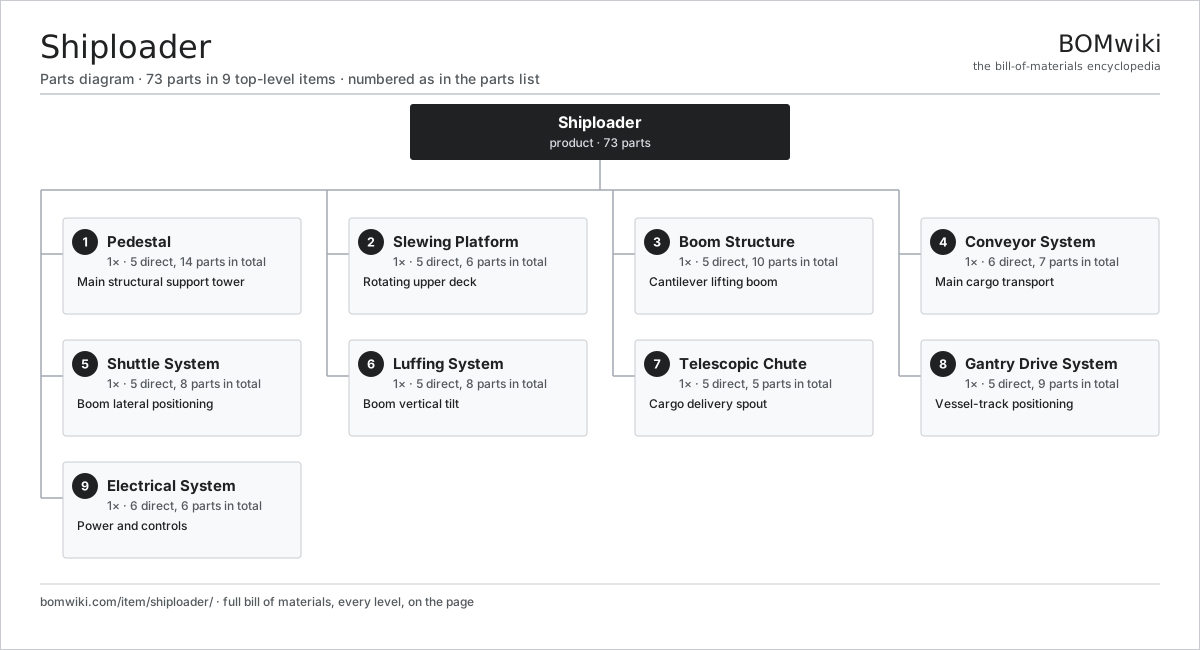
| # | Part | Qty | What it does |
|---|---|---|---|
| 1 | Pedestal 5 parts | 1× | Main structural support tower |
| 2 | Slewing Platform 5 parts | 1× | Rotating upper deck |
| 3 | Boom Structure 5 parts | 1× | Cantilever lifting boom |
| 4 | Conveyor System 6 parts | 1× | Main cargo transport |
| 5 | Shuttle System 5 parts | 1× | Boom lateral positioning |
| 6 | Luffing System 5 parts | 1× | Boom vertical tilt |
| 7 | Telescopic Chute 5 parts | 1× | Cargo delivery spout |
| 8 | Gantry Drive System 5 parts | 1× | Vessel-track positioning |
| 9 | Electrical System 6 parts | 1× | Power and controls |
3D model
No 3D model yet. Have a CAD file of this? Add a 3D model. STL renders right on this page; STEP, FreeCAD, and OpenSCAD sources are welcome too (openly licensed, like all 3D models on BOMwiki).
Build & assembly graph
expand / collapse · shared sub-assemblies converge · links to related products · est. labourTap an assembly to expand/collapse · tap a part to open it · use “Open page” for any node · drag to pan, scroll to zoom.
Bill of materials for Shiploader
9 top-level lines · 56 rows shown · 73 parts total · indented to 3 levels| # | Item / sub-assembly | Part no. | Qty/assy | Ext. qty | Parts | Type |
|---|---|---|---|---|---|---|
| 1 | Pedestal 5 parts | shiploader-pedestal | 1× | 1 | 14 | assembly |
| 1.1 | Pedestal Columns | shiploader-pedestal-columns | 4× | 4 | · | part |
| 1.2 | Pedestal Bracing | shiploader-pedestal-bracing | 3× | 3 | · | part |
| 1.3 | Foundation Base | shiploader-foundation-base | 1× | 1 | · | part |
| 1.4 | Slew Ring Bearing | shiploader-slew-ring-bearing | 1× | 1 | · | part |
| 1.5 | Fastener Set | fastener-set | 5× | 5 | · | part |
| 2 | Slewing Platform 5 parts | shiploader-slewing-platform | 1× | 1 | 6 | assembly |
| 2.1 | Platform Deck | shiploader-platform-deck | 1× | 1 | · | part |
| 2.2 | Slew Drive Motor | shiploader-slew-motor | 1× | 1 | · | part |
| 2.3 | Slew Brake | shiploader-slew-brake | 1× | 1 | · | part |
| 2.4 | Control Cabin | shiploader-control-cabin | 1× | 1 | · | part |
| 2.5 | Fastener Set | fastener-set | 2× | 2 | · | part |
| 3 | Boom Structure 5 parts | shiploader-boom-structure | 1× | 1 | 10 | assembly |
| 3.1 | Boom Main Beam | shiploader-boom-main-beam | 1× | 1 | · | part |
| 3.2 | Boom Bracing | shiploader-boom-bracing | 2× | 2 | · | part |
| 3.3 | Boom Trolley Rails | shiploader-boom-trolley-rails | 2× | 2 | · | part |
| 3.4 | Cable Conduit System | shiploader-boom-cable-routing | 1× | 1 | · | part |
| 3.5 | Fastener Set | fastener-set | 4× | 4 | · | part |
| 4 | Conveyor System 6 parts | shiploader-conveyor-system | 1× | 1 | 7 | assembly |
| 4.1 | Conveyor Belt | shiploader-conveyor-belt | 1× | 1 | · | part |
| 4.2 | Conveyor Drive Motor | shiploader-conveyor-drive-motor | 1× | 1 | · | part |
| 4.3 | Conveyor Idler Pulleys | shiploader-conveyor-idler-pulleys | 2× | 2 | · | part |
| 4.4 | Conveyor Hopper | shiploader-conveyor-hopper | 1× | 1 | · | part |
| 4.5 | Conveyor Fasteners | shiploader-conveyor-fasteners | 1× | 1 | · | part |
| 4.6 | Conveyor Frame | shiploader-conveyor-frame | 1× | 1 | · | part |
| 5 | Shuttle System 5 parts | shiploader-shuttle-system | 1× | 1 | 8 | assembly |
| 5.1 | Shuttle Carriage | shiploader-shuttle-carriage | 1× | 1 | · | part |
| 5.2 | Shuttle Drive Motor | shiploader-shuttle-motor | 1× | 1 | · | part |
| 5.3 | Shuttle Gearbox | shiploader-shuttle-gearbox | 1× | 1 | · | part |
| 5.4 | Shuttle Wheels | shiploader-shuttle-wheels | 4× | 4 | · | part |
| 5.5 | Shuttle Brake | shiploader-shuttle-brake | 1× | 1 | · | part |
| 6 | Luffing System 5 parts | shiploader-luffing-system | 1× | 1 | 8 | assembly |
| 6.1 | Luff Cylinders | shiploader-luff-cylinders | 2× | 2 | · | part |
| 6.2 | Luff Pump | shiploader-luff-pump | 1× | 1 | · | part |
| 6.3 | Luff Control Valve | shiploader-luff-control-valve | 1× | 1 | · | part |
| 6.4 | Luff Cylinder Mounts | shiploader-luff-cylinder-mounts | 2× | 2 | · | part |
| 6.5 | O-Ring Set | oring-set | 2× | 2 | · | part |
| 7 | Telescopic Chute 5 parts | shiploader-telescopic-chute | 1× | 1 | 5 | assembly |
| 7.1 | Chute Outer Tube | shiploader-chute-outer-tube | 1× | 1 | · | part |
| 7.2 | Chute Inner Tube | shiploader-chute-inner-tube | 1× | 1 | · | part |
| 7.3 | Expansion Joint | shiploader-chute-expansion-joint | 1× | 1 | · | part |
| 7.4 | Discharge Cap | shiploader-chute-cap | 1× | 1 | · | part |
| 7.5 | Chute Bracing | shiploader-chute-bracing | 1× | 1 | · | part |
| 8 | Gantry Drive System 5 parts | shiploader-gantry-drive | 1× | 1 | 9 | assembly |
| 8.1 | Gantry Drive Motor | shiploader-gantry-motor | 1× | 1 | · | part |
| 8.2 | Gantry Gearbox | shiploader-gantry-gearbox | 1× | 1 | · | part |
| 8.3 | Gantry Wheels | shiploader-gantry-wheels | 4× | 4 | · | part |
| 8.4 | Gantry Brake | shiploader-gantry-brake | 1× | 1 | · | part |
| 8.5 | Gantry Limit Switches | shiploader-gantry-limit-switches | 2× | 2 | · | part |
| 9 | Electrical System 6 parts | shiploader-electrical-system | 1× | 1 | 6 | assembly |
| 9.1 | Main Switchboard | shiploader-main-switchboard | 1× | 1 | · | part |
| 9.2 | Control Transformer | shiploader-control-transformer | 1× | 1 | · | part |
| 9.3 | Soft Starter | shiploader-soft-starter | 1× | 1 | · | part |
| 9.4 | PLC Control Unit | shiploader-plc-unit | 1× | 1 | · | part |
| 9.5 | Instrumentation Package | shiploader-instrumentation | 1× | 1 | · | part |
| 9.6 | Lighting System | shiploader-lighting | 1× | 1 | · | part |
Something wrong in this list? Report a problem with this BOM.
Related products
same domain, ranked by shared parts Articulated Forklift
2,417 parts · shares 1 with this page
Automated Mooring System
81 parts · shares 1 with this page
Articulated Forklift
2,417 parts · shares 1 with this page
Automated Mooring System
81 parts · shares 1 with this page
 Bag Dump Station
134 parts · shares 1 with this page
Bag Dump Station
134 parts · shares 1 with this page
 Bale Grab Handler
75 parts · shares 1 with this page
Bulk Bag Discharger
178 parts · shares 1 with this page
Coal Yard Stacker
571 parts · shares 1 with this page
Bale Grab Handler
75 parts · shares 1 with this page
Bulk Bag Discharger
178 parts · shares 1 with this page
Coal Yard Stacker
571 parts · shares 1 with this page
Sourcing: possible vendors
Browse the supplier directory → Prices, MOQ, and lead times are algorithmic estimates, not quotes, and not claims about these companies. Company mappings are curated by keyword; est. price band $2k–$300k. How estimates work| Vendor | HQ | Specialty | MOQ | Lead time |
|---|---|---|---|---|
| toyota-industries.com ↗ | Kariya, JP | Forklifts & logistics | 20 units | 10–16 wks |
| kiongroup.com ↗ | Frankfurt, DE | Forklifts (Linde, STILL) | 20 units | 10–16 wks |
| jungheinrich.com ↗ | Hamburg, DE | Warehouse trucks | 20 units | 10–16 wks |
| crown.com ↗ | New Bremen, US | Forklifts | 20 units | 10–16 wks |
|
🇨🇳Hangcha
hcforklift.com ↗
|
Hangzhou, CN | Forklifts & material handling | 20 units | 10–16 wks |
1,647-word article