Singeing Machine
ProductOverview
A singeing machine burns off surface fuzz from fabric using controlled flame or hot surfaces, improving fabric appearance, printability, and dyeability. Singeing is a critical pre-processing step in textile finishing, especially for cotton and cotton blends. Fuzz-free fabric accepts inks and dyes more uniformly, enabling sharper prints and deeper colors. The process is fast (100–300 m/minute) and energy-efficient compared to older methods like acid or enzyme treatments.
Singeing is so fundamental to textile quality that most commercial fabric production includes this step. Mills integrate singeingmachines into finishing lines immediately after desizing or scouring and before dyeing.
How It Works
Raw fabric from the unwind roll advances under controlled tension through a flame zone. The burner system produces a controllable flame (800–1200°C) that momentarily contacts the fabric surface. The flame burns off protruding fibers (fuzz) without significantly damaging the underlying yarn structure. Fabric temperature rises to 200–500°C during singeing, hot enough to singe fiber but not hot enough to scorch (which would cause color change and strength loss).
The singeing process takes milliseconds. As fabric exits the flame, a quenching system cools it rapidly using water spray, halting the burning and stabilizing the fabric. A brush roller then removes any charred fiber residue (singeing dust), which is collected by a dust hood.
The finished, fuzz-free fabric is rewound onto the output roll and ready for the next process step (dyeing, printing, or finishing).
Burner System Design
The burner system typically has two identical burner heads, one above and one below the fabric. This dual-burner design ensures complete fuzz removal on both surfaces simultaneously. Each burner mixes fuel gas (propane or natural gas) with regulated air to produce a stable, blue flame. Excess fuel produces a sooty, orange flame that chars rather than singeing; insufficient fuel produces weak combustion with incomplete fuzz removal.
The flame control solenoid adjusts fuel flow, allowing intensity modulation. The infrared sensor monitors flame zone temperature and feeds back to a PLC, which adjusts fuel to maintain setpoint. Faster fabric speeds require hotter flames; slower speeds may use lower heat.
Some machines use a hot ceramic plate instead of open flame, relying on radiant heat. Plate singeing is safer and produces more uniform results but is slower and less flexible than flame singeing.
Quenching and Cooling
The quenching zone sprays water onto the hot fabric immediately after the burner, cooling it to safe handling temperature (40–60°C) within seconds. Water circulation is continuous, with a pump recirculating cooled water from the tank. High-speed machines require significant water flow (50–200 liters/minute) to prevent fabric overheating between quench nozzles and brush roller.
Inadequate quenching causes fabric distortion, yellowing, or premature dyeing (fabric is still hot and reactive with dyes in air). Excessive water causes moisture absorption and may cause yarn swelling on sensitive fibers.
Brush Roller and Dust Removal
The brush roller is a steel drum 200–400 mm diameter with hundreds of fine wire bristles embedded in the surface. It rotates at 500–1500 rpm opposite to fabric motion. As fabric passes over the roller, bristles gently brush away charred fiber dust. A dust hood with a small fan captures dust for disposal (often a baghouse or cyclone separator).
Brush pressure is critical: too light and dust remains; too heavy and bristles can damage the fabric or create pilling. Pressure is set via a pneumatic or spring-loaded system and is adjustable per fabric type.
Fabric Types and Singeing Effect
Different fibers singe differently:
- Cotton: Singeing removes surface fuzz and strengthens the fabric by removing weak fiber ends. Cotton becomes glossy and prints crisply.
- Polyester: Polyester fuzz doesn't burn as readily as cotton. Singeing with intense heat can melt fibers slightly, creating a smooth feel.
- Wool: Wool singeing must be carefully controlled to avoid damaging the fiber; typically done at lower temperatures.
- Blends: Blended fabrics singe differently depending on fiber ratio; machine settings must be optimized per blend.
Oversingeing causes color change (yellowing or browning), loss of strength, and pilling. Undersingeing leaves fuzz and defeats the purpose. Achieving the right balance requires skilled operator control and quality control testing (visual inspection, handle testing, absorbency testing).
Production Control
The main motor (3–7.5 kW) drives fabric advance at speeds typically 100–250 m/minute. A variable frequency drive allows speed adjustment without changing burner settings. Faster speeds mean fabric spends less time in the flame, requiring hotter flame; slower speeds allow cooler, more uniform singeing.
Operators adjust:
- Fabric speed (m/minute)
- Flame temperature (via fuel solenoid %)
- Brush roller speed
- Quench water flow
On automatic machines, sensors detect fabric thickness and adjust flame and quench accordingly. Thick fabrics need hotter flames; lightweight fabrics need gentler treatment.
Safety and Environmental Considerations
Singeing machines operate in an open flame environment with hot surfaces. Modern machines include:
- Emergency stop button cutting all power and closing fuel solenoid instantly.
- Flame monitor detecting flame stability and shutting down if flame extinguishes.
- Temperature limit switch cutting fuel if zone exceeds safe threshold.
Emissions include water vapor, CO₂, and small amounts of unburned hydrocarbons. Modern installations vent exhaust outside or use afterburners to oxidize unburned compounds.
Variants
- Box singeing: Fabric passes through an enclosed box with gas burners on all sides, producing very uniform singeing.
- Plate singeing: Hot ceramic or metal plates replace open flame; safer and slower but precise.
- Continuous flameless singeing: Using infrared elements or high-intensity halogen lamps instead of open flame (less common, higher cost).
- Spot singeing: Selective singeing only regions of fabric (e.g., before printing).
Most mills use open-flame direct singeing for speed and flexibility. Box and infrared singeing are used for sensitive fibers or when emissions must be minimized.
Singeing Machine parts and their functions
8 top-level parts · 52 parts in total · full bill of materials below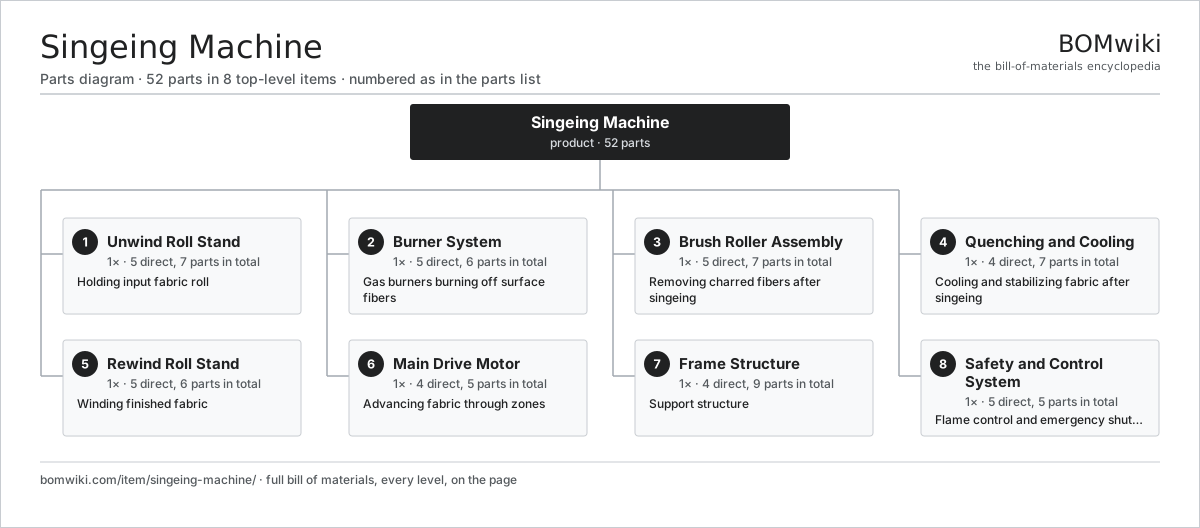
| # | Part | Qty | What it does |
|---|---|---|---|
| 1 | Unwind Roll Stand 5 parts | 1× | Holding input fabric roll |
| 2 | Burner System 5 parts | 1× | Gas burners burning off surface fibers |
| 3 | Brush Roller Assembly 5 parts | 1× | Removing charred fibers after singeing |
| 4 | Quenching and Cooling 4 parts | 1× | Cooling and stabilizing fabric after singeing |
| 5 | Rewind Roll Stand 5 parts | 1× | Winding finished fabric |
| 6 | Main Drive Motor 4 parts | 1× | Advancing fabric through zones |
| 7 | Frame Structure 4 parts | 1× | Support structure |
| 8 | Safety and Control System 5 parts | 1× | Flame control and emergency shutdown |
3D model
No 3D model yet. Have a CAD file of this? Add a 3D model. STL renders right on this page; STEP, FreeCAD, and OpenSCAD sources are welcome too (openly licensed, like all 3D models on BOMwiki).
Build & assembly graph
expand / collapse · shared sub-assemblies converge · links to related products · est. labourTap an assembly to expand/collapse · tap a part to open it · use “Open page” for any node · drag to pan, scroll to zoom.
Bill of materials for Singeing Machine
8 top-level lines · 45 rows shown · 52 parts total · indented to 3 levels| # | Item / sub-assembly | Part no. | Qty/assy | Ext. qty | Parts | Type |
|---|---|---|---|---|---|---|
| 1 | Unwind Roll Stand 5 parts | singeing-machine-unwind-stand | 1× | 1 | 7 | assembly |
| 1.1 | Unwind Roll Shaft | singeing-machine-roll-shaft | 1× | 1 | · | part |
| 1.2 | Bearing Block | singeing-machine-shaft-bearing-block | 2× | 2 | · | part |
| 1.3 | Friction Brake | singeing-machine-tension-brake | 1× | 1 | · | part |
| 1.4 | Dancer Arm | singeing-machine-dancer-arm | 1× | 1 | · | part |
| 1.5 | Ball Bearing | ball-bearing | 2× | 2 | · | part |
| 2 | Burner System 5 parts | singeing-machine-burner-zone | 1× | 1 | 6 | assembly |
| 2.1 | Burner Head | singeing-machine-burner-head | 2× | 2 | · | part |
| 2.2 | Gas Supply Manifold | singeing-machine-gas-inlet | 1× | 1 | · | part |
| 2.3 | Air Supply Manifold | singeing-machine-air-inlet | 1× | 1 | · | part |
| 2.4 | Flame Control Solenoid | singeing-machine-flame-control-valve | 1× | 1 | · | part |
| 2.5 | Temperature Sensor | singeing-machine-temperature-sensor | 1× | 1 | · | part |
| 3 | Brush Roller Assembly 5 parts | singeing-machine-brush-roller | 1× | 1 | 7 | assembly |
| 3.1 | Brush Roller Drum | singeing-machine-brush-roller-drum | 1× | 1 | · | part |
| 3.2 | Brush Drive Motor | singeing-machine-brush-motor | 1× | 1 | · | part |
| 3.3 | Brush Roller Bearings | singeing-machine-brush-roller-bearings | 2× | 2 | · | part |
| 3.4 | Dust Collection Hood | singeing-machine-dust-collection-hood | 1× | 1 | · | part |
| 3.5 | Ball Bearing | ball-bearing | 2× | 2 | · | part |
| 4 | Quenching and Cooling 4 parts | singeing-machine-quench-zone | 1× | 1 | 7 | assembly |
| 4.1 | Water Spray Nozzle | singeing-machine-water-spray-nozzle | 4× | 4 | · | part |
| 4.2 | Water Circulation Pump | singeing-machine-water-pump | 1× | 1 | · | part |
| 4.3 | Water Tank | singeing-machine-water-tank | 1× | 1 | · | part |
| 4.4 | Quench Roller | singeing-machine-quench-roller | 1× | 1 | · | part |
| 5 | Rewind Roll Stand 5 parts | singeing-machine-rewind-stand | 1× | 1 | 6 | assembly |
| 5.1 | Rewind Drive Motor | singeing-machine-rewind-motor | 1× | 1 | · | part |
| 5.2 | Rewind Shaft | singeing-machine-rewind-shaft | 1× | 1 | · | part |
| 5.3 | Rewind Nip Roller | singeing-machine-rewind-nip-roller | 1× | 1 | · | part |
| 5.4 | Rewind Tension Arm | singeing-machine-rewind-tension-control | 1× | 1 | · | part |
| 5.5 | Ball Bearing | ball-bearing | 2× | 2 | · | part |
| 6 | Main Drive Motor 4 parts | singeing-machine-drive-motor | 1× | 1 | 5 | assembly |
| 6.1 | Main Motor | singeing-machine-main-motor | 1× | 1 | · | part |
| 6.2 | Variable Frequency Drive | singeing-machine-speed-control-vfd | 1× | 1 | · | part |
| 6.3 | Drive Belt | singeing-machine-transmission-belt | 1× | 1 | · | part |
| 6.4 | Relay | relay | 2× | 2 | · | part |
| 7 | Frame Structure 4 parts | singeing-machine-frame | 1× | 1 | 9 | assembly |
| 7.1 | Main Frame | singeing-machine-main-frame | 1× | 1 | · | part |
| 7.2 | Heat Shield | singeing-machine-heat-shield | 4× | 4 | · | part |
| 7.3 | Sheet Metal Panel | sheet-panel | 3× | 3 | · | part |
| 7.4 | Fastener Set | fastener-set | 1× | 1 | · | part |
| 8 | Safety and Control System 5 parts | singeing-machine-safety-system | 1× | 1 | 5 | assembly |
| 8.1 | Emergency Stop Button | singeing-machine-emergency-stop-button | 1× | 1 | · | part |
| 8.2 | Flame Monitor | singeing-machine-flame-monitor | 1× | 1 | · | part |
| 8.3 | Temperature Limit Switch | singeing-machine-temperature-limit-switch | 1× | 1 | · | part |
| 8.4 | Control PLC | singeing-machine-control-plc | 1× | 1 | · | part |
| 8.5 | Alarm Buzzer | alarm-buzzer | 1× | 1 | · | part |
Something wrong in this list? Report a problem with this BOM.
Related products
same domain, ranked by shared parts Automatic Fabric Cutting Machine
1,695 parts · shares 1 with this page
Automatic Winding Machine
288 parts · shares 1 with this page
Automatic Fabric Cutting Machine
1,695 parts · shares 1 with this page
Automatic Winding Machine
288 parts · shares 1 with this page
 Chainstitch Machine
82 parts · shares 1 with this page
Computerized Flat Knitting Machine
6,577 parts · shares 1 with this page
Cotton Blowroom Line
258 parts · shares 1 with this page
Chainstitch Machine
82 parts · shares 1 with this page
Computerized Flat Knitting Machine
6,577 parts · shares 1 with this page
Cotton Blowroom Line
258 parts · shares 1 with this page
Sourcing: possible vendors
Browse the supplier directory → Prices, MOQ, and lead times are algorithmic estimates, not quotes, and not claims about these companies. Company mappings are curated by keyword; est. price band $10k–$1M. How estimates work| Vendor | HQ | Specialty | MOQ | Lead time |
|---|---|---|---|---|
|
🇨🇭Rieter
rieter.com ↗
|
Winterthur, CH | Spinning machinery | 10 units | 14–24 wks |
| truetzschler.com ↗ | Mönchengladbach, DE | Textile machinery | 10 units | 14–24 wks |
|
🇧🇪Picanol
picanol.be ↗
|
Ypres, BE | Weaving machines | 10 units | 14–24 wks |
| karlmayer.com ↗ | Obertshausen, DE | Warp knitting machines | 10 units | 14–24 wks |
|
🇨🇭Saurer
saurer.com ↗
|
Arbon, CH | Spinning & embroidery | 10 units | 14–24 wks |
1,042-word article