Skeleton Clock
ProductOverview
A skeleton clock is a mechanical clock with nothing hidden: the solid plates of an ordinary movement are replaced by fretted brass frames, the dial is reduced to an open ring, and the whole machine stands under glass so the gear train, escapement, and mainspring drive can be watched running. The form flourished in France and England between about 1820 and 1870, when makers competed on how much metal they could saw away while keeping the Frame Plates rigid enough to hold pivot depths to a few hundredths of a millimetre.
Structurally the clock is two pierced plates, the Front Plate and Back Plate, spaced by turned Frame Pillars and bolted to a Plinth. The Glass Dome over everything is not decoration: an open movement collects dust in its oil within months without it.
Power and the fusee
The most distinctive mechanical feature of a good English skeleton clock is the Fusee Drive. A plain mainspring delivers strong torque freshly wound and weak torque run down, which shifts the rate of a pendulum clock through the week. The fusee fixes this. The Spring Barrel connects to the cone-shaped Fusee Cone by the Fusee Chain, a miniature riveted chain wound in a spiral groove. When the spring is fully wound and strongest, the chain pulls at the narrow top of the cone on a short lever arm; as the spring weakens over eight days the chain works down to the wide base and the lever arm grows. Torque at the great wheel stays nearly constant from one winding to the next.
Two details make the system practical. The Setup Ratchet lets the spring be set up with one or two turns of pre-tension so the chain never goes slack, and Maintaining Power keeps a small spring driving the train during winding, when pulling chain back onto the fusee would otherwise reverse the power and stop the clock.
Train and escapement
From the fusee the Going Train steps up through the Center Wheel (one turn per hour), the Third Wheel, and the Fourth Wheel to the escapement. Because the wheels are exhibited rather than hidden, they are crossed out with five or six polished spokes and the brass is lacquered against tarnish; the workmanship of the crossings is one of the main quality tells when judging these clocks.
The Escapement is normally a Graham deadbeat, a step up from the recoil anchor of common house clocks. The locking faces of the Deadbeat Anchor are arcs centered on the anchor's own pivot, so when a tooth of the Escape Wheel lands it stands dead still instead of being pushed backwards. Eliminating recoil removes a variable interference with the pendulum and is worth a several-fold improvement in rate stability. Impulse passes to the pendulum through the Crutch, and the Beat Adjuster lets the restorer set the escapement in beat so the intervals between tick and tock are equal, an out-of-beat clock at low amplitude will stop.
The Pendulum hangs on a flat Suspension Spring spring behind the back plate. With a Pendulum Rod of about 250 mm it beats half-seconds, and rate is set by the Rating Nut under the Pendulum Bob; one turn is worth roughly 15–30 seconds a day at this length. A clean, well-adjusted example holds about half a minute a week.
Dial work and display
Time is read from the Chapter Ring, a silvered ring sawn open between the numerals so the train shows through it. The Motion Work sits exposed on the front plate, performing the usual 12:1 reduction from the Minute Hand to the Hour Hand; on a cased clock these wheels hide behind the dial, but here they are finished to the same standard as the train. Hands are traditionally heat-blued steel, the blue oxide both protecting the steel and giving legibility against polished brass.
Practical notes
Skeleton clocks are wound weekly through the Winding Square with a key, holding the dome rather than tilting the clock. Setup matters more than for a cased clock: the Base Feet must put the plinth dead level or the pendulum swings out of beat, and the dome must be reseated promptly because exposed pivot oil gathers grit. Servicing follows ordinary clock practice, strip, clean, peg out pivot holes, re-oil, but the chain deserves attention, since a worn fusee chain carries the full mainspring pull of several kilograms and a snapped chain can wreck the train. Reproduction skeleton movements are still made, generally with a plain going barrel in place of the fusee, which simplifies the drive at the cost of the constant-torque behaviour that defined the originals.
Skeleton Clock parts and their functions
7 top-level parts · 35 parts in total · full bill of materials below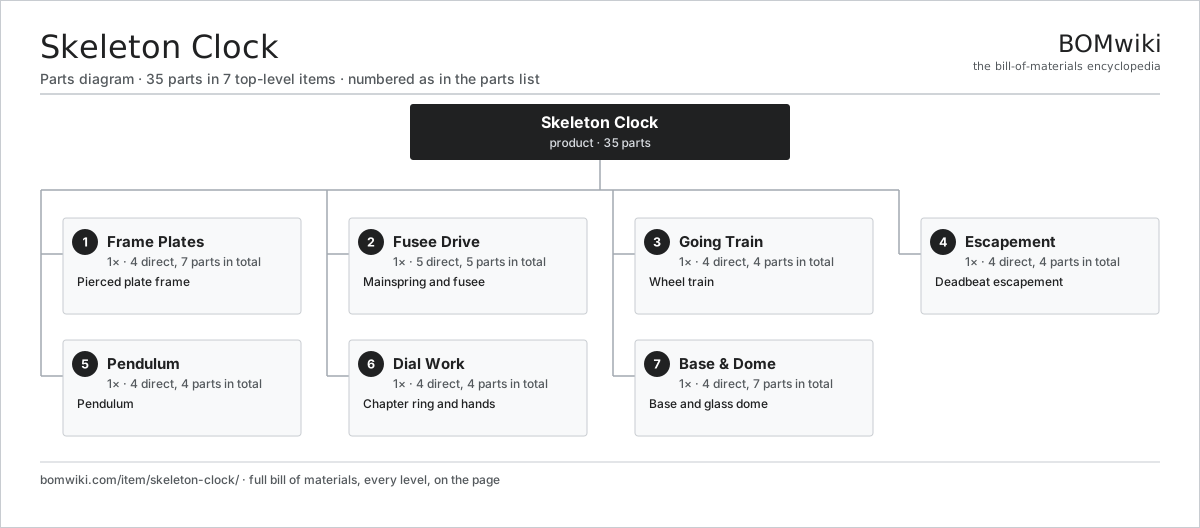
| # | Part | Qty | What it does |
|---|---|---|---|
| 1 | Frame Plates 4 parts | 1× | Pierced plate frame |
| 2 | Fusee Drive 5 parts | 1× | Mainspring and fusee |
| 3 | Going Train 4 parts | 1× | Wheel train |
| 4 | Escapement 4 parts | 1× | Deadbeat escapement |
| 5 | Pendulum 4 parts | 1× | Pendulum |
| 6 | Dial Work 4 parts | 1× | Chapter ring and hands |
| 7 | Base & Dome 4 parts | 1× | Base and glass dome |
3D model
No 3D model yet. Have a CAD file of this? Add a 3D model. STL renders right on this page; STEP, FreeCAD, and OpenSCAD sources are welcome too (openly licensed, like all 3D models on BOMwiki).
Build & assembly graph
expand / collapse · shared sub-assemblies converge · links to related products · est. labourTap an assembly to expand/collapse · tap a part to open it · use “Open page” for any node · drag to pan, scroll to zoom.
Bill of materials for Skeleton Clock
7 top-level lines · 36 rows shown · 35 parts total · indented to 3 levels| # | Item / sub-assembly | Part no. | Qty/assy | Ext. qty | Parts | Type |
|---|---|---|---|---|---|---|
| 1 | Frame Plates 4 parts | skeleton-clock-frame | 1× | 1 | 7 | assembly |
| 1.1 | Front Plate | skeleton-clock-front-plate | 1× | 1 | · | part |
| 1.2 | Back Plate | skeleton-clock-back-plate | 1× | 1 | · | part |
| 1.3 | Frame Pillars | skeleton-clock-pillars | 4× | 4 | · | part |
| 1.4 | Fastener Set | fastener-set | 1× | 1 | · | part |
| 2 | Fusee Drive 5 parts | skeleton-clock-fusee-drive | 1× | 1 | 5 | assembly |
| 2.1 | Spring Barrel | skeleton-clock-spring-barrel | 1× | 1 | · | part |
| 2.2 | Fusee Cone | skeleton-clock-fusee-cone | 1× | 1 | · | part |
| 2.3 | Fusee Chain | skeleton-clock-fusee-chain | 1× | 1 | · | part |
| 2.4 | Setup Ratchet | skeleton-clock-ratchet-click | 1× | 1 | · | part |
| 2.5 | Winding Square | skeleton-clock-winding-square | 1× | 1 | · | part |
| 3 | Going Train 4 parts | skeleton-clock-going-train | 1× | 1 | 4 | assembly |
| 3.1 | Center Wheel | skeleton-clock-center-wheel | 1× | 1 | · | part |
| 3.2 | Third Wheel | skeleton-clock-third-wheel | 1× | 1 | · | part |
| 3.3 | Fourth Wheel | skeleton-clock-fourth-wheel | 1× | 1 | · | part |
| 3.4 | Maintaining Power | skeleton-clock-maintaining-power | 1× | 1 | · | part |
| 4 | Escapement 4 parts | skeleton-clock-escapement | 1× | 1 | 4 | assembly |
| 4.1 | Escape Wheel | skeleton-clock-escape-wheel | 1× | 1 | · | part |
| 4.2 | Deadbeat Anchor | skeleton-clock-deadbeat-anchor | 1× | 1 | · | part |
| 4.3 | Crutch | skeleton-clock-crutch | 1× | 1 | · | part |
| 4.4 | Beat Adjuster | skeleton-clock-beat-adjuster | 1× | 1 | · | part |
| 5 | Pendulum 4 parts | skeleton-clock-pendulum | 1× | 1 | 4 | assembly |
| 5.1 | Pendulum Rod | skeleton-clock-pendulum-rod | 1× | 1 | · | part |
| 5.2 | Pendulum Bob | skeleton-clock-pendulum-bob | 1× | 1 | · | part |
| 5.3 | Rating Nut | skeleton-clock-rating-nut | 1× | 1 | · | part |
| 5.4 | Suspension Spring | skeleton-clock-suspension | 1× | 1 | · | part |
| 6 | Dial Work 4 parts | skeleton-clock-dial-work | 1× | 1 | 4 | assembly |
| 6.1 | Chapter Ring | skeleton-clock-chapter-ring | 1× | 1 | · | part |
| 6.2 | Hour Hand | skeleton-clock-hour-hand | 1× | 1 | · | part |
| 6.3 | Minute Hand | skeleton-clock-minute-hand | 1× | 1 | · | part |
| 6.4 | Motion Work | skeleton-clock-motion-work | 1× | 1 | · | part |
| 7 | Base & Dome 4 parts | skeleton-clock-base-dome | 1× | 1 | 7 | assembly |
| 7.1 | Glass Dome | skeleton-clock-glass-dome | 1× | 1 | · | part |
| 7.2 | Plinth | skeleton-clock-plinth | 1× | 1 | · | part |
| 7.3 | Base Feet | skeleton-clock-base-feet | 4× | 4 | · | part |
| 7.4 | Fastener Set | fastener-set | 1× | 1 | · | part |
Something wrong in this list? Report a problem with this BOM.
Sourcing: possible vendors
Browse the supplier directory → Prices, MOQ, and lead times are algorithmic estimates, not quotes, and not claims about these companies. Company mappings are curated by keyword; est. price band $20–$50k. How estimates work| Vendor | HQ | Specialty | MOQ | Lead time |
|---|---|---|---|---|
|
🇯🇵Seiko
seikowatches.com ↗
|
Tokyo, JP | Watches | 500 units | 8–14 wks |
|
🇯🇵Citizen
citizenwatch-global.com ↗
|
Tokyo, JP | Watches | 500 units | 8–14 wks |
|
🇯🇵Casio
casio.com ↗
|
Tokyo, JP | Watches & electronics | 500 units | 8–14 wks |
| swatchgroup.com ↗ | Biel, CH | Watches (Omega, Tissot) | 500 units | 8–14 wks |
| titancompany.in ↗ | Bengaluru, IN | Watches & timepieces | 500 units | 8–14 wks |
842-word article