Ski Binding
ProductOverview
A ski binding is a mechanical interface that connects a ski boot to a ski, performing two critical functions: transmitting control inputs (force, weight, and movement) from the skier to the ski, and releasing the boot from the ski during a fall to prevent injury. The binding must be rigid enough to communicate precise edge control yet compliant enough to absorb vibration, and it must release laterally (when the boot twists) and vertically (when the boot catches during a tumble) within a precisely calibrated force range.
The modern alpine binding emerged in the 1970s and evolved through the 1980s and 1990s as international safety standards (ISO 11088) were established. Today's bindings are engineered to exacting specifications, with release forces adjusted by rider weight and ability level using a dial marked with DIN units (Deutsche Industrie Norm). A binding that releases too easily puts the skier at risk of losing a ski mid-run; one that releases too late can cause injuries like ACL tears, tibia fractures, or knee torsion.
How it works
The Toe Piece grips the toe of the boot via movable jaws, held in place by the Toe Spring. The Heel Piece presses downward on the boot heel via a heelplate, held in place by the Heel Spring. The Base Plate ties these components together and is bonded to the ski.
During normal skiing, the boot is locked into the binding. The skier's weight and movements are transmitted directly to the ski. The AFD Plate (anti-friction device) reduces friction between boot and binding, allowing smooth forward-backward motion as the skier flexes the ankle.
When the skier falls and twists the boot laterally (rotating the foot inward or outward), the toe jaws release first, rotating about their pivot point. The released toe allows the boot to swing outward, breaking the torsional load. Simultaneously, or immediately after, the heel mechanism releases: as the toe comes free, the Heel Lifter rises, rotating the heelplate upward and freeing the heel to rotate backward and away from the ski. This two-stage release (toe first, then heel) prevents lower-leg torsional injuries.
In a backward fall, the forward pressure on the boot heel during the tumble can cause the heelplate to lift directly, releasing the heel. The Brake Assembly prevents the ski from sliding away uncontrolled; as the boot disengages, the brake arms swing down, the Brake Arms dig into the snow, and friction brings the ski to a stop.
DIN settings and release force
The DIN Adjuster calibrates the release force based on the DIN scale, which ranges from 3 (lightest, for very light or young skiers) to 18 (heaviest, for large or aggressive skiers). The DIN value is proportional to the force required to release the binding. A lighter skier (below 50 kg) might use DIN 3–5; a typical adult (70–90 kg) might use DIN 8–10; a heavy or aggressive skier (over 100 kg) might use DIN 12–14.
The release force is set by tightening or loosening calibrated springs within the Spring Assembly. The Main Spring provides lateral release force; the Retention Spring provides vertical or forward-backward force. These springs interact with the boot geometry and the mechanical advantage of the jaws and heelplate, producing the final release force in Newtons.
Proper DIN setting is critical for safety. A setting too loose may cause the binding to release during hard carving or mogul skiing, putting the skier at risk of a runaway ski. A setting too stiff may prevent release during a fall, resulting in the skier being twisted or thrown while still connected to the ski. Standard practice is to have a binding technician measure the skier's height, weight, and ability level, then set the DIN to the manufacturer's recommended value from a lookup table.
Materials and construction
The Base Plate is typically machined from 6061-T6 or 7075-T73 aluminum alloy, chosen for stiffness-to-weight ratio and corrosion resistance. The baseplate is anodized or powder-coated to further protect against moisture and oxidation. Some racing bindings use steel baseplates for increased rigidity, accepting the weight penalty.
The Toe Jaws are hardened aluminum or steel, shaped to grip the toe of a standard ISO 5355 alpine boot. The jaws include a notch or recess that engages a corresponding bump on the boot, preventing unwanted lateral or vertical play. The Heel Piece is similarly shaped to mate with the boot heel.
The Spring Assembly consists of stainless steel coil springs or leaf springs. Coil springs are common in entry-level bindings for simplicity and cost; leaf springs and complex spring geometries are found in advanced bindings seeking to optimize release force over a wider range of boot rotation speeds (slow falls vs. rapid impacts).
The Brake Assembly is typically a dual-arm design, with two metal arms hinged at a central pivot. When the boot releases, the arms spring outward, the Brake Arms sweep down and dig into the snow surface. The brake arms are shaped with serrated or jagged edges to maximize friction. A typical brake width is 50–80 mm for narrow skis, up to 130 mm for wide powder skis.
The AFD Plate is a thin sheet of low-friction material, typically PTFE (Teflon) or ultra-high-molecular-weight polyethylene (UHMWPE), bonded to the baseplate. The AFD reduces the coefficient of friction between boot and binding to 0.05–0.10, much lower than the unlubricated metal-on-boot interface (0.4–0.6), allowing smooth sliding during forward-backward flex movements.
The Mounting Plate is bonded to the ski using epoxy or polyurethane adhesive, and secured mechanically with bolts driven into threaded inserts in the ski core. Modern bindings use a standardized ISO binding pattern, allowing the binding to be mounted and remounted multiple times without damage.
Maintenance and inspection
Bindings should be inspected and serviced annually by a qualified technician. Inspection includes testing release force (using a specialized jig), checking for corrosion or ice buildup around the springs and jaws, and ensuring smooth movement of all pivoting parts. Springs can lose preload over time, reducing release force; corrosion can increase friction and prevent smooth release; ice or snow buildup can lock the mechanism and prevent proper function.
Regular cleaning after each day of skiing (with a soft brush and dry cloth) prevents buildup of ice and dirt. The AFD Plate can wear thin with use; if visible wear or excessive friction is observed, the AFD should be replaced. The Brake Assembly brake arms can be worn or bent; bent brakes should be straightened or replaced to ensure proper runaway prevention.
Most ski bindings have a useful life of 5–10 seasons with proper maintenance. Some bindings manufactured before the 1990s may not meet current safety standards and are recommended for retirement. Bindings that have been through multiple falls or crashes should be serviced more frequently to ensure reliable release.
Ski Binding parts and their functions
8 top-level parts · 30 parts in total · full bill of materials below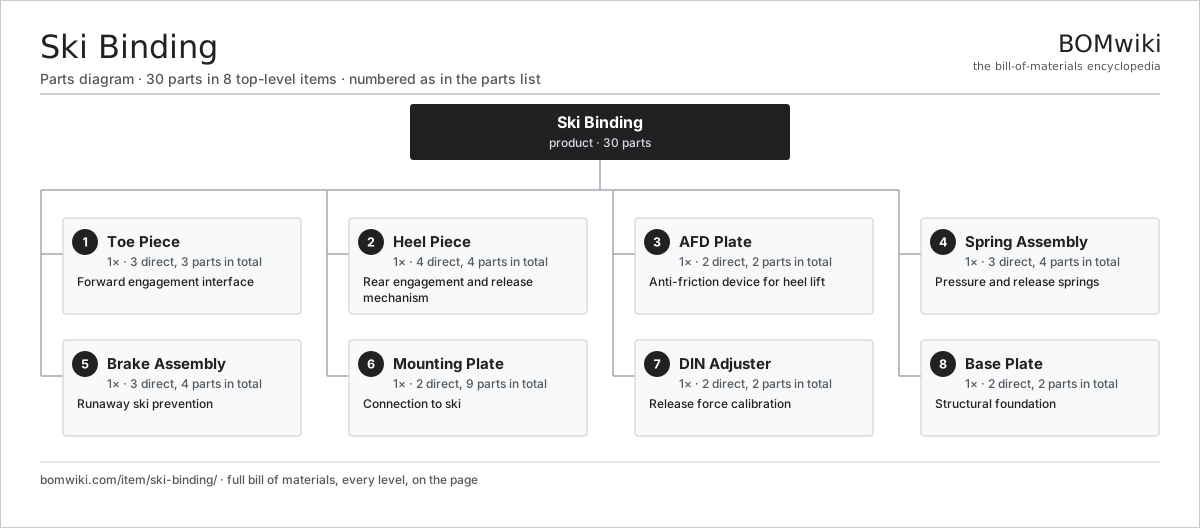
| # | Part | Qty | What it does |
|---|---|---|---|
| 1 | Toe Piece 3 parts | 1× | Forward engagement interface |
| 2 | Heel Piece 4 parts | 1× | Rear engagement and release mechanism |
| 3 | AFD Plate 2 parts | 1× | Anti-friction device for heel lift |
| 4 | Spring Assembly 3 parts | 1× | Pressure and release springs |
| 5 | Brake Assembly 3 parts | 1× | Runaway ski prevention |
| 6 | Mounting Plate 2 parts | 1× | Connection to ski |
| 7 | DIN Adjuster 2 parts | 1× | Release force calibration |
| 8 | Base Plate 2 parts | 1× | Structural foundation |
3D model
No 3D model yet. Have a CAD file of this? Add a 3D model. STL renders right on this page; STEP, FreeCAD, and OpenSCAD sources are welcome too (openly licensed, like all 3D models on BOMwiki).
Build & assembly graph
expand / collapse · shared sub-assemblies converge · links to related products · est. labourTap an assembly to expand/collapse · tap a part to open it · use “Open page” for any node · drag to pan, scroll to zoom.
Bill of materials for Ski Binding
8 top-level lines · 29 rows shown · 30 parts total · indented to 3 levels| # | Item / sub-assembly | Part no. | Qty/assy | Ext. qty | Parts | Type |
|---|---|---|---|---|---|---|
| 1 | Toe Piece 3 parts | ski-binding-toe-piece | 1× | 1 | 3 | assembly |
| 1.1 | Toe Jaws | ski-binding-toe-jaws | 1× | 1 | · | part |
| 1.2 | Toe Spring | ski-binding-toe-spring | 1× | 1 | · | part |
| 1.3 | Toe Adjustment | ski-binding-toe-adjustment | 1× | 1 | · | part |
| 2 | Heel Piece 4 parts | ski-binding-heel-piece | 1× | 1 | 4 | assembly |
| 2.1 | Heelplate | ski-binding-heelplate | 1× | 1 | · | part |
| 2.2 | Heel Lifter | ski-binding-heel-lifter | 1× | 1 | · | part |
| 2.3 | Heel Spring | ski-binding-heel-spring | 1× | 1 | · | part |
| 2.4 | Heel Adjustment | ski-binding-heel-adjustment | 1× | 1 | · | part |
| 3 | AFD Plate 2 parts | ski-binding-afd-plate | 1× | 1 | 2 | assembly |
| 3.1 | AFD Plastic | ski-binding-afd-plastic | 1× | 1 | · | part |
| 3.2 | AFD Mounting | ski-binding-afd-mounting | 1× | 1 | · | part |
| 4 | Spring Assembly 3 parts | ski-binding-spring-assembly | 1× | 1 | 4 | assembly |
| 4.1 | Main Spring | ski-binding-main-spring | 2× | 2 | · | part |
| 4.2 | Retention Spring | ski-binding-retention-spring | 1× | 1 | · | part |
| 4.3 | Spring Retainer | ski-binding-spring-retainer | 1× | 1 | · | part |
| 5 | Brake Assembly 3 parts | ski-binding-brake-assembly | 1× | 1 | 4 | assembly |
| 5.1 | Brake Arms | ski-binding-brake-arms | 2× | 2 | · | part |
| 5.2 | Brake Spring | ski-binding-brake-spring | 1× | 1 | · | part |
| 5.3 | Brake Pivot | ski-binding-brake-pivot | 1× | 1 | · | part |
| 6 | Mounting Plate 2 parts | ski-binding-mounting-plate | 1× | 1 | 9 | assembly |
| 6.1 | Baseplate Material | ski-binding-baseplate-material | 1× | 1 | · | part |
| 6.2 | Mounting Fasteners | ski-binding-mounting-fasteners | 8× | 8 | · | part |
| 7 | DIN Adjuster 2 parts | ski-binding-din-adjuster | 1× | 1 | 2 | assembly |
| 7.1 | DIN Screw | ski-binding-din-screw | 1× | 1 | · | part |
| 7.2 | DIN Scale | ski-binding-din-scale | 1× | 1 | · | part |
| 8 | Base Plate 2 parts | ski-binding-base-plate | 1× | 1 | 2 | assembly |
| 8.1 | Plate Aluminum | ski-binding-plate-aluminum | 1× | 1 | · | part |
| 8.2 | Plate Finish | ski-binding-plate-finish | 1× | 1 | · | part |
Something wrong in this list? Report a problem with this BOM.
Sourcing: possible vendors
Browse the supplier directory → Prices, MOQ, and lead times are algorithmic estimates, not quotes, and not claims about these companies. Company mappings are curated by keyword; est. price band $20–$2k. How estimates work| Vendor | HQ | Specialty | MOQ | Lead time |
|---|---|---|---|---|
|
🇺🇸Coleman
coleman.com ↗
|
Chicago, US | Camping gear | 1,000 units | 6–10 wks |
| thenorthface.com ↗ | Denver, US | Outdoor apparel & gear | 1,000 units | 6–10 wks |
|
🇺🇸YETI
yeti.com ↗
|
Austin, US | Coolers & drinkware | 1,000 units | 6–10 wks |
| decathlon.com ↗ | Villeneuve-d'Ascq, FR | Sporting goods | 1,000 units | 6–10 wks |
|
🇺🇸Garmin
garmin.com ↗
|
Olathe, US | GPS & wearables | 1,000 units | 6–10 wks |
1,202-word article