Sleeper Laying Machine
ProductOverview
Automated sleeper laying machines are specialized gantry cranes that transport pre-fabricated concrete sleepers (ties) from a magazine, position them transversely across the track, and lower them onto prepared ballast beds. The machine operates in tandem with rail lifting cylinders, which temporarily raise rails to allow sleeper insertion beneath them.
Modern sleeper laying machines can place 80–120 sleepers per hour, making them essential for high-speed track renewal projects. A typical 30 km track section containing ~12,500 sleepers can be relaid in 3–4 weeks, compared to 8–12 weeks with manual labor.
Concrete Sleeper Specifications
Geometry & Materials
Modern concrete sleepers conform to specifications:
- Type: Bi-block monoblock prestressed concrete.
- Length: 2,400–2,600 mm (standard for 1,500 mm rail gauge).
- Width: 260–300 mm (accommodates rail width and ballast engagement).
- Height: 200–230 mm (depth for rail seat and ballast grip).
- Weight: 350–450 kg (depending on concrete density and reinforcement).
- Concrete strength: fck = 50 MPa (28-day compressive strength).
- Rail seat geometry: Sloped at 1:40 (facilitates drainage).
Pre-stressing
Longitudinal steel tendons (cables) are tensioned before concrete pour to 1,200–1,400 MPa, then gradually released as concrete hardens. This induces compressive stress in concrete, improving resistance to flexural cracking under dynamic railway loads.
Fastening System
Each sleeper accommodates rail clips (or elastic fasteners) that lock rails to the sleeper via:
- Sandwiched clips: Spring-steel clips pressing down on rail foot.
- Resilient pads: Elastomer (neoprene or natural rubber) isolating rail vibration from concrete.
Modern systems use pandrol-type clips (or equivalent): a spring-operated clip that applies ~10 kN downward force without over-stressing the concrete anchorage point.
Machine Architecture & Operation
Gantry Positioning
The gantry crane spans both rails (2.5 m centerline) with a vertical mast and horizontal beam. The horizontal trolley runs along the beam, translating the electric hoist to any longitudinal position.
A powered height adjuster raises/lowers the hoist boom vertically to accommodate varying track elevation and sleeper magazine height.
Magazine System
The magazine is a stacked bin mounted on the machine frame, typically holding 30–50 sleepers in vertical tiers. A hydraulic ejector plate located below the top sleeper automatically pushes it toward the gripper head as each sleeper is lifted away.
Weight sensing (load cell) monitors magazine fullness; when weight drops below a threshold, an alert signals the operator to reload (typically requiring a separate materials train with fresh sleepers).
Gripper & Handling
The gripper head employs a 3-point clamping system:
- Center grip: Spring-loaded jaw gripping the sleeper web (central area).
- End grips (2×): Pneumatic jaws on each sleeper end.
Clamping is achieved via pneumatic cylinders, each delivering 5–8 kN. A pressure switch confirms grip security before hoist motor energizes; if pressure drops mid-lift, system immediately halts and lowers sleeper to prevent drop hazard.
Rail Threading Guide System
The threading guide system uses dual threaded rods (left and right) to position the sleeper transversely:
- Motor-driven rods: A stepper or servo motor rotates both rods synchronously.
- Carriage mounting: The sleeper is suspended from a carriage that rides on both threaded rods via internal nuts.
- Fine positioning: Rotation of rod by 1 full turn = lateral movement of 2–3 mm (depending on thread pitch).
Feedback loop: A rotary encoder on the guide motor allows closed-loop control. The PLC compares target position (derived from GPS or rail position markers) to actual position and adjusts motor commands to within ±10 mm tolerance.
Cycle Workflow
- Magazine load: Operator signals to load sleepers into magazine from supply train.
- Positioning approach (5–8 seconds):
- Hoist motor transports empty gripper head to sleeper position along beam.
- Height adjuster lowers boom to magazine top.
- Sleeper extraction (3–5 seconds):
- Gripper descends, engages ejector-presented sleeper.
- Pneumatic cylinders clamp center and ends.
- Pressure sensor confirms hold (>5 kN per jaw).
- Ejector retracts, and hoist begins lifting.
- Sleeper transport (10–15 seconds):
- Hoist hoists sleeper 2–3 meters above track bed.
- Horizontal trolley translates to target sleeper position over track.
- Height adjuster lowers sleeper toward track.
- Threading & alignment (8–12 seconds):
- Dual guide rods rotate, positioning sleeper perpendicular to rails.
- Position encoder feedback refines transverse position to ±10 mm.
- Machine advances (via rail lift cylinders) if needed to synchronize with next rail pair.
- Insertion & release (5–10 seconds):
- Dual rail lift cylinders elevate rails 80–100 mm (sufficient to pass sleeper under rail foot).
- Hoist descends further, lowering sleeper into position on ballast bed.
- Lift cylinders retract, lowering rails back onto sleeper.
- Rails compress sleeper elastically, seating it firmly.
- Gripper pneumatics release, jaws open.
- Hoist retracts upward; gripper disengages from sleeper.
- Advance to next (2–3 seconds):
- Traction motors advance machine 2.4 m (standard sleeper spacing) along track.
- System loops to step 2 for next sleeper.
Total cycle time: 30–45 seconds per sleeper (dependent on magazine loading state, GPS positioning accuracy, and rail lift responsiveness). For a standard 2.4 m spacing:
- Production rate: ~80–120 sleepers/hour = 190–290 m/hour = ~2.3–3.5 km per 8-hour shift.
- 30 km section: 80–110 working days (2–4 months) to complete relay.
Hydraulic & Pneumatic Systems
Hydraulic Subsystems
The main hydraulic system includes:
- Pump: Fixed-displacement centrifugal pump, 20 cc/rev at 1800 rpm, supplying ~35 bar nominal working pressure.
- Proportional valve: Multi-spool block directing flow to ejector, lift cylinders, and traction motors.
- Accumulator: 5 L energy storage for lift cylinder pressure transients.
- Cooler: Plate-frame oil cooler maintaining <50 °C.
Pneumatic Gripper Circuit
A separate compressor (5–10 kW electric) supplies 7 bar compressed air to:
- Gripper cylinders (clamp/release cycles).
- Optional dust suppression spray nozzles (if moisture control is required in dry climates).
Pneumatic pressure is preferred for grippers because:
- Safety: Pneumatics cannot hold pressure if hose ruptures (air vents freely); hydraulic hose rupture can cause uncontrolled drop.
- Simplicity: Pneumatic proportional valves are cheaper than hydraulic equivalents.
- Responsiveness: Compressed air responds instantly to valve commands.
Safety Features & Constraints
Load Limiting
The gripper system includes a pressure relief valve set to 8 kN per jaw. If a sleeper is trapped or unusually heavy:
- Pressure exceeds relief threshold.
- Proportional valve pilots close, preventing further hoist lift.
- Operator is alerted (buzzer, light).
This prevents catastrophic lift failure and over-stressing the sleeper.
Wind & Environmental
- Wind speed limit: Machines are halted if sustained wind exceeds 12 m/s (holds 10-ton load at 2.5 m above track with significant arm overhang; gust forces risk tipping).
- Rain: Light rain is acceptable (water lubricates sleeper surfaces). Heavy downpour requires halt (ground slipperiness, visibility).
- Temperature: Pneumatic pressure and hoist motor torque degrade in cold (<-10 °C). Machines are often not deployed in winter.
Operator Competency
Sleeper laying machine operators must hold certification in many jurisdictions (e.g., RFID-enabled license in EU rail networks). Training covers:
- Machine operation and emergency stops.
- Track safety and communication protocols.
- Load limiting and grip verification procedures.
- Basic troubleshooting (pressure readings, cylinder response).
Maintenance & Service Life
Gripper Wear
The grip pads (rubber or elastomer) experience compression wear at ~2 mm per 10,000 sleepers. Replacement pads cost €200–500 and require 2–4 hours labor.
Pneumatic Seals
Gripper cylinders operate at 7 bar, 500+ cycles per shift. Seals degrade in 2–4 years; replacement is ~€100 per cylinder (labor-intensive).
Hoist Motor & Brake
The electric hoist motor is typically a 10-ton capacity unit rated for duty cycle S4 (intermittent use with load). Thermal overload protection prevents burnout if duty cycle is exceeded.
Brake linings (spring-apply electric-release) wear at ~10 microns per engagement. Typical service life: 5–10 years (50,000+ brake cycles).
Productivity & Economics
Cost Drivers
- Equipment lease: €2,000–€3,500/day for rental (short-term project).
- Operator wages: €150–€200/day + benefits.
- Fuel: Diesel for hydraulic/pneumatic compressor: €50–€100/day.
- Consumables (gripper seals, hydraulic oil): €200–€500/month.
Total cost per sleeper: ~€3–€5 labor + equipment amortization, vs. ~€8–€12 for manual placement.
Constraints & Bottlenecks
- Material logistics: Sleeper supply train must keep pace; production halts if magazine empties (30–50 sleeper capacity = 20–40 minutes of machine operation).
- Rail lifting responsiveness: If lift cylinders are slow or undersized, cycle time extends to 45–60 seconds.
- GPS accuracy: Poor positioning feedback forces manual override, slowing throughput.
Standards & Compliance
Sleeper laying machines must comply with:
- EN 12299: Railway applications – Track – Specification for laying and maintenance of switches.
- ISO 3864: Safety signs and labels.
- Machinery Directive 2006/42/EC: CE certification for EU markets.
- ROPS/FOPS: Rollover and falling-object protection structures (if machine operates in zones with traffic risk).
Sleeper Laying Machine parts and their functions
6 top-level parts · 41 parts in total · full bill of materials below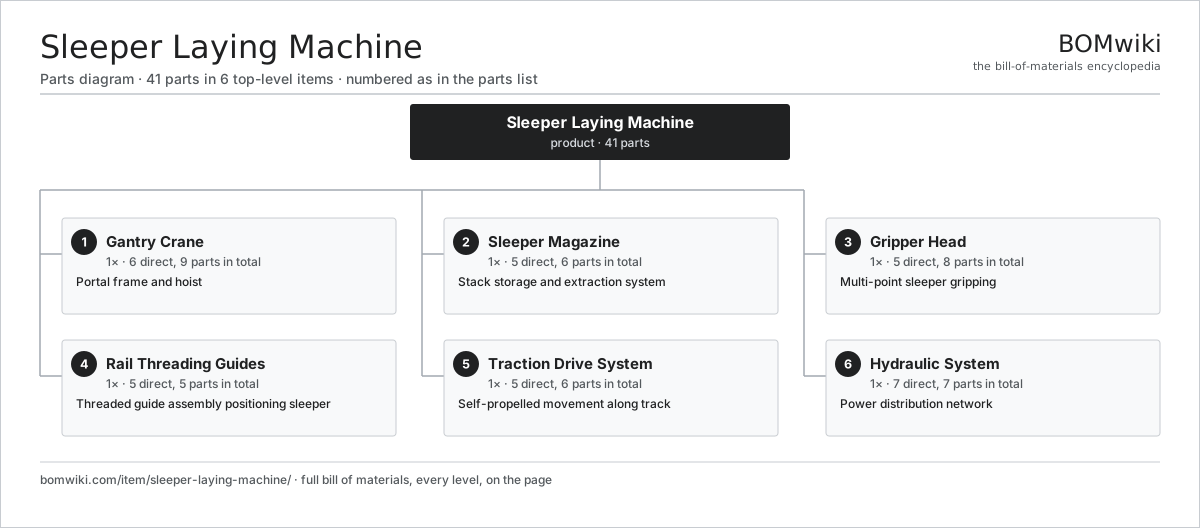
| # | Part | Qty | What it does |
|---|---|---|---|
| 1 | Gantry Crane 6 parts | 1× | Portal frame and hoist |
| 2 | Sleeper Magazine 5 parts | 1× | Stack storage and extraction system |
| 3 | Gripper Head 5 parts | 1× | Multi-point sleeper gripping |
| 4 | Rail Threading Guides 5 parts | 1× | Threaded guide assembly positioning sleeper |
| 5 | Traction Drive System 5 parts | 1× | Self-propelled movement along track |
| 6 | Hydraulic System 7 parts | 1× | Power distribution network |
3D model
No 3D model yet. Have a CAD file of this? Add a 3D model. STL renders right on this page; STEP, FreeCAD, and OpenSCAD sources are welcome too (openly licensed, like all 3D models on BOMwiki).
Build & assembly graph
expand / collapse · shared sub-assemblies converge · links to related products · est. labourTap an assembly to expand/collapse · tap a part to open it · use “Open page” for any node · drag to pan, scroll to zoom.
Bill of materials for Sleeper Laying Machine
6 top-level lines · 39 rows shown · 41 parts total · indented to 3 levels| # | Item / sub-assembly | Part no. | Qty/assy | Ext. qty | Parts | Type |
|---|---|---|---|---|---|---|
| 1 | Gantry Crane 6 parts | sleeper-laying-machine-gantry-crane | 1× | 1 | 9 | assembly |
| 1.1 | Gantry Portal | sleeper-laying-machine-gantry-portal | 1× | 1 | · | part |
| 1.2 | Horizontal Trolley | sleeper-laying-machine-horizontal-trolley | 1× | 1 | · | part |
| 1.3 | Hoist Motor | sleeper-laying-machine-hoist-motor | 1× | 1 | · | part |
| 1.4 | Gantry Wheels | sleeper-laying-machine-gantry-wheels | 4× | 4 | · | part |
| 1.5 | Height Adjuster | sleeper-laying-machine-height-adjuster | 1× | 1 | · | part |
| 1.6 | Encoder | encoder | 1× | 1 | · | part |
| 2 | Sleeper Magazine 5 parts | sleeper-laying-machine-sleeper-magazine | 1× | 1 | 6 | assembly |
| 2.1 | Magazine Frame | sleeper-laying-machine-magazine-frame | 1× | 1 | · | part |
| 2.2 | Sleeper Stack | sleeper-laying-machine-sleeper-stack | 1× | 1 | · | part |
| 2.3 | Ejector Plate | sleeper-laying-machine-ejector-plate | 1× | 1 | · | part |
| 2.4 | Magazine Guide | sleeper-laying-machine-magazine-guide | 2× | 2 | · | part |
| 2.5 | Load Cell | sleeper-laying-machine-load-cell | 1× | 1 | · | part |
| 3 | Gripper Head 5 parts | sleeper-laying-machine-gripper-head | 1× | 1 | 8 | assembly |
| 3.1 | Center Gripper | sleeper-laying-machine-center-gripper | 1× | 1 | · | part |
| 3.2 | End Gripper | sleeper-laying-machine-end-gripper | 2× | 2 | · | part |
| 3.3 | Gripper Cylinder | sleeper-laying-machine-gripper-cylinder | 3× | 3 | · | part |
| 3.4 | Gripper Bracket | sleeper-laying-machine-gripper-bracket | 1× | 1 | · | part |
| 3.5 | Gripper Pressure Sensor | sleeper-laying-machine-gripper-sensor | 1× | 1 | · | part |
| 4 | Rail Threading Guides 5 parts | sleeper-laying-machine-rail-guides | 1× | 1 | 5 | assembly |
| 4.1 | Left Guide Rail | sleeper-laying-machine-left-guide-rail | 1× | 1 | · | part |
| 4.2 | Right Guide Rail | sleeper-laying-machine-right-guide-rail | 1× | 1 | · | part |
| 4.3 | Guide Motor | sleeper-laying-machine-guide-motor | 1× | 1 | · | part |
| 4.4 | Guide Carrier | sleeper-laying-machine-guide-carrier | 1× | 1 | · | part |
| 4.5 | Position Feedback | sleeper-laying-machine-position-feedback | 1× | 1 | · | part |
| 5 | Traction Drive System 5 parts | sleeper-laying-machine-traction-drive | 1× | 1 | 6 | assembly |
| 5.1 | Drive Motor | sleeper-laying-machine-drive-motor | 1× | 1 | · | part |
| 5.2 | Drive Gearbox | sleeper-laying-machine-drive-gearbox | 1× | 1 | · | part |
| 5.3 | Drive Wheel | sleeper-laying-machine-drive-wheel | 2× | 2 | · | part |
| 5.4 | Speed Control | sleeper-laying-machine-speed-control | 1× | 1 | · | part |
| 5.5 | Brake Unit | sleeper-laying-machine-brake-unit | 1× | 1 | · | part |
| 6 | Hydraulic System 7 parts | sleeper-laying-machine-hydraulic-system | 1× | 1 | 7 | assembly |
| 6.1 | Hydraulic Pump | sleeper-laying-machine-hydraulic-pump | 1× | 1 | · | part |
| 6.2 | Proportional Valve | sleeper-laying-machine-proportional-valve | 1× | 1 | · | part |
| 6.3 | Accumulator | sleeper-laying-machine-accumulator | 1× | 1 | · | part |
| 6.4 | Filter Unit | sleeper-laying-machine-filter | 1× | 1 | · | part |
| 6.5 | Cooler | sleeper-laying-machine-cooler | 1× | 1 | · | part |
| 6.6 | Reservoir | sleeper-laying-machine-reservoir | 1× | 1 | · | part |
| 6.7 | Pressure Sensor | pressure-sensor | 1× | 1 | · | part |
Something wrong in this list? Report a problem with this BOM.
Related products
same domain, ranked by shared parts Automated People Mover
450 parts · shares 1 with this page
Automated People Mover
450 parts · shares 1 with this page
 Ballast Cleaning Machine
54 parts · shares 1 with this page
Ballast Cleaning Machine
54 parts · shares 1 with this page
 Ballast Tamping Machine
51 parts · shares 1 with this page
Ballast Tamping Machine
51 parts · shares 1 with this page
 Ballast Undercutter
38 parts · shares 1 with this page
Ballast Undercutter
38 parts · shares 1 with this page
 Bus Rapid Transit Vehicle
4,251 parts · shares 1 with this page
Bus Rapid Transit Vehicle
4,251 parts · shares 1 with this page
 Coach Bus
999 parts · shares 1 with this page
Coach Bus
999 parts · shares 1 with this page
Sourcing: possible vendors
Browse the supplier directory → Prices, MOQ, and lead times are algorithmic estimates, not quotes, and not claims about these companies. Company mappings are curated by keyword; est. price band $500k–$60M. How estimates work| Vendor | HQ | Specialty | MOQ | Lead time |
|---|---|---|---|---|
|
🇨🇳CRRC
crrcgc.cc ↗
|
Beijing, CN | Rolling stock & rail systems | made to order | 40–72 wks |
|
🇫🇷Alstom
alstom.com ↗
|
Saint-Ouen, FR | Rail rolling stock | made to order | 40–72 wks |
| mobility.siemens.com ↗ | Munich, DE | Rail systems | made to order | 40–72 wks |
| stadlerrail.com ↗ | Bussnang, CH | Rail rolling stock | made to order | 40–72 wks |
|
🇺🇸Wabtec
wabteccorp.com ↗
|
Pittsburgh, US | Rail equipment | made to order | 40–72 wks |
1,602-word article