Slurry Tunnel Boring Machine
ProductOverview
A slurry tunnel boring machine (slurry TBM) is a large-diameter tunneling system designed for stable soil and mixed ground conditions. The machine uses a pressurized bentonite slurry to support the excavation face, separate excavated soil from the cutting tools, and transport spoil to surface for processing. The slurry approach eliminates dangerous decompression work and provides superior face control in saturated soil, silts, and soft rock.
The slurry TBM is the dominant choice for underwater crossings, urban shields, and deep soft-ground tunnels. Unlike earth pressure balance (EPB) machines, slurry systems do not require pressurized operator work chambers and generate less settlement in fine-grained soils due to continuous slurry-supported face pressure.
How It Works
Excavation begins at the Cutterhead, a rotating disc-cutter assembly with scrapers mounted on a large main bearing. As the Main Drive Motor and Gearbox rotates the cutterhead via an epicyclic gearbox, tungsten-carbide Disc Cutters (Set) fracture soil and rock while Scraper Tools (Set) break and collect cuttings. The excavation chamber is filled with pressurized bentonite slurry, which suspends the fragmented soil and holds back the tunnel face.
The Slurry Circulation System maintains face pressure by pumping slurry to the chamber opening via a large Slurry Discharge Pump. As fresh slurry enters, cuttings-laden slurry is discharged through Slurry Delivery Pipework to a Slurry Separation Plant at ground level. The separation plant uses hydrocyclones and vibrating screens to recover bentonite particles and dispose of soil, allowing slurry recirculation.
Simultaneously, the Jacking Frame and Erector advances the machine by pushing hydraulic Jacking Cylinders against concrete segments already installed in the Shield and Pressure Bulkhead. As the machine advances, a trailing crew installs precast concrete lining segments in rings, secured by a Tunnel Segment Erector robotic arm. The Tail Seal Assembly prevents slurry escape at the shield rear during segment placement.
The Control Cabin and Instrumentation houses operator controls, a Total Station Theodolite laser theodolite for alignment, and proportional valve systems that regulate face pressure, spoil flow, and jacking thrust. The Probe Drill Assembly extends ahead to sample geology before mining, allowing real-time design adjustments.
Slurry Circulation and Face Pressure
Maintaining stable face pressure is critical in slurry tunneling. Insufficient pressure allows soil collapse and face heave; excessive pressure causes ground uplift and surface settlement. The slurry pump displacement and Pressure Sensor feedback allow operators to adjust discharge rate continuously. The separation plant must recover slurry efficiently, recovery loss means higher bentonite consumption and environmental impact. Large hydrocyclones operate in parallel to process 300–1200 m³/h of slurry from deep tunnels.
Installation Sequence
Precast concrete segments (typically 1.5 m wide, 0.6 m deep) are stacked in a ring assembly before installation. The Tunnel Segment Erector arm picks a segment from the cache, positions it in the erection frame, and aligns it with dowels and spacer blocks. Once all 6–7 segments are locked into a complete ring, the Jacking Cylinders advance and the process repeats. Modern machines achieve ring build times of 45–90 minutes depending on segment size and operator experience.
Applications
Slurry TBMs dominate crossings of the English Channel, Hong Kong harbor, Singapore metro, and Alpine base tunnels. They excel in water-bearing sands, clays, and weak rock where ground stability and low settlement are paramount. Disadvantages include surface spoil plant footprint, slurry disposal costs, and reduced versatility in hard rock compared to gripper TBMs.
Key Design Features
- Main bearing: Single-row or double-row tapered rollers supporting radial and thrust loads up to 200 MN
- Cutterhead: Disc cutters spaced 300–500 mm apart with scrapers; typical wear requires 2–4 month cutter changes
- Drive system: Epicyclic gearbox reduces motor speed from 60 rpm to 2–12 rpm cutterhead RPM; torque reaches 1000–3000 kNm
- Slurry chamber: Pressurized at 2–6 bar depending on depth and soil water table; bentonite concentration 6–10% by weight
- Separation plant: Cascade hydrocyclones (200–500 mm diameter) with shaker tables and centrifuges to recover 80–95% bentonite
- Tail seal: Elastomer brush and backup rings limit slurry leakage to <5% during segment installation
Safety Considerations
Slurry TBM work is non-pressurized, eliminating decompression sickness. However, systems remain hazardous due to rotating equipment, high hydraulic pressures (200–350 bar), and confined-space hazards. Control cabins are pressurized to prevent slurry spray. Emergency probe and probe drill allow early warning of hazardous gases or unexpected ground changes.
Slurry Tunnel Boring Machine parts and their functions
8 top-level parts · 57 parts in total · full bill of materials below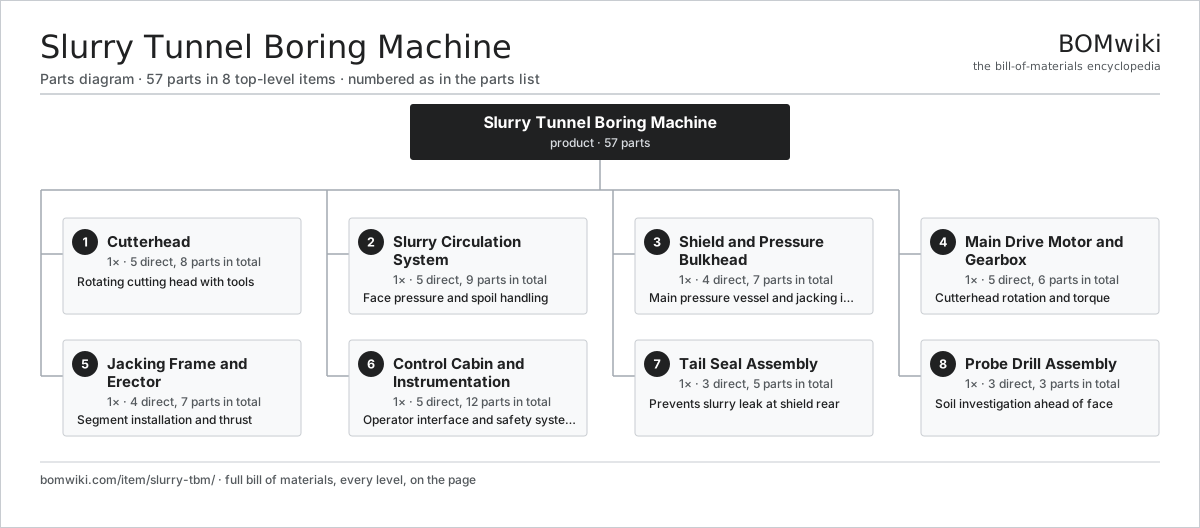
| # | Part | Qty | What it does |
|---|---|---|---|
| 1 | Cutterhead 5 parts | 1× | Rotating cutting head with tools |
| 2 | Slurry Circulation System 5 parts | 1× | Face pressure and spoil handling |
| 3 | Shield and Pressure Bulkhead 4 parts | 1× | Main pressure vessel and jacking interface |
| 4 | Main Drive Motor and Gearbox 5 parts | 1× | Cutterhead rotation and torque |
| 5 | Jacking Frame and Erector 4 parts | 1× | Segment installation and thrust |
| 6 | Control Cabin and Instrumentation 5 parts | 1× | Operator interface and safety systems |
| 7 | Tail Seal Assembly 3 parts | 1× | Prevents slurry leak at shield rear |
| 8 | Probe Drill Assembly 3 parts | 1× | Soil investigation ahead of face |
3D model
No 3D model yet. Have a CAD file of this? Add a 3D model. STL renders right on this page; STEP, FreeCAD, and OpenSCAD sources are welcome too (openly licensed, like all 3D models on BOMwiki).
Build & assembly graph
expand / collapse · shared sub-assemblies converge · links to related products · est. labourTap an assembly to expand/collapse · tap a part to open it · use “Open page” for any node · drag to pan, scroll to zoom.
Bill of materials for Slurry Tunnel Boring Machine
8 top-level lines · 42 rows shown · 57 parts total · indented to 3 levels| # | Item / sub-assembly | Part no. | Qty/assy | Ext. qty | Parts | Type |
|---|---|---|---|---|---|---|
| 1 | Cutterhead 5 parts | slurry-tbm-cutterhead | 1× | 1 | 8 | assembly |
| 1.1 | Main Bearing (Cutterhead) | slurry-tbm-main-bearing | 1× | 1 | · | part |
| 1.2 | Disc Cutters (Set) | slurry-tbm-disc-cutters | 1× | 1 | · | part |
| 1.3 | Scraper Tools (Set) | slurry-tbm-scraper-tools | 1× | 1 | · | part |
| 1.4 | Ball Bearing | ball-bearing | 2× | 2 | · | part |
| 1.5 | Pressure Sensor | pressure-sensor | 3× | 3 | · | part |
| 2 | Slurry Circulation System 5 parts | slurry-tbm-slurry-system | 1× | 1 | 9 | assembly |
| 2.1 | Slurry Discharge Pump | slurry-tbm-slurry-pump | 1× | 1 | · | part |
| 2.2 | Slurry Delivery Pipework | slurry-tbm-slurry-pipework | 1× | 1 | · | part |
| 2.3 | Slurry Separation Plant | slurry-tbm-separation-plant | 1× | 1 | · | part |
| 2.4 | Pressure Sensor | pressure-sensor | 2× | 2 | · | part |
| 2.5 | Oil Seal | oil-seal | 4× | 4 | · | part |
| 3 | Shield and Pressure Bulkhead 4 parts | slurry-tbm-shield | 1× | 1 | 7 | assembly |
| 3.1 | Shield Ring Sections | slurry-tbm-shield-rings | 1× | 1 | · | part |
| 3.2 | Bulkhead Wall | slurry-tbm-bulkhead-wall | 1× | 1 | · | part |
| 3.3 | Access Doors | slurry-tbm-access-doors | 2× | 2 | · | part |
| 3.4 | Fastener Set | fastener-set | 3× | 3 | · | part |
| 4 | Main Drive Motor and Gearbox 5 parts | slurry-tbm-main-drive | 1× | 1 | 6 | assembly |
| 4.1 | Main Drive Motor | slurry-tbm-motor | 1× | 1 | · | part |
| 4.2 | Epicyclic Gearbox | slurry-tbm-gearbox | 1× | 1 | · | part |
| 4.3 | Flexible Coupling | slurry-tbm-coupling | 1× | 1 | · | part |
| 4.4 | IGBT Power Module | igbt-module | 2× | 2 | · | part |
| 4.5 | Encoder | encoder | 1× | 1 | · | part |
| 5 | Jacking Frame and Erector 4 parts | slurry-tbm-jacking-frame | 1× | 1 | 7 | assembly |
| 5.1 | Jacking Cylinders | slurry-tbm-jacking-cylinders | 1× | 1 | · | part |
| 5.2 | Segment Erector Arm | slurry-tbm-segment-erector | 1× | 1 | · | part |
| 5.3 | Main Hydraulic Pump | slurry-tbm-hydraulic-pump | 1× | 1 | · | part |
| 5.4 | Pressure Sensor | pressure-sensor | 4× | 4 | · | part |
| 6 | Control Cabin and Instrumentation 5 parts | slurry-tbm-control-cabin | 1× | 1 | 12 | assembly |
| 6.1 | Control Panel | slurry-tbm-control-panel | 1× | 1 | · | part |
| 6.2 | Total Station Theodolite | slurry-tbm-total-station | 1× | 1 | · | part |
| 6.3 | Pressure Sensor | pressure-sensor | 6× | 6 | · | part |
| 6.4 | LCD Panel | lcd-panel | 2× | 2 | · | part |
| 6.5 | Hall Sensor | hall-sensor | 2× | 2 | · | part |
| 7 | Tail Seal Assembly 3 parts | slurry-tbm-tail-seal | 1× | 1 | 5 | assembly |
| 7.1 | Tail Brush (Wiper) | slurry-tbm-tail-brush | 1× | 1 | · | part |
| 7.2 | O-Ring Set | oring-set | 3× | 3 | · | part |
| 7.3 | Backup Ring Seals | slurry-tbm-backup-rings | 1× | 1 | · | part |
| 8 | Probe Drill Assembly 3 parts | slurry-tbm-probe-drill | 1× | 1 | 3 | assembly |
| 8.1 | Probe Drill Motor | slurry-tbm-probe-motor | 1× | 1 | · | part |
| 8.2 | Probe Drill Rods | slurry-tbm-probe-rods | 1× | 1 | · | part |
| 8.3 | Probe Sample Bit | slurry-tbm-probe-bit | 1× | 1 | · | part |
Something wrong in this list? Report a problem with this BOM.
Related products
same domain, ranked by shared parts Main Beam Tunnel Boring Machine
10,126 parts · shares 5 with this page
Main Beam Tunnel Boring Machine
10,126 parts · shares 5 with this page
 Tunnel Muck Conveyor
43 parts · shares 3 with this page
Tunnel Muck Conveyor
43 parts · shares 3 with this page
 Tunnel Ventilation Fan
33 parts · shares 3 with this page
Tunnel Ventilation Fan
33 parts · shares 3 with this page
 Construction Hoist
457 parts · shares 2 with this page
Construction Hoist
457 parts · shares 2 with this page
 Shotcrete Spraying Robot
40 parts · shares 2 with this page
Shotcrete Spraying Robot
40 parts · shares 2 with this page
 Tower Crane
433 parts · shares 3 with this page
Tower Crane
433 parts · shares 3 with this page
Sourcing: possible vendors
Browse the supplier directory → Prices, MOQ, and lead times are algorithmic estimates, not quotes, and not claims about these companies. Company mappings are curated by keyword; est. price band $15k–$2M. How estimates work| Vendor | HQ | Specialty | MOQ | Lead time |
|---|---|---|---|---|
| herrenknecht.com ↗ | Schwanau, DE | Tunnel boring machines | made to order | 16–28 wks |
| crectbm.com ↗ | Zhengzhou, CN | Tunnel boring machines | made to order | 16–28 wks |
| crchi.com ↗ | Changsha, CN | Tunnel boring machines | made to order | 16–28 wks |
| robbinstbm.com ↗ | Solon, US | Hard rock & soft ground TBMs | made to order | 16–28 wks |
743-word article