Smokeless Fire Pit
ProductOverview
A smokeless fire pit is a double-wall steel combustion chamber that dramatically reduces smoke output by forcing fuel combustion at temperatures exceeding 1100°F through engineered airflow. The design channels ambient air upward through louvers in the outer wall, across the hot fuel (creating primary draft), and then injects hot gases into a secondary combustion zone at the base of the inner chamber, where unburned volatiles combust completely. The result is 70–85% less smoke than an open campfire, while maintaining 15,000–25,000 BTU/hour heat output.
The technology is based on the inverse fire pyramid concept, originally developed for military applications and now widely used in basecamp and backyard settings. A traditional open fire releases volatiles that escape unburned, producing thick white smoke. A smokeless pit's design forces secondary combustion of these volatiles before they escape, consuming them in the flame rather than as smoke. This reduces particulate emissions, minimizes air pollution, and eliminates the acrid smell that clings to clothing and gear.
How it Works
The Smokeless Fire Pit uses a double-wall architecture: an Outer Wall (welded steel cylinder with vertical louvers) surrounds an Inner Combustion Wall (smaller combustion chamber with secondary air holes). Between the two walls is a 0.5–1 inch thermal gap, sometimes filled with ceramic wool to insulate the outer wall.
The Fuel Grate & Support sits at the base of the inner chamber, holding logs above an Ash Pan Assembly. Seasoned hardwood (oak, maple, ash, 3–4 inch diameter) burns cleanly and produces minimal creosote. Logs should be split lengthwise to expose cross-grain, accelerating combustion and reducing volatile emissions.
When fuel ignites, hot gases rise through the Primary Air Jets at the base of the inner wall. These jets (tubes or nozzles directing air from the surrounding louvers) accelerate incoming air into the combustion zone. The Venturi effect of air moving through tight nozzles creates a low-pressure zone that draws more air from the louvers, establishing a self-sustaining draft.
At the same time, Secondary Air Holes (small apertures near the base of the inner cylinder) introduce additional oxygen to the hot gas zone. This oxygen ignites unburned hydrocarbons (volatiles from wood) that would otherwise escape as smoke. Secondary combustion occurs at temperatures >1100°F (white-hot), consuming these hydrocarbons and leaving only carbon dioxide, water vapor, and fine ash. The result is flame visible above the fuel (indicating complete combustion) rather than thick white smoke.
The Outer Wall and Louver Ring establish a uniform updraft. Ambient air at ground level is drawn into the base of the pit through the louver slots. This ambient air is heated and accelerated by the primary air jets, then flows across hot fuel, and finally carries hot combustion gases upward and out the top. The thermal stack effect (hot gases rising faster than cold air entering) drives continuous airflow without mechanical blowers.
The Ground Stand elevates the pit 6–12 inches above ground, allowing air circulation beneath the base and improving ash collection. Three or four legs with non-slip feet prevent tipping and sinking in soft ground.
Combustion Thermodynamics
Smokeless pits operate at higher temperatures and faster burn rates than open fires. A typical burn cycle:
- Ignition (0–5 minutes): Kindling catches fire; fuel bed reaches 800–900°F.
- Ramp-up (5–15 minutes): Primary air jets establish. Inner wall reaches 1000–1200°F. Secondary combustion begins.
- Steady State (15–120 minutes): Fuel bed temperature 1100–1300°F. Burn rate 1–2 lbs per hour. Flame extends 4–8 inches above pit opening. Smoke is minimal (white wisp only).
- Burn-down (120–240 minutes): Fuel diminishes. Temperature drops to 800–1000°F. Smoke increases as secondary combustion weakens. Embers and coals remain.
A full load of 6–8 lbs of logs produces 2–4 hours of usable fire (coals remain for another 1–2 hours). Heat output peaks at 20,000–25,000 BTU/hour during steady state, equivalent to a large propane burner, though less concentrated.
Smoke & Particulate Reduction
Open campfires emit volatile organic compounds (VOCs) as smoke: benzene, toluene, naphthalene, and phenolic compounds. These substances are responsible for the acrid smoke smell and minor respiratory irritation. Smokeless pits reduce VOC emissions by 70–85% through secondary combustion.
The visible smoke (white wisp) escaping from a properly-functioning smokeless pit is primarily water vapor and residual particulates. Total particulate mass (PM2.5, PM10) is 4–5x lower than an open fire of equivalent heat output. This is significant in basecamp environments where multiple fires are present: a 10-person expedition using smokeless pits produces substantially less air pollution than an equivalent group using open fires.
Smoke reduction also impacts comfort: clothing worn near a smokeless fire does not absorb the thick, oily smoke smell of traditional fires. This is measurable in long-term expeditions where clothing washing is infrequent.
Cooking Capability
The Cooking Grill (a steel bar grate) fits across the top opening, allowing use as a cooktop for pans, kettles, and grilling. The intense, steady heat (20,000 BTU/hour) cooks faster than open fires. Coals remain consistent throughout the burn cycle, providing even heat distribution.
For grill-style cooking (kebabs, fish, vegetables), the pit is allowed to burn down to embers and coals, then the grill is positioned 4–6 inches above the coal bed. The high, consistent heat produces cooking similar to a gas grill. Wind does not disrupt cooking as easily as with open fires, because the pit's walls shield flames.
Materials & Durability
Outer walls are typically stainless steel (304 or 316 grade) or painted carbon steel (1/8 inch thickness). Stainless versions are rustproof and last 12–15 years with minimal maintenance. Carbon steel versions are cheaper but require annual paint touch-ups and careful storage when not in use.
Inner walls are thinner (1/16 inch) because they don't face weather; the thermal gap insulates them from rain and snow. The ceramic wool insulation (0.5–1 inch) between walls degrades slowly and may need replacement after 8–10 years if exposed to frequent moisture.
Rivets and bolts are stainless to prevent corrosion. Lock nuts prevent vibration loosening over time.
Field Maintenance & Ash Disposal
The Ash Pan Assembly is removed after each use, emptied, and rinsed. Ash is typically 10–15% of fuel weight: a 6 lb fuel load produces 1 lb of ash. Ash can be scattered in kitchen areas (provides mineral nutrients to soil) or packed out if in sensitive terrain.
The grate and inner walls accumulate creosote (pyrolysis byproducts) over time. Annual cleaning involves a wire brush to scrape walls and grate, and a damp cloth to wipe interior. Excessive creosote (black, sticky residue) indicates wet or unseasoned wood was burned; future fires should use only seasoned hardwood (moisture <20%).
Portability & Transport
The legs fold or disassemble in 2–3 minutes. The Carrying Bag holds the pit and legs. Total weight is 15–25 lbs, manageable for two people carrying or for a single vehicle load. This makes smokeless pits practical for RV camping, multi-week basecamp expeditions, and permanent-location glamping setups.
Environmental & Health Context
Smokeless pits are increasingly popular in regions with air quality regulations. Many jurisdictions restrict open fires during high-pollution days; smokeless pits are often exempt because particulate emissions are low. Additionally, for expedition settings in sensitive environments (alpine zones, high-altitude camps, desert wilderness), the reduced smoke and ash footprint aligns with leave-no-trace principles.
Long-term basecamp inhabitants (10+ person research camps, seasonal hunting lodges) benefit most: smoke reduction improves air quality in camp, reduces respiratory irritation, and extends visibility for navigation and safety. The consistent heat output also enables reliable cooking and water heating, critical in remote locations where fuel resupply is difficult.
Smokeless Fire Pit parts and their functions
7 top-level parts · 27 parts in total · full bill of materials below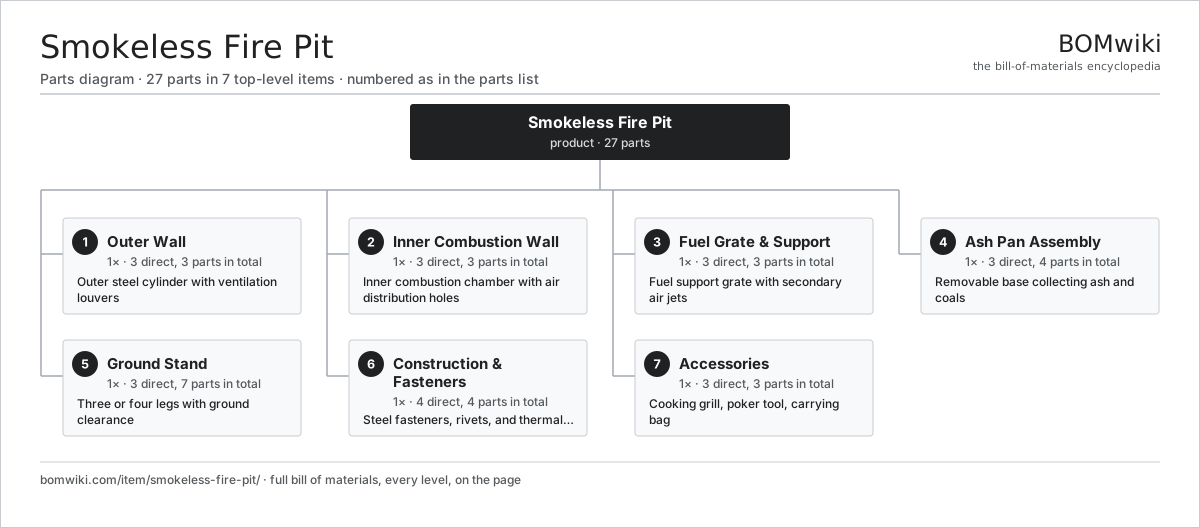
| # | Part | Qty | What it does |
|---|---|---|---|
| 1 | Outer Wall 3 parts | 1× | Outer steel cylinder with ventilation louvers |
| 2 | Inner Combustion Wall 3 parts | 1× | Inner combustion chamber with air distribution holes |
| 3 | Fuel Grate & Support 3 parts | 1× | Fuel support grate with secondary air jets |
| 4 | Ash Pan Assembly 3 parts | 1× | Removable base collecting ash and coals |
| 5 | Ground Stand 3 parts | 1× | Three or four legs with ground clearance |
| 6 | Construction & Fasteners 4 parts | 1× | Steel fasteners, rivets, and thermal spacers |
| 7 | Accessories 3 parts | 1× | Cooking grill, poker tool, carrying bag |
3D model
No 3D model yet. Have a CAD file of this? Add a 3D model. STL renders right on this page; STEP, FreeCAD, and OpenSCAD sources are welcome too (openly licensed, like all 3D models on BOMwiki).
Build & assembly graph
expand / collapse · shared sub-assemblies converge · links to related products · est. labourTap an assembly to expand/collapse · tap a part to open it · use “Open page” for any node · drag to pan, scroll to zoom.
Bill of materials for Smokeless Fire Pit
7 top-level lines · 29 rows shown · 27 parts total · indented to 3 levels| # | Item / sub-assembly | Part no. | Qty/assy | Ext. qty | Parts | Type |
|---|---|---|---|---|---|---|
| 1 | Outer Wall 3 parts | fire-pit-outer-wall | 1× | 1 | 3 | assembly |
| 1.1 | Outer Cylinder | fire-pit-outer-cylinder | 1× | 1 | · | part |
| 1.2 | Louver Ring | fire-pit-louver-ring | 1× | 1 | · | part |
| 1.3 | Top Rim | fire-pit-top-rim | 1× | 1 | · | part |
| 2 | Inner Combustion Wall 3 parts | fire-pit-inner-wall | 1× | 1 | 3 | assembly |
| 2.1 | Inner Cylinder | fire-pit-inner-cylinder | 1× | 1 | · | part |
| 2.2 | Secondary Air Holes | fire-pit-secondary-air-holes | 1× | 1 | · | part |
| 2.3 | Heat Spacer | fire-pit-heat-spacer | 1× | 1 | · | part |
| 3 | Fuel Grate & Support 3 parts | fire-pit-grate-assembly | 1× | 1 | 3 | assembly |
| 3.1 | Grate Bars | fire-pit-grate-bars | 1× | 1 | · | part |
| 3.2 | Grate Frame | fire-pit-grate-frame | 1× | 1 | · | part |
| 3.3 | Primary Air Jets | fire-pit-primary-air-jets | 1× | 1 | · | part |
| 4 | Ash Pan Assembly 3 parts | fire-pit-ash-pan | 1× | 1 | 4 | assembly |
| 4.1 | Pan Tray | fire-pit-pan-tray | 1× | 1 | · | part |
| 4.2 | Pan Support Legs | fire-pit-pan-legs | 2× | 2 | · | part |
| 4.3 | Pan Handles | fire-pit-pan-handle | 1× | 1 | · | part |
| 5 | Ground Stand 3 parts | fire-pit-stand | 1× | 1 | 7 | assembly |
| 5.1 | Leg | fire-pit-leg-set | 3× | 3 | · | part |
| 5.2 | Leg Joint | fire-pit-leg-joints | 1× | 1 | · | part |
| 5.3 | Foot Pad | fire-pit-foot-pads | 3× | 3 | · | part |
| 6 | Construction & Fasteners 4 parts | fire-pit-construction-materials | 1× | 1 | 4 | assembly |
| 6.1 | Rivets | fire-pit-rivets | 1× | 1 | · | part |
| 6.2 | Bolts | fire-pit-bolts | 1× | 1 | · | part |
| 6.3 | Washers & Lock Nuts | fire-pit-washers-locknut | 1× | 1 | · | part |
| 6.4 | Ceramic Insulation | fire-pit-ceramic-insulation | 1× | 1 | · | part |
| 7 | Accessories 3 parts | fire-pit-accessories | 1× | 1 | 3 | assembly |
| 7.1 | Cooking Grill | fire-pit-cooking-grill | 1× | 1 | · | part |
| 7.2 | Poker Tool | fire-pit-poker-tool | 1× | 1 | · | part |
| 7.3 | Carrying Bag | fire-pit-carrying-bag | 1× | 1 | · | part |
Something wrong in this list? Report a problem with this BOM.
Sourcing: possible vendors
Browse the supplier directory → Prices, MOQ, and lead times are algorithmic estimates, not quotes, and not claims about these companies. Company mappings are curated by keyword; est. price band $20–$2k. How estimates work| Vendor | HQ | Specialty | MOQ | Lead time |
|---|---|---|---|---|
|
🇺🇸Coleman
coleman.com ↗
|
Chicago, US | Camping gear | 1,000 units | 6–10 wks |
| thenorthface.com ↗ | Denver, US | Outdoor apparel & gear | 1,000 units | 6–10 wks |
|
🇺🇸YETI
yeti.com ↗
|
Austin, US | Coolers & drinkware | 1,000 units | 6–10 wks |
| decathlon.com ↗ | Villeneuve-d'Ascq, FR | Sporting goods | 1,000 units | 6–10 wks |
|
🇺🇸Garmin
garmin.com ↗
|
Olathe, US | GPS & wearables | 1,000 units | 6–10 wks |
1,333-word article