Twin-Screw Food Extruder
ProductOverview
The Twin-Screw Food Extruder is an industrial-scale continuous processor designed for forming snack products from dry or moist meal-based raw materials. Twin counter-rotating screws intermeshing inside a heated barrel apply mechanical shear and thermal energy to plasticize the material, forcing it through a shaped die to form pellets, strands, or rings. The system integrates material metering, temperature control, extrusion, cutting, and basic collection, making it the centerpiece of snack manufacturing lines from potato-based chips to breakfast cereals and ready-to-eat pellets.
The machine operates on a feeding-heating-forming-cutting workflow. Raw material enters a preconditioner where moisture and temperature are adjusted before gravity-feeding into the main Barrel Assembly. The twin Twin Screw Pair rotate at controlled speed, advancing material forward while high local pressure and friction heat it to 100–150°C. This softened dough-like mass is forced through the Die Unit under pressure (40–80 bar typical), forming strands that exit continuously. A synchronized Cutter Mechanism with rotating blades cuts the warm extrudate into uniform pellets falling into a collection hopper or conveyor.
How It Works
Material flow begins at the Preconditioner, where incoming raw meal is mixed with a small amount of water or steam and brought to 50–70°C, ensuring consistent hydration. The Feeder System then meters this preconditioned material into the extruder barrel at a controlled rate via a variable-speed auger driven by a Feeder Motor. Flow rate feedback from a Flow Sensor allows operators to maintain steady production.
Inside the Barrel Assembly, the twin screws rotate at 100–300 rpm, compressing and homogenizing the material while the Band Heater maintain barrel temperatures between 100–150°C. The screws have a precisely matched 2:1 lead ratio and mesh at 45 degrees, creating a figure-eight flow pattern that churns and mixes material while advancing it toward the discharge end. Pressure builds as material is restricted by the die, typically reaching 40–80 bar at the barrel tip. This combination of heat, mechanical shear, and pressure causes starch gelatinization and partial protein denaturation, creating the springy, low-density texture characteristic of expanded snacks.
The exit Die Unit contains a series of small drilled cavities (2–4 mm diameter for pellets, or shaped orifices for specialty products). Pressurized dough is forced through these holes, producing continuous extrudate strands. These are cut to uniform length by the Cutter Mechanism, which operates synchronously with the main screw speed, typically 2–6 cuts per second depending on desired pellet length.
The Drive System transmits power from a 15 kW electric motor through a gear reducer to the twin screws. The reducer is rated for 50 Nm continuous torque and includes a safety brake. An inverter (VFD Control Panel) allows variable-speed operation, enabling the same machine to process soft doughs (low speed, high shear) or dry meals (high speed, rapid advance).
Key Performance Parameters
Production rate scales nonlinearly with speed and material density. Light, aerated snack materials (e.g., cheese curls) may achieve 250 kg/h at 300 rpm, while denser products (e.g., meat-based pellets) run 100–150 kg/h at lower speeds to prevent overheating. The Barrel Liners are tungsten carbide–lined to resist abrasion from mineral-filled or grit-contaminated raw materials; replacement typically occurs every 18–36 months depending on feedstock.
Temperature control across the four Band Heater is critical. Zone 1 (inlet) runs cool (40–60°C) to prevent premature swelling; zones 2–3 ramp to 120–140°C for dough development; zone 4 (discharge) may reach 150–170°C to maximize water evaporation and gelatinization before die exit. A PID controller monitors the Temperature Controller and modulates heater power to maintain setpoint within ±5°C.
The Cutter Blade are carbide-tipped for long edge life in continuous service, but must be replaced every 2,000–4,000 production hours depending on material abrasiveness. The Main Gearbox is sealed and oil-cooled; oil changes occur every 500 operating hours to maintain viscosity and heat dissipation.
Maintenance and Variations
Twin-screw extruders can be operated in two distinct modes: kneading (low speed, high backpressure, maximum shear for heavy conditioning) or conveying (high speed, moderate backpressure, rapid throughput). The choice depends on raw material moisture and desired product texture.
Screw element design is modular in many industrial units; the same barrel can accept different screw geometries (conveying elements, reverse-pitch elements, distributive mixers) to adapt to wheat flour, corn meal, soy isolate, or meat powders. This flexibility has made the twin-screw extruder the industry standard for snack R&D and small-batch specialty production.
Twin-Screw Food Extruder parts and their functions
6 top-level parts · 32 parts in total · full bill of materials below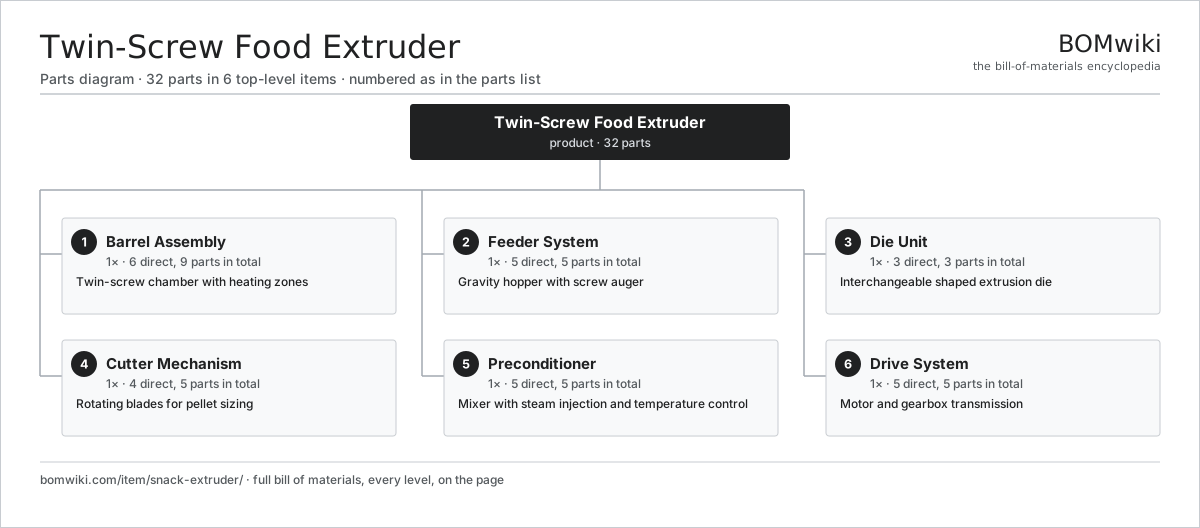
| # | Part | Qty | What it does |
|---|---|---|---|
| 1 | Barrel Assembly 6 parts | 1× | Twin-screw chamber with heating zones |
| 2 | Feeder System 5 parts | 1× | Gravity hopper with screw auger |
| 3 | Die Unit 3 parts | 1× | Interchangeable shaped extrusion die |
| 4 | Cutter Mechanism 4 parts | 1× | Rotating blades for pellet sizing |
| 5 | Preconditioner 5 parts | 1× | Mixer with steam injection and temperature control |
| 6 | Drive System 5 parts | 1× | Motor and gearbox transmission |
3D model
No 3D model yet. Have a CAD file of this? Add a 3D model. STL renders right on this page; STEP, FreeCAD, and OpenSCAD sources are welcome too (openly licensed, like all 3D models on BOMwiki).
Build & assembly graph
expand / collapse · shared sub-assemblies converge · links to related products · est. labourTap an assembly to expand/collapse · tap a part to open it · use “Open page” for any node · drag to pan, scroll to zoom.
Bill of materials for Twin-Screw Food Extruder
6 top-level lines · 34 rows shown · 32 parts total · indented to 3 levels| # | Item / sub-assembly | Part no. | Qty/assy | Ext. qty | Parts | Type |
|---|---|---|---|---|---|---|
| 1 | Barrel Assembly 6 parts | snack-extruder-barrel-assembly | 1× | 1 | 9 | assembly |
| 1.1 | Barrel Housing | snack-extruder-barrel-housing | 1× | 1 | · | part |
| 1.2 | Twin Screw Pair | snack-extruder-screw-pair | 1× | 1 | · | part |
| 1.3 | Barrel Liners | snack-extruder-barrel-liners | 1× | 1 | · | part |
| 1.4 | Band Heater | snack-extruder-heating-zones | 4× | 4 | · | part |
| 1.5 | Barrel Seals | snack-extruder-barrel-seals | 1× | 1 | · | part |
| 1.6 | Pressure Sensor | pressure-sensor | 1× | 1 | · | part |
| 2 | Feeder System 5 parts | snack-extruder-feeder-system | 1× | 1 | 5 | assembly |
| 2.1 | Hopper | snack-extruder-hopper | 1× | 1 | · | part |
| 2.2 | Feeder Screw | snack-extruder-feeder-screw | 1× | 1 | · | part |
| 2.3 | Feeder Motor | snack-extruder-feeder-motor | 1× | 1 | · | part |
| 2.4 | Feeder Gearbox | snack-extruder-feeder-gearbox | 1× | 1 | · | part |
| 2.5 | Flow Sensor | snack-extruder-flow-sensor | 1× | 1 | · | part |
| 3 | Die Unit 3 parts | snack-extruder-die-unit | 1× | 1 | 3 | assembly |
| 3.1 | Die Plate | snack-extruder-die-plate | 1× | 1 | · | part |
| 3.2 | Die Adapter | snack-extruder-die-adapter | 1× | 1 | · | part |
| 3.3 | Die Scraper | snack-extruder-die-scraper | 1× | 1 | · | part |
| 4 | Cutter Mechanism 4 parts | snack-extruder-cutter-mechanism | 1× | 1 | 5 | assembly |
| 4.1 | Cutter Head | snack-extruder-cutter-head | 1× | 1 | · | part |
| 4.2 | Cutter Servo Motor | snack-extruder-cutter-motor | 1× | 1 | · | part |
| 4.3 | Cutter Gearbox | snack-extruder-cutter-gearbox | 1× | 1 | · | part |
| 4.4 | Cutter Blade | snack-extruder-cutter-blade-set | 2× | 2 | · | part |
| 5 | Preconditioner 5 parts | snack-extruder-preconditioner | 1× | 1 | 5 | assembly |
| 5.1 | Precondition Drum | snack-extruder-precondition-drum | 1× | 1 | · | part |
| 5.2 | Precondition Paddle | snack-extruder-precondition-paddle | 1× | 1 | · | part |
| 5.3 | Precondition Motor | snack-extruder-precondition-motor | 1× | 1 | · | part |
| 5.4 | Steam Injector | snack-extruder-steam-injector | 1× | 1 | · | part |
| 5.5 | Temperature Controller | snack-extruder-temp-control | 1× | 1 | · | part |
| 6 | Drive System 5 parts | snack-extruder-drive-system | 1× | 1 | 5 | assembly |
| 6.1 | Main Drive Motor | snack-extruder-main-motor | 1× | 1 | · | part |
| 6.2 | Main Gearbox | snack-extruder-main-gearbox | 1× | 1 | · | part |
| 6.3 | Flex Coupling | snack-extruder-flex-coupling | 1× | 1 | · | part |
| 6.4 | Motor Brake | snack-extruder-motor-brake | 1× | 1 | · | part |
| 6.5 | VFD Control Panel | snack-extruder-vfd-panel | 1× | 1 | · | part |
Something wrong in this list? Report a problem with this BOM.
Related products
same domain, ranked by shared parts Automatic Espresso Tamper
45 parts · shares 1 with this page
Automatic Filleting Machine
73 parts · shares 1 with this page
Automatic Espresso Tamper
45 parts · shares 1 with this page
Automatic Filleting Machine
73 parts · shares 1 with this page
 Bakery Deck Oven
44 parts · shares 1 with this page
Batter and Breading Line
127 parts · shares 1 with this page
Beverage Carbonator
95 parts · shares 1 with this page
Bakery Deck Oven
44 parts · shares 1 with this page
Batter and Breading Line
127 parts · shares 1 with this page
Beverage Carbonator
95 parts · shares 1 with this page
Sourcing: possible vendors
Browse the supplier directory → Prices, MOQ, and lead times are algorithmic estimates, not quotes, and not claims about these companies. Company mappings are curated by keyword; est. price band $1k–$500k. How estimates work| Vendor | HQ | Specialty | MOQ | Lead time |
|---|---|---|---|---|
| gea.com ↗ | Düsseldorf, DE | Process technology | 20 units | 12–20 wks |
| buhlergroup.com ↗ | Uzwil, CH | Food & materials processing | 20 units | 12–20 wks |
| tetrapak.com ↗ | Pully, CH | Food packaging & processing | 20 units | 12–20 wks |
| jbtc.com ↗ | Chicago, US | Food processing equipment | 20 units | 12–20 wks |
| alfalaval.com ↗ | Lund, SE | Heat transfer & separation | 20 units | 12–20 wks |
808-word article