Snow Melting Machine
ProductOverview
A snow melter is a mobile facility for converting accumulated snow into water, critical in dense urban areas where snow storage is limited or impossible. The machine consists of a trailer-towed tank fitted with diesel burner tubes, a loading conveyor, and a discharge pump that exports warm water to storm drains or treatment systems. A front-loader pushes snow windrows into the Input Hopper, the Loading Conveyor elevates it into the Melting Tank, and the Diesel Burner and Combustion Control melts it in situ by submerged immersion tubes.
The design avoids the complexity and cost of steam or hot-water piping systems. The burner heats the tank water to 80–90 °C; incoming snow melts through direct contact with hot water and submersion. A Temperature Sensor triggers burner shutdown at target temperature, then the Discharge Pump and Hose System exports the water. Sludge and salt accumulate at the tank bottom and are periodically flushed during maintenance.
Input hopper and conveyor
The Input Hopper is an open-top steel or aluminum box welded to the front of the trailer. A Grate screens out rocks and gravel. The hopper has a 2–3 m³ capacity, enough for two or three front-loader bucket loads before the operator must pause to allow melting.
The Loading Conveyor is usually an inclined Auger Screw at 30–45°, rotating at 100–200 rpm. The Auger Motor is a 7–15 kW electric or small hydraulic motor. The Auger Shaft is driven via a Drive Coupling, and Auger Bearing units support it against radial snow load and side thrust. As the auger rotates, it pulls snow upward from the hopper and discharges it into the tank at the upper end of the incline. The auger compacts the snow somewhat, reducing volume as it travels.
Melting tank and immersion burner
The Melting Tank is the core system. The Tank Shell is a welded steel vessel, typically cylindrical or rectangular, rated for 150 kPa internal pressure. The Tank Insulation is ceramic fiber or mineral wool wrapped around the shell, reducing heat loss to ambient and maintaining the water at 60–90 °C between melts.
Inside the tank, four to eight Burner Tubes are immersed in the water. These are stainless-steel heat-exchanger tubes carrying combustion products (hot gases) from the Diesel Burner at the tank bottom. The burner is a standard commercial oil-fired unit, rated 200–400 kW, with air inlet and nozzle. The Fuel Pump draws [[No. 2 diesel]] from an onboard tank and meters it to the nozzle at 3–7 bar. An Ignition Electrode provides spark or glow-plug ignition; if the flame is lost, the controller shuts down the burner for safety.
The Temperature Sensor is a thermostat or RTD mounted in the tank that sends a signal to the Burner Controller PLC. Once water reaches 90 °C, the burner is shut off; when it falls back to 70 °C, the burner reignites. This on-off cycling minimizes fuel waste while maintaining steady output.
The Tank Drain is at the lowest point, sloped so gravity helps water flow to the Discharge Pump and Hose System. The Access Hatch hatch allows periodic drain-out of sludge and salt sediment that settles at the bottom. Depending on snow source (contaminated urban windrows vs. clean natural snow), sediment can be 10–20% of melted volume by weight.
Discharge system
The Discharge Pump and Hose System is a centrifugal or small positive-displacement pump (5–10 kW electric motor) that exports 20–50 L/min of warm water through the Discharge Hose to storm drains, a treatment lagoon, or a waiting transport truck. The Discharge Valve allows the operator to shut off flow when the destination is full or unavailable.
A Discharge Strainer cartridge or basket filter immediately downstream of the pump removes sludge and fine sediment before the water reaches the storm drain. Without this, silt and salt quickly clog storm drains and cause environmental contamination.
Most melters are positioned near a storm-drain inlet or connected to a portable treatment tank. In some jurisdictions, water must be treated before discharge to remove salt and heavy metals (rubber, brake dust, etc.). A simple treatment is to allow water to settle in a lagoon for 24 hours; the sediment sinks, and cleaner water is decanted to the drain.
Trailer and mobility
The Trailer Chassis is a single or tandem-axle towed platform. The Trailer Frame is heavy-duty welded steel with a drawbar hitch, typically rated to tow 8–12 tonnes (tank plus water load). The Axles and Wheel Assembly are tuned for the full load, with spring suspension for ride quality. The Brake System is usually a surge brake (mechanically activated by tow-vehicle deceleration) or electric trailer brake synchronized to the tow vehicle via a 24 V control wire.
The Hitch Assembly is a pintle or ball coupler with integrated 24 V lighting (marker and brake lights). The trailer must display a hazmat placard if water is classified as wastewater; requirements vary by jurisdiction.
Controls and operation
The Operator Controls are typically a weatherproof Control Panel mounted on the trailer with large push buttons for:
- Burner start/stop
- Conveyor start/stop
- Pump start/stop
The Indicator Light shows when the burner is active and alarms if temperature exceeds setpoint or flame is lost. Most systems have a PLC that monitors all three simultaneously, burner won't start if water is already at 90 °C, pump won't run if water is below 40 °C, etc.
Typical operation: the melter is positioned next to a storm drain, the dump truck or front-loader fills the hopper, the operator starts the conveyor and burner, and within 30 minutes the tank fills with hot water. The operator then starts the discharge pump, and 20–50 L/min flows to the drain. As space opens in the tank, the conveyor and burner continue, melting more incoming snow. A single melter processing thick, wet snow can handle 8–15 tonnes per hour if hopper refills are rapid.
On very cold days (below −20 °C), the tank water temperature may drop below 60 °C between refills if the burner is off too long, and incoming snow becomes thick slush that resists conveyance. Operators must manage burn time to maintain adequate heat reserve.
Snow Melting Machine parts and their functions
7 top-level parts · 74 parts in total · full bill of materials below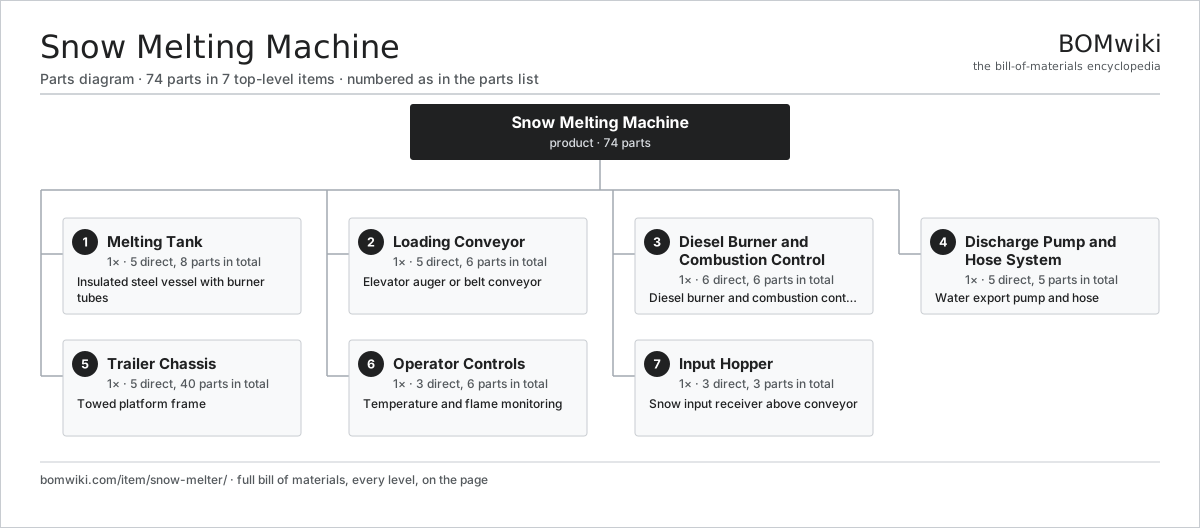
| # | Part | Qty | What it does |
|---|---|---|---|
| 1 | Melting Tank 5 parts | 1× | Insulated steel vessel with burner tubes |
| 2 | Loading Conveyor 5 parts | 1× | Elevator auger or belt conveyor |
| 3 | Diesel Burner and Combustion Control 6 parts | 1× | Diesel burner and combustion control |
| 4 | Discharge Pump and Hose System 5 parts | 1× | Water export pump and hose |
| 5 | Trailer Chassis 5 parts | 1× | Towed platform frame |
| 6 | Operator Controls 3 parts | 1× | Temperature and flame monitoring |
| 7 | Input Hopper 3 parts | 1× | Snow input receiver above conveyor |
3D model
No 3D model yet. Have a CAD file of this? Add a 3D model. STL renders right on this page; STEP, FreeCAD, and OpenSCAD sources are welcome too (openly licensed, like all 3D models on BOMwiki).
Build & assembly graph
expand / collapse · shared sub-assemblies converge · links to related products · est. labourTap an assembly to expand/collapse · tap a part to open it · use “Open page” for any node · drag to pan, scroll to zoom.
Bill of materials for Snow Melting Machine
7 top-level lines · 44 rows shown · 74 parts total · indented to 3 levels| # | Item / sub-assembly | Part no. | Qty/assy | Ext. qty | Parts | Type |
|---|---|---|---|---|---|---|
| 1 | Melting Tank 5 parts | snow-melter-melting-tank | 1× | 1 | 8 | assembly |
| 1.1 | Tank Shell | snow-melter-tank-shell | 1× | 1 | · | part |
| 1.2 | Tank Insulation | snow-melter-tank-insulation | 1× | 1 | · | part |
| 1.3 | Burner Tubes | snow-melter-burner-tubes | 4× | 4 | · | part |
| 1.4 | Tank Drain | snow-melter-tank-drain | 1× | 1 | · | part |
| 1.5 | Access Hatch | snow-melter-tank-access | 1× | 1 | · | part |
| 2 | Loading Conveyor 5 parts | snow-melter-loading-conveyor | 1× | 1 | 6 | assembly |
| 2.1 | Auger Screw | snow-melter-auger-screw | 1× | 1 | · | part |
| 2.2 | Auger Shaft | snow-melter-auger-shaft | 1× | 1 | · | part |
| 2.3 | Auger Motor | snow-melter-auger-motor | 1× | 1 | · | part |
| 2.4 | Auger Bearing | snow-melter-auger-bearing | 2× | 2 | · | part |
| 2.5 | Drive Coupling | snow-melter-drive-coupling | 1× | 1 | · | part |
| 3 | Diesel Burner and Combustion Control 6 parts | snow-melter-burner-system | 1× | 1 | 6 | assembly |
| 3.1 | Diesel Burner | snow-melter-diesel-burner | 1× | 1 | · | part |
| 3.2 | Fuel Pump | snow-melter-fuel-pump | 1× | 1 | · | part |
| 3.3 | Fuel Filter | snow-melter-fuel-filter | 1× | 1 | · | part |
| 3.4 | Ignition Electrode | snow-melter-ignition-electrode | 1× | 1 | · | part |
| 3.5 | Temperature Sensor | snow-melter-temperature-sensor | 1× | 1 | · | part |
| 3.6 | Burner Controller | snow-melter-burner-control | 1× | 1 | · | part |
| 4 | Discharge Pump and Hose System 5 parts | snow-melter-discharge-pump | 1× | 1 | 5 | assembly |
| 4.1 | Export Pump | snow-melter-export-pump | 1× | 1 | · | part |
| 4.2 | Pump Motor | snow-melter-pump-motor | 1× | 1 | · | part |
| 4.3 | Discharge Hose | snow-melter-discharge-hose | 1× | 1 | · | part |
| 4.4 | Discharge Valve | snow-melter-discharge-valve | 1× | 1 | · | part |
| 4.5 | Discharge Strainer | snow-melter-strainer | 1× | 1 | · | part |
| 5 | Trailer Chassis 5 parts | snow-melter-trailer-chassis | 1× | 1 | 40 | assembly |
| 5.1 | Trailer Frame | snow-melter-frame | 1× | 1 | · | part |
| 5.2 | Axles | snow-melter-axles | 1× | 1 | · | part |
| 5.3 | Wheel Assembly 5 parts | wheel-assembly | 4× | 4 | 9 | assembly |
| 5.3.1 | Alloy Wheel | alloy-wheel | 1× | 4 | · | part |
| 5.3.2 | Tire | tire | 1× | 4 | · | part |
| 5.3.3 | TPMS Sensor | tpms-sensor | 1× | 4 | · | part |
| 5.3.4 | Lug Nut | lug-nut | 5× | 20 | · | part |
| 5.3.5 | Valve Stem | valve-stem | 1× | 4 | · | part |
| 5.4 | Hitch Assembly | snow-melter-hitch | 1× | 1 | · | part |
| 5.5 | Brake System | snow-melter-brake-system | 1× | 1 | · | part |
| 6 | Operator Controls 3 parts | snow-melter-controls | 1× | 1 | 6 | assembly |
| 6.1 | Control Panel | snow-melter-control-panel | 1× | 1 | · | part |
| 6.2 | Pushbutton | snow-melter-pushbutton | 3× | 3 | · | part |
| 6.3 | Indicator Light | snow-melter-indicator-light | 2× | 2 | · | part |
| 7 | Input Hopper 3 parts | snow-melter-hopper | 1× | 1 | 3 | assembly |
| 7.1 | Hopper Box | snow-melter-hopper-box | 1× | 1 | · | part |
| 7.2 | Grate | snow-melter-hopper-grate | 1× | 1 | · | part |
| 7.3 | Chute Baffle | snow-melter-hopper-baffle | 1× | 1 | · | part |
Something wrong in this list? Report a problem with this BOM.
Related products
same domain, ranked by shared parts Articulated Dump Truck
128 parts · shares 6 with this page
Articulated Dump Truck
128 parts · shares 6 with this page
 Asphalt Distributor Truck
113 parts · shares 6 with this page
Asphalt Distributor Truck
113 parts · shares 6 with this page
 Backhoe Loader
278 parts · shares 6 with this page
Backhoe Loader
278 parts · shares 6 with this page
 Chip Spreader
108 parts · shares 6 with this page
Chip Spreader
108 parts · shares 6 with this page
 Concrete Mixer Truck
286 parts · shares 6 with this page
Concrete Mixer Truck
286 parts · shares 6 with this page
Sourcing: possible vendors
Browse the supplier directory → Prices, MOQ, and lead times are algorithmic estimates, not quotes, and not claims about these companies. Company mappings are curated by keyword; est. price band $15k–$2M. How estimates work| Vendor | HQ | Specialty | MOQ | Lead time |
|---|---|---|---|---|
| caterpillar.com ↗ | Irving, US | Construction & mining equipment | made to order | 16–28 wks |
|
🇯🇵Komatsu
komatsu.com ↗
|
Tokyo, JP | Construction & mining equipment | made to order | 16–28 wks |
|
🇸🇪Volvo CE
volvoce.com ↗
|
Gothenburg, SE | Construction equipment | made to order | 16–28 wks |
|
🇨🇭Liebherr
liebherr.com ↗
|
Bulle, CH | Cranes & heavy equipment | made to order | 16–28 wks |
|
🇨🇳XCMG
xcmg.com ↗
|
Xuzhou, CN | Construction machinery | made to order | 16–28 wks |
1,112-word article