Snowboard
ProductOverview
A snowboard is a laminated composite board designed for downhill snow riding, standing sideways on a single platform rather than in line like skis. The modern snowboard consists of a layered construction with a wood or foam core for flex and vibration damping, surrounded by fiberglass and epoxy resin for structural stiffness, finished with a polyethylene base for gliding and steel edges for carving. The board flexes in two directions: lengthwise for response to terrain, and torsionally for edge control. Most snowboards use a symmetrical or directional twin shape with a nose and tail of similar flex and rocker profile, allowing riding in either direction (switch).
The sport of snowboarding emerged in the late 1970s, evolving from surfing and skateboarding principles applied to snow. Unlike skis, which separate the feet and distribute weight over two independent platforms, a snowboard requires the rider to stand at a 45–70° angle relative to the board's length and use body rotation, weight transfer, and edge tilt to control direction and speed. This fundamental difference shaped the engineering: snowboards require stronger torsional stiffness and more pronounced sidecut geometry than skis of equivalent length.
How it works
The rider stands with one foot forward (regular or goofy stance) and uses heel and toe edge pressure to carve turns. The Edge Assembly digs into the snow, and the Core Assembly flex creates natural rebound. The Base Layer glides with minimal friction, while wax helps maintain speed. The Topsheet Layer and Sidewall Assembly protect the core and edges from impact and water ingress.
The Binding Interface mounts the rider's boots via standard binding patterns (ISO 1776 or earlier Burner patterns). The Insert Set provides threaded anchor points; the binding straps tighten around the boot, transferring rider weight and control inputs to the board. When the rider tilts the board to an edge and applies pressure, the steel edges cut into the snow, creating a curved path following the board's sidecut radius and rider-induced flex.
Rocker profile (upward curve at nose and tail) reduces edge length in contact with snow, easing turn initiation and flotation in soft snow. Camber profile (upward curve in the middle) increases edge contact and responsiveness on hard-packed terrain. Most boards blend both geometries.
Materials and construction
The Wood Core is typically laminated poplar or pine, valued for its lightweight and responsive flex characteristics. Manufacturers select wood grades and layer orientation (staggered thickness or cross-plied) to achieve target flex ratings. The Foam Layer, often expanded polystyrene or polyurethane, fills voids and absorbs vibration; closed-cell foams improve durability and resist water absorption.
The fiberglass layup is critical to torsional stiffness. Unidirectional fiberglass fibers running lengthwise (0°) resist bending; fibers at ±45° resist torsion; a 0°/90° woven can cover both. The Fiberglass Bias Ply plies are impregnated with Resin System (typically epoxy) to form a pre-preg or wet-laid laminate that hardens in a heated press. The ordering of plies (stacking sequence) determines board personality: boards with resin-rich outer plies feel more responsive, while dense core-heavy stacks prioritize durability.
The Base Layer is extruded ultra-high-molecular-weight polyethylene (UHMWPE), chosen for its low friction coefficient and wax absorption. Sintered bases, formed by heating and pressing polyethylene powder, offer greater porosity and slightly lower friction but higher maintenance cost. The base is routed with a slight concave profile to prevent edge hopping and improve gliding.
The snowboard-steel-edge-assembly consists of tapered hardened steel (often 4340 or similar) mounted on the board's perimeter. Tapered geometry (thicker at the top surface, thinner at the base) provides stiffness for edge hold while remaining light. Edges are bonded with Edge Adhesive and often riveted with Edge Rivets for safety redundancy. The Topsheet Layer covers the top surface with printed graphics under a UV-resistant Gloss Coat, while the Sidewall Assembly wraps the sides, protecting the laminate stack and adding torsional support.
The Binding Interface and Insert Set are installed during construction. Mounting channels are aligned perpendicular to the board's length and parallel to the binding stance width. Brass inserts are pressed into the wood core under heat and epoxy, creating threads that survive repeated screw insertion cycles (typical boards endure 5+ binding mount/remount cycles).
Performance characteristics
Snowboard performance varies by target discipline. All-mountain boards (length 150–160 cm, flex 4–6) balance carving edge hold with float and maneuverability. Freestyle boards (length 145–155 cm, flex 2–4) prioritize pop and torsional forgiveness for tricks. Freeride boards (length 155–165 cm, flex 6–8) favor directional stiffness and edge stability at speed. Racing boards (length 155–170 cm, flex 8–10) maximize edge precision and minimize flex for high-speed carving.
Sidecut radius (typically 8–25 m for alpine, wider for all-mountain and powder) determines the radius of the arc the board naturally follows when tilted to an edge. A tighter sidecut enables quick, short-radius turns; a gentler sidecut suits longer, faster carves. Effective edge length (typically 70–120 cm) is the portion of the edge actually in contact with snow when the board is flat; a longer effective edge provides stability and hold, while a shorter edge eases maneuverability.
Flex and torsional stiffness strongly influence feel. A soft, torsionally flexible board (rating 2–3) forgives uneven pressure and absorbs vibration, making it accessible to beginners; a stiff board (rating 8–10) requires precise technique but rewards edge control and speed stability. Many riders favor a board with stiffer lengthwise flex but moderate torsional flex, providing edge hold without excessive demand on technique.
Maintenance
Bases require periodic waxing; a fresh coat of wax applied by iron or in a shop improves gliding and protects the polyethylene from oxidation and moisture damage. Edges dull with use and benefit from professional sharpening (using a base bevel angle of 0°–3° and a side bevel of 1°–2° depending on discipline). Damaged edges can be repaired by welding (using aluminum filler and subsequent polishing) if the core is not exposed. The topsheet and sidewalls are cosmetic; minor cracks do not affect performance, but large delaminations that reach the core require professional repair to prevent water ingress and rot.
End-of-season maintenance includes a deep wax and storage in a cool, dry environment away from direct sunlight, as UV exposure degrades the topsheet and sidewalls. Boards stored with improper edge or base contact (e.g., leaning against a wall on a flat edge) can warp. A board in regular use should last 3–7 seasons before the base becomes too thin for effective gliding or the edges corrode beyond safe restoration.
Snowboard parts and their functions
8 top-level parts · 33 parts in total · full bill of materials below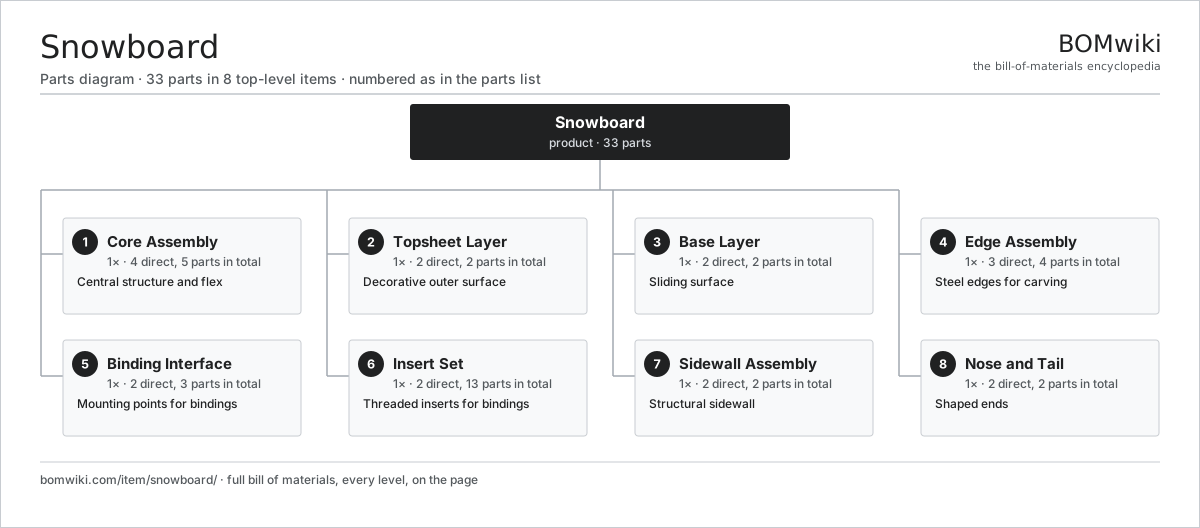
| # | Part | Qty | What it does |
|---|---|---|---|
| 1 | Core Assembly 4 parts | 1× | Central structure and flex |
| 2 | Topsheet Layer 2 parts | 1× | Decorative outer surface |
| 3 | Base Layer 2 parts | 1× | Sliding surface |
| 4 | Edge Assembly 3 parts | 1× | Steel edges for carving |
| 5 | Binding Interface 2 parts | 1× | Mounting points for bindings |
| 6 | Insert Set 2 parts | 1× | Threaded inserts for bindings |
| 7 | Sidewall Assembly 2 parts | 1× | Structural sidewall |
| 8 | Nose and Tail 2 parts | 1× | Shaped ends |
3D model
No 3D model yet. Have a CAD file of this? Add a 3D model. STL renders right on this page; STEP, FreeCAD, and OpenSCAD sources are welcome too (openly licensed, like all 3D models on BOMwiki).
Build & assembly graph
expand / collapse · shared sub-assemblies converge · links to related products · est. labourTap an assembly to expand/collapse · tap a part to open it · use “Open page” for any node · drag to pan, scroll to zoom.
Bill of materials for Snowboard
8 top-level lines · 27 rows shown · 33 parts total · indented to 3 levels| # | Item / sub-assembly | Part no. | Qty/assy | Ext. qty | Parts | Type |
|---|---|---|---|---|---|---|
| 1 | Core Assembly 4 parts | snowboard-core-assembly | 1× | 1 | 5 | assembly |
| 1.1 | Wood Core | snowboard-wood-core | 1× | 1 | · | part |
| 1.2 | Foam Layer | snowboard-foam-layer | 1× | 1 | · | part |
| 1.3 | Fiberglass Bias Ply | snowboard-fiberglass-bias | 2× | 2 | · | part |
| 1.4 | Resin System | snowboard-resin-system | 1× | 1 | · | part |
| 2 | Topsheet Layer 2 parts | snowboard-topsheet-layer | 1× | 1 | 2 | assembly |
| 2.1 | ABS Sheet | snowboard-abs-sheet | 1× | 1 | · | part |
| 2.2 | Gloss Coat | snowboard-gloss-coat | 1× | 1 | · | part |
| 3 | Base Layer 2 parts | snowboard-base-layer | 1× | 1 | 2 | assembly |
| 3.1 | Polyethylene Base | snowboard-pe-extruded-base | 1× | 1 | · | part |
| 3.2 | Wax Compound | snowboard-wax-compound | 1× | 1 | · | part |
| 4 | Edge Assembly 3 parts | snowboard-edge-assembly | 1× | 1 | 4 | assembly |
| 4.1 | Steel Edge Stock | snowboard-steel-edge-stock | 2× | 2 | · | part |
| 4.2 | Edge Adhesive | snowboard-edge-adhesive | 1× | 1 | · | part |
| 4.3 | Edge Rivets | snowboard-edge-rivets | 1× | 1 | · | part |
| 5 | Binding Interface 2 parts | snowboard-binding-interface | 1× | 1 | 3 | assembly |
| 5.1 | Mounting Channel | snowboard-mounting-channel | 2× | 2 | · | part |
| 5.2 | Channel Seal | snowboard-channel-seal | 1× | 1 | · | part |
| 6 | Insert Set 2 parts | snowboard-insert-set | 1× | 1 | 13 | assembly |
| 6.1 | Brass Insert | snowboard-brass-insert | 12× | 12 | · | part |
| 6.2 | Insert Adhesive | snowboard-insert-adhesive | 1× | 1 | · | part |
| 7 | Sidewall Assembly 2 parts | snowboard-sidewall-assembly | 1× | 1 | 2 | assembly |
| 7.1 | Sidewall Plastic | snowboard-sidewall-plastic | 1× | 1 | · | part |
| 7.2 | Sidewall Adhesive | snowboard-sidewall-adhesive | 1× | 1 | · | part |
| 8 | Nose and Tail 2 parts | snowboard-nose-tail | 1× | 1 | 2 | assembly |
| 8.1 | Nose Shape | snowboard-nose-shape | 1× | 1 | · | part |
| 8.2 | Tail Shape | snowboard-tail-shape | 1× | 1 | · | part |
Something wrong in this list? Report a problem with this BOM.
Sourcing: possible vendors
Browse the supplier directory → Prices, MOQ, and lead times are algorithmic estimates, not quotes, and not claims about these companies. Company mappings are curated by keyword; est. price band $20–$2k. How estimates work| Vendor | HQ | Specialty | MOQ | Lead time |
|---|---|---|---|---|
|
🇺🇸Coleman
coleman.com ↗
|
Chicago, US | Camping gear | 1,000 units | 6–10 wks |
| thenorthface.com ↗ | Denver, US | Outdoor apparel & gear | 1,000 units | 6–10 wks |
|
🇺🇸YETI
yeti.com ↗
|
Austin, US | Coolers & drinkware | 1,000 units | 6–10 wks |
| decathlon.com ↗ | Villeneuve-d'Ascq, FR | Sporting goods | 1,000 units | 6–10 wks |
|
🇺🇸Garmin
garmin.com ↗
|
Olathe, US | GPS & wearables | 1,000 units | 6–10 wks |
1,126-word article