Snowshoes
ProductOverview
Snowshoes are footwear designed to distribute a person's weight over a large surface area, enabling walking on soft snow without sinking. Traditional snowshoes feature an elongated oval or teardrop frame made of ash wood, with webbing (historically rawhide, now synthetic) stretched across the frame, and metal crampons welded to the underside for ice traction. Modern designs substitute lightweight aluminum frames and synthetic webbing, improving durability and reducing weight. A mechanical heel lift mechanism helps users navigate uphill terrain by elevating the heel, reducing calf fatigue and increasing walking efficiency.
Snowshoes are essential in snow climates (northern regions, mountain areas) where snow depth exceeds 10 cm. Without flotation aids, walkers sink 30–50 cm with each step on powder snow; snowshoes reduce sinking to 5–10 cm, dramatically extending range and reducing fatigue.
How It Works
The Oval Frame Structure is an oval or teardrop perimeter structure, typically 50–80 cm long and 20–30 cm wide. Traditional frames are steam-bent ash wood, laminated and held in shape with rawhide lashes at the corners. Modern frames use aluminum extrusion, shaped to the traditional profile. The Frame Crossbar members (usually two transverse braces) add structural rigidity without adding much weight.
The Webbed Deck Surface is a web of nylon or synthetic fiber laced in a specific pattern: vertical strands run toe-to-heel, and Cross-Lacing Pattern perpendicular strands create a mesh. This open weave allows snow to fall through rather than accumulating and adding weight. The Nylon Webbing Deck is typically 2–3 mm thick, providing moderate stiffness; it is attached to the frame via small knots or bolts at regular intervals.
When a user walks in snowshoes, their weight is distributed across the large footprint area (typically 1000–2400 cm²). By comparison, a boot alone has a footprint of ~100 cm², a 10–24x reduction in pressure per square centimeter. This lower pressure prevents sinking into soft powder (which yields under high stress but remains stable under distributed light loads).
The Foot Bindings secure the boot to the snowshoe deck, accommodating boots of various sizes via a Ratchet Binding System mechanism. The Toe Strap holds the boot toe in a fixed forward position, and the Heel Strap wraps around the ankle or heel. Most modern bindings allow the heel to lift freely (the boot sole is not rigidly attached to the deck), enabling a natural walking gait.
The Metal Traction Crampons are metal claws welded to the frame undersurface. The Toe Crampons provides forward bite on icy conditions; the Heel Crampon Points points bite downhill. The Side Crampon Teeth along the frame edges (port and starboard) prevent sideways slipping on slopes. Crampons are typically stainless or hardened steel, with 4–6 serrated teeth or points each.
The Heel Lift Bar is a mechanical innovation that improves uphill walking efficiency. As the user walks uphill, they can activate the Heel Lift Lever (a hinged bar at the snowshoe rear) by pressing their heel backward. This elevates the heel 25–50 mm above the Webbed Deck Surface, reducing the angle of the foot relative to the slope. Normally, uphill walking in snowshoes requires significant calf and shin effort because the long snowshoe deck is flexed and held horizontal. The heel lift allows the user to assume a more natural "heel-up" climbing posture, significantly reducing fatigue on sustained climbs. The Lift Spring Mechanism automatically lowers the lift lever when the user descends or walks on level ground.
Material Science
The Wooden Frame (Ash) (ash) is chosen for its combination of strength and flexibility. Ash has a high strength-to-weight ratio and tolerates repeated bending without cracking. Wood frames are traditionally steam-bent to shape and laminated to reinforce the structure. The Aluminum Frame Extrusion (6061-T6 alloy) is lighter and does not require maintenance, but is slightly stiffer and less damping (less forgiving on rough terrain).
The Nylon Webbing Deck is typically a 600–1000 denier nylon or polyester fabric, providing adequate stiffness without excessive weight. Some designs use polycarbonate or polypropylene composite decking for increased durability. The open-weave pattern ensures snow does not accumulate; a closed deck would add 1–2 kg of ice weight per snowshoe during a day's use.
The Metal Traction Crampons are stainless steel (resistant to corrosion) or hardened carbon steel (stronger but requires annual waxing to prevent rust). Most crampons are welded to the frame at multiple attachment points to distribute stress.
Load Capacity and Flotation
A snowshoe's load capacity is determined by its footprint area. The rule of thumb: floatation requires approximately 20 cm² of snowshoe area per kilogram of user weight (including gear). A 70 kg person requires ~1400 cm² footprint; standard teardrop snowshoes (50 cm × 25 cm ≈ 1250 cm²) are at the borderline, while larger models (60 cm × 28 cm ≈ 1680 cm²) provide comfort margin.
Overloading (e.g., a 100 kg person in 1200 cm² shoes) causes excessive sinking (15–20 cm), increasing energy expenditure and leg fatigue. Underloading (e.g., a 40 kg person in large snowshoes) causes instability, making the snowshoes difficult to control on slopes.
Walking Gait
Snowshoe walking is inherently wider than normal walking. The width (20–30 cm) exceeds the natural stride width, causing the foot to splay outward slightly. Users walk with a "waddling" motion, rotating hips more than in normal walking. This is unavoidable and accounts for increased energy expenditure (10–20%) compared to walking the same distance on snow-free terrain.
The Heel Lift Bar dramatically improves efficiency on slopes. Climbs of 15–30° slopes are 30–50% less fatiguing with the heel lift engaged. Descents are made with the lift disengaged, allowing the long snowshoe to work as a brake.
Snow Type Considerations
Snowshoes perform best on packed powder and wind-compacted snow. Wet, spring snow (isothermal, near-freezing) causes accumulation on the Webbed Deck Surface, adding 2–4 kg per snowshoe. Some users apply a non-stick coating (Teflon spray) to the decking to reduce adhesion.
Crust-covered snow (a layer of ice over powder) is treacherous in snowshoes; the user may break through the crust and sink into powder underneath. Many snowshoe users carry emergency flotation aids in mountainous terrain where post-holing (sinking suddenly through a crust layer) risks becoming trapped.
Modern Variants
Lightweight racing or mountaineering snowshoes reduce frame and decking weight to 0.8–1.2 kg per pair, sacrificing some durability for speed. Larger recreational snowshoes accommodate overweight users or heavy gear loads, reaching 2.0 kg per pair.
Some modern designs integrate the Metal Traction Crampons directly into the decking (molded-in teeth) rather than separate welded components, reducing manufacturing steps but slightly reducing durability.
Electric heated bindings have emerged for extreme-cold mountaineering, keeping feet warm without bulky insulation that would restrict ankle movement.
Snowshoes parts and their functions
5 top-level parts · 30 parts in total · full bill of materials below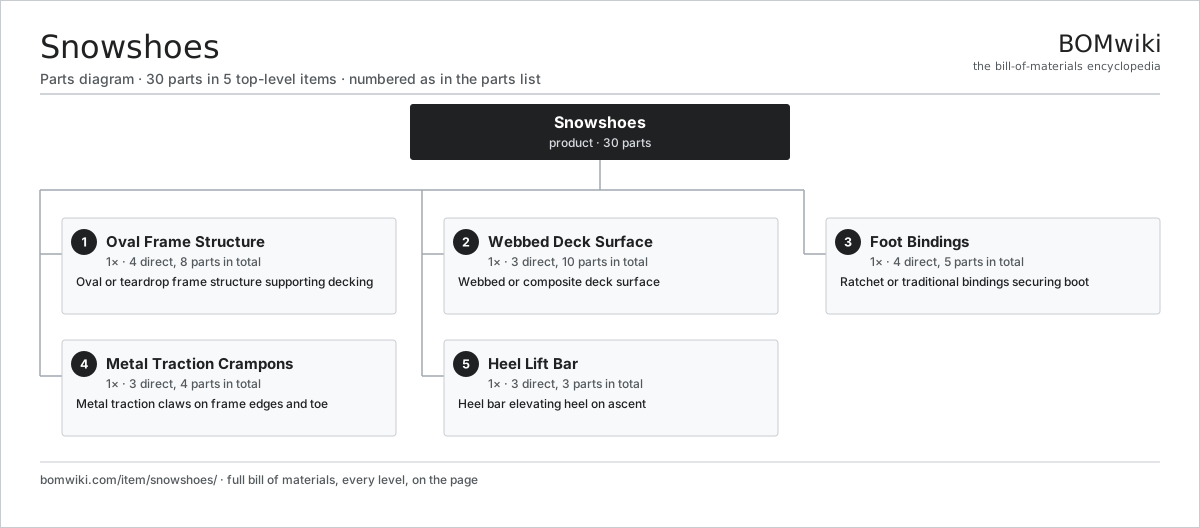
| # | Part | Qty | What it does |
|---|---|---|---|
| 1 | Oval Frame Structure 4 parts | 1× | Oval or teardrop frame structure supporting decking |
| 2 | Webbed Deck Surface 3 parts | 1× | Webbed or composite deck surface |
| 3 | Foot Bindings 4 parts | 1× | Ratchet or traditional bindings securing boot |
| 4 | Metal Traction Crampons 3 parts | 1× | Metal traction claws on frame edges and toe |
| 5 | Heel Lift Bar 3 parts | 1× | Heel bar elevating heel on ascent |
3D model
No 3D model yet. Have a CAD file of this? Add a 3D model. STL renders right on this page; STEP, FreeCAD, and OpenSCAD sources are welcome too (openly licensed, like all 3D models on BOMwiki).
Build & assembly graph
expand / collapse · shared sub-assemblies converge · links to related products · est. labourTap an assembly to expand/collapse · tap a part to open it · use “Open page” for any node · drag to pan, scroll to zoom.
Bill of materials for Snowshoes
5 top-level lines · 22 rows shown · 30 parts total · indented to 3 levels| # | Item / sub-assembly | Part no. | Qty/assy | Ext. qty | Parts | Type |
|---|---|---|---|---|---|---|
| 1 | Oval Frame Structure 4 parts | snowshoes-frame | 1× | 1 | 8 | assembly |
| 1.1 | Wooden Frame (Ash) | snowshoes-frame-wood | 1× | 1 | · | part |
| 1.2 | Aluminum Frame Extrusion | snowshoes-frame-aluminum | 1× | 1 | · | part |
| 1.3 | Frame Crossbar | snowshoes-frame-crossbar | 2× | 2 | · | part |
| 1.4 | Frame Corner Connector | snowshoes-frame-connector | 4× | 4 | · | part |
| 2 | Webbed Deck Surface 3 parts | snowshoes-decking | 1× | 1 | 10 | assembly |
| 2.1 | Nylon Webbing Deck | snowshoes-decking-nylon | 1× | 1 | · | part |
| 2.2 | Cross-Lacing Pattern | snowshoes-decking-cross-lace | 1× | 1 | · | part |
| 2.3 | Webbing Fasteners | snowshoes-decking-attachment | 8× | 8 | · | part |
| 3 | Foot Bindings 4 parts | snowshoes-bindings | 1× | 1 | 5 | assembly |
| 3.1 | Ratchet Binding System | snowshoes-binding-ratchet | 1× | 1 | · | part |
| 3.2 | Toe Strap | snowshoes-binding-toe-strap | 1× | 1 | · | part |
| 3.3 | Heel Strap | snowshoes-binding-heel-strap | 1× | 1 | · | part |
| 3.4 | Binding Anchor Bolts | snowshoes-binding-attachment-points | 2× | 2 | · | part |
| 4 | Metal Traction Crampons 3 parts | snowshoes-crampons | 1× | 1 | 4 | assembly |
| 4.1 | Toe Crampons | snowshoes-crampon-toe | 1× | 1 | · | part |
| 4.2 | Heel Crampon Points | snowshoes-crampon-heel | 1× | 1 | · | part |
| 4.3 | Side Crampon Teeth | snowshoes-crampon-side-teeth | 2× | 2 | · | part |
| 5 | Heel Lift Bar 3 parts | snowshoes-heel-lift | 1× | 1 | 3 | assembly |
| 5.1 | Heel Lift Lever | snowshoes-lift-lever | 1× | 1 | · | part |
| 5.2 | Lift Spring Mechanism | snowshoes-lift-spring | 1× | 1 | · | part |
| 5.3 | Lift Positive Stop | snowshoes-lift-latch | 1× | 1 | · | part |
Something wrong in this list? Report a problem with this BOM.
Sourcing: possible vendors
Browse the supplier directory → Prices, MOQ, and lead times are algorithmic estimates, not quotes, and not claims about these companies. Company mappings are curated by keyword; est. price band $20–$2k. How estimates work| Vendor | HQ | Specialty | MOQ | Lead time |
|---|---|---|---|---|
|
🇺🇸Coleman
coleman.com ↗
|
Chicago, US | Camping gear | 1,000 units | 6–10 wks |
| thenorthface.com ↗ | Denver, US | Outdoor apparel & gear | 1,000 units | 6–10 wks |
|
🇺🇸YETI
yeti.com ↗
|
Austin, US | Coolers & drinkware | 1,000 units | 6–10 wks |
| decathlon.com ↗ | Villeneuve-d'Ascq, FR | Sporting goods | 1,000 units | 6–10 wks |
|
🇺🇸Garmin
garmin.com ↗
|
Olathe, US | GPS & wearables | 1,000 units | 6–10 wks |
1,136-word article