Sock Knitting Machine
ProductOverview
A sock-knitting machine produces complete socks from yarn without seams. The machine is a specialized circular knitter with a hemispherical or drum-shaped Needle Cylinder holding 200–400 latch needles arranged in a circle. Unlike a generic circular knitter that produces a simple tube, the sock machine has specialized cams and mechanisms for shaping the heel pocket, tapering the leg-to-foot transition, and closing the toe by gathering loops without knotting. A modern sock machine is fully computerized: the operator loads yarn, selects a sock size and pattern from the control panel, and the machine knits a complete finished sock in 30–60 seconds, ejecting it into a bin.
The Main Frame is cast iron with a rotary Needle Cylinder supported by precision bearings. The Yarn Feeder System deliver yarn under constant tension to the rotating needle bed; typical machines have 4–12 feeders, each feeding one color or texture, allowing multicolor and mixed-fiber socks. The Patterning Selector System determine which needles knit and which hold, creating stitch patterns and color designs. The Heel Formation System redirects needles to form a heel pocket; the Toe Closing System gathers the final loops and cuts the yarn; and the Takedown Mechanism draws the completed sock from the cylinder. The Main Drive System synchronizes all motion, and the Control Unit allows the operator to select sock length, width, heel style, and pattern.
How it works
Circular knitting begins with a set of needles rotating inside the cylinder. Each time the cylinder rotates one position, the Yarn Feeder System feed new yarn into the needle hooks. A series of stationary cams above and below the cylinder guide the needles through their sequence: yarn insertion, hook closure (latching), yarn withdrawal, and loop formation. As the cycle repeats around 360 degrees and the cylinder rotates, a continuous tube of knitted fabric emerges below the needle bed, where it is held in place by the Sinker Ring.
The key to sock production is shaped knitting. Early in the cycle, all needles knit to build the sock leg (a simple tube). At a programmed point, the Heel Formation System switches part of the needles (typically half) into a "hold" mode while the others continue. The held needles remain stationary relative to the cylinder, effectively shortening the working needle bed and creating a partial-circle of knitting. This narrowing, combined with the lateral motion of the Heel Shaping Cam, forms a tapered heel pocket. After a few rotations, the held needles are returned to knitting, and the tube expands again into the foot section.
The Patterning Selector System work by solenoid-actuated levers that push individual needle latches open or closed. The Control Unit firmware manages the solenoid firing pattern, one row at a time. This allows any color or stitch pattern that fits within the needle count. Modern machines can execute jacquard-style multicolor socks by switching yarn feeders in and out at specific rows, so the same latch needle can knit different colors in different rows.
As the tube grows and descends, the Takedown Mechanism pulls the fabric downward at a rate synchronized to the needle cylinder speed. The takedown is critical: if it pulls too fast, the stitches distort; if too slow, the fabric jams. Feedback from the Encoder on the takedown roller keeps speed balanced.
Heel and toe formation
The heel is formed by a transition: needles that were full-circle are temporarily narrowed to a smaller arc (typically 180°), so only half the needles knit while the other half hold their loops. The held section becomes the back of the heel, while the knitting section forms the sole. After several rows, the held needles rejoin, restoring the full-circle foot section. The tapered geometry of the Heel Formation System and the sequencing of the Heel Selector determine the exact shape: a shallow heel for comfort, a deep heel for reinforcement, or a sloped heel for a better fit.
The toe is the most complex formation. As the sock approaches its end, the Toe Cam progressively removes needles from the working set, narrowing the knitting width. Simultaneously, the Loop Transfer Device begins gathering the loops from the narrowing section onto a smaller set of needles. As the final needles meet, all remaining loops are drawn up and onto one or two threads, and the Thread Cutter severs the yarn. The result is a closed toe with no knot or visible seam, the loops are simply gathered and the ends tucked inside.
Yarn and fiber considerations
Sock machines accept yarn from 20 tex (fine merino or acrylic) to 600 tex (heavy wool or blends). Fine yarns knit faster and produce denser, smoother socks; heavier yarns knit slower and yield bulkier, warmer socks. The Yarn Feeder System apply back-tension to prevent yarn breakage and ensure even loops. Most machines have tension settings per feeder; finer yarns run at lower tension (2–4 oz), coarser yarns at higher (6–10 oz). Elastane or spandex is often added to one feeder at low percentage for stretch and recovery.
Natural fibers (cotton, wool) are more prone to moisture-dependent tension shifts, so facilities in humid climates often condition the yarn or adjust feeder tension seasonally. Synthetic fibers (nylon, acrylic, polyester) are more stable. Blended yarns are common, a core of acrylic or polyester with a surface of wool or cotton for comfort and durability.
Production and cost drivers
A typical sock machine produces 30–60 finished socks per minute depending on sock size and complexity. A simple solid-color crew sock from medium gauge takes 30–40 seconds; a multicolor jacquard calf-length sock takes 50–70 seconds. The machine cost is high (200–400k USD for a modern computerized model), but per-unit labor is negligible, one person can operate 2–4 machines simultaneously. The real cost drivers are yarn cost, machine utilization, and needle/cam wear. Needles last 50–200 machine-hours depending on yarn abrasiveness; worn needles cause dropped stitches and must be replaced. Needle packs are expensive, so good textile mills closely monitor needle life and retire needles just before failure rather than waiting for breakage.
Sock Knitting Machine parts and their functions
9 top-level parts · 114 parts in total · full bill of materials below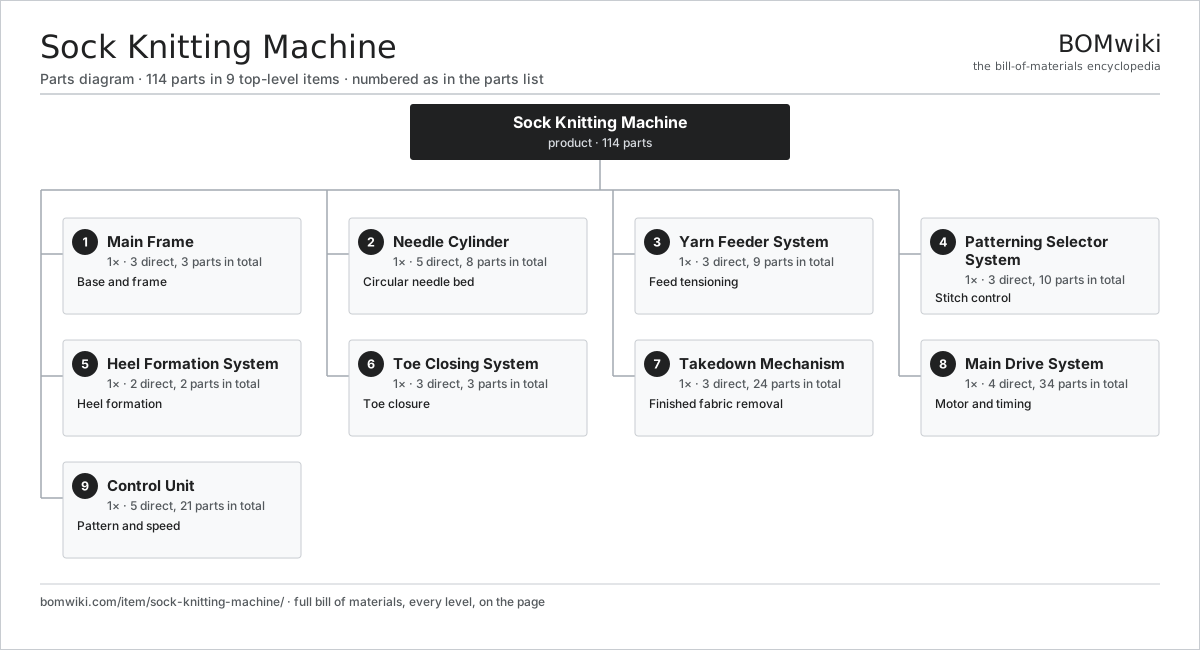
| # | Part | Qty | What it does |
|---|---|---|---|
| 1 | Main Frame 3 parts | 1× | Base and frame |
| 2 | Needle Cylinder 5 parts | 1× | Circular needle bed |
| 3 | Yarn Feeder System 3 parts | 1× | Feed tensioning |
| 4 | Patterning Selector System 3 parts | 1× | Stitch control |
| 5 | Heel Formation System 2 parts | 1× | Heel formation |
| 6 | Toe Closing System 3 parts | 1× | Toe closure |
| 7 | Takedown Mechanism 3 parts | 1× | Finished fabric removal |
| 8 | Main Drive System 4 parts | 1× | Motor and timing |
| 9 | Control Unit 5 parts | 1× | Pattern and speed |
3D model
No 3D model yet. Have a CAD file of this? Add a 3D model. STL renders right on this page; STEP, FreeCAD, and OpenSCAD sources are welcome too (openly licensed, like all 3D models on BOMwiki).
Build & assembly graph
expand / collapse · shared sub-assemblies converge · links to related products · est. labourTap an assembly to expand/collapse · tap a part to open it · use “Open page” for any node · drag to pan, scroll to zoom.
Bill of materials for Sock Knitting Machine
9 top-level lines · 49 rows shown · 114 parts total · indented to 3 levels| # | Item / sub-assembly | Part no. | Qty/assy | Ext. qty | Parts | Type |
|---|---|---|---|---|---|---|
| 1 | Main Frame 3 parts | sock-knitting-machine-main-frame | 1× | 1 | 3 | assembly |
| 1.1 | Base Casting | sock-knitting-machine-base-casting | 1× | 1 | · | part |
| 1.2 | Column Support | sock-knitting-machine-column-support | 1× | 1 | · | part |
| 1.3 | Head Plate | sock-knitting-machine-head-plate | 1× | 1 | · | part |
| 2 | Needle Cylinder 5 parts | sock-knitting-machine-needle-cylinder | 1× | 1 | 8 | assembly |
| 2.1 | Cylinder Body | sock-knitting-machine-cylinder-body | 1× | 1 | · | part |
| 2.2 | Needle Slot System | sock-knitting-machine-needle-slot | 1× | 1 | · | part |
| 2.3 | Latch Needle Pack | sock-knitting-machine-latch-needle | 1× | 1 | · | part |
| 2.4 | Ball Bearing | ball-bearing | 4× | 4 | · | part |
| 2.5 | Sinker Ring | sock-knitting-machine-sinker-ring | 1× | 1 | · | part |
| 3 | Yarn Feeder System 3 parts | sock-knitting-machine-yarn-feeders | 1× | 1 | 9 | assembly |
| 3.1 | Tension Disc | sock-knitting-machine-tension-device | 4× | 4 | · | part |
| 3.2 | Yarn Guide | sock-knitting-machine-yarn-guide | 4× | 4 | · | part |
| 3.3 | Feeder Oscillator | sock-knitting-machine-feeder-oscillator | 1× | 1 | · | part |
| 4 | Patterning Selector System 3 parts | sock-knitting-machine-patterning-selectors | 1× | 1 | 10 | assembly |
| 4.1 | Solenoid Bank | sock-knitting-machine-solenoid-selector | 1× | 1 | · | part |
| 4.2 | Selector Cam | sock-knitting-machine-selector-cam | 1× | 1 | · | part |
| 4.3 | Relay | relay | 8× | 8 | · | part |
| 5 | Heel Formation System 2 parts | sock-knitting-machine-heel-cam | 1× | 1 | 2 | assembly |
| 5.1 | Heel Shaping Cam | sock-knitting-machine-heel-shaping-cam | 1× | 1 | · | part |
| 5.2 | Heel Selector | sock-knitting-machine-heel-needle-selector | 1× | 1 | · | part |
| 6 | Toe Closing System 3 parts | sock-knitting-machine-toe-closing-system | 1× | 1 | 3 | assembly |
| 6.1 | Toe Cam | sock-knitting-machine-toe-cam | 1× | 1 | · | part |
| 6.2 | Loop Transfer Device | sock-knitting-machine-loop-transfer-device | 1× | 1 | · | part |
| 6.3 | Thread Cutter | sock-knitting-machine-thread-cutter | 1× | 1 | · | part |
| 7 | Takedown Mechanism 3 parts | sock-knitting-machine-takedown-mechanism | 1× | 1 | 24 | assembly |
| 7.1 | Takedown Roller | sock-knitting-machine-takedown-roller | 1× | 1 | · | part |
| 7.2 | Takedown Motor 2 parts | sock-knitting-machine-takedown-motor | 1× | 1 | 22 | assembly |
| 7.2.1 | Stator Assembly 3 parts + deeper › | stator-assembly | 1× | 1 | 3 | assembly |
| 7.2.2 | Rotor Assembly 4 parts + deeper › | rotor-assembly | 1× | 1 | 19 | assembly |
| 7.3 | Encoder | encoder | 1× | 1 | · | part |
| 8 | Main Drive System 4 parts | sock-knitting-machine-main-drive | 1× | 1 | 34 | assembly |
| 8.1 | Drive Motor 4 parts | sock-knitting-machine-drive-motor | 1× | 1 | 25 | assembly |
| 8.1.1 | Stator Assembly 3 parts + deeper › | stator-assembly | 1× | 1 | 3 | assembly |
| 8.1.2 | Rotor Assembly 4 parts + deeper › | rotor-assembly | 1× | 1 | 19 | assembly |
| 8.1.3 | Ball Bearing | ball-bearing | 2× | 2 | · | part |
| 8.1.4 | Oil Seal | oil-seal | 1× | 1 | · | part |
| 8.2 | Drive Gearbox 3 parts | sock-knitting-machine-drive-gearbox | 1× | 1 | 7 | assembly |
| 8.2.1 | Gearbox Housing | gearbox-housing | 1× | 1 | · | part |
| 8.2.2 | Helical Gear Pair | gear-pair | 2× | 2 | · | part |
| 8.2.3 | Ball Bearing | ball-bearing | 4× | 4 | · | part |
| 8.3 | Cam Shaft Assembly | sock-knitting-machine-cam-shaft-assembly | 1× | 1 | · | part |
| 8.4 | Drive Belt | drive-belt | 1× | 1 | · | part |
| 9 | Control Unit 5 parts | sock-knitting-machine-control-unit | 1× | 1 | 21 | assembly |
| 9.1 | PLC Card | sock-knitting-machine-plc-card | 1× | 1 | · | part |
| 9.2 | VFD Module | sock-knitting-machine-vfd | 1× | 1 | · | part |
| 9.3 | Relay | relay | 6× | 6 | · | part |
| 9.4 | Connector | connector | 12× | 12 | · | part |
| 9.5 | Power Supply | power-supply | 1× | 1 | · | part |
Something wrong in this list? Report a problem with this BOM.
Related products
same domain, ranked by shared parts Automatic Fabric Cutting Machine
1,695 parts · shares 2 with this page
Automatic Pocket Welt Machine
98 parts · shares 2 with this page
Automatic Winding Machine
288 parts · shares 2 with this page
Belt Loop Attaching Machine
84 parts · shares 2 with this page
Blindstitch Hemming Machine
67 parts · shares 2 with this page
Automatic Fabric Cutting Machine
1,695 parts · shares 2 with this page
Automatic Pocket Welt Machine
98 parts · shares 2 with this page
Automatic Winding Machine
288 parts · shares 2 with this page
Belt Loop Attaching Machine
84 parts · shares 2 with this page
Blindstitch Hemming Machine
67 parts · shares 2 with this page
Sourcing: possible vendors
Browse the supplier directory → Prices, MOQ, and lead times are algorithmic estimates, not quotes, and not claims about these companies. Company mappings are curated by keyword; est. price band $10k–$1M. How estimates work| Vendor | HQ | Specialty | MOQ | Lead time |
|---|---|---|---|---|
|
🇨🇭Rieter
rieter.com ↗
|
Winterthur, CH | Spinning machinery | 10 units | 14–24 wks |
| truetzschler.com ↗ | Mönchengladbach, DE | Textile machinery | 10 units | 14–24 wks |
|
🇧🇪Picanol
picanol.be ↗
|
Ypres, BE | Weaving machines | 10 units | 14–24 wks |
| karlmayer.com ↗ | Obertshausen, DE | Warp knitting machines | 10 units | 14–24 wks |
|
🇨🇭Saurer
saurer.com ↗
|
Arbon, CH | Spinning & embroidery | 10 units | 14–24 wks |
1,086-word article