Solar Attic Fan
ProductOverview
A solar attic fan is a simple, maintenance-free ventilation device powered by a roof-mounted photovoltaic panel, exhausting hot air from the attic to reduce cooling load and prevent moisture damage. The DC fan motor is temperature-controlled: a thermostat switches the fan on when attic temperature exceeds 75–85 °C (user-adjustable) and off when it drops to 65–75 °C.
In hot climates (Arizona, Southern California, Middle East), attic temperatures can reach 60–70 °C on summer afternoons, raising ceiling temperature and increasing air-conditioning load. Conventional (AC-powered) attic fans consume 200–500 W continuously, running on a timer regardless of need. Solar attic fans consume only 20–50 W during operation (powered by direct solar radiation) and operate only when needed (temperature-triggered), making them ideal for off-grid homes, RVs, and retrofits where electrical access is limited or energy costs are high.
PV Panel
The photovoltaic panel is typically a small-format monocrystalline module (10–100 W rated output). At standard test conditions (1000 W/m², 25 °C), a 50 W panel outputs ~3 A at 20 V open-circuit.
The monocrystalline cells (36 cells in series for 12 V module, 72 cells for 24 V) are soldered and tabbed, laminated with tempered borosilicate front cover (92%+ transmission) and polyethylene rear sheet. The aluminum frame provides structural support and mounting points.
A bypass diode (Schottky, rated 60 A) is integral to the junction box, allowing current to bypass the panel if shaded (preventing hot-spot overheating damage). The diode has zero forward voltage drop under normal operation but conducts immediately if any cell is shaded.
Peak power occurs at solar noon (~1000 W/m²), producing maximum fan airflow. Early morning and late afternoon output is reduced proportionally. The fan throughput is continuous with solar intensity (no batteries), so ventilation is highest when attic heat is greatest, a perfect match.
DC Fan Motor
The brushless DC fan (20–50 W rating) is the core component. Brushless design eliminates carbon dust and EMI, making it ideal for residential use. The motor speed automatically reduces as panel voltage decreases (morning/evening), and the thermostat controller gates the motor on/off based on attic temperature.
The fan blade design is optimized for low noise (<60 dB) and modest airflow (500–2000 CFM depending on panel size). Larger installations (multiple units or higher-power panel) achieve 3000+ CFM ventilation, suitable for whole-house cooling.
A thermistor temperature sensor is mounted in the attic airstream, measuring ambient air temperature. This feedback signal is routed via shielded twisted-pair cable to the thermostat control logic.
Thermostat and Control Logic
The thermostat is a simple proportional-temperature controller, often implemented as a discrete comparator circuit or low-cost microcontroller. Logic:
- If attic air temperature (from thermistor) > 80 °C (factory setting), energize the fan motor via gate-drive MOSFET.
- If temperature drops below 70 °C (10 °C hysteresis), de-energize the motor, stopping the fan.
Hysteresis (dead-band) prevents rapid on/off cycling at the threshold, which would reduce efficiency and cause motor wear.
The thermostat is mounted in an IP67 weatherproof box near the PV panel, powered by the same panel voltage. Some designs integrate the thermostat directly into the fan housing or junction box for simplicity.
Roof Flashing and Mounting
The roof flashing is a critical weather-tight penetration. An aluminum or galvanized-steel flashing ring is sloped to match roof pitch (4:12 or steeper), with an EPDM rubber gasket creating a waterproof seal. All fastener holes (typically 12 screws or nails) are sealed with caulk or rubber washers to prevent leaks.
The PV panel is mounted on the roof beside the fan, tilted at the latitude angle (or 30° for simplicity in mid-latitudes) for peak winter/spring power. The fan intake draws air from the attic via the flashing collar; hot air exits through a motorized damper valve on the roof or gable wall, preventing backdraft when the fan is off.
Wiring and Electrical Safety
Low-voltage DC wiring runs from the PV panel to the fan and thermostat. The 10 or 12 AWG UV-rated copper cable carries power (~3–5 A at 20 V); the shielded twisted-pair carries the temperature sensor signal (low current, <1 mA). A 20 A DC disconnect is installed for safe maintenance.
The entire circuit is low-voltage (12–24 V DC), so no electrical permit is typically required in most jurisdictions. However, proper grounding and UV-rated connectors are essential, outdoor elements (rain, snow, ice melt salt) will corrode unprotected copper within months.
Performance and Energy Savings
Attic ventilation reduces ceiling temperature, lowering air-conditioning load. A typical single-story house with attic:
- Without fan: Attic reaches 65 °C on a 30 °C day (ΔT = 35 K)
- With 2000 CFM fan: Attic drops to 40 °C (ΔT = 10 K) during fan operation
The cooling energy savings are roughly proportional to reduced ceiling temperature:
- Ceiling temperature drop: 5 K → ~3–5% reduction in AC energy consumption
- Annual cooling cost: $100–300 (mild climates) to $500–1500 (hot climates)
- Fan payback time: 1–3 years in hot regions; longer in mild climates
Moisture control is another benefit: attic humidity drops when hot air is vented, reducing mold and wood rot risk. A motorized damper prevents humid outdoor air from entering when the fan is off.
Limitations and Considerations
- Weather dependent: Overcast days → reduced panel output → weak fan cooling (ironic, since overcast days often have lower cooling demand).
- Night cooling: Solar fan cannot operate at night; a small battery (~20 Ah LiFePO₄) can provide 4–6 hours evening cooling if night heat rejection is needed.
- Noise: Fan noise (~60 dB) may be audible in attic spaces; insulation and vibration damping help.
- Maintenance: Blade cleaning every 12–24 months (dust accumulation reduces efficiency by ~10–20%).
Variants
- Integrated thermostat + MPPT: Advanced models include maximum-power-point-tracking (MPPT) converters to optimize fan speed across the solar curve, extracting an extra 15–20% power at partial sun.
- WiFi monitoring: Remote models send attic temperature to smartphone; useful for whole-house comfort management.
- Gable-mounted fans: Alternative vent opening (gable wall instead of roof) avoids roof penetration but can require longer ducting.
Solar attic fans are particularly popular in RV and off-grid applications, where electricity is scarce and cooling load is high. A single 50 W unit costs $200–500 installed and requires zero maintenance, making it a popular retrofit for existing homes.
Solar Attic Fan parts and their functions
6 top-level parts · 73 parts in total · full bill of materials below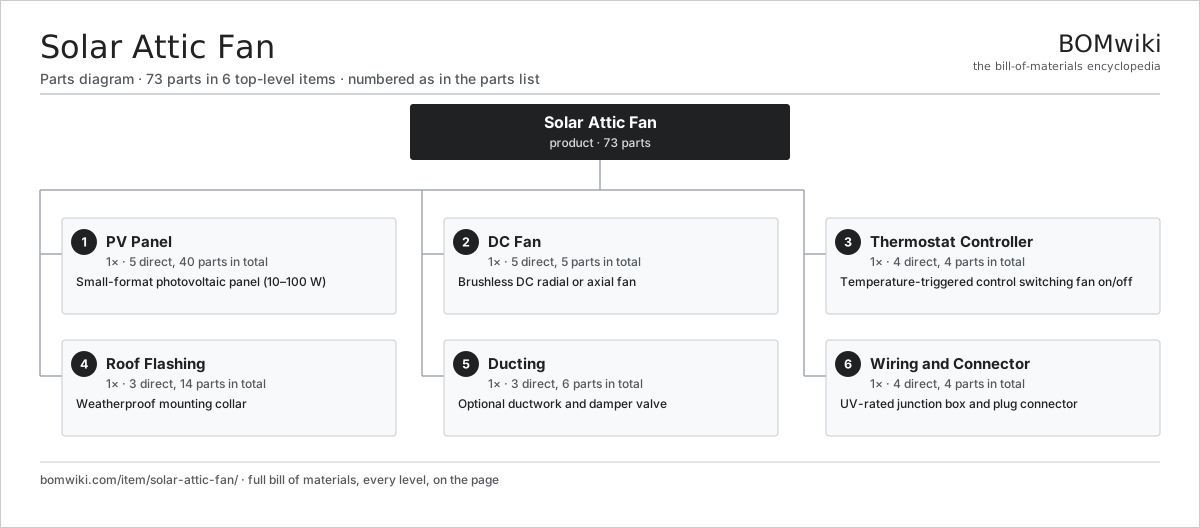
| # | Part | Qty | What it does |
|---|---|---|---|
| 1 | PV Panel 5 parts | 1× | Small-format photovoltaic panel (10–100 W) |
| 2 | DC Fan 5 parts | 1× | Brushless DC radial or axial fan |
| 3 | Thermostat Controller 4 parts | 1× | Temperature-triggered control switching fan on/off |
| 4 | Roof Flashing 3 parts | 1× | Weatherproof mounting collar |
| 5 | Ducting 3 parts | 1× | Optional ductwork and damper valve |
| 6 | Wiring and Connector 4 parts | 1× | UV-rated junction box and plug connector |
3D model
No 3D model yet. Have a CAD file of this? Add a 3D model. STL renders right on this page; STEP, FreeCAD, and OpenSCAD sources are welcome too (openly licensed, like all 3D models on BOMwiki).
Build & assembly graph
expand / collapse · shared sub-assemblies converge · links to related products · est. labourTap an assembly to expand/collapse · tap a part to open it · use “Open page” for any node · drag to pan, scroll to zoom.
Bill of materials for Solar Attic Fan
6 top-level lines · 30 rows shown · 73 parts total · indented to 3 levels| # | Item / sub-assembly | Part no. | Qty/assy | Ext. qty | Parts | Type |
|---|---|---|---|---|---|---|
| 1 | PV Panel 5 parts | solar-attic-pv-panel | 1× | 1 | 40 | assembly |
| 1.1 | PV Cells | solar-attic-pv-cells | 36× | 36 | · | part |
| 1.2 | PV Frame | solar-attic-pv-frame | 1× | 1 | · | part |
| 1.3 | PV Glass | solar-attic-pv-glass | 1× | 1 | · | part |
| 1.4 | PV Junction Box | solar-attic-pv-junction-box | 1× | 1 | · | part |
| 1.5 | PV Backsheet | solar-attic-pv-backsheet | 1× | 1 | · | part |
| 2 | DC Fan 5 parts | solar-attic-dc-fan | 1× | 1 | 5 | assembly |
| 2.1 | Fan Motor | solar-attic-fan-motor | 1× | 1 | · | part |
| 2.2 | Fan Impeller | solar-attic-fan-impeller | 1× | 1 | · | part |
| 2.3 | Fan Housing | solar-attic-fan-housing | 1× | 1 | · | part |
| 2.4 | Fan Thermistor | solar-attic-fan-thermistor | 1× | 1 | · | part |
| 2.5 | Fan Connector | solar-attic-fan-connector | 1× | 1 | · | part |
| 3 | Thermostat Controller 4 parts | solar-attic-thermostat | 1× | 1 | 4 | assembly |
| 3.1 | Thermostat MCU | solar-attic-thermostat-mcu | 1× | 1 | · | part |
| 3.2 | Thermostat MOSFET | solar-attic-thermostat-mosfet | 1× | 1 | · | part |
| 3.3 | Thermostat Sensor | solar-attic-thermostat-sensor | 1× | 1 | · | part |
| 3.4 | Thermostat Enclosure | solar-attic-thermostat-enclosure | 1× | 1 | · | part |
| 4 | Roof Flashing 3 parts | solar-attic-roof-flashing | 1× | 1 | 14 | assembly |
| 4.1 | Flashing Base | solar-attic-flashing-base | 1× | 1 | · | part |
| 4.2 | Flashing Membrane | solar-attic-flashing-membrane | 1× | 1 | · | part |
| 4.3 | Flashing Fasteners | solar-attic-flashing-fasteners | 12× | 12 | · | part |
| 5 | Ducting 3 parts | solar-attic-ducting | 1× | 1 | 6 | assembly |
| 5.1 | Flex Ducting | solar-attic-duct-flex | 1× | 1 | · | part |
| 5.2 | Damper Valve | solar-attic-damper-valve | 1× | 1 | · | part |
| 5.3 | Duct Clamp | solar-attic-duct-clamp | 4× | 4 | · | part |
| 6 | Wiring and Connector 4 parts | solar-attic-wiring-connector | 1× | 1 | 4 | assembly |
| 6.1 | Power Cable | solar-attic-power-cable | 1× | 1 | · | part |
| 6.2 | Sensor Cable | solar-attic-sensor-cable | 1× | 1 | · | part |
| 6.3 | Junction Connector | solar-attic-junction-connector | 1× | 1 | · | part |
| 6.4 | Circuit Breaker | solar-attic-circuit-breaker | 1× | 1 | · | part |
Something wrong in this list? Report a problem with this BOM.
Sourcing: possible vendors
Browse the supplier directory → Prices, MOQ, and lead times are algorithmic estimates, not quotes, and not claims about these companies. Company mappings are curated by keyword; est. price band $100–$20M. How estimates work| Vendor | HQ | Specialty | MOQ | Lead time |
|---|---|---|---|---|
|
🇩🇰Vestas
vestas.com ↗
|
Aarhus, DK | Wind turbines | 500 units | 12–24 wks |
| firstsolar.com ↗ | Tempe, US | PV modules | 500 units | 12–24 wks |
|
🇨🇳LONGi
longi.com ↗
|
Xi'an, CN | Solar wafers & modules | 500 units | 12–24 wks |
| enphase.com ↗ | Fremont, US | Microinverters & storage | 500 units | 12–24 wks |
|
🇨🇳Sungrow
sungrowpower.com ↗
|
Hefei, CN | Solar inverters & storage | 500 units | 12–24 wks |
1,197-word article