Solar Pool Heating System
ProductOverview
A solar pool heating system uses flat-plate thermal collectors to warm swimming pool water via direct solar absorption, extending the swimming season by 3–4 months in temperate climates. Unlike photovoltaic panels (which generate electricity), solar thermal collectors convert incident sunlight directly to heat: they absorb 60–80% of incoming solar radiation and transfer it to circulating pool water.
A typical residential pool (50 m³ / 13,000 gallons) requires 4–8 m² of collector area to achieve comfortable 26–28 °C water temperature during the swimming season (April–October in Northern Hemisphere). The system costs $3000–8000 installed, with annual heating cost savings of $500–1500 (vs. natural gas or electric heat pumps), yielding 4–6 year payback.
Collector Technology
The flat-plate solar thermal collector is the heart of the system. The absorber plate is typically black-painted copper tubing (1/2" or 3/4" diameter) soldered or bonded to an aluminum plate for high thermal conductivity. Water flows through the tubes in either:
- Serpentine: Single continuous path through all tubes (series)
- Parallel: Multiple tubes, water distributed via headers (more resistant to flow blockage)
The glazing, usually a single pane of tempered borosilicate glass (3–4 mm), transmits 85–90% of incident solar spectrum while preventing convective heat loss. The foam or fiberglass backing (50 mm, R-13 to R-19) reduces conduction loss through the frame.
Operating principle: Incident solar radiation (1000 W/m² at solar noon) penetrates the glass and is absorbed by the black absorber plate. The heated plate transfers energy to circulating water via conduction and convection. Heat loss occurs via:
- Radiation from hot plate through glass back to sky (reduced by glazing and selective coatings)
- Convection from top surface to ambient air (reduced by glass covering)
- Conduction through insulation and frame (minimized by material choice)
Net efficiency is roughly: η = 0.80 − 4.0 × ΔT/I, where ΔT is (plate temperature − ambient temperature) and I is incident irradiance (W/m²).
For a 40 °C pool on a 20 °C day: ΔT = 20 K, I = 800 W/m² (morning) → η ≈ 0.80 − 4.0 × 20/800 = 0.70 (70% efficiency). Peak power output per m² is ~0.70 × 800 = 560 W/m².
Glazed vs. Unglazed:
- Glazed collectors (standard): Can reach 75–85 °C, retain heat in cool weather, suitable for spring/fall/winter heating. Higher cost (~$600/m²).
- Unglazed/plastic collectors: Max 40–45 °C, minimal heat retention, best for summer pool heating in warm climates. Lower cost ($200/m²).
Circulation System
The circulation pump is often the existing pool filter pump (1–3 hp AC motor) operating during sunny hours. The three-way diverter valve directs flow:
- Summer (pool hot enough): Bypass mode, pump runs through filter only
- Sunny day (pool below setpoint): Through collector mode, pump heats water
The thermostat controller compares collector outlet temperature against pool temperature. If collector > pool + 10 °C (differential setpoint), the solenoid energizes, opening the collector valve and water flows through the array.
A one-way check valve on the collector outlet prevents siphoning (cold water backflow) at night, which would cool the pool. This is especially important in systems without active pump control, even a small overnight siphon loss of 1–2 K can negate a day's heating gain.
Control Logic and Safety
The automated control typically follows this sequence:
- Morning (first sun): Collector warms; if collector > pool + 10 °C, pump starts and diverter diverts to collectors.
- Midday (peak sun): Water heats 5–10 °C per hour; thermostat holds diverter in collector mode.
- Afternoon (sun declining): Flow continues as long as collector > pool + 3 °C (hysteresis prevents oscillation).
- Evening (sun sets): Collector cools below pool temperature; thermostat switches diverter to bypass, pump continues for filtration only.
- Night/stow: Pump is off (or running filter only); check valve seals collectors, preventing siphoning.
Safety interlocks:
- High-temperature relief valve (1.5 bar) on collector outlet, protecting against stagnation pressure (when no flow, midday heat buildup can raise pressure to 2+ bar).
- Air-vent valve on collectors, allowing air escape during fill and preventing vacuum siphoning.
- Low-flow detection: If pump stalls, thermostat shuts down diverter to prevent overheating/boiling in collectors.
System Sizing and Performance
Collector area is chosen based on pool size and desired heating:
- Rule of thumb: 0.5–1.0 m² collector per m³ pool volume
- 50 m³ pool → 25–50 m² optimal area (aggressive heating)
- 50 m³ pool → 4–8 m² practical area (light heating, supplement with gas/electric)
Annual heating output (temperate climate, 4–8 m² array):
- May–September (summer, clear sky): 40–60 MWh thermal (pool stays at 25–28 °C)
- April, October (shoulder season, mixed cloud): 15–25 MWh thermal (pool at 18–23 °C)
- November–March (winter, low insolation): Minimal heating; solar supplement to gas or heat pump
A 10 m² glazed collector array in Southern California:
- Annual insolation: ~2200 kWh/m² (excellent site)
- System efficiency: 65% (accounting for losses, weather)
- Annual output: 10 × 2200 × 0.65 = 14,300 kWh thermal (14.3 MWh)
- Energy equivalent: 4200 therms natural gas or 4200 kWh electric heat
- Cost savings (natural gas $1.50/therm): $6,300/year
Winterization and Freeze Protection
In cold climates (below 0 °C), freeze damage is a risk. Standard approaches:
- Drain-down system: Manual or automatic drain valve empties collectors at night, stored water is returned to pool next morning.
- Heat exchanger: Uses pool heat pump (running in reverse) to protect collectors without draining.
- Antifreeze loop (not recommended): Mix of glycol/water circulates through collectors, transferring heat to pool via heat exchanger (adds complexity and cost).
For residential pools, drain-down is simplest: before first frost, system is de-pressurized and water drained to pool.
Installation Considerations
- Roof pitch: Ideal pitch matches latitude (40° N latitude → 40° roof slope) for maximum winter performance; shallow pitches are acceptable for summer-only heating.
- Orientation: True south (±15°) is ideal; east or west deviations reduce annual output by 5–10%.
- Shading: Must avoid tree shadows or building overhangs during prime heating hours (9:00–15:00).
- Wind: Collectors on exposed rooftops are vulnerable; mounting must withstand 50 m/s wind with safety factor 2×.
- Roof loading: 4–8 m² array weighs ~100–200 kg; roof structural capacity must be verified.
Economics and Decision Factors
When solar pool heating makes sense:
- Warm, sunny climate (>2000 kWh/m²/year insolation)
- In-ground pool (not above-ground, which can be heated cheaper with electric coils)
- Heated year-round or extended season (spring/fall)
- Natural gas or electric heating currently used, with high utility costs
- Pool used frequently (payback depends on use intensity)
When it doesn't:
- Cold climate with short swim season (April–September only)
- Occasional use (weekends only)
- Above-ground pool (capital cost not justified)
- Very high pool load (e.g., hot tub, requiring 50+ °C; solar thermal cannot reach 70+ °C needed for economical heat exchanger sizing)
Modern systems integrate seamlessly with existing pool plumbing, often using the existing filter pump. Installation takes 2–3 days (roofer + plumber). Maintenance is minimal: annual inspection of gaskets, and cleaning collectors if dusty.
Solar Pool Heating System parts and their functions
7 top-level parts · 35 parts in total · full bill of materials below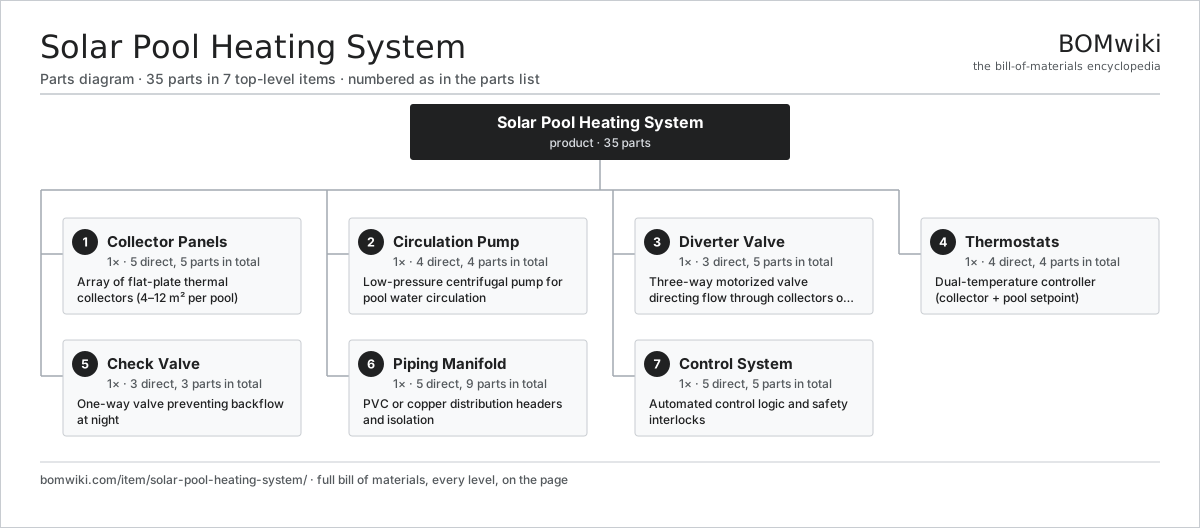
| # | Part | Qty | What it does |
|---|---|---|---|
| 1 | Collector Panels 5 parts | 1× | Array of flat-plate thermal collectors (4–12 m² per pool) |
| 2 | Circulation Pump 4 parts | 1× | Low-pressure centrifugal pump for pool water circulation |
| 3 | Diverter Valve 3 parts | 1× | Three-way motorized valve directing flow through collectors or bypass |
| 4 | Thermostats 4 parts | 1× | Dual-temperature controller (collector + pool setpoint) |
| 5 | Check Valve 3 parts | 1× | One-way valve preventing backflow at night |
| 6 | Piping Manifold 5 parts | 1× | PVC or copper distribution headers and isolation |
| 7 | Control System 5 parts | 1× | Automated control logic and safety interlocks |
3D model
No 3D model yet. Have a CAD file of this? Add a 3D model. STL renders right on this page; STEP, FreeCAD, and OpenSCAD sources are welcome too (openly licensed, like all 3D models on BOMwiki).
Build & assembly graph
expand / collapse · shared sub-assemblies converge · links to related products · est. labourTap an assembly to expand/collapse · tap a part to open it · use “Open page” for any node · drag to pan, scroll to zoom.
Bill of materials for Solar Pool Heating System
7 top-level lines · 36 rows shown · 35 parts total · indented to 3 levels| # | Item / sub-assembly | Part no. | Qty/assy | Ext. qty | Parts | Type |
|---|---|---|---|---|---|---|
| 1 | Collector Panels 5 parts | solar-pool-collector-panels | 1× | 1 | 5 | assembly |
| 1.1 | Absorber | solar-pool-collector-absorber | 1× | 1 | · | part |
| 1.2 | Collector Glazing | solar-pool-collector-glazing | 1× | 1 | · | part |
| 1.3 | Collector Insulation | solar-pool-collector-insulation | 1× | 1 | · | part |
| 1.4 | Collector Frame | solar-pool-collector-frame | 1× | 1 | · | part |
| 1.5 | Collector Header | solar-pool-collector-header | 1× | 1 | · | part |
| 2 | Circulation Pump 4 parts | solar-pool-circulation-pump | 1× | 1 | 4 | assembly |
| 2.1 | Pump Motor | solar-pool-pump-motor | 1× | 1 | · | part |
| 2.2 | Pump Impeller | solar-pool-pump-impeller | 1× | 1 | · | part |
| 2.3 | Pump Strainer | solar-pool-pump-basket-strainer | 1× | 1 | · | part |
| 2.4 | Pump Check Valve | solar-pool-pump-check-valve | 1× | 1 | · | part |
| 3 | Diverter Valve 3 parts | solar-pool-diverter-valve | 1× | 1 | 5 | assembly |
| 3.1 | Diverter Actuator | solar-pool-diverter-actuator | 1× | 1 | · | part |
| 3.2 | Diverter Solenoid | solar-pool-diverter-solenoid | 1× | 1 | · | part |
| 3.3 | Diverter Ports | solar-pool-diverter-ports | 3× | 3 | · | part |
| 4 | Thermostats 4 parts | solar-pool-thermostats | 1× | 1 | 4 | assembly |
| 4.1 | Collector Sensor | solar-pool-thermo-collector-sensor | 1× | 1 | · | part |
| 4.2 | Pool Sensor | solar-pool-thermo-pool-sensor | 1× | 1 | · | part |
| 4.3 | Thermostat Controller | solar-pool-thermo-controller | 1× | 1 | · | part |
| 4.4 | Temperature Display | solar-pool-thermo-display | 1× | 1 | · | part |
| 5 | Check Valve 3 parts | solar-pool-check-valve | 1× | 1 | 3 | assembly |
| 5.1 | Check Ball | solar-pool-check-ball | 1× | 1 | · | part |
| 5.2 | Check Housing | solar-pool-check-housing | 1× | 1 | · | part |
| 5.3 | Check Spring | solar-pool-check-spring | 1× | 1 | · | part |
| 6 | Piping Manifold 5 parts | solar-pool-piping-manifold | 1× | 1 | 9 | assembly |
| 6.1 | Inlet Header | solar-pool-inlet-header | 1× | 1 | · | part |
| 6.2 | Outlet Header | solar-pool-outlet-header | 1× | 1 | · | part |
| 6.3 | Isolation Balls | solar-pool-isolation-balls | 4× | 4 | · | part |
| 6.4 | Drain Valve | solar-pool-drain-valve | 1× | 1 | · | part |
| 6.5 | Thermometer Ports | solar-pool-thermometer-ports | 2× | 2 | · | part |
| 7 | Control System 5 parts | solar-pool-control-system | 1× | 1 | 5 | assembly |
| 7.1 | Control PLC | solar-pool-control-plc | 1× | 1 | · | part |
| 7.2 | Control Relays | solar-pool-control-relay-logic | 1× | 1 | · | part |
| 7.3 | Control Cabinet | solar-pool-control-cabinet | 1× | 1 | · | part |
| 7.4 | Pressure Relief | solar-pool-safety-pressure-relief | 1× | 1 | · | part |
| 7.5 | Air Vent | solar-pool-safety-air-vent | 1× | 1 | · | part |
Something wrong in this list? Report a problem with this BOM.
Sourcing: possible vendors
Browse the supplier directory → Prices, MOQ, and lead times are algorithmic estimates, not quotes, and not claims about these companies. Company mappings are curated by keyword; est. price band $100–$20M. How estimates work| Vendor | HQ | Specialty | MOQ | Lead time |
|---|---|---|---|---|
|
🇩🇰Vestas
vestas.com ↗
|
Aarhus, DK | Wind turbines | 500 units | 12–24 wks |
| firstsolar.com ↗ | Tempe, US | PV modules | 500 units | 12–24 wks |
|
🇨🇳LONGi
longi.com ↗
|
Xi'an, CN | Solar wafers & modules | 500 units | 12–24 wks |
| enphase.com ↗ | Fremont, US | Microinverters & storage | 500 units | 12–24 wks |
|
🇨🇳Sungrow
sungrowpower.com ↗
|
Hefei, CN | Solar inverters & storage | 500 units | 12–24 wks |
1,270-word article