Solar Telescope
ProductOverview
A solar telescope observes the Sun's photosphere, chromosphere, and magnetic field with high spatial resolution (0.3–1 arcsecond), revealing fine structure: sunspots, granulation, prominences, and magnetic reconnection sites. Unlike night-time astronomy, solar observations must cope with intense thermal loading (1 kW per cm² at Earth), requiring specialized heat rejection and vacuum systems.
The Solar Telescope uses a large primary lens (0.5–2 m aperture), forms a solar image at a vacuum heat stop, and feeds downstream spectroscopy and imaging instruments with narrow-band light. A real-time image stabilizer corrects ~5 arcsecond solar granulation-induced jitter, achieving sub-arcsecond resolution.
How it works
Heat Management
The Aperture Assembly is sealed with a borosilicate vacuum window, maintaining <1 Pa inside the optical tube. This vacuum suppresses convection and reduces refractive distortion from hot air. The Aperture Heatsink and chiller dissipate solar heating at the entrance aperture.
At the Heat Stop, typically located at the primary focus or an intermediate image plane, a dichroic IR filter blocks >99% of infrared radiation while transmitting visible and near-UV light. Excess heat is absorbed by a water-cooled copper or aluminum plate, keeping the downstream spectrograph and detector cool.
Primary Optics
The Objective Lens is a large-aperture refracting objective (f/50 to f/100, 0.5–2 m diameter) with precise anti-reflection coatings reducing losses to <0.5% per surface. Apochromatic (three-element) designs minimize chromatic aberration across the hydrogen-alpha line (656 nm) and nearby spectral regions.
Narrow-Band Filtering
The Etalon Filter is a Fabry-Perot interferometer providing 0.01–1 nm spectral resolution. Two glass plates separated by a 2–20 µm air gap (or solid spacer) form a resonant cavity. Multiple high-reflectance mirrors (R >99.9%) create high finesse, selecting a single spectral line (e.g., H-alpha at 656.3 nm) from broadband solar light.
The piezoelectric tuning element adjusts cavity spacing to scan across spectral lines, mapping chromospheric Doppler shifts and detecting prominence structures. A Etalon Prefilter (0.1–1 nm wide) limits the free spectral range, preventing multiple transmission peaks.
Spectral Analysis
The Spectrograph disperses solar light into spectrum. A motorized slit (0.1–2 arcsec wide) at the focal plane selects a thin slice of the solar image. The off-axis parabolic mirror collimates this slit-restricted light; a diffraction grating (600–3600 lines/mm) disperses it by wavelength. A slit-mounted spectrographic CCD records the entire spectrum.
This enables measuring line-of-sight velocity (Doppler shift), line width (turbulence), and intensity (temperature proxy) across a one-dimensional cut through the solar image.
Magnetic Field Measurement
The Polarimeter measures solar magnetic field via Zeeman splitting or Hanle effect. The polarization analyzer decomposes incident light into Stokes parameters (I, Q, U, V). In a magnetic field, the Zeeman effect splits spectral lines: σ-polarization (right- and left-circular) separates at ΔλB = 4.67×10⁻¹³ B λ² (B in Gauss, λ in nm).
A Faraday rotator (electro-optic modulator) rotates polarization at MHz rates, modulating the Zeeman signal for lock-in detection. The polarimetric camera measures weak Stokes V (circular polarization) to <0.1% of continuum intensity, enabling detection of weak magnetic fields (50–500 Gauss).
Image Stabilization
Solar granulation (convection cells 1000 km across) and telescope vibrations cause 5–10 arcsecond jitter on minute timescales. The adaptive optics and image stabilizer correct this in real-time:
A low-latency wavefront sensor (100–1000 fps) measures image displacement via centroid tracking or Shack-Hartmann sensing. A fast-steering mirror (100–1000 Hz response) corrects tip-tilt jitter to <0.1 arcsecond. The servo loop computes mirror commands from sensor displacement.
Observational Science
Solar astronomers study:
- Sunspots: magnetic structures with penumbrae, umbrae, light bridges; field strengths 2000–4000 Gauss.
- Chromospheric dynamics: H-alpha filaments, spicules, coronal jets.
- Prominence eruptions: cool plasma suspended in hot corona by magnetic field.
- Flares and energetic release: magnetic reconnection and particle acceleration.
- Quiet-Sun oscillations: 5-minute acoustic waves, 3-minute gravity modes.
Spectral diagnostics leverage multiple lines: H-alpha (chromosphere), Mg I (photosphere), Ca K (upper photosphere/lower chromosphere) observed simultaneously or in sequence enable temperature/density reconstruction via radiative-transfer inversion codes.
Observing Conditions
Unlike night-time astronomy, seeing at solar wavelengths is often worse due to daytime thermal convection in the atmosphere. High-altitude sites (La Palma, Maui, Chile) and sites with air-stable environments (northern Switzerland, US Southwest) offer better solar seeing. Modern large-aperture solar telescopes (e.g., Daniel K. Inouye Solar Telescope, 4 m) employ adaptive optics extensively.
Data Volume
A 0.5 m telescope at 0.1 arcsec sampling, observing a 1000×1000 arcsec solar region with a 1 GHz spectrograph, produces 10–100 MB/s raw data. Modern solar observatories generate terabytes of data per observing day, requiring distributed data centers and automated quick-look reduction pipelines.
Solar Telescope parts and their functions
8 top-level parts · 37 parts in total · full bill of materials below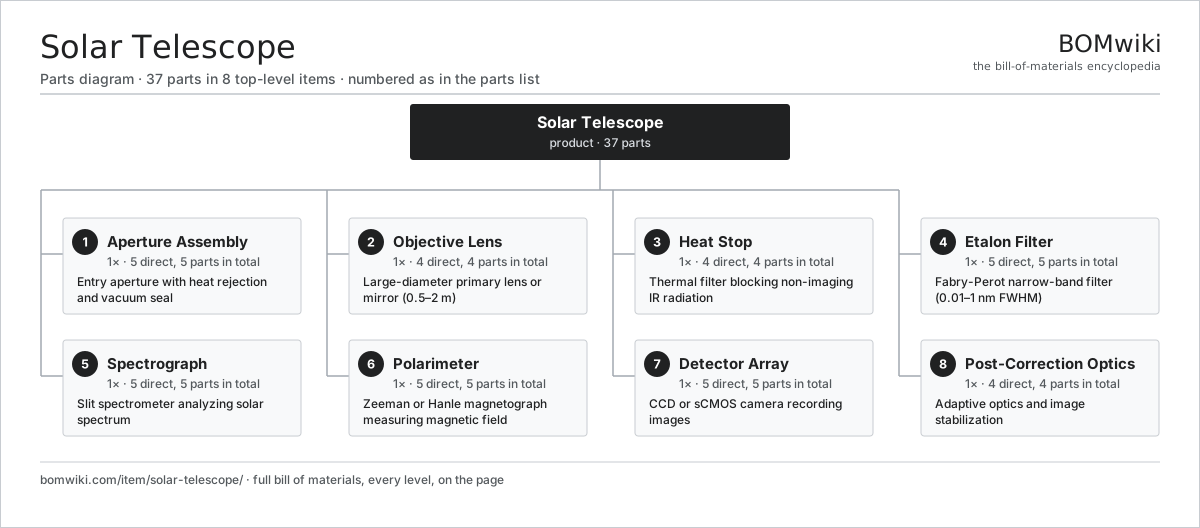
| # | Part | Qty | What it does |
|---|---|---|---|
| 1 | Aperture Assembly 5 parts | 1× | Entry aperture with heat rejection and vacuum seal |
| 2 | Objective Lens 4 parts | 1× | Large-diameter primary lens or mirror (0.5–2 m) |
| 3 | Heat Stop 4 parts | 1× | Thermal filter blocking non-imaging IR radiation |
| 4 | Etalon Filter 5 parts | 1× | Fabry-Perot narrow-band filter (0.01–1 nm FWHM) |
| 5 | Spectrograph 5 parts | 1× | Slit spectrometer analyzing solar spectrum |
| 6 | Polarimeter 5 parts | 1× | Zeeman or Hanle magnetograph measuring magnetic field |
| 7 | Detector Array 5 parts | 1× | CCD or sCMOS camera recording images |
| 8 | Post-Correction Optics 4 parts | 1× | Adaptive optics and image stabilization |
3D model
No 3D model yet. Have a CAD file of this? Add a 3D model. STL renders right on this page; STEP, FreeCAD, and OpenSCAD sources are welcome too (openly licensed, like all 3D models on BOMwiki).
Build & assembly graph
expand / collapse · shared sub-assemblies converge · links to related products · est. labourTap an assembly to expand/collapse · tap a part to open it · use “Open page” for any node · drag to pan, scroll to zoom.
Bill of materials for Solar Telescope
8 top-level lines · 45 rows shown · 37 parts total · indented to 3 levels| # | Item / sub-assembly | Part no. | Qty/assy | Ext. qty | Parts | Type |
|---|---|---|---|---|---|---|
| 1 | Aperture Assembly 5 parts | solar-telescope-aperture-assembly | 1× | 1 | 5 | assembly |
| 1.1 | Aperture Window | solar-telescope-aperture-window | 1× | 1 | · | part |
| 1.2 | Vacuum Pump | solar-telescope-vacuum-pump | 1× | 1 | · | part |
| 1.3 | Aperture Heatsink | solar-telescope-aperture-heatsink | 1× | 1 | · | part |
| 1.4 | Aperture Baffle | solar-telescope-aperture-baffle | 1× | 1 | · | part |
| 1.5 | Fastener Set | fastener-set | 1× | 1 | · | part |
| 2 | Objective Lens 4 parts | solar-telescope-objective-lens | 1× | 1 | 4 | assembly |
| 2.1 | Lens Element | solar-telescope-lens-element | 1× | 1 | · | part |
| 2.2 | Lens Mount | solar-telescope-lens-mount | 1× | 1 | · | part |
| 2.3 | AR Coating | solar-telescope-lens-ar-coating | 1× | 1 | · | part |
| 2.4 | Fastener Set | fastener-set | 1× | 1 | · | part |
| 3 | Heat Stop 4 parts | solar-telescope-heat-stop | 1× | 1 | 4 | assembly |
| 3.1 | Heat Stop Absorber | solar-telescope-heat-stop-absorber | 1× | 1 | · | part |
| 3.2 | Heat Stop Filter | solar-telescope-heat-stop-filter | 1× | 1 | · | part |
| 3.3 | Heat Stop Cooling | solar-telescope-heat-stop-cooling | 1× | 1 | · | part |
| 3.4 | Fastener Set | fastener-set | 1× | 1 | · | part |
| 4 | Etalon Filter 5 parts | solar-telescope-etalon-filter | 1× | 1 | 5 | assembly |
| 4.1 | Etalon Cavity | solar-telescope-etalon-cavity | 1× | 1 | · | part |
| 4.2 | Etalon Tuning PZT | solar-telescope-etalon-tuning-pzt | 1× | 1 | · | part |
| 4.3 | Etalon Prefilter | solar-telescope-etalon-prefilter | 1× | 1 | · | part |
| 4.4 | Etalon Coating | solar-telescope-etalon-mirror-coating | 1× | 1 | · | part |
| 4.5 | Power Supply | power-supply | 1× | 1 | · | part |
| 5 | Spectrograph 5 parts | solar-telescope-spectrograph | 1× | 1 | 5 | assembly |
| 5.1 | Slit Mechanism | solar-telescope-slit-mechanism | 1× | 1 | · | part |
| 5.2 | Collimator Mirror | solar-telescope-collimator-mirror | 1× | 1 | · | part |
| 5.3 | Grating Element | solar-telescope-grating-element | 1× | 1 | · | part |
| 5.4 | Spec Detector | solar-telescope-spec-detector | 1× | 1 | · | part |
| 5.5 | Fastener Set | fastener-set | 1× | 1 | · | part |
| 6 | Polarimeter 5 parts | solar-telescope-polarimeter | 1× | 1 | 5 | assembly |
| 6.1 | Analyzer Optics | solar-telescope-analyzer-optics | 1× | 1 | · | part |
| 6.2 | Faraday Rotator | solar-telescope-faraday-rotator | 1× | 1 | · | part |
| 6.3 | Polarimetry Camera | solar-telescope-polarimetry-camera | 1× | 1 | · | part |
| 6.4 | Magnetogram Software | solar-telescope-magnetogram-software | 1× | 1 | · | part |
| 6.5 | Power Supply | power-supply | 1× | 1 | · | part |
| 7 | Detector Array 5 parts | solar-telescope-detector-array | 1× | 1 | 5 | assembly |
| 7.1 | Imaging CCD | solar-telescope-imaging-ccd | 1× | 1 | · | part |
| 7.2 | Filter Wheel | solar-telescope-filter-wheel | 1× | 1 | · | part |
| 7.3 | Camera Cooling | solar-telescope-camera-cooling | 1× | 1 | · | part |
| 7.4 | Camera Interface | solar-telescope-camera-interface | 1× | 1 | · | part |
| 7.5 | Power Supply | power-supply | 1× | 1 | · | part |
| 8 | Post-Correction Optics 4 parts | solar-telescope-post-correction-optics | 1× | 1 | 4 | assembly |
| 8.1 | Tip-Tilt Mirror | solar-telescope-tip-tilt-mirror | 1× | 1 | · | part |
| 8.2 | Stabilizer Sensor | solar-telescope-image-stabilizer-sensor | 1× | 1 | · | part |
| 8.3 | Stabilizer Servo | solar-telescope-image-stabilizer-servo | 1× | 1 | · | part |
| 8.4 | Path Stabilizer | solar-telescope-optical-path-stabilizer | 1× | 1 | · | part |
Something wrong in this list? Report a problem with this BOM.
Related products
same domain, ranked by shared parts Adaptive Optics System
35 parts · shares 1 with this page
Adaptive Optics System
35 parts · shares 1 with this page
 Camera Motion Control Rig
210 parts · shares 1 with this page
Camera Motion Control Rig
210 parts · shares 1 with this page
 Digital Cinema Camera
305 parts · shares 1 with this page
Digital Cinema Camera
305 parts · shares 1 with this page
 Document Camera
247 parts · shares 1 with this page
Document Camera
247 parts · shares 1 with this page
 High-Speed Camera
183 parts · shares 1 with this page
High-Speed Camera
183 parts · shares 1 with this page
 Industrial 3D Scanner
149 parts · shares 1 with this page
Industrial 3D Scanner
149 parts · shares 1 with this page
Sourcing: possible vendors
Browse the supplier directory → Prices, MOQ, and lead times are algorithmic estimates, not quotes, and not claims about these companies. Company mappings are curated by keyword; est. price band $100–$8k. How estimates work| Vendor | HQ | Specialty | MOQ | Lead time |
|---|---|---|---|---|
|
🇯🇵Canon
canon.com ↗
|
Tokyo, JP | Imaging & optics | 500 units | 10–16 wks |
|
🇯🇵Nikon
nikon.com ↗
|
Tokyo, JP | Imaging & optics | 500 units | 10–16 wks |
|
🇩🇪ZEISS
zeiss.com ↗
|
Oberkochen, DE | Optics & optoelectronics | 500 units | 10–16 wks |
| leica-camera.com ↗ | Wetzlar, DE | Cameras & optics | 500 units | 10–16 wks |
| flir.com ↗ | Wilsonville, US | Thermal imaging | 500 units | 10–16 wks |
904-word article