Sole Attaching Press
ProductOverview
The sole attaching press is a critical bottleneck in footwear manufacturing, responsible for permanently bonding the shoe sole (rubber, plastic, or composite) to the upper (leather, textile, or synthetic material) via adhesive. Modern sole presses are hydraulic systems combining controlled heating, pressure, and dwell time to achieve reliable, durable sole-to-upper bonds.
Traditional sole attachment relied on hand-stitching (welt seam) or hand-hammering and nailing, which demanded skilled laborers and offered variable quality. Today, adhesive-based pressing has largely displaced stitching in volume production, reducing cost and enabling faster cycle times. A single sole press operator manages 1–2 machines, loading lasted shoes, pressing the start button, and unloading pressed shoes every 90–120 seconds.
Sole Attachment Mechanism: Adhesive Chemistry
Modern shoe adhesives are typically polyurethane or rubber-based formulations applied to either the sole or upper (or both) before pressing. The adhesive mechanism depends on formulation:
Polyurethane (PU) Adhesives
Polyurethane is moisture-sensitive: the isocyanate (NCO) groups in the polymer backbone react with moisture (water) to form urea crosslinks, curing the adhesive into a rigid elastomer. The process:
- Wet-out phase: PU adhesive is applied as a liquid with 15–20% residual solvent (typically N,N-dimethylformamide or similar). When the upper and sole are brought into contact under pressure, adhesive flows into surface roughness and microscopic cavities.
- Solvent evaporation: Heat (80–100 °C from the press platens) accelerates solvent departure, concentrating the resin and reducing viscosity-driven slipping.
- Moisture absorption: Atmospheric moisture at the adhesive film surface triggers isocyanate-water reaction (exothermic), forming urea bridges. This reaction is slow at room temperature (24+ hours for full cure) but accelerates significantly at elevated temperature.
- Final crosslinking: Over 2–8 hours post-press, remaining solvent continues to evaporate and polyurethane fully cures, achieving maximum peel strength (bond strength perpendicular to interface) and tensile strength (in-plane bond).
Polyurethane's advantage: even thin adhesive films (1–3 mils, ~25–75 micrometers) can achieve 5+ kg/cm² peel strength, sufficient to resist shoe-in-wear stress.
Pressing Cycle Requirements
To maximize bond formation, the press platens must deliver three synergistic actions:
- Temperature: 80–100 °C activates polyurethane cure and reduces adhesive viscosity, promoting flow and wet-out.
- Pressure: 500–2000 bar (5–20 MPa) applied force compresses the sole and upper together, expelling air pockets and forcing adhesive into surface roughness. Excessive pressure (>2000 bar) can squeeze adhesive out of the joint entirely, leaving a starved bond.
- Dwell time: 15–45 seconds at temperature and pressure allows adhesive cure initiation and prevents slippage during de-clamping.
After de-clamping, the shoe is transferred to a cooling stage (optional) or directly to inventory, where it rests 2–4 hours before quality inspection and packaging.
Press Platen Architecture
The core of the sole press is its platen system: two heated steel plates (upper and lower) that sandwich the shoe and apply force. Key design parameters:
Upper Platen (Moving Head)
The upper platen is mounted on a hydraulically driven slide, typically a double-rod cylinder providing even pressure distribution. To prevent platens from sticking to adhesive residue, surfaces are finished with nickel plating or PTFE (Teflon) coating, which are naturally low-friction and easily cleaned.
Platen thickness: 8–10 mm steel ensures uniform temperature distribution and minimizes deflection under clamping load.
Lower Platen (Stationary Base)
The lower platen is fixed to the press frame and often integral to the last holder positioning fixture. A removable pressure pad (cork or foam facing) sits atop the lower platen to distribute clamping force and protect sole finishes from platen indentation.
Heating System
Each platen contains embedded electric heating cartridges (2–4 kW combined), controlled by a thermostat relay that modulates power to maintain setpoint temperature (±5 °C accuracy). Heat is transferred by conduction through the steel, reaching the adhesive interface within 5–10 seconds of platen contact.
Optional coolant circulation (water loop) can be embedded in platen galleries for high-volume production, actively cooling platens between cycles to reduce cycle time and prevent thermal runaway.
Pressure Control and Load Cell Feedback
The hydraulic system uses a variable-displacement axial piston pump driven by a 3–5 kW AC motor. Clamping pressure is user-adjustable (typically 500–2000 bar setpoint) via a proportional pressure relief valve, allowing different shoe constructions (thin/thick uppers, hard/soft soles) to be optimized independently.
A pressure transducer monitors real-time platen force; if pressure spikes above setpoint (indicating sole or upper is slipping away from center, or adhesive is incompressible), the control system triggers an alarm and logs the deviation. This feedback is critical for detecting adhesive batch issues (bad viscosity, low solids content) before the shoe leaves the line.
Cycle Timing and Operator Interface
The control system is typically a small PLC or dedicated timer module with a simple pushbutton interface: Start, Stop, Emergency Stop.
The operator:
- Places a lasted, cement-coated shoe (from the shoe lasting machine) onto the lower platen, centered under the upper platen.
- Presses "Start" button.
- Control system checks sensors (shoe in place, platens at temperature). If all-clear:
- Hydraulic cylinder drives upper platen down, compressing shoe between platens.
- Pressure ramps over 3–5 seconds to setpoint (e.g., 1200 bar).
- Dwell timer maintains pressure for 20–30 seconds (user-adjustable).
- Hydraulic cylinder retracts; upper platen rises.
- Audible tone signals "shoe ready to unload."
Total cycle: ~90–120 seconds depending on dwell time and cooling phase.
Sole-to-Upper Material Compatibility
Different shoe constructions require different pressing parameters:
- Leather upper + rubber sole: PU adhesive, 80–90 °C, 1200 bar, 25 sec dwell. Leather is strong and relatively moisture-resistant, allowing aggressive pressure.
- Canvas upper + EVA foam sole: Same adhesive, 70–80 °C (lower temp to prevent foam melting), 800 bar, 20 sec dwell.
- Synthetic textile + plastic sole: Rubber adhesive (faster cure), 60–70 °C, 600 bar, 15 sec dwell. Synthetics are moisture-sensitive and can warp under heat.
Operators typically maintain a notebook or laminated card at the machine listing cycle parameters (temperature, pressure, dwell time) for each shoe model SKU, switching parameters when product changes hands.
Common Failure Modes and Quality Control
Several failure modes compromise sole-to-upper bond durability:
- Starved adhesive (too much pressure, thin adhesive film): Insufficient resin at interface leads to low peel strength; sole can be manually peeled off post-cure, indicating < 1 kg/cm² bond.
- Inadequate dwell time (operator skips cooling phase): Adhesive hasn't fully reacted; shoe feels "squishier" than expected and may delaminate after 100–200 wearing hours.
- Platen temperature mismatch: If thermostats drift, low temperature (<70 °C) slows cure and high temperature (>110 °C) can degrade adhesive base resin, reducing final strength.
- Pressure spikes: Transient overpressure (>2200 bar) can puncture sole or upper, creating micro-ruptures that propagate into larger delaminations.
Quality inspection is typically a peel test: technicians manually bend the sole laterally and attempt to peel corners. A properly cured bond resists >5 kg/cm² peel force without delaminating. Samples are also aged 24 hours at 70 °C in high-humidity conditions (85% RH) to accelerate any moisture-induced degradation; sound bonds survive this without failure.
Sole Attaching Press parts and their functions
8 top-level parts · 41 parts in total · full bill of materials below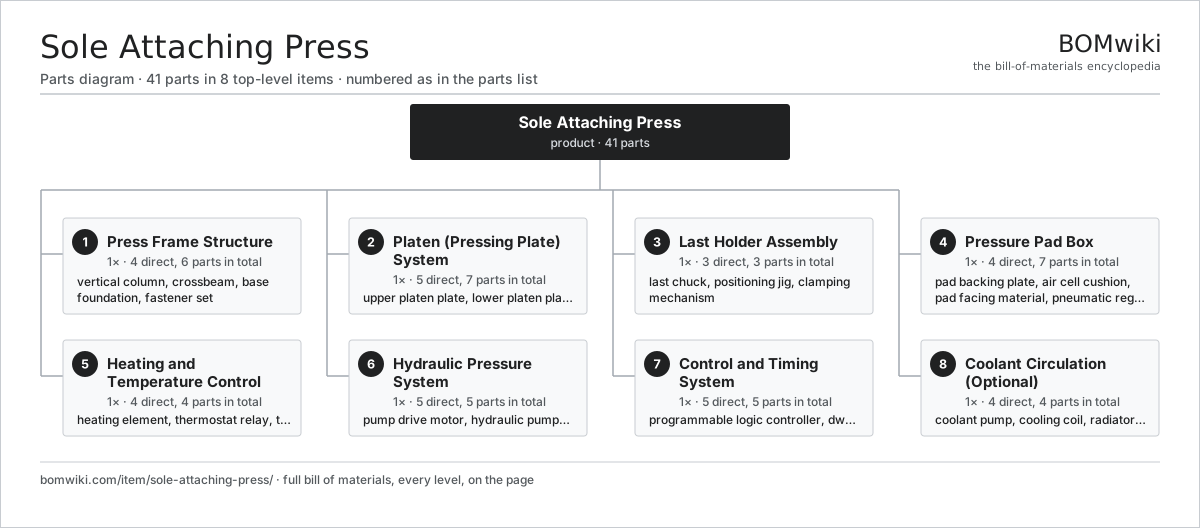
| # | Part | Qty | What it does |
|---|---|---|---|
| 1 | Press Frame Structure 4 parts | 1× | Welded steel C-frame or H-frame that provides rigid support and guides the pressure head motion. |
| 2 | Platen (Pressing Plate) System 5 parts | 1× | Upper and lower heated steel platens that apply uniform heat and pressure to bond sole to upper. |
| 3 | Last Holder Assembly 3 parts | 1× | Fixture that positions and holds the lasted shoe during sole attachment, centered between platens. |
| 4 | Pressure Pad Box 4 parts | 1× | Air-cell or spring-loaded pad distributing clamping force uniformly over sole and upper contact area. |
| 5 | Heating and Temperature Control 4 parts | 1× | Electric heating elements and thermostat loop maintaining platen temperature at 80–100 °C. |
| 6 | Hydraulic Pressure System 5 parts | 1× | Hydraulic pump and manifold delivering controlled clamping force (500–2000 bar) to upper pressure head. |
| 7 | Control and Timing System 5 parts | 1× | Programmable timer and pressure limiter managing cycle timing, dwell duration, and pressure ramp rate. |
| 8 | Coolant Circulation (Optional) 4 parts | 1× | Water cooling loop for dissipating heat from platens during extended high-volume pressing. |
3D model
No 3D model yet. Have a CAD file of this? Add a 3D model. STL renders right on this page; STEP, FreeCAD, and OpenSCAD sources are welcome too (openly licensed, like all 3D models on BOMwiki).
Build & assembly graph
expand / collapse · shared sub-assemblies converge · links to related products · est. labourTap an assembly to expand/collapse · tap a part to open it · use “Open page” for any node · drag to pan, scroll to zoom.
Bill of materials for Sole Attaching Press
8 top-level lines · 42 rows shown · 41 parts total · indented to 3 levels| # | Item / sub-assembly | Part no. | Qty/assy | Ext. qty | Parts | Type |
|---|---|---|---|---|---|---|
| 1 | Press Frame Structure 4 parts | sole-attaching-press-frame | 1× | 1 | 6 | assembly |
| 1.1 | Vertical Column | sole-attaching-press-vertical-column | 2× | 2 | · | part |
| 1.2 | Crossbeam | sole-attaching-press-crossbeam | 2× | 2 | · | part |
| 1.3 | Base Foundation | sole-attaching-press-base-foundation | 1× | 1 | · | part |
| 1.4 | Fastener Set | fastener-set | 1× | 1 | · | part |
| 2 | Platen (Pressing Plate) System 5 parts | sole-attaching-press-platen-system | 1× | 1 | 7 | assembly |
| 2.1 | Upper Platen Plate | sole-attaching-press-upper-platen | 1× | 1 | · | part |
| 2.2 | Lower Platen Plate | sole-attaching-press-lower-platen | 1× | 1 | · | part |
| 2.3 | Heating Cartridge | sole-attaching-press-platen-heating | 2× | 2 | · | part |
| 2.4 | Thermal Insulation Pack | sole-attaching-press-platen-insulation | 1× | 1 | · | part |
| 2.5 | Temperature Sensor (PT100) | sole-attaching-press-temperature-sensor | 2× | 2 | · | part |
| 3 | Last Holder Assembly 3 parts | sole-attaching-press-last-holder | 1× | 1 | 3 | assembly |
| 3.1 | Last Chuck | sole-attaching-press-last-chuck | 1× | 1 | · | part |
| 3.2 | Positioning Jig | sole-attaching-press-positioning-jig | 1× | 1 | · | part |
| 3.3 | Clamping Mechanism | sole-attaching-press-clamping-mechanism | 1× | 1 | · | part |
| 4 | Pressure Pad Box 4 parts | sole-attaching-press-pressure-pad | 1× | 1 | 7 | assembly |
| 4.1 | Pad Backing Plate | sole-attaching-press-pad-base | 1× | 1 | · | part |
| 4.2 | Air Cell Cushion | sole-attaching-press-air-cells | 4× | 4 | · | part |
| 4.3 | Pad Facing Material | sole-attaching-press-pad-surface | 1× | 1 | · | part |
| 4.4 | Pneumatic Regulator | sole-attaching-press-pressure-regulator | 1× | 1 | · | part |
| 5 | Heating and Temperature Control 4 parts | sole-attaching-press-heating-system | 1× | 1 | 4 | assembly |
| 5.1 | Heating Element | sole-attaching-press-heating-element | 1× | 1 | · | part |
| 5.2 | Thermostat Relay | sole-attaching-press-thermostat-relay | 1× | 1 | · | part |
| 5.3 | Temperature Display | sole-attaching-press-temperature-display | 1× | 1 | · | part |
| 5.4 | Thermal Fuse | sole-attaching-press-thermal-fuse | 1× | 1 | · | part |
| 6 | Hydraulic Pressure System 5 parts | sole-attaching-press-hydraulic-pump | 1× | 1 | 5 | assembly |
| 6.1 | Pump Drive Motor | sole-attaching-press-pump-motor | 1× | 1 | · | part |
| 6.2 | Hydraulic Pump | sole-attaching-press-hydraulic-pump-unit | 1× | 1 | · | part |
| 6.3 | Check Valve | sole-attaching-press-check-valve | 1× | 1 | · | part |
| 6.4 | Pressure Relief Valve | sole-attaching-press-pressure-relief | 1× | 1 | · | part |
| 6.5 | Pressure Gauge | sole-attaching-press-pressure-gauge | 1× | 1 | · | part |
| 7 | Control and Timing System 5 parts | sole-attaching-press-control-system | 1× | 1 | 5 | assembly |
| 7.1 | Programmable Logic Controller | sole-attaching-press-plc | 1× | 1 | · | part |
| 7.2 | Dwell Timer Card | sole-attaching-press-timer-card | 1× | 1 | · | part |
| 7.3 | Pressure Transducer | sole-attaching-press-pressure-transducer | 1× | 1 | · | part |
| 7.4 | HMI Control Panel | sole-attaching-press-hmi-buttons | 1× | 1 | · | part |
| 7.5 | Power Supply | power-supply | 1× | 1 | · | part |
| 8 | Coolant Circulation (Optional) 4 parts | sole-attaching-press-coolant-system | 1× | 1 | 4 | assembly |
| 8.1 | Coolant Pump | sole-attaching-press-water-pump | 1× | 1 | · | part |
| 8.2 | Cooling Coil | sole-attaching-press-cooling-coil | 1× | 1 | · | part |
| 8.3 | Radiator Heat Exchanger | sole-attaching-press-radiator | 1× | 1 | · | part |
| 8.4 | Coolant Temperature Controller | sole-attaching-press-temperature-controller | 1× | 1 | · | part |
Something wrong in this list? Report a problem with this BOM.
Sourcing: possible vendors
Browse the supplier directory → Prices, MOQ, and lead times are algorithmic estimates, not quotes, and not claims about these companies. Company mappings are curated by keyword; est. price band $10k–$1M. How estimates work| Vendor | HQ | Specialty | MOQ | Lead time |
|---|---|---|---|---|
|
🇨🇭Rieter
rieter.com ↗
|
Winterthur, CH | Spinning machinery | 10 units | 14–24 wks |
| truetzschler.com ↗ | Mönchengladbach, DE | Textile machinery | 10 units | 14–24 wks |
|
🇧🇪Picanol
picanol.be ↗
|
Ypres, BE | Weaving machines | 10 units | 14–24 wks |
| karlmayer.com ↗ | Obertshausen, DE | Warp knitting machines | 10 units | 14–24 wks |
|
🇨🇭Saurer
saurer.com ↗
|
Arbon, CH | Spinning & embroidery | 10 units | 14–24 wks |
1,266-word article