Soup Kettle
ProductOverview
A soup kettle is a large, tilting cooking pot surrounded by a water-filled heating jacket. The water bath method is one of the gentlest ways to heat food in volume, because the water cannot exceed 212 °F at sea level and conducts heat evenly to all sides of the pot, preventing scorching and ensuring uniform cooking.
The equipment consists of a heavy stainless-steel inset pot, typically 10–40 gallons, that sits inside an outer Heating Jacket also made of stainless steel. The space between the two is filled with water; an electric Heating Element submerged in this water bath heats it. As the water heats, it transfers energy to the pot, warming the contents inside. A Thermostat senses the water temperature and cycles the heating element on and off to maintain the set temperature, typically 160–180 °F.
The Lid Assembly, hinged on one side, covers the pot and traps steam, reducing evaporation. The Pot Handle, a horizontal loop welded to each side, allows two people to lift the pot if necessary, though the primary design feature is the Tilt Mechanism: a lever or hydraulic actuator that tilts the entire pot forward, allowing the contents to pour out for service or cleaning without lifting.
The unit stands on a mobile Support Frame with four swivel casters, so it can be rolled around the kitchen for convenient access to serving lines or dish stations.
How it works
The cook adds stock, water, or broth to the Pot Assembly and closes the Lid Assembly. The thermostat is set to 160 °F. The heating element is switched on and begins to draw current.
The Heating Element submerged in the Heating Jacket water bath begins to warm. Conduction and natural convection carry the heat to the inner pot walls. The pot slowly comes to temperature, a process taking 20–30 minutes for a full 40-gallon batch. The indirect heating prevents local hot spots and boiling that would scorch delicate soups or curdle cream.
Once the contents begin to steam, the cook adds ingredients: vegetables, proteins, seasonings, in stages as needed. The gentle, surrounding heat keeps everything simmering at a consistent, barely-bubbling pace. Because the heat source is water surrounded by an insulated jacket, the temperature is stable and responsive, faster than an open flame but slower than direct electric heating, which suits long-cooking dishes like stocks, bisques, and potages.
The Thermostat continuously adjusts heating to maintain the set temperature. If the contents cool (e.g., after adding a large cold ingredient), the thermostat increases power to bring it back up. This automatic regulation is crucial in high-volume operations where multiple batches and temperature fluctuations occur throughout service.
When the soup or stock is ready, the cook pulls the Tilt Lever, which engages the Tilt Bracket. The entire pot tilts forward and up, raising the far edge and lowering the near edge, creating a 45–60 degree incline. The contents pour out through the lip of the pot into awaiting containers, service wells, or holding pans. Because the pour is controlled by gravity and leverage, not muscle, a single operator can safely dispense a 40-gallon batch.
The Support Frame with its swivel casters allows the kettle to be positioned close to serving lines, reducing spillage and labor. At end of service, the pot is tilted forward and rinsed, or soaked overnight for stubborn deposits. The soup-kettle-water-pan (a removable tray above the heating element) is also emptied and cleaned.
The water bath in the Heating Jacket is drained and replaced every few months via the Drain Valve, as minerals accumulate and reduce thermal transfer efficiency over time.
Soup kettles are mainstays in institutional food service, hospitals, schools, senior communities, cruise ships, where large quantities of warm, comforting food must be produced and held safely. Their simplicity, safety, and ability to produce silky soups and stocks without scorching make them indispensable in any large kitchen.
Soup Kettle parts and their functions
6 top-level parts · 27 parts in total · full bill of materials below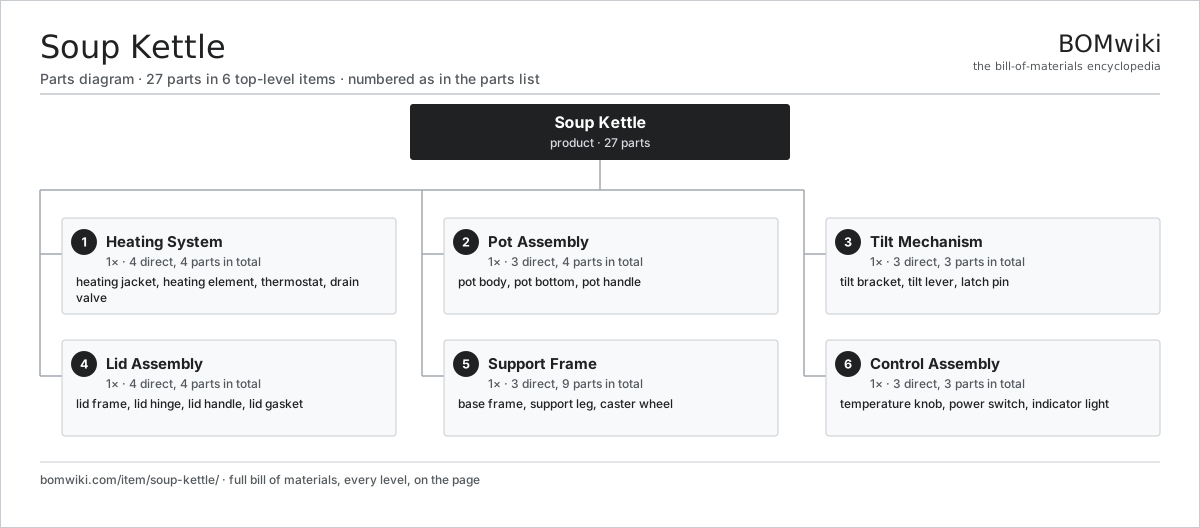
| # | Part | Qty | What it does |
|---|---|---|---|
| 1 | Heating System 4 parts | 1× | Water-bath heating jacket that surrounds the cooking pot to provide gentle, even heat. |
| 2 | Pot Assembly 3 parts | 1× | Large stainless-steel inset pot with horizontal handles that sits in the heating jacket. |
| 3 | Tilt Mechanism 3 parts | 1× | Mechanical lever or hydraulic system that tilts the pot for draining and serving. |
| 4 | Lid Assembly 4 parts | 1× | Hinged stainless-steel cover with a glass or perforated panel that retains steam. |
| 5 | Support Frame 3 parts | 1× | Steel structural base that holds the kettle assembly and provides tilt pivot points. |
| 6 | Control Assembly 3 parts | 1× | Simple dial for temperature setting and an on/off switch for the heating element. |
3D model
No 3D model yet. Have a CAD file of this? Add a 3D model. STL renders right on this page; STEP, FreeCAD, and OpenSCAD sources are welcome too (openly licensed, like all 3D models on BOMwiki).
Build & assembly graph
expand / collapse · shared sub-assemblies converge · links to related products · est. labourTap an assembly to expand/collapse · tap a part to open it · use “Open page” for any node · drag to pan, scroll to zoom.
Bill of materials for Soup Kettle
6 top-level lines · 26 rows shown · 27 parts total · indented to 3 levels| # | Item / sub-assembly | Part no. | Qty/assy | Ext. qty | Parts | Type |
|---|---|---|---|---|---|---|
| 1 | Heating System 4 parts | soup-kettle-heating-system | 1× | 1 | 4 | assembly |
| 1.1 | Heating Jacket | soup-kettle-heating-jacket | 1× | 1 | · | part |
| 1.2 | Heating Element | soup-kettle-heating-element | 1× | 1 | · | part |
| 1.3 | Thermostat | soup-kettle-thermostat | 1× | 1 | · | part |
| 1.4 | Drain Valve | soup-kettle-drain-valve | 1× | 1 | · | part |
| 2 | Pot Assembly 3 parts | soup-kettle-pot-assembly | 1× | 1 | 4 | assembly |
| 2.1 | Pot Body | soup-kettle-pot-body | 1× | 1 | · | part |
| 2.2 | Pot Bottom | soup-kettle-pot-bottom | 1× | 1 | · | part |
| 2.3 | Pot Handle | soup-kettle-pot-handle | 2× | 2 | · | part |
| 3 | Tilt Mechanism 3 parts | soup-kettle-tilt-mechanism | 1× | 1 | 3 | assembly |
| 3.1 | Tilt Bracket | soup-kettle-tilt-bracket | 1× | 1 | · | part |
| 3.2 | Tilt Lever | soup-kettle-tilt-lever | 1× | 1 | · | part |
| 3.3 | Latch Pin | soup-kettle-latch-pin | 1× | 1 | · | part |
| 4 | Lid Assembly 4 parts | soup-kettle-lid | 1× | 1 | 4 | assembly |
| 4.1 | Lid Frame | soup-kettle-lid-frame | 1× | 1 | · | part |
| 4.2 | Lid Hinge | soup-kettle-lid-hinge | 1× | 1 | · | part |
| 4.3 | Lid Handle | soup-kettle-lid-handle | 1× | 1 | · | part |
| 4.4 | Lid Gasket | soup-kettle-lid-gasket | 1× | 1 | · | part |
| 5 | Support Frame 3 parts | soup-kettle-support-frame | 1× | 1 | 9 | assembly |
| 5.1 | Base Frame | soup-kettle-base-frame | 1× | 1 | · | part |
| 5.2 | Support Leg | soup-kettle-support-legs | 4× | 4 | · | part |
| 5.3 | Caster Wheel | soup-kettle-casters | 4× | 4 | · | part |
| 6 | Control Assembly 3 parts | soup-kettle-controls | 1× | 1 | 3 | assembly |
| 6.1 | Temperature Knob | soup-kettle-temperature-knob | 1× | 1 | · | part |
| 6.2 | Power Switch | soup-kettle-power-switch | 1× | 1 | · | part |
| 6.3 | Indicator Light | soup-kettle-indicator-light | 1× | 1 | · | part |
Something wrong in this list? Report a problem with this BOM.
Sourcing: possible vendors
Browse the supplier directory → Prices, MOQ, and lead times are algorithmic estimates, not quotes, and not claims about these companies. Company mappings are curated by keyword; est. price band $1k–$500k. How estimates work| Vendor | HQ | Specialty | MOQ | Lead time |
|---|---|---|---|---|
| gea.com ↗ | Düsseldorf, DE | Process technology | 20 units | 12–20 wks |
| buhlergroup.com ↗ | Uzwil, CH | Food & materials processing | 20 units | 12–20 wks |
| tetrapak.com ↗ | Pully, CH | Food packaging & processing | 20 units | 12–20 wks |
| jbtc.com ↗ | Chicago, US | Food processing equipment | 20 units | 12–20 wks |
| alfalaval.com ↗ | Lund, SE | Heat transfer & separation | 20 units | 12–20 wks |
691-word article