Spacecraft Radiator Panel
ProductOverview
The spacecraft radiator panel is the primary heat dissipation system for most satellites and space platforms. Unlike terrestrial equipment, which can shed waste heat to the surrounding air via convection, spacecraft in the vacuum of space cannot use air cooling. The only mechanism available is radiative heat transfer: the spacecraft must emit thermal radiation (infrared photons) to the vacuum, with radiating surfaces at one side of the spacecraft oriented away from the sun and toward deep space.
The Spacecraft Radiator Panel is a large, carefully designed surface that maximizes radiative heat dissipation. The panel is coated with materials chosen to absorb minimal solar energy (low absorptivity to visible light) while emitting maximum thermal radiation (high emissivity in the infrared). Heat generated by spacecraft electronics is transported to the radiator via Heat Pipe Array, passive devices that rapidly move heat over long distances with minimal temperature loss.
Radiation physics and Stefan-Boltzmann law
The power radiated by a surface is given by the Stefan-Boltzmann law:
P_rad = ε σ A T⁴
where:
- ε is emissivity (0 to 1; 1 = perfect blackbody)
- σ is the Stefan-Boltzmann constant (5.67 × 10⁻⁸ W/m²⋅K⁴)
- A is surface area
- T is absolute temperature
For a spacecraft radiator at 70 °C (343 K) with emissivity 0.9 and area 2 m²:
P_rad = 0.9 × 5.67 × 10⁻⁸ × 2 × (343)⁴ ≈ 2.5 kW
This demonstrates a key principle: radiative power is extremely sensitive to temperature. A small increase in radiator temperature dramatically increases power dissipation. Conversely, the radiator must be sized carefully; if it's too small, the radiator temperature will climb to undesirably high levels (potentially above electronic component ratings), and power dissipation will suffer.
Radiator face sheet and coatings
The Radiator Face Sheet is typically thin aluminum (2–5 mm) or copper, selected for light weight and excellent thermal conductivity. The surface is coated with a high-emissivity, low-absorptivity material:
Black anodize: Aluminum alloy is anodized in a chromic or sulfuric acid bath, creating a black aluminum oxide layer (0.5–2 μm thick). The resulting black surface has ε ≈ 0.9 and α ≈ 0.9 (high absorptivity to solar radiation). This trade-off is acceptable for Earth-orbit radiators, where the sun is distant and radiative dissipation in the thermal infrared band dominates.
Space white paint: A mixture of zinc oxide, titanium dioxide, or SiO₂ particles in a polyurethane or epoxy binder. This white coating has ε ≈ 0.85 and α ≈ 0.3 (low absorptivity to visible/near-IR solar radiation). White radiators are preferred for missions requiring tight thermal control, as they minimize solar heating; however, white paint is more prone to UV degradation and contamination in low-Earth orbit.
Optical solar reflector (OSR) coatings: Specialized coatings (e.g., aluminized Kapton) designed to reflect solar radiation (α ≈ 0.05) while maintaining high thermal emissivity (ε ≈ 0.75). These are expensive but ideal for heat-sensitive spacecraft.
Heat pipes and transport
The Heat Pipe Array are the critical technology enabling radiator efficiency. A heat pipe is a sealed tube filled with a small amount of working fluid (ammonia or water), with the interior coated with a Heat Pipe Wick sintered metal structure.
Operating principle. At one end of the heat pipe (the "evaporator"), heat from spacecraft electronics is applied. This causes the working fluid to evaporate, turning it into vapor. The vapor pressure inside the tube rises, causing vapor to flow toward the cooler end of the pipe (the "condenser"). At the condenser, the vapor cools and condenses back into liquid, releasing latent heat of vaporization. The liquid then returns to the evaporator through the capillary wick structure, which draws liquid back via capillary action (surface tension).
Efficiency. A single heat pipe can transport 50–500 W over a 1-meter distance with a temperature difference of only a few degrees Celsius. This is far superior to solid-metal conduction, which would require much larger cross-sectional area and would exhibit significant temperature drop along the length.
Working fluid selection. Ammonia (NH₃) is preferred for space applications: it has high latent heat, works well at the operating temperatures of spacecraft radiators (−40 °C to +70 °C), and is thermodynamically efficient. Water is sometimes used for lower-temperature applications but has poorer performance at the extreme cold conditions of some orbits.
Panel architecture and heat transport
A typical radiator comprises a network of Heat Pipe Array in parallel, all connected to the Radiator Face Sheet. Heat from spacecraft electronics (processors, amplifiers, motors) flows via Thermal Strap Assembly flexible copper straps or secondary heat pipes to the main radiator heat pipes. The heat pipes transport this thermal energy to the radiator face sheet, which radiates it to space.
The Radiator Support Frame is a structural skeleton (typically aluminum tubing or composite) that holds the radiator shape and maintains alignment with the spacecraft bus. The Mounting Standoffs provide the mechanical and thermal interface to the spacecraft structure, with Thermal Interface Material material (indium foil or phase-change pad) ensuring good thermal contact.
Insulation and MLI blankets
The MLI Blanket (Space Side) is a critical element often overlooked: it is multi-layer insulation (MLI) applied to the space-facing (cold) side of the radiator, between the radiator and the spacecraft structure. The MLI consists of many layers of aluminized mylar or Kapton film separated by thin spacer materials (nylon mesh or felt). This multi-layer stack dramatically reduces radiative coupling between the hot radiator surface (radiating to space) and the warm spacecraft body (which would absorb radiation from the radiator if not shielded).
Without MLI, the radiator would radiate thermal energy both outward (to space, which is useful) and inward (to the spacecraft, heating it further). The MLI reflects the inward-radiating thermal energy back to the radiator, ensuring nearly all dissipated heat exits to space.
Thermal control and variable conductance
Most spacecraft require active thermal control: the radiator must dissipate a variable heat load (electronics operate at different power levels depending on mission phase), while maintaining component temperatures within safe bounds (typically −40 °C to +85 °C).
Passive regulation. As the heat load increases, radiator temperature rises, increasing radiative dissipation (per Stefan-Boltzmann T⁴ dependence). This provides some automatic regulation: higher heat = higher temperature = higher dissipation, reaching equilibrium.
Active regulation. For tighter control, the Variable Conductance Element variable heat pipe or louver mechanism modulates heat dissipation. A Louver Mechanism motorized shutter opens or closes to expose or hide radiator area from direct radiation to space. A wax-motor or Microcontroller controller adjusts louver position based on Pressure Sensor temperature feedback, maintaining radiator outlet temperature within a narrow band.
Alternatively, a Variable Heat Pipe variable heat pipe uses a gas charge with a control pressure regulating the effective conductance. As operating temperature increases, gas expands, reducing effective fluid conductance and heat transport. This provides automatic control without moving parts.
Thermal design and sizing
Radiator sizing is a critical early design choice:
Spacecraft power dissipation estimation. For a spacecraft dissipating 5 kW of waste heat (from avionics, motors, amplifiers, etc.), the radiator must have sufficient area to reject this 5 kW while keeping temperatures within bounds.
Operational orbit. The radiator's effectiveness depends on its orientation to the sun and the background temperature of space. A radiator oriented toward deep space (away from the sun and Earth) is much more effective than one facing the sun. Earth-orbit spacecraft orient radiators perpendicular to the sun-spacecraft vector.
Temperature equilibrium. At thermal equilibrium, the heat dissipated equals the radiative power:
P_dissipated = ε σ A (T_rad⁴ − T_space⁴)
Rearranging, the equilibrium temperature is found by solving for T_rad. For a 5 kW dissipation, 2 m² area, ε = 0.9, and T_space ≈ 0 K (deep space):
5000 = 0.9 × 5.67 × 10⁻⁸ × 2 × T_rad⁴ T_rad ≈ 343 K (70 °C)
Margin and redundancy. Radiators are typically oversized by 20–30% to provide margin for degradation (surface coating degradation from micrometeorite erosion and UV damage over 15+ years) and for operational variations.
Micrometeorite protection
The space environment contains high-velocity particles (dust and fragments from comets and asteroids) that can puncture the thin radiator face sheet. To protect against this, radiators are sometimes shielded by a Outer Micrometeorite Shield Whipple bumper, an outer sacrificial layer separated from the radiator by a standoff gap. Incoming micrometeorites impact the outer layer, spreading their kinetic energy; by the time the debris reaches the radiator, it is slow enough to be absorbed without penetrating.
Alternatively, fine wire mesh provides protection while remaining nearly transparent to radiative heat transfer.
Deployable radiators
On some spacecraft, radiators are too large to fit in the launch fairing and must be MLI Structural Assembly deployed after reaching orbit. A Deployment Hinge allows the radiator to fold against the spacecraft body during launch, then rotate outward once in space. The hinged radiator is locked in place by mechanical latches and must be large enough to dissipate full operational power once deployed.
Lifetime and degradation
Space-rated radiator coatings (black anodize and white paint) gradually degrade over a 15-year mission due to:
- Atomic oxygen erosion (in low-Earth orbit, below ~300 km altitude, atomic oxygen atoms damage polymer coatings)
- UV degradation (ultraviolet radiation breaks chemical bonds in coatings)
- Micrometeorite erosion (impacts slowly erode coating surface)
Thermal emissivity typically decreases by 10–20% over 15 years, requiring the radiator to be sized larger than the immediate thermal requirement to account for this degradation margin.
Spacecraft Radiator Panel parts and their functions
8 top-level parts · 32 parts in total · full bill of materials below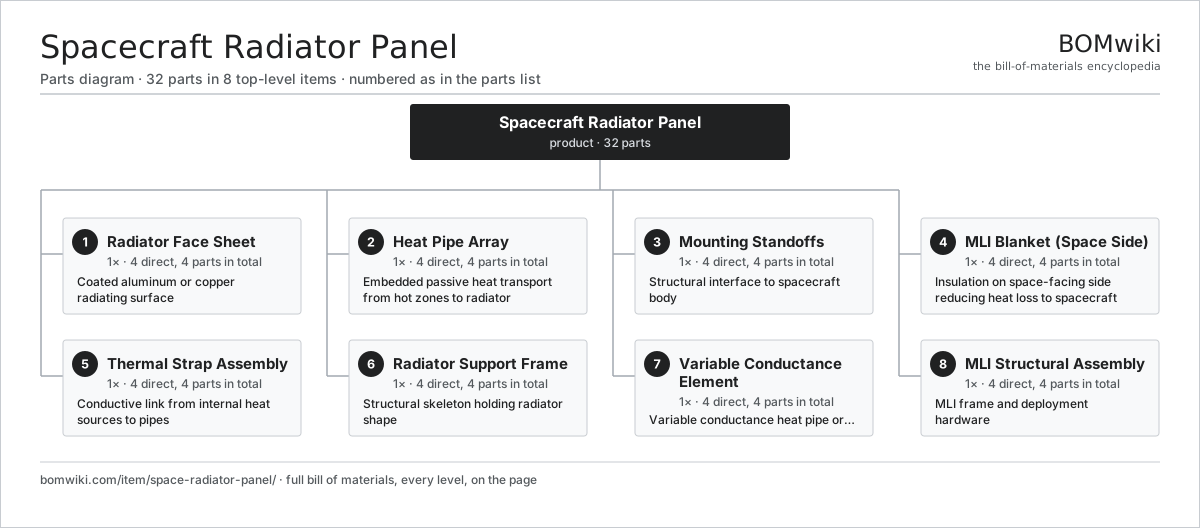
| # | Part | Qty | What it does |
|---|---|---|---|
| 1 | Radiator Face Sheet 4 parts | 1× | Coated aluminum or copper radiating surface |
| 2 | Heat Pipe Array 4 parts | 1× | Embedded passive heat transport from hot zones to radiator |
| 3 | Mounting Standoffs 4 parts | 1× | Structural interface to spacecraft body |
| 4 | MLI Blanket (Space Side) 4 parts | 1× | Insulation on space-facing side reducing heat loss to spacecraft |
| 5 | Thermal Strap Assembly 4 parts | 1× | Conductive link from internal heat sources to pipes |
| 6 | Radiator Support Frame 4 parts | 1× | Structural skeleton holding radiator shape |
| 7 | Variable Conductance Element 4 parts | 1× | Variable conductance heat pipe or shutoff valve |
| 8 | MLI Structural Assembly 4 parts | 1× | MLI frame and deployment hardware |
3D model
No 3D model yet. Have a CAD file of this? Add a 3D model. STL renders right on this page; STEP, FreeCAD, and OpenSCAD sources are welcome too (openly licensed, like all 3D models on BOMwiki).
Build & assembly graph
expand / collapse · shared sub-assemblies converge · links to related products · est. labourTap an assembly to expand/collapse · tap a part to open it · use “Open page” for any node · drag to pan, scroll to zoom.
Bill of materials for Spacecraft Radiator Panel
8 top-level lines · 40 rows shown · 32 parts total · indented to 3 levels| # | Item / sub-assembly | Part no. | Qty/assy | Ext. qty | Parts | Type |
|---|---|---|---|---|---|---|
| 1 | Radiator Face Sheet 4 parts | space-radiator-panel-face-sheet | 1× | 1 | 4 | assembly |
| 1.1 | Radiator Substrate Sheet | space-radiator-panel-substrate-sheet | 1× | 1 | · | part |
| 1.2 | High-Emissivity Coating | space-radiator-panel-coating | 1× | 1 | · | part |
| 1.3 | Edge Frame | space-radiator-panel-edge-frame | 1× | 1 | · | part |
| 1.4 | Fastener Set | fastener-set | 1× | 1 | · | part |
| 2 | Heat Pipe Array 4 parts | space-radiator-panel-heat-pipes | 1× | 1 | 4 | assembly |
| 2.1 | Heat Pipe Tube | space-radiator-panel-pipe-tube | 1× | 1 | · | part |
| 2.2 | Heat Pipe Wick | space-radiator-panel-pipe-wick | 1× | 1 | · | part |
| 2.3 | Pipe Header | space-radiator-panel-pipe-header | 1× | 1 | · | part |
| 2.4 | Fastener Set | fastener-set | 1× | 1 | · | part |
| 3 | Mounting Standoffs 4 parts | space-radiator-panel-mounting-standoffs | 1× | 1 | 4 | assembly |
| 3.1 | Standoff Post | space-radiator-panel-standoff-post | 1× | 1 | · | part |
| 3.2 | Fastener Set | fastener-set | 1× | 1 | · | part |
| 3.3 | Vibration Isolator | space-radiator-panel-vibration-isolator | 1× | 1 | · | part |
| 3.4 | Thermal Interface Material | space-radiator-panel-thermal-interface | 1× | 1 | · | part |
| 4 | MLI Blanket (Space Side) 4 parts | space-radiator-panel-mli-blanket | 1× | 1 | 4 | assembly |
| 4.1 | MLI Layer | space-radiator-panel-mli-layer | 1× | 1 | · | part |
| 4.2 | MLI Frame | space-radiator-panel-mli-frame | 1× | 1 | · | part |
| 4.3 | Fastener Set | fastener-set | 1× | 1 | · | part |
| 4.4 | Outer Micrometeorite Shield | space-radiator-panel-outer-cover | 1× | 1 | · | part |
| 5 | Thermal Strap Assembly 4 parts | space-radiator-panel-thermal-strap | 1× | 1 | 4 | assembly |
| 5.1 | Strap Material | space-radiator-panel-strap-material | 1× | 1 | · | part |
| 5.2 | Strap Connector | space-radiator-panel-strap-connector | 1× | 1 | · | part |
| 5.3 | Fastener Set | fastener-set | 1× | 1 | · | part |
| 5.4 | Interface Pad | space-radiator-panel-interface-pad | 1× | 1 | · | part |
| 6 | Radiator Support Frame 4 parts | space-radiator-panel-support-frame | 1× | 1 | 4 | assembly |
| 6.1 | Frame Tube | space-radiator-panel-frame-tube | 1× | 1 | · | part |
| 6.2 | Corner Bracket | space-radiator-panel-frame-corner | 1× | 1 | · | part |
| 6.3 | Fastener Set | fastener-set | 1× | 1 | · | part |
| 6.4 | Wire Bundle | wire-bundle | 1× | 1 | · | part |
| 7 | Variable Conductance Element 4 parts | space-radiator-panel-valve-element | 1× | 1 | 4 | assembly |
| 7.1 | Variable Heat Pipe | space-radiator-panel-vhp-tube | 1× | 1 | · | part |
| 7.2 | Louver Mechanism | space-radiator-panel-louver-mechanism | 1× | 1 | · | part |
| 7.3 | Microcontroller | mcu | 1× | 1 | · | part |
| 7.4 | Connector | connector | 1× | 1 | · | part |
| 8 | MLI Structural Assembly 4 parts | space-radiator-panel-secondary-structure | 1× | 1 | 4 | assembly |
| 8.1 | Deployment Hinge | space-radiator-panel-deployment-hinge | 1× | 1 | · | part |
| 8.2 | Fastener Set | fastener-set | 1× | 1 | · | part |
| 8.3 | Cable Management | space-radiator-panel-cable-management | 1× | 1 | · | part |
| 8.4 | Wire Bundle | wire-bundle | 1× | 1 | · | part |
Something wrong in this list? Report a problem with this BOM.
Sourcing: possible vendors
Browse the supplier directory → Prices, MOQ, and lead times are algorithmic estimates, not quotes, and not claims about these companies. Company mappings are curated by keyword; est. price band $50k–$500M. How estimates work| Vendor | HQ | Specialty | MOQ | Lead time |
|---|---|---|---|---|
|
🇺🇸SpaceX
spacex.com ↗
|
Hawthorne, US | Launch & spacecraft | made to order | 52–104 wks |
| northropgrumman.com ↗ | Falls Church, US | Space & defense | made to order | 52–104 wks |
|
🇫🇷Airbus
airbus.com ↗
|
Toulouse, FR | Aerospace OEM | made to order | 52–104 wks |
| rocketlabusa.com ↗ | Long Beach, US | Launch & spacecraft | made to order | 52–104 wks |
| thalesaleniaspace.com ↗ | Cannes, FR | Satellites | made to order | 52–104 wks |
1,599-word article