Speargun
ProductOverview
A speargun is an underwater hunting weapon launching a barbed spear at fish or game animals. The Spear Barrel Guide guides the Spear Shaft & Flopper along a straight-line trajectory. The Propulsion System (pneumatic or latex-band-based) stores and releases energy in rapid succession, accelerating the shaft to 15–25 m/s (54–90 km/h).
Most modern spearguns are pneumatic, charged with compressed air or CO2 to 80–120 psi. Older designs use stacked natural-rubber bands, which are less consistent but require no pressurization. A Retrieval Reel & Mechanism stores braided Braided Retrieval Line enabling recovery of the speared fish.
Spearguns are used by sport spearfishers worldwide, and are subject to varied local regulations regarding size, deployment location, and game species. Most recreational spearfishing occurs at 5–20 meters depth in coastal waters.
Pneumatic System
The Air Pressure Chamber is a sealed aluminum tube charged with compressed air via a small Schrader valve (like a bicycle tire valve). Typical pressure is 90–120 psi, providing 80–200 lb thrust depending on chamber volume and design.
When the Safety & Release Trigger is activated, the sear releases a piston connected to a rod or band assembly, propelling the Spear Shaft & Flopper forward. The gas expands rapidly, accelerating the shaft. Efficiency drops as pressure falls, most guns deliver peak power in the first 50–70 cm of shaft travel, then taper.
Latex Band Alternative
Older speargun designs use 3–5 stacked natural rubber bands, each 3–5 mm thick, looped over the Spear Barrel Guide. Pulling the shaft back stretches the bands, storing elastic energy. Upon trigger release, the bands snap forward, propelling the shaft.
Latex bands are simpler and do not require charging, but output is less consistent. Cold water stiffens the bands, reducing power. Repeated cycling causes degradation, bands eventually lose elasticity and must be replaced.
Projectile Assembly
The Spear Shaft Rod is hardened steel or aluminum, tapered from ~25 mm at the base (where it attaches to bands or pneumatic piston) to ~8 mm at the tip. The taper reduces drag and focuses impact energy.
The Barbed Spear Point is a forged steel multi-prong or barbed cone preventing fish escape. Barb geometry varies, some designs use single large barb, others use three or four smaller prongs. The tip must be sharp and sturdy to penetrate scales and bone.
The Rear Fin Stabilizer is a small tail-fin (plastic or rubber) at the shaft rear, stabilizing the projectile in-flight and preventing tumble. Without it, the shaft would spin unpredictably, missing targets.
The Retrieval Line Eyelet is a stainless steel eyelet bonded or soldered to the shaft mid-point. Braided Braided Retrieval Line attaches here, connecting the speared fish to the Retrieval Reel & Mechanism.
Trigger System
The Safety & Release Trigger is a mechanical lever-sear preventing accidental discharge. The sear catches the piston or band assembly in the loaded position. Squeezing the trigger lever actuates the sear, releasing the stored energy.
A Safety Engagement Notch adds a secondary lock, the gun cannot fire unless the safety is explicitly disengaged. This prevents accidental discharge during transport or storage.
Reel & Retrieval
The Retrieval Reel & Mechanism is mounted on the gun's handle, holding 30–100 meters of Braided Retrieval Line. Hand-crank reels require manual effort to winch in line and catch; motorized electric reels (powered by rechargeable battery) enable effortless retrieval but add weight and complexity.
A Reel Freespool Clutch enables freespool during the shot, when the gun fires, the reel disengages, allowing line to payout freely. During retrieval, the clutch re-engages, winding the line (and attached fish or game) back to the diver.
Accuracy & Technique
Speargun accuracy depends on barrel rigidity, trigger smoothness, and the diver's breathing stability. A rigid Spear Barrel Guide minimizes deflection under water resistance. A smooth trigger enables the shot without disturbing aim.
Divers hold the gun across their body, using both hands to aim. Shots are taken at ranges of 1–5 meters (rarely longer, due to drag losses). The Rear Fin Stabilizer reduces spread but does not eliminate it, spearfishing requires skill and practice.
Safety Considerations
Speargun discharge underwater is dangerous, the projectile travels at 15–25 m/s and does not slow appreciably until 10+ meters. Divers must observe strict rules: only aim at intended game; check the area behind the target; never point the gun at another diver; practice trigger discipline.
A misfired round traveling through the water can ricochet off rocks or sand, becoming unpredictable. Modern spearguns have excellent mechanical safeties and are considered safe when used by trained, disciplined spearfishers.
Regulations
Most countries regulate speargun use, depth limits, species restrictions, bag limits, and area closures apply. Some countries ban spearfishing entirely in certain waters. Local authorities enforce these rules, and violations can result in fines or gear confiscation.
Speargun parts and their functions
6 top-level parts · 23 parts in total · full bill of materials below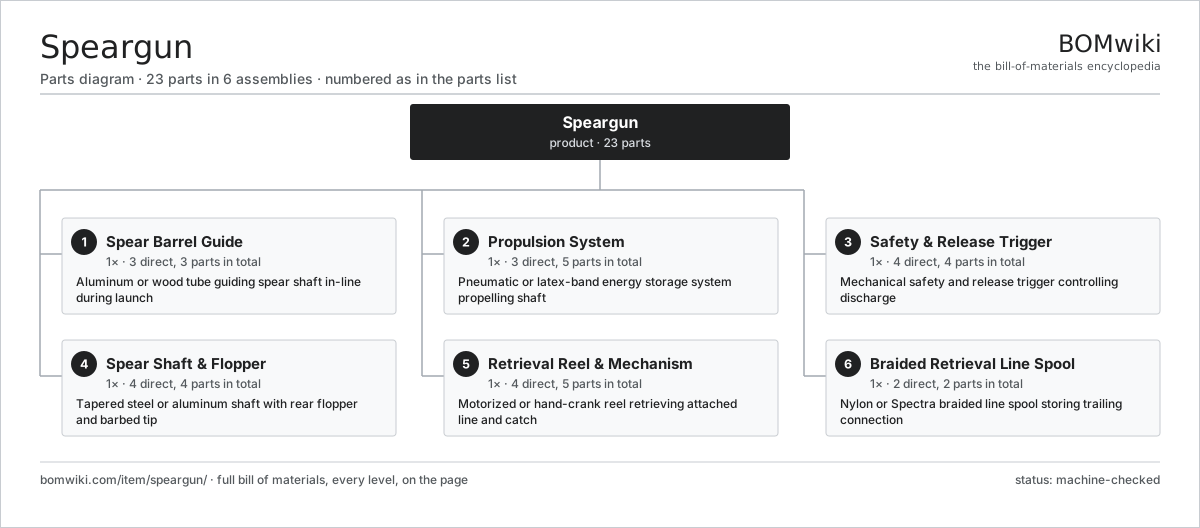
| # | Part | Qty | What it does |
|---|---|---|---|
| 1 | Spear Barrel Guide 3 parts | 1× | Aluminum or wood tube guiding spear shaft in-line during launch |
| 2 | Propulsion System 3 parts | 1× | Pneumatic or latex-band energy storage system propelling shaft |
| 3 | Safety & Release Trigger 4 parts | 1× | Mechanical safety and release trigger controlling discharge |
| 4 | Spear Shaft & Flopper 4 parts | 1× | Tapered steel or aluminum shaft with rear flopper and barbed tip |
| 5 | Retrieval Reel & Mechanism 4 parts | 1× | Motorized or hand-crank reel retrieving attached line and catch |
| 6 | Braided Retrieval Line Spool 2 parts | 1× | Nylon or Spectra braided line spool storing trailing connection |
3D model
No 3D model yet. Have a CAD file of this? Add a 3D model — STL renders right on this page; STEP, FreeCAD, and OpenSCAD sources are welcome too (openly licensed, like all 3D models on BOMwiki).
Build & assembly graph
expand / collapse · shared sub-assemblies converge · links to related products · est. labourTap an assembly to expand/collapse · tap a part to open it · use “Open page” for any node · drag to pan, scroll to zoom.
Bill of materials for Speargun
6 top-level lines · 26 rows shown · 23 parts total · indented to 3 levels| # | Item / sub-assembly | Part no. | Qty/assy | Ext. qty | Parts | Type |
|---|---|---|---|---|---|---|
| 1 | Spear Barrel Guide 3 parts | speargun-barrel | 1× | 1 | 3 | assembly |
| 1.1 | Aluminum or Wood Barrel Tube | speargun-barrel-tube | 1× | 1 | · | part |
| 1.2 | Front Aiming Sight | speargun-barrel-front-sight | 1× | 1 | · | part |
| 1.3 | Rear Adjustable Sight | speargun-barrel-rear-sight | 1× | 1 | · | part |
| 2 | Propulsion System 3 parts | speargun-propulsion-chamber | 1× | 1 | 5 | assembly |
| 2.1 | Air Pressure Chamber | speargun-pneumatic-chamber | 1× | 1 | · | part |
| 2.2 | Natural Rubber Propulsion Band | speargun-latex-band-set | 3× | 3 | · | part |
| 2.3 | Propulsion Band Mounting Bracket | speargun-band-anchor | 1× | 1 | · | part |
| 3 | Safety & Release Trigger 4 parts | speargun-trigger-mechanism | 1× | 1 | 4 | assembly |
| 3.1 | Mechanical Trigger Lever | speargun-trigger-lever | 1× | 1 | · | part |
| 3.2 | Trigger Sear Catch | speargun-trigger-sear | 1× | 1 | · | part |
| 3.3 | Safety Engagement Notch | speargun-safety-notch | 1× | 1 | · | part |
| 3.4 | Trigger Return Spring | speargun-trigger-spring | 1× | 1 | · | part |
| 4 | Spear Shaft & Flopper 4 parts | speargun-shaft-assembly | 1× | 1 | 4 | assembly |
| 4.1 | Spear Shaft Rod | speargun-shaft-steel | 1× | 1 | · | part |
| 4.2 | Barbed Spear Point | speargun-barbed-tip | 1× | 1 | · | part |
| 4.3 | Rear Fin Stabilizer | speargun-flopper-assembly | 1× | 1 | · | part |
| 4.4 | Retrieval Line Eyelet | speargun-line-attach-ring | 1× | 1 | · | part |
| 5 | Retrieval Reel & Mechanism 4 parts | speargun-reel-system | 1× | 1 | 5 | assembly |
| 5.1 | Line Spool Drum | speargun-reel-spool | 1× | 1 | · | part |
| 5.2 | Reel Hand Crank | speargun-reel-crank | 1× | 1 | · | part |
| 5.3 | Spool Bearing | speargun-reel-bearing | 2× | 2 | · | part |
| 5.4 | Reel Freespool Clutch | speargun-reel-clutch | 1× | 1 | · | part |
| 6 | Braided Retrieval Line Spool 2 parts | speargun-line-storage | 1× | 1 | 2 | assembly |
| 6.1 | Braided Retrieval Line | speargun-line-material | 1× | 1 | · | part |
| 6.2 | Line Terminus Knot | speargun-line-anchor-point | 1× | 1 | · | part |
Sourcing: possible vendors
Prices, MOQ, and lead times are algorithmic estimates, not quotes, and not claims about these companies. Company mappings are curated by keyword; est. price band $20–$2k. How estimates work| Vendor | HQ | Specialty | MOQ | Lead time |
|---|---|---|---|---|
|
🇺🇸Coleman
coleman.com ↗
|
Chicago, US | Camping gear | 1,000 units | 6–10 wks |
| thenorthface.com ↗ | Denver, US | Outdoor apparel & gear | 1,000 units | 6–10 wks |
|
🇺🇸YETI
yeti.com ↗
|
Austin, US | Coolers & drinkware | 1,000 units | 6–10 wks |
| decathlon.com ↗ | Villeneuve-d'Ascq, FR | Sporting goods | 1,000 units | 6–10 wks |
|
🇺🇸Garmin
garmin.com ↗
|
Olathe, US | GPS & wearables | 1,000 units | 6–10 wks |
802-word article