Spectrum Analyzer
ProductOverview
A spectrum analyzer is a frequency-domain measurement instrument that displays signal strength versus frequency across a wide bandwidth. Unlike oscilloscopes which show voltage versus time, spectrum analyzers decompose periodic and random signals into their frequency components using heterodyne mixing and intermediate frequency processing. Spectrum analyzers are indispensable in RF/microwave engineering, telecommunications, EMC testing, broadcast monitoring, and scientific research.
Modern spectrum analyzers use phase-locked synthesizers to sweep the LO Synthesizer across the measurement band while monitoring the signal power through a Mixer Stage and IF Chain. A logarithmic display (dBm scale) normalizes power perception across 80–110 dB dynamic range, making weak sidebands and harmonics visible alongside strong carriers.
How it works
The signal enters the RF Front End, where the Step Attenuator reduces strong signals to prevent overload, and the Low-Noise Preamp amplifies weak signals to improve sensitivity. The Preselector Filter is a tunable bandpass filter that rejects image frequencies and out-of-band interference.
The Mixer Stage down-converts RF to a fixed intermediate frequency (typically 10 MHz) using a Mixer IC driven by the LO Synthesizer. The mixer is a nonlinear device that produces sum and difference frequencies; only the difference (IF) is desired.
The LO Synthesizer consists of a VCO (voltage-controlled oscillator) phase-locked to a precision Reference Oscillator via a PLL IC. The PLL Loop Filter shapes the control voltage, setting loop bandwidth (typically 10–100 Hz) to balance fast tracking against noise.
The IF Chain amplifies the IF signal through multiple stages: First IF Amplifier, First IF Filter (broad bandpass), Second IF Amplifier, and Second IF Filter (narrowband, sets resolution bandwidth or RBW). Resolution bandwidth ranges 100 Hz–3 MHz; narrower RBW reveals weak tones but increases sweep time.
The Detector and Video stage uses a Schottky Schottky Detector to detect the IF envelope, followed by a Video Filter and logarithmic conversion via Log Converter. The output is digitized by a Video ADC and sent to the DSP Processor, which computes instantaneous or smoothed (video-averaged) traces.
The Display Subsystem renders the trace on an LCD Panel with graticule, frequency axis, dBm scale, and optional marker annotations. Trace memory and peak hold allow comparison against reference spectra.
Frequency Coverage and Mixing Strategy
A single IF stage covers a limited span. To measure 10 kHz–3 GHz on a single 10 MHz IF, the LO Synthesizer must tune 10.01 MHz–3010 MHz. This wide LO tuning is achieved using a YIG oscillator (yttrium iron garnet, magnetically tuned) or a PLL-synthesized VCO with multiple ranges. Image frequencies (f_LO ± f_IF) are rejected by the Preselector Filter and First IF Filter.
Dynamic Range and Attenuation
Dynamic range is the ratio of the largest signal (before 1 dB compression) to the smallest detectable signal. A spectrum analyzer with −110 dBm sensitivity and +20 dBm maximum input spans 130 dB theoretically; practical dynamic range is 80–110 dB due to compression and noise floor rise with strong interferers.
The Step Attenuator in 2 dB steps (0–40 dB) allows measurement of strong signals without saturating the Low-Noise Preamp. A strong signal compresses gain and increases noise floor if not attenuated; conversely, weak signals need the preamp for visibility.
Resolution and Video Bandwidth
Resolution bandwidth (RBW) is the −3 dB width of the IF filter stack. A 1 kHz RBW rejects noise and nearby weak tones but takes longer to scan (narrower bandwidth = longer settling time per frequency). A 1 MHz RBW reveals fast transients and wide signals but masks weak spectral lines under noise.
Video bandwidth (VBW) is the lowpass bandwidth after detection. A 1 Hz VBW heavily averages the trace, smoothing noise but reducing transient visibility. A 1 MHz VBW shows instantaneous fluctuations. The ratio RBW:VBW determines trace smoothness; typical is 1:10 to 1:100.
Display Modes and Averaging
Spectrum analyzers offer several trace modes:
- Clear/Write: Each sweep erases the previous trace; shows instantaneous spectrum.
- Max Hold: Retains the maximum value at each frequency across multiple sweeps; captures transients and harmonics that may appear only briefly.
- Average: Linearly sums successive sweeps, reducing random noise at the cost of slower response.
- Video Averaging: Post-detection lowpass filtering, more efficient than sweep averaging.
Measurement Functions
Modern analyzers include automated measurements: carrier power, adjacent channel power ratio (ACPR), occupied bandwidth (OBW), harmonic power, noise floor, and time-domain gate triggering. Markers pinpoint specific frequencies and read power; delta markers measure relative power between two tones.
The DSP Processor computes these functions in real time, improving measurement speed and repeatability versus manual graticule reading.
Source Synthesis and Frequency Accuracy
The LO Synthesizer achieves frequency accuracy of ±(reference stability + synthesizer resolution). A 10 ppm reference (±100 Hz at 10 MHz) combined with 1 Hz resolution synthesizer steps yields ±100 Hz absolute accuracy across 3 GHz. Rubidium or disciplined oscillators achieve ±0.1 ppm for traceable frequency standards.
Phase Noise and Spectral Purity
Phase noise of the LO Synthesizer appears as skirts around the measured signal; high phase noise masks weak signals near strong carriers. The PLL IC and PLL Loop Filter jointly determine phase noise; tighter loop bandwidth reduces noise but sacrifices settling speed.
Applications
- Cellular, broadcast, and ISM band signal monitoring
- Conducted and radiated emission measurement (EMC testing)
- Oscillator and synthesizer characterization
- Filter response measurement (with external source)
- Harmonic and intermodulation product detection
- Transient and burst RF signal capture
- Frequency stability verification and service
Measurement Uncertainty
Absolute amplitude accuracy depends on Step Attenuator uncertainty (±0.2 dB typical), Schottky Detector linearity, and reference signal coupling. Relative measurements (level of one tone versus another) are more accurate than absolute dBm values.
Spectrum Analyzer parts and their functions
8 top-level parts · 85 parts in total · full bill of materials below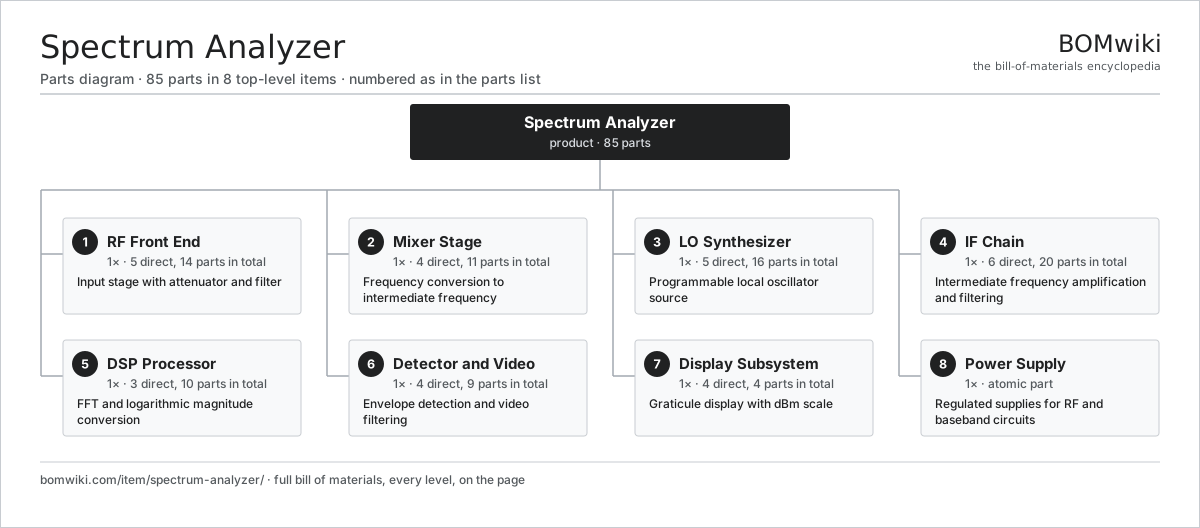
| # | Part | Qty | What it does |
|---|---|---|---|
| 1 | RF Front End 5 parts | 1× | Input stage with attenuator and filter |
| 2 | Mixer Stage 4 parts | 1× | Frequency conversion to intermediate frequency |
| 3 | LO Synthesizer 5 parts | 1× | Programmable local oscillator source |
| 4 | IF Chain 6 parts | 1× | Intermediate frequency amplification and filtering |
| 5 | DSP Processor 3 parts | 1× | FFT and logarithmic magnitude conversion |
| 6 | Detector and Video 4 parts | 1× | Envelope detection and video filtering |
| 7 | Display Subsystem 4 parts | 1× | Graticule display with dBm scale |
| 8 | Power Supply | 1× | Regulated supplies for RF and baseband circuits |
3D model
No 3D model yet. Have a CAD file of this? Add a 3D model. STL renders right on this page; STEP, FreeCAD, and OpenSCAD sources are welcome too (openly licensed, like all 3D models on BOMwiki).
Build & assembly graph
expand / collapse · shared sub-assemblies converge · links to related products · est. labourTap an assembly to expand/collapse · tap a part to open it · use “Open page” for any node · drag to pan, scroll to zoom.
Bill of materials for Spectrum Analyzer
8 top-level lines · 39 rows shown · 85 parts total · indented to 3 levels| # | Item / sub-assembly | Part no. | Qty/assy | Ext. qty | Parts | Type |
|---|---|---|---|---|---|---|
| 1 | RF Front End 5 parts | spectrum-analyzer-rf-frontend | 1× | 1 | 14 | assembly |
| 1.1 | Input Connector | spectrum-analyzer-input-connector | 1× | 1 | · | part |
| 1.2 | Step Attenuator | spectrum-analyzer-attenuator-pad | 1× | 1 | · | part |
| 1.3 | Low-Noise Preamp | spectrum-analyzer-preamp | 1× | 1 | · | part |
| 1.4 | Preselector Filter | spectrum-analyzer-preselector | 1× | 1 | · | part |
| 1.5 | SMD Passive (R/C/L) | smd-passives | 10× | 10 | · | part |
| 2 | Mixer Stage 4 parts | spectrum-analyzer-mixer-stage | 1× | 1 | 11 | assembly |
| 2.1 | Mixer IC | spectrum-analyzer-mixer-ic | 1× | 1 | · | part |
| 2.2 | LO Coupling Network | spectrum-analyzer-lo-port | 1× | 1 | · | part |
| 2.3 | IF Coupling Network | spectrum-analyzer-if-coupling | 1× | 1 | · | part |
| 2.4 | SMD Passive (R/C/L) | smd-passives | 8× | 8 | · | part |
| 3 | LO Synthesizer 5 parts | spectrum-analyzer-lo-synthesizer | 1× | 1 | 16 | assembly |
| 3.1 | VCO | spectrum-analyzer-lo-vco | 1× | 1 | · | part |
| 3.2 | PLL IC | spectrum-analyzer-pll-ic | 1× | 1 | · | part |
| 3.3 | Reference Oscillator | spectrum-analyzer-reference-oscillator | 1× | 1 | · | part |
| 3.4 | PLL Loop Filter | spectrum-analyzer-loop-filter | 1× | 1 | · | part |
| 3.5 | SMD Passive (R/C/L) | smd-passives | 12× | 12 | · | part |
| 4 | IF Chain 6 parts | spectrum-analyzer-if-chain | 1× | 1 | 20 | assembly |
| 4.1 | First IF Amplifier | spectrum-analyzer-if-amp-1 | 1× | 1 | · | part |
| 4.2 | First IF Filter | spectrum-analyzer-if-filter-1 | 1× | 1 | · | part |
| 4.3 | Second IF Amplifier | spectrum-analyzer-if-amp-2 | 1× | 1 | · | part |
| 4.4 | Second IF Filter | spectrum-analyzer-if-filter-2 | 1× | 1 | · | part |
| 4.5 | Video Amplifier | spectrum-analyzer-video-amp | 1× | 1 | · | part |
| 4.6 | SMD Passive (R/C/L) | smd-passives | 15× | 15 | · | part |
| 5 | DSP Processor 3 parts | spectrum-analyzer-dsp-processor | 1× | 1 | 10 | assembly |
| 5.1 | DSP Controller | spectrum-analyzer-dsp-controller | 1× | 1 | · | part |
| 5.2 | Video ADC | spectrum-analyzer-adc-if | 1× | 1 | · | part |
| 5.3 | SMD Passive (R/C/L) | smd-passives | 8× | 8 | · | part |
| 6 | Detector and Video 4 parts | spectrum-analyzer-detector-video | 1× | 1 | 9 | assembly |
| 6.1 | Schottky Detector | spectrum-analyzer-detector-diode | 1× | 1 | · | part |
| 6.2 | Video Filter | spectrum-analyzer-video-filter | 1× | 1 | · | part |
| 6.3 | Log Converter | spectrum-analyzer-log-converter | 1× | 1 | · | part |
| 6.4 | SMD Passive (R/C/L) | smd-passives | 6× | 6 | · | part |
| 7 | Display Subsystem 4 parts | spectrum-analyzer-display-subsystem | 1× | 1 | 4 | assembly |
| 7.1 | LCD Panel | lcd-panel | 1× | 1 | · | part |
| 7.2 | Graphics Processor | spectrum-analyzer-graphics-processor | 1× | 1 | · | part |
| 7.3 | Trace Memory | spectrum-analyzer-memory-trace | 1× | 1 | · | part |
| 7.4 | Power Supply | power-supply | 1× | 1 | · | part |
| 8 | Power Supply | power-supply | 1× | 1 | · | part |
Something wrong in this list? Report a problem with this BOM.
Related products
same domain, ranked by shared parts Vector Network Analyzer
84 parts · shares 8 with this page
Vector Network Analyzer
84 parts · shares 8 with this page
 Analytical Balance
54 parts · shares 2 with this page
Analytical Balance
54 parts · shares 2 with this page
 Atomic Absorption Spectrometer
648 parts · shares 2 with this page
Autoclave Sterilizer
282 parts · shares 2 with this page
Atomic Absorption Spectrometer
648 parts · shares 2 with this page
Autoclave Sterilizer
282 parts · shares 2 with this page
 Automated Cell Counter
54 parts · shares 2 with this page
Automated Colony Counter
322 parts · shares 2 with this page
Automated Cell Counter
54 parts · shares 2 with this page
Automated Colony Counter
322 parts · shares 2 with this page
Sourcing: possible vendors
Browse the supplier directory → Prices, MOQ, and lead times are algorithmic estimates, not quotes, and not claims about these companies. Company mappings are curated by keyword; est. price band $1k–$500k. How estimates work| Vendor | HQ | Specialty | MOQ | Lead time |
|---|---|---|---|---|
| thermofisher.com ↗ | Waltham, US | Lab instruments | 100 units | 10–18 wks |
|
🇺🇸Agilent
agilent.com ↗
|
Santa Clara, US | Analytical instruments | 100 units | 10–18 wks |
|
🇺🇸Bruker
bruker.com ↗
|
Billerica, US | Scientific instruments | 100 units | 10–18 wks |
|
🇯🇵Shimadzu
shimadzu.com ↗
|
Kyoto, JP | Analytical instruments | 100 units | 10–18 wks |
|
🇺🇸Waters
waters.com ↗
|
Milford, US | Chromatography & MS | 100 units | 10–18 wks |
1,007-word article