Tracked Spider Lift
ProductOverview
A tracked spider lift is a specialized access platform combining a powerful articulated boom with all-terrain rubber-track mobility. Unlike conventional boom lifts on rigid bases or tires, spider lifts excel on soft ground, slopes, and constrained spaces (construction sites, orchards, wetlands, vegetation management) where conventional equipment would sink or lose traction. The name "spider" refers to the splayed outrigger legs that stabilize the unit.
The system comprises a Track Chassis (rubber-track drive base), Hybrid Power System (hybrid diesel-electric), Articulated Boom (multi-section articulated reach), Work Platform Basket (personnel platform), Outrigger Stabilizer System (four stabilizing feet), and a complete Hydraulic System powering all motion.
Track chassis and mobility
The Track Chassis is a compact rubber-tracked undercarriage. Two heavy-duty Rubber Track (600–1000 mm width, aggressive tread) per side provide traction on mud, grass, snow, and steep slopes (40–50% grade on grass, 25–30% on pavement). Independent Track Drive Motor units on each side allow differential steering without breaking ground. A Track Tensioner system keeps tracks properly tensioned.
The track design is key: wide contact patch and flexible rubber absorb terrain shock while gripping unpaved surfaces. Operators can traverse soft ground (orchards, nurseries, wetlands) that would be impossible for wheeled boom lifts.
Hybrid power system
The Hybrid Power System combines a 30–60 kW Diesel Engine with an Electric Motor (AC or DC) powered by an onboard Battery Pack (lithium or lead-acid). An Engine Controller intelligently switches between:
- Diesel mode: Full-power work (boom extension, climbing steep slopes).
- Electric mode: Quiet positioning, indoor work, zero emissions.
- Hybrid mode: Engine charges battery while delivering boom power simultaneously.
This hybrid approach reduces fuel consumption and allows silent operation in noise-sensitive environments (hospitals, urban construction, early-morning work).
Articulated boom system
The Articulated Boom consists of 3–4 Boom Section (welded rectangular tube, steel or aluminum). Each section telescopes within the next, multiplying reach without excessive length when retracted. Boom Joint articulation points between sections allow the boom to bend, enabling operators to reach over obstacles, position the basket into confined spaces (roof corners, window frames), or lower the basket below the boom pivot for fine vertical positioning.
Boom Hose (high-pressure SAE hose) routes through hollow boom sections, supplying Boom Cylinder that extend, retract, and articulate the boom. Boom Wiring carries electrical signals for sensors and proportional valve commands.
A typical spider lift reaches 15–30 m working height with 10–20 m horizontal reach from the pivot point, sufficient for most access and maintenance tasks.
Personnel basket and entry
The Work Platform Basket is a welded-steel or aluminum platform (typically 2.0 m × 1.5 m footprint) accommodating 2–6 workers. The Basket Frame is rated for 500–750 kg total load (operators + tools). Basket Guardrail (1.1 m+ height per ANSI A92.1) perimeter rails protect occupants. A Basket Gate hinged entry gate locks closed before lift operation, with an interlock preventing boom motion if the gate is open.
The Basket Floor is perforated anti-slip steel or composite allowing water drainage. Operators control all boom and basket movement via a Proportional Joystick proportional input device mounted inside the basket, allowing intuitive reach-in-any-direction positioning.
Outrigger stabilization
The Outrigger Stabilizer System are four Outrigger Arm assemblies (one per corner) extending 1–3 m outward from the chassis. Each arm ends in a large Outrigger Foot (0.3–0.5 m² flat pad) distributing load on soft terrain. Outrigger Cylinder (double-acting) raise and lower each arm on operator command; a Outrigger Valve proportional valve controls arm speed and pressure.
On soft ground, outriggers prevent tip-over even with the boom fully extended and loaded. On hard pavement, operators can retract outriggers for compact travel, though they remain ready to deploy instantly.
Hydraulic power system
The Hydraulic System is the actuating backbone. A variable-displacement Hydraulic Pump (30–50 cc/rev swashplate, ~250 bar rated) is engine-driven, delivering proportional flow on demand. Three Boom Cylinder (80–150 mm bore) articulate and extend/retract boom sections. Outrigger and track circuits each have dedicated Flow Valve proportional valve sections.
All hydraulic hoses are Hose Assembly (SAE 100R12 or 100R13 spiral hose, 1/2" to 1.25" diameter) rated for 280 bar continuous. Hydraulic Fluid (ISO VG 46 anti-wear oil) is circulated through the system; a small onboard cooler manages heat dissipation during heavy work.
Operator control and safety
Operators in the basket use a Proportional Joystick proportional input device (X/Y/Z axes) to command boom and basket motion. A Control Box electrical processor converts joystick signals to proportional valve commands. An Intercom System radio or intercom links the basket operator with ground spotters.
Safety is paramount:
- Load Pin: Load cell pins under boom and outriggers transmit real-time load to the controller, preventing overload operation.
- Tilt Sensor: Inclinometer prevents boom extension if chassis tilt exceeds safe limit (typically ±2.5° from horizontal).
- Pressure Relief: Pilot-operated relief valves protect all hydraulic circuits from overpressure.
- Emergency Descent: Manual descent valve allows controlled basket lowering if hydraulic power is lost.
- Emergency Beacon: Flashing beacon and audible alarm alert ground crew to overload or emergency conditions.
Operational characteristics
Spider lifts excel in:
- Orchards and nurseries: Rubber tracks don't compact soil; can operate on muddy terrain.
- Wetland and bog work: Wide, low-pressure footprint allows access where wheels would sink.
- Steep slopes: 40–50% grade capability on grass, 25–30% on pavement.
- Constrained urban sites: Hybrid electric mode allows early-morning/evening work without noise.
- Selective positioning: Articulating boom reaches around obstacles, into corners, or below pivot for fine work.
Typical duty is 6–8 hours daily at a construction site or vegetation-management project. Maintenance includes daily track tension check, weekly hydraulic fluid level/condition, and annual inspection of seals, hoses, and load pins.
Tracked Spider Lift parts and their functions
8 top-level parts · 113 parts in total · full bill of materials below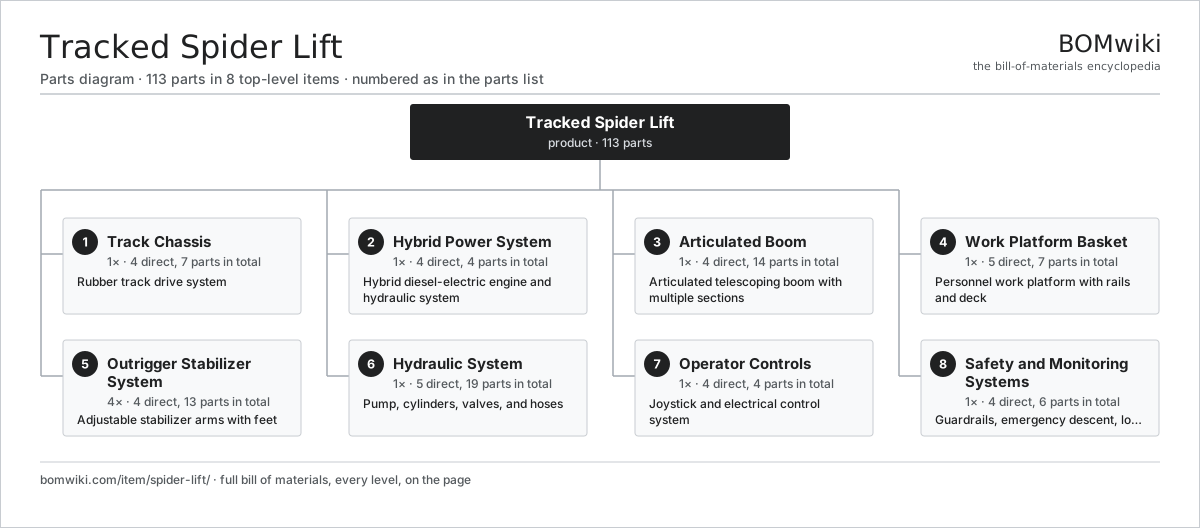
| # | Part | Qty | What it does |
|---|---|---|---|
| 1 | Track Chassis 4 parts | 1× | Rubber track drive system |
| 2 | Hybrid Power System 4 parts | 1× | Hybrid diesel-electric engine and hydraulic system |
| 3 | Articulated Boom 4 parts | 1× | Articulated telescoping boom with multiple sections |
| 4 | Work Platform Basket 5 parts | 1× | Personnel work platform with rails and deck |
| 5 | Outrigger Stabilizer System 4 parts | 4× | Adjustable stabilizer arms with feet |
| 6 | Hydraulic System 5 parts | 1× | Pump, cylinders, valves, and hoses |
| 7 | Operator Controls 4 parts | 1× | Joystick and electrical control system |
| 8 | Safety and Monitoring Systems 4 parts | 1× | Guardrails, emergency descent, load monitoring |
3D model
No 3D model yet. Have a CAD file of this? Add a 3D model. STL renders right on this page; STEP, FreeCAD, and OpenSCAD sources are welcome too (openly licensed, like all 3D models on BOMwiki).
Build & assembly graph
expand / collapse · shared sub-assemblies converge · links to related products · est. labourTap an assembly to expand/collapse · tap a part to open it · use “Open page” for any node · drag to pan, scroll to zoom.
Bill of materials for Tracked Spider Lift
8 top-level lines · 42 rows shown · 113 parts total · indented to 3 levels| # | Item / sub-assembly | Part no. | Qty/assy | Ext. qty | Parts | Type |
|---|---|---|---|---|---|---|
| 1 | Track Chassis 4 parts | spider-lift-chassis | 1× | 1 | 7 | assembly |
| 1.1 | Track Frame | spider-lift-track-frame | 1× | 1 | · | part |
| 1.2 | Rubber Track | spider-lift-rubber-track | 2× | 2 | · | part |
| 1.3 | Track Drive Motor | spider-lift-track-motor | 2× | 2 | · | part |
| 1.4 | Track Tensioner | spider-lift-track-tension | 2× | 2 | · | part |
| 2 | Hybrid Power System 4 parts | spider-lift-engine | 1× | 1 | 4 | assembly |
| 2.1 | Diesel Engine | spider-lift-diesel-engine | 1× | 1 | · | part |
| 2.2 | Electric Motor | spider-lift-electric-motor | 1× | 1 | · | part |
| 2.3 | Battery Pack | spider-lift-battery-pack | 1× | 1 | · | part |
| 2.4 | Engine Controller | spider-lift-engine-controller | 1× | 1 | · | part |
| 3 | Articulated Boom 4 parts | spider-lift-boom | 1× | 1 | 14 | assembly |
| 3.1 | Boom Section | spider-lift-boom-section | 3× | 3 | · | part |
| 3.2 | Boom Joint | spider-lift-boom-joint | 2× | 2 | · | part |
| 3.3 | Boom Hose | spider-lift-boom-hose | 8× | 8 | · | part |
| 3.4 | Boom Wiring | spider-lift-boom-wiring | 1× | 1 | · | part |
| 4 | Work Platform Basket 5 parts | spider-lift-basket | 1× | 1 | 7 | assembly |
| 4.1 | Basket Frame | spider-lift-basket-frame | 1× | 1 | · | part |
| 4.2 | Basket Floor | spider-lift-basket-floor | 1× | 1 | · | part |
| 4.3 | Basket Guardrail | spider-lift-basket-guardrails | 3× | 3 | · | part |
| 4.4 | Basket Gate | spider-lift-basket-gate | 1× | 1 | · | part |
| 4.5 | Basket Attachment | spider-lift-basket-attachment | 1× | 1 | · | part |
| 5 | Outrigger Stabilizer System 4 parts | spider-lift-outriggers | 4× | 4 | 13 | assembly |
| 5.1 | Outrigger Arm | spider-lift-outrigger-arm | 4× | 16 | · | part |
| 5.2 | Outrigger Foot | spider-lift-outrigger-foot | 4× | 16 | · | part |
| 5.3 | Outrigger Cylinder | spider-lift-outrigger-cylinder | 4× | 16 | · | part |
| 5.4 | Outrigger Valve | spider-lift-outrigger-valve | 1× | 4 | · | part |
| 6 | Hydraulic System 5 parts | spider-lift-hydraulic-system | 1× | 1 | 19 | assembly |
| 6.1 | Hydraulic Pump | spider-lift-hydraulic-pump | 1× | 1 | · | part |
| 6.2 | Boom Cylinder | spider-lift-boom-cylinders | 3× | 3 | · | part |
| 6.3 | Flow Valve | spider-lift-flow-valve | 2× | 2 | · | part |
| 6.4 | Hose Assembly | spider-lift-hose-assembly | 12× | 12 | · | part |
| 6.5 | Hydraulic Fluid | spider-lift-hydraulic-fluid | 1× | 1 | · | part |
| 7 | Operator Controls 4 parts | spider-lift-controls | 1× | 1 | 4 | assembly |
| 7.1 | Proportional Joystick | spider-lift-joystick | 1× | 1 | · | part |
| 7.2 | Control Box | spider-lift-control-box | 1× | 1 | · | part |
| 7.3 | Emergency Descent | spider-lift-emergency-descent | 1× | 1 | · | part |
| 7.4 | Intercom System | spider-lift-intercom | 1× | 1 | · | part |
| 8 | Safety and Monitoring Systems 4 parts | spider-lift-safety-systems | 1× | 1 | 6 | assembly |
| 8.1 | Load Pin | spider-lift-load-pin | 2× | 2 | · | part |
| 8.2 | Tilt Sensor | spider-lift-tilt-sensor | 1× | 1 | · | part |
| 8.3 | Pressure Relief | spider-lift-pressure-relief | 2× | 2 | · | part |
| 8.4 | Emergency Beacon | spider-lift-emergency-beacon | 1× | 1 | · | part |
Something wrong in this list? Report a problem with this BOM.
Sourcing: possible vendors
Browse the supplier directory → Prices, MOQ, and lead times are algorithmic estimates, not quotes, and not claims about these companies. Company mappings are curated by keyword; est. price band $15k–$2M. How estimates work| Vendor | HQ | Specialty | MOQ | Lead time |
|---|---|---|---|---|
| caterpillar.com ↗ | Irving, US | Construction & mining equipment | made to order | 16–28 wks |
|
🇯🇵Komatsu
komatsu.com ↗
|
Tokyo, JP | Construction & mining equipment | made to order | 16–28 wks |
|
🇸🇪Volvo CE
volvoce.com ↗
|
Gothenburg, SE | Construction equipment | made to order | 16–28 wks |
|
🇨🇭Liebherr
liebherr.com ↗
|
Bulle, CH | Cranes & heavy equipment | made to order | 16–28 wks |
|
🇨🇳XCMG
xcmg.com ↗
|
Xuzhou, CN | Construction machinery | made to order | 16–28 wks |
1,045-word article