Spiral Concentrator
ProductOverview
A spiral concentrator is a gravity concentration device consisting of helical troughs down which ore slurry flows. As the slurry spirals downward, heavy minerals (gold, cassiterite, magnetite) settle toward the inner wall of the helix due to centrifugal force, while light gangue flows toward the outer wall. Movable splitters near the discharge partition the settled heavy minerals from the light fractions, creating a concentrated product.
Spirals are the most economical gravity concentrator for fine gold and other heavy minerals (−50 to +0.1 mm). A single spiral can process 5–50 t/h depending on ore density and target mineral content. Large plants use 4–12 spirals stacked in a compact vertical bank, achieving 50–500 t/h throughput with minimal footprint. Capital and operating costs are substantially lower than flotation for simple ore types with clear density separation.
How it works
Prepared ore slurry (typically −3 to +100 μm for gold, −500 μm for cassiterite) is mixed with water to achieve 40–60% solids by weight. The slurry is fed to the top of the spiral trough via a distribution box that evenly divides flow among multiple spiral decks if present.
As the slurry flows downward along the helical path, the spiral's shape and slope (typically 50–55° to horizontal) create a laminar flow regime. The curvature induces centrifugal acceleration perpendicular to the flow direction. Heavy particles (e.g., gold, ρ = 19.3 g/cm³) experience a greater centrifugal force than the surrounding slurry and migrate toward the inner wall of the helix. Light gangue (e.g., quartz, ρ = 2.6 g/cm³) tends to remain in the upper slurry layers, flowing toward the outer wall.
Over the course of the spiral descent (5–15 m path length), particles have time to segregate by density. At the discharge, a splitter gate (adjustable blade) is positioned to direct:
- Concentrate (heavy fraction): Inner and lower portion of the discharge stream, settling at the bottom.
- Middlings: Middle portion (variable recovery, often recycled).
- Tailings (light fraction): Outer and upper portion, containing most light gangue.
The concentrate flows to a concentrate tank for settling and thickening before ball mill or flotation. The tailings flow to a tailings system. Middlings are often recycled to the spiral inlet for second-pass concentration.
Density Separation Mechanism
Spiral concentration exploits the density difference between minerals. Consider gold (19.3 g/cm³) in a slurry of quartz (2.6 g/cm³) and water (1.0 g/cm³):
The slurry has an apparent density between water and the solid minerals. As the slurry curves along the spiral path with centripetal acceleration a = v²/R (where v is slurry velocity and R is the spiral radius of curvature):
- A gold particle experiences an outward centrifugal "force" (in the rotating frame) proportional to its mass and a.
- A quartz particle experiences a lesser centrifugal force (smaller mass for the same volume).
- Buoyancy and drag forces act on both, but gold's net outward force is greater, causing it to settle inward.
Over a long spiral path, even fine gold (−0.1 mm) can segregate efficiently because the process is continuous and residence time is sufficient (5–15 minutes).
Spiral Configuration
Spirals are typically arranged in vertical stacks or ''banks,'' with 4–12 individual spiral troughs per bank. Each trough is 1–3 m wide and 5–15 m long. The trough is constructed from precast concrete or fabricated steel, lined with replaceable rubber or polyurethane wear liners to resist abrasion.
The slope must be precise, typically 50–55° from horizontal. A steeper angle increases throughput but reduces residence time and worsens separation. A gentler angle improves separation but reduces capacity. Support frames hold each trough at the correct angle using adjustable pedestals.
Multiple spirals discharge into a common collection sump or directly into downstream tanks. The compact vertical arrangement is a key advantage: a 6-spiral bank occupies ~4 m × 3 m footprint while handling 50–300 t/h, whereas an equivalent DMS cyclone or flotation cell circuit would require significantly more floor space.
Product Control via Splitters
A critical innovation is the movable splitter gate positioned at or near the spiral discharge. This adjustable blade is positioned to partition the discharge stream:
- If positioned toward the inner wall (heavy side), a larger proportion of intermediate-density material is classified as concentrate, increasing recovery but lowering concentrate grade.
- If positioned toward the outer wall (light side), the concentrate contains only the densest particles, raising grade but reducing recovery.
By adjusting splitter position, an operator can fine-tune the trade-off between recovery and grade in real-time. For a gold plant, this might mean operating at 85% recovery with 70% concentrate grade, or 70% recovery with 85% grade, depending on downstream economics.
Collar Scavenging
A key feature of modern spirals is ''collar scavenging'', a secondary collection channel around the spiral discharge capturing entrained heavy minerals in the tailings stream. A pump recirculates this scavenged material back to the spiral inlet, giving particles a second pass to settle. This can improve overall recovery by 10–20%, offsetting losses to the tailings due to imperfect flow distribution.
Feed Preparation and Slurry Management
Spirals require well-prepared feed: particles must be within a narrow size range (typically −3 to +0.1 mm for gold) to segregate efficiently. Feed sizing is achieved by screens or hydrocyclones upstream. Slurry density is critical, too thick (>70% solids) and flow becomes churning; too dilute (<30% solids) and settling is slow. Target density is 40–60% solids by mass.
The water metering system maintains density by adding fresh water or recycling thickener overflow. The controller measures inlet density and adjusts water addition automatically, optimizing separation.
Power and Equipment
Spirals are low-power devices. A 4-spiral bank processing 100 t/h requires:
- Vibrating feeder: 5–10 kW
- Scavenge pump: 5–10 kW
- Water metering pump: 2–3 kW
- Total: 12–23 kW
This is a fraction of the power needed for equivalent flotation capacity (200+ kW) or ball mill comminution (500+ kW). This low operating cost, combined with simple maintenance (liner replacement, pump servicing), makes spirals attractive for small to medium mines and artisanal operations.
Maintenance and Wear
Trough liners are the primary wear item, replaced every 6–12 months depending on ore hardness and abrasivity. Liner removal requires draining and isolating the spiral; installation typically takes 4–8 hours per trough. The concrete or steel trough body itself can last 20+ years if properly maintained.
Splitter blades wear and must be sharpened or replaced annually. Seals on splitter gates should be inspected monthly; worn seals allow slurry bypass and reduce separation efficiency.
The scavenge pump is a positive displacement unit subject to abrasive slurry wear; impeller and housing should be inspected every 6 months.
Advantages and Limitations
Advantages:
- Lowest capital cost per tonne of capacity among concentration devices.
- Lowest operating power (10–20 kW per 100 t/h).
- Simple maintenance; no complex hydraulics or automation required.
- Excellent recovery for fine heavy minerals (gold, cassiterite, magnetite).
- Flexible, splitter adjustment allows on-the-fly optimization.
Limitations:
- Requires narrow feed size distribution; coarse material (>3 mm) segregates poorly.
- Concentrate grade is typically 50–90% (not ultra-pure); follow-up milling or gravity may be needed.
- Sensitivity to feed density and water chemistry (viscosity affects settling).
- Not suitable for fine clay-rich ores (clay slimes reduce settling efficiency).
Typical Applications
Gold mining: Alluvial or eluvial gold recovery, producing a gravity concentrate for final smelting or further refinement.
Cassiterite (tin) concentration: Producing high-grade tin concentrates for smelting.
Iron sand (magnetite) concentration: Concentrating beach or riverine iron sand for iron production or pigment uses.
Diamond recovery: Initial concentration of diamond-bearing kimberlite before formal diamond recovery circuits.
Artisanal and small-scale mining: Spirals are the de facto standard due to low cost and robustness.
A typical installation might comprise a 4-to-6 spiral bank fed by a screen classifier, with a concentrate thickener and simple tailings dam. Total installed cost is $50,000–$150,000 for a 100 t/h unit, versus $500,000+ for an equivalent flotation circuit.
Spiral Concentrator parts and their functions
8 top-level parts · 27 parts in total · full bill of materials below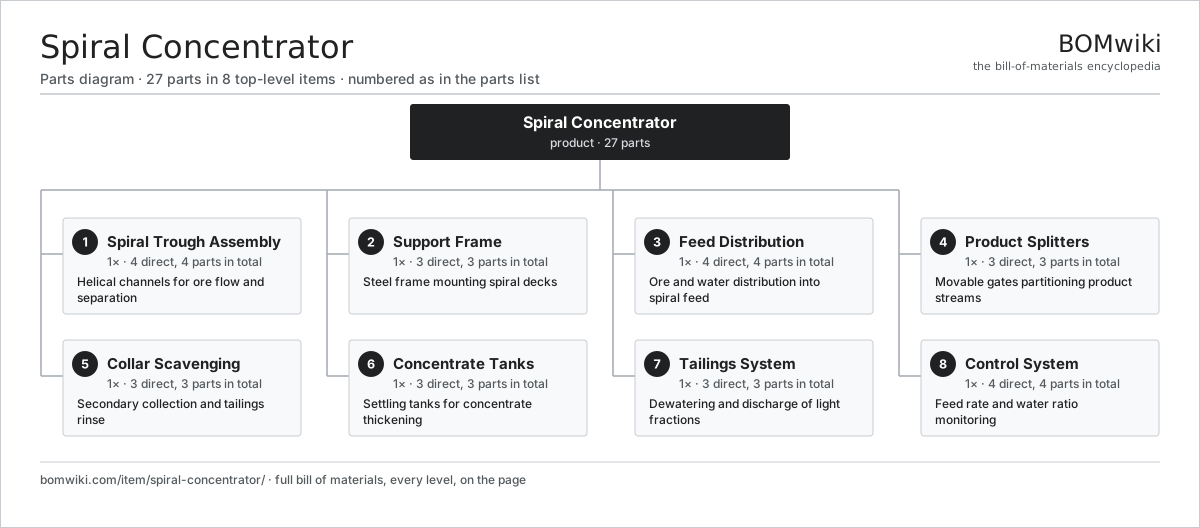
| # | Part | Qty | What it does |
|---|---|---|---|
| 1 | Spiral Trough Assembly 4 parts | 1× | Helical channels for ore flow and separation |
| 2 | Support Frame 3 parts | 1× | Steel frame mounting spiral decks |
| 3 | Feed Distribution 4 parts | 1× | Ore and water distribution into spiral feed |
| 4 | Product Splitters 3 parts | 1× | Movable gates partitioning product streams |
| 5 | Collar Scavenging 3 parts | 1× | Secondary collection and tailings rinse |
| 6 | Concentrate Tanks 3 parts | 1× | Settling tanks for concentrate thickening |
| 7 | Tailings System 3 parts | 1× | Dewatering and discharge of light fractions |
| 8 | Control System 4 parts | 1× | Feed rate and water ratio monitoring |
3D model
No 3D model yet. Have a CAD file of this? Add a 3D model. STL renders right on this page; STEP, FreeCAD, and OpenSCAD sources are welcome too (openly licensed, like all 3D models on BOMwiki).
Build & assembly graph
expand / collapse · shared sub-assemblies converge · links to related products · est. labourTap an assembly to expand/collapse · tap a part to open it · use “Open page” for any node · drag to pan, scroll to zoom.
Bill of materials for Spiral Concentrator
8 top-level lines · 35 rows shown · 27 parts total · indented to 3 levels| # | Item / sub-assembly | Part no. | Qty/assy | Ext. qty | Parts | Type |
|---|---|---|---|---|---|---|
| 1 | Spiral Trough Assembly 4 parts | spiral-concentrator-spiral-troughs | 1× | 1 | 4 | assembly |
| 1.1 | Spiral Trough Body | spiral-concentrator-trough-body | 1× | 1 | · | part |
| 1.2 | Trough Liners | spiral-concentrator-trough-liners | 1× | 1 | · | part |
| 1.3 | Slope Control | spiral-concentrator-trough-slope | 1× | 1 | · | part |
| 1.4 | Trough Fasteners | spiral-concentrator-trough-mounting | 1× | 1 | · | part |
| 2 | Support Frame 3 parts | spiral-concentrator-support-structure | 1× | 1 | 3 | assembly |
| 2.1 | Frame Beams | spiral-concentrator-frame-beams | 1× | 1 | · | part |
| 2.2 | Deck Pedestals | spiral-concentrator-deck-supports | 1× | 1 | · | part |
| 2.3 | Damping Pads | spiral-concentrator-vibration-damping | 1× | 1 | · | part |
| 3 | Feed Distribution 4 parts | spiral-concentrator-feed-system | 1× | 1 | 4 | assembly |
| 3.1 | Feed Hopper | spiral-concentrator-feed-hopper | 1× | 1 | · | part |
| 3.2 | Feed Chute | spiral-concentrator-feed-chute | 1× | 1 | · | part |
| 3.3 | Feed Distributor | spiral-concentrator-feed-splitter | 1× | 1 | · | part |
| 3.4 | Water Metering System | spiral-concentrator-water-metering | 1× | 1 | · | part |
| 4 | Product Splitters 3 parts | spiral-concentrator-splitters | 1× | 1 | 3 | assembly |
| 4.1 | Splitter Blades | spiral-concentrator-splitter-gates | 1× | 1 | · | part |
| 4.2 | Gate Actuator | spiral-concentrator-gate-actuation | 1× | 1 | · | part |
| 4.3 | Gate Seals | spiral-concentrator-gate-seals | 1× | 1 | · | part |
| 5 | Collar Scavenging 3 parts | spiral-concentrator-collar-scavenging | 1× | 1 | 3 | assembly |
| 5.1 | Scavenge Chute | spiral-concentrator-collar-chute | 1× | 1 | · | part |
| 5.2 | Scavenge Pump | spiral-concentrator-collar-pump | 1× | 1 | · | part |
| 5.3 | Scavenge Return Pipe | spiral-concentrator-collar-return-pipe | 1× | 1 | · | part |
| 6 | Concentrate Tanks 3 parts | spiral-concentrator-concentrate-collection | 1× | 1 | 3 | assembly |
| 6.1 | Concentrate Tank | spiral-concentrator-concentrate-tank | 1× | 1 | · | part |
| 6.2 | Concentrate Pump | spiral-concentrator-concentrate-pump | 1× | 1 | · | part |
| 6.3 | Concentrate Discharge Valve | spiral-concentrator-underflow-valve | 1× | 1 | · | part |
| 7 | Tailings System 3 parts | spiral-concentrator-tailings-disposal | 1× | 1 | 3 | assembly |
| 7.1 | Tailings Thickener | spiral-concentrator-tailings-thickener | 1× | 1 | · | part |
| 7.2 | Tailings Pump | spiral-concentrator-tailings-discharge | 1× | 1 | · | part |
| 7.3 | Water Recycle Line | spiral-concentrator-water-recycle | 1× | 1 | · | part |
| 8 | Control System 4 parts | spiral-concentrator-control-system | 1× | 1 | 4 | assembly |
| 8.1 | Feed Rate Transmitter | spiral-concentrator-feed-rate-sensor | 1× | 1 | · | part |
| 8.2 | Density Meter | spiral-concentrator-slurry-density-meter | 1× | 1 | · | part |
| 8.3 | Grade Sampler | spiral-concentrator-concentrate-grade-analyzer | 1× | 1 | · | part |
| 8.4 | Spiral Controller | spiral-concentrator-plc | 1× | 1 | · | part |
Something wrong in this list? Report a problem with this BOM.
Sourcing: possible vendors
Browse the supplier directory → Prices, MOQ, and lead times are algorithmic estimates, not quotes, and not claims about these companies. Company mappings are curated by keyword; est. price band $200k–$5M. How estimates work| Vendor | HQ | Specialty | MOQ | Lead time |
|---|---|---|---|---|
| caterpillar.com ↗ | Irving, US | Construction & mining equipment | made to order | 20–36 wks |
|
🇯🇵Komatsu
komatsu.com ↗
|
Tokyo, JP | Construction & mining equipment | made to order | 20–36 wks |
|
🇸🇪Sandvik
rocktechnology.sandvik ↗
|
Stockholm, SE | Mining & rock technology | made to order | 20–36 wks |
|
🇸🇪Epiroc
epiroc.com ↗
|
Stockholm, SE | Mining & drilling equipment | made to order | 20–36 wks |
|
🇫🇮Metso
metso.com ↗
|
Helsinki, FI | Crushing & minerals processing | made to order | 20–36 wks |
1,428-word article