Spiral Staircase Kit
ProductOverview
A spiral staircase kit packs a full storey of stair into a footprint of little more than a square metre and a few flat boxes. Unlike a fabricated helical stair, which is welded to order, the kit stair is a stack of identical parts: wedge-shaped treads threaded onto a Center Column with Spacer Ring elements between their hubs. The installer sets the rise by choosing spacer heights, sets the helix by rotating each tread a fixed angle against a Tread Angle Template, and locks the whole stack with Clamp Collar fittings. One product covers a range of floor heights and either hand of rotation.
Typical kits span floor-to-floor heights of 2,500–3,200 mm with diameters from 1,200 mm (secondary access) to 2,000 mm (primary stair). Building codes drive most of the geometry: rises of 200–240 mm, a minimum going measured on the walking line, 900 mm handrail height, and guarding that rejects a 100 mm sphere, which is what the Riser Guard Bar between treads exists to satisfy.
How it works
Structurally the stair is a vertical cantilever fan. Every Wedge Tread is a small cantilever beam: its Tread Hub grips the column, its Tread Plate spans outward, and a person standing on the outer edge applies a moment back into the Column Tube. Individually each hub could rotate or rock on the tube; clamped together through the spacers into one compressed stack, the hubs act as a continuous sleeve and the stair becomes surprisingly stiff. The Balustrade System adds more than guarding: the continuous helical handrail ties all the tread outer edges together, so the rail and Baluster pickets work as an outer tension-compression chord that cuts tread deflection roughly in half.
The top of the column does not stand free. The Landing Platform platform bridges from the last tread to the floor edge, and its Landing Frame bolts to the trimmer joists through Floor Edge Bracket angles. This top connection takes out the overturning moment, leaving the Base Anchorage to carry mostly vertical load: a 200–300 mm Base Plate on four Anchor Bolt fixings, shimmed plumb with Leveling Shim packers before torquing. A stair anchored only at the base and not at the landing will sway noticeably; manufacturers specify both connections.
Geometry and code compliance
The walking line of a spiral stair is conventionally taken at 2/3 of the radius from the centre. On that line the going must meet the local code minimum (220 mm in BS 5395-2 for a private stair; the IBC requires a 191 mm minimum tread depth at 12 inches from the narrow edge and 1,982 mm headroom). Rotation per tread is fixed by the Baluster Boss spacing and template, usually 30° for a 12-tread turn or 22.5° for 16; smaller angles give an easier walk but a taller column for the same headroom, since headroom is measured one full turn above each tread.
Rise adjustment is the kit's key trick. The total height is divided into equal rises, and the matching Spacer Ring height is selected or machined; many kits ship rings in 5 mm increments plus a Column Extension Sleeve extension for tall floors. Codes require all rises equal within a few millimetres, so the division must come out even, installers measure finished floor to finished floor, not slab to slab.
Assembly
Assembly proceeds from the bottom: base plate anchored, column plumbed, then alternating spacers and treads slid down the tube, each tread's Tread Hub Bushing protecting the finish. Once all treads are stacked and rotated to the template, the clamp collars compress the stack and the Landing Plate and frame are bolted to the floor opening. Balusters drop into the tread bosses, two per step, and the Handrail Segment lengths are pulled around the helix and joined with Handrail Connector splices and Rail Bracket swivels; flexible PVC rail is the common kit choice because it takes the helix without pre-forming. Thread Locker on the collar and balustrade bolts prevents loosening from foot-traffic vibration, and the Handrail End Cap and Base Cover Ring finish the runs. A practiced two-person crew assembles a 13-rise kit in roughly a day.
Exterior kits swap the powder coat for hot-dip galvanizing per EN ISO 1461, use grating Tread Insert surfaces instead of timber, and uprate anchors for wind load on the open helix.
Spiral Staircase Kit parts and their functions
7 top-level parts · 210 parts in total · full bill of materials below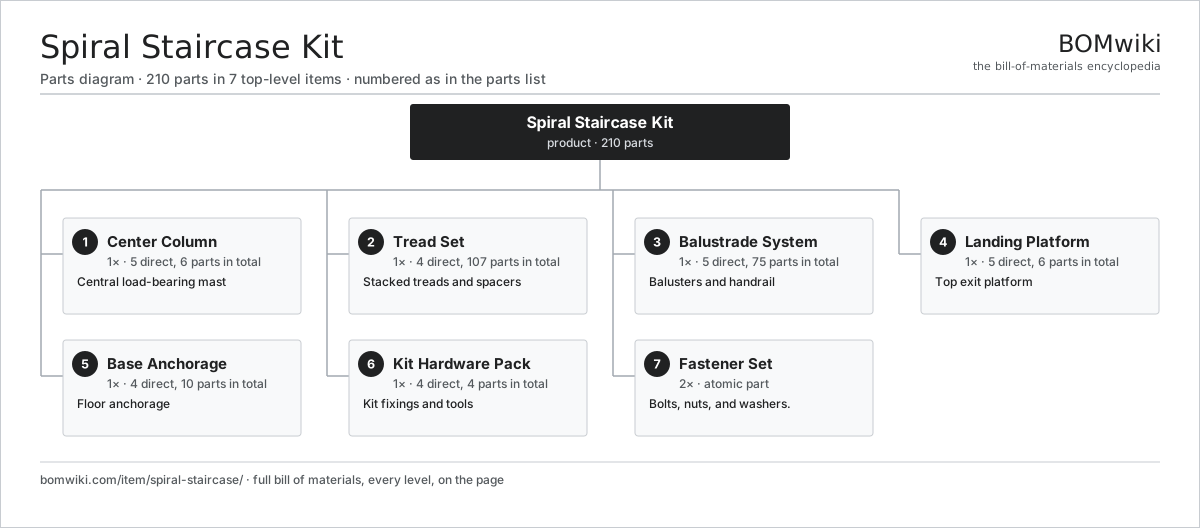
| # | Part | Qty | What it does |
|---|---|---|---|
| 1 | Center Column 5 parts | 1× | Central load-bearing mast |
| 2 | Tread Set 4 parts | 1× | Stacked treads and spacers |
| 3 | Balustrade System 5 parts | 1× | Balusters and handrail |
| 4 | Landing Platform 5 parts | 1× | Top exit platform |
| 5 | Base Anchorage 4 parts | 1× | Floor anchorage |
| 6 | Kit Hardware Pack 4 parts | 1× | Kit fixings and tools |
| 7 | Fastener Set | 2× | Bolts, nuts, and washers. |
3D model
No 3D model yet. Have a CAD file of this? Add a 3D model. STL renders right on this page; STEP, FreeCAD, and OpenSCAD sources are welcome too (openly licensed, like all 3D models on BOMwiki).
Build & assembly graph
expand / collapse · shared sub-assemblies converge · links to related products · est. labourTap an assembly to expand/collapse · tap a part to open it · use “Open page” for any node · drag to pan, scroll to zoom.
Bill of materials for Spiral Staircase Kit
7 top-level lines · 39 rows shown · 210 parts total · indented to 3 levels| # | Item / sub-assembly | Part no. | Qty/assy | Ext. qty | Parts | Type |
|---|---|---|---|---|---|---|
| 1 | Center Column 5 parts | spiral-staircase-column | 1× | 1 | 6 | assembly |
| 1.1 | Column Tube | spiral-staircase-column-tube | 1× | 1 | · | part |
| 1.2 | Column Extension Sleeve | spiral-staircase-column-sleeve | 1× | 1 | · | part |
| 1.3 | Column Cap | spiral-staircase-column-cap | 1× | 1 | · | part |
| 1.4 | Clamp Collar | spiral-staircase-clamp-collar | 2× | 2 | · | part |
| 1.5 | Fastener Set | fastener-set | 1× | 1 | · | part |
| 2 | Tread Set 4 parts | spiral-staircase-tread-set | 1× | 1 | 107 | assembly |
| 2.1 | Wedge Tread 5 parts | spiral-staircase-tread | 12× | 12 | 6 | assembly |
| 2.1.1 | Tread Plate | spiral-staircase-tread-plate | 1× | 12 | · | part |
| 2.1.2 | Tread Insert | spiral-staircase-tread-insert | 1× | 12 | · | part |
| 2.1.3 | Tread Hub | spiral-staircase-tread-hub | 1× | 12 | · | part |
| 2.1.4 | Baluster Boss | spiral-staircase-baluster-boss | 2× | 24 | · | part |
| 2.1.5 | Fastener Set | fastener-set | 1× | 12 | · | part |
| 2.2 | Spacer Ring | spiral-staircase-spacer-ring | 12× | 12 | · | part |
| 2.3 | Tread Hub Bushing | spiral-staircase-tread-bush | 12× | 12 | · | part |
| 2.4 | Riser Guard Bar | spiral-staircase-riser-bar | 11× | 11 | · | part |
| 3 | Balustrade System 5 parts | spiral-staircase-balustrade | 1× | 1 | 75 | assembly |
| 3.1 | Baluster | spiral-staircase-baluster | 24× | 24 | · | part |
| 3.2 | Handrail Segment | spiral-staircase-handrail-segment | 13× | 13 | · | part |
| 3.3 | Handrail Connector | spiral-staircase-rail-connector | 12× | 12 | · | part |
| 3.4 | Rail Bracket | spiral-staircase-rail-bracket | 24× | 24 | · | part |
| 3.5 | Handrail End Cap | spiral-staircase-rail-end-cap | 2× | 2 | · | part |
| 4 | Landing Platform 5 parts | spiral-staircase-landing | 1× | 1 | 6 | assembly |
| 4.1 | Landing Plate | spiral-staircase-landing-plate | 1× | 1 | · | part |
| 4.2 | Landing Frame | spiral-staircase-landing-frame | 1× | 1 | · | part |
| 4.3 | Landing Guard Rail | spiral-staircase-landing-rail | 1× | 1 | · | part |
| 4.4 | Floor Edge Bracket | spiral-staircase-floor-bracket | 2× | 2 | · | part |
| 4.5 | Fastener Set | fastener-set | 1× | 1 | · | part |
| 5 | Base Anchorage 4 parts | spiral-staircase-base | 1× | 1 | 10 | assembly |
| 5.1 | Base Plate | spiral-staircase-base-plate | 1× | 1 | · | part |
| 5.2 | Anchor Bolt | spiral-staircase-anchor-bolt | 4× | 4 | · | part |
| 5.3 | Base Cover Ring | spiral-staircase-base-cover | 1× | 1 | · | part |
| 5.4 | Leveling Shim | spiral-staircase-leveling-shim | 4× | 4 | · | part |
| 6 | Kit Hardware Pack 4 parts | spiral-staircase-hardware | 1× | 1 | 4 | assembly |
| 6.1 | Tread Angle Template | spiral-staircase-template | 1× | 1 | · | part |
| 6.2 | Touch-Up Paint | spiral-staircase-touch-up-paint | 1× | 1 | · | part |
| 6.3 | Thread Locker | spiral-staircase-thread-locker | 1× | 1 | · | part |
| 6.4 | Fastener Set | fastener-set | 1× | 1 | · | part |
| 7 | Fastener Set | fastener-set | 2× | 2 | · | part |
Something wrong in this list? Report a problem with this BOM.
Sourcing: possible vendors
Browse the supplier directory → Prices, MOQ, and lead times are algorithmic estimates, not quotes, and not claims about these companies. Company mappings are curated by keyword; est. price band $50–$10k. How estimates work| Vendor | HQ | Specialty | MOQ | Lead time |
|---|---|---|---|---|
| assaabloy.com ↗ | Stockholm, SE | Locks & access | 1,000 units | 8–12 wks |
|
🇺🇸Allegion
allegion.com ↗
|
Dublin, US | Security products (Schlage) | 1,000 units | 8–12 wks |
| dormakaba.com ↗ | Rümlang, CH | Access & door systems | 1,000 units | 8–12 wks |
| honeywell.com ↗ | Charlotte, US | Building & safety tech | 1,000 units | 8–12 wks |
| hikvision.com ↗ | Hangzhou, CN | Surveillance & security | 1,000 units | 8–12 wks |
789-word article