Horizontal Split-Case Pump
ProductOverview
The horizontal split-case pump is the workhorse of large clean-water pumping: municipal distribution, cooling water, fire protection under NFPA 20, irrigation headworks, and HVAC plant rooms. Its defining feature is in the name, the casing splits along a horizontal plane through the shaft axis. Unbolt the parting flange, lift the Upper Casing Half, and the entire Rotating Element lies exposed in the Lower Casing Half like an engine on a stand, with suction and discharge piping still connected. No other pump configuration offers that maintenance access. In API 610 terms it is the BB1 type: between-bearings, axially split, single stage.
Casing and hydraulic design
The Lower Casing Half carries both nozzles, suction and discharge flanges sit side by side, usually horizontally opposed, plus the mounting feet, so the top half comes off without touching pipework or alignment. A die-cut Split Gasket seals the parting flange, and fitted Dowel Pin pins register the halves so the internal waterways line up to machining tolerance. Most casings are double-volute: two cutwaters 180° apart cancel the radial hydraulic load that a single volute puts on the shaft at off-design flow.
The hydraulic heart is the Double-Suction Impeller, a double-suction design fed from both sides simultaneously. This buys two things. Axial thrust cancels hydraulically, because the two suction eyes pull in opposite directions, so the bearings carry little more than rotor weight. And each eye swallows only half the flow, which roughly halves the NPSH required compared with an equivalent single-suction impeller, the reason split-case pumps tolerate marginal suction conditions in big water installations. Leakage back from discharge to suction is controlled at renewable rings: a Casing Wear Ring in each casing half running against an Impeller Wear Ring at 0.3–0.5 mm diametral clearance. When efficiency drops after years of service, replacing these rings restores it.
Rotating element
The Pump Shaft spans between bearings with the impeller keyed at mid-span by the Impeller Key and clamped by Sleeve Nut pairs. Renewable bronze Shaft Sleeve journals protect the shaft through the sealing boxes. The whole element, shaft, impeller, sleeves, and bearings, lifts out as one balanced unit, and plants commonly keep a complete spare element so an overhaul is a swap measured in hours.
Each end of the shaft runs in a Bearing Assembly: a Ball Bearing in a cast Bearing Housing doweled to the lower casing, closed by a Bearing End Cover, sealed with Oil Seal lips, and on oil-lubricated builds fed by a Constant-Level Oiler holding the bath at centreline. The outboard bearing is usually a duplex pair fixing axial position; the inboard floats to absorb thermal growth. A Shaft Deflector slinger keeps gland leakage out of the housing.
Sealing
Where the shaft passes through the casing, each side has a Shaft Sealing System. The traditional arrangement is a packed Stuffing Box: five graphited Packing Ring turns with a Lantern Ring two rings deep, fed discharge-pressure water through the Seal Flush Line, compressed by a two-bolt Packing Gland adjusted for 20–60 drips a minute, packing must leak slightly or it burns. Because suction pressure sits at both boxes (a by-product of the double-suction layout), sealing duty is mild, and conversion to cartridge mechanical seals is straightforward where drips are unacceptable.
Drive train and installation
A Flexible Coupling with two keyed Coupling Hub halves and a replaceable Coupling Element connects to the Drive Motor, typically a 4-pole TEFC motor from 15 kW to several hundred; an OSHA-compliant Coupling Guard encloses it. Pump and motor mount on a common Baseplate whose welded Base Frame is grouted onto Anchor Bolt foundations; laminated Shim Pack stacks under the motor feet bring shaft alignment within 0.05 mm TIR, and a Drip Rim collects gland leakage.
Application notes
Split-case pumps reach efficiencies above 90% at best efficiency point and hold high efficiency across a broad flow range, which matters at municipal scale where a point of efficiency is real money. Their limits are equally clear: the axially split joint restricts them to moderate temperatures and pressures (the gasketed flange cannot match a radially split barrel at high energy), and the double-suction impeller wants straight, symmetric suction piping, an elbow close to the suction nozzle in the wrong plane starves one eye and causes noise, vibration, and premature bearing wear. Five diameters of straight pipe, or a properly oriented elbow, is the standard rule.
Horizontal Split-Case Pump parts and their functions
7 top-level parts · 94 parts in total · full bill of materials below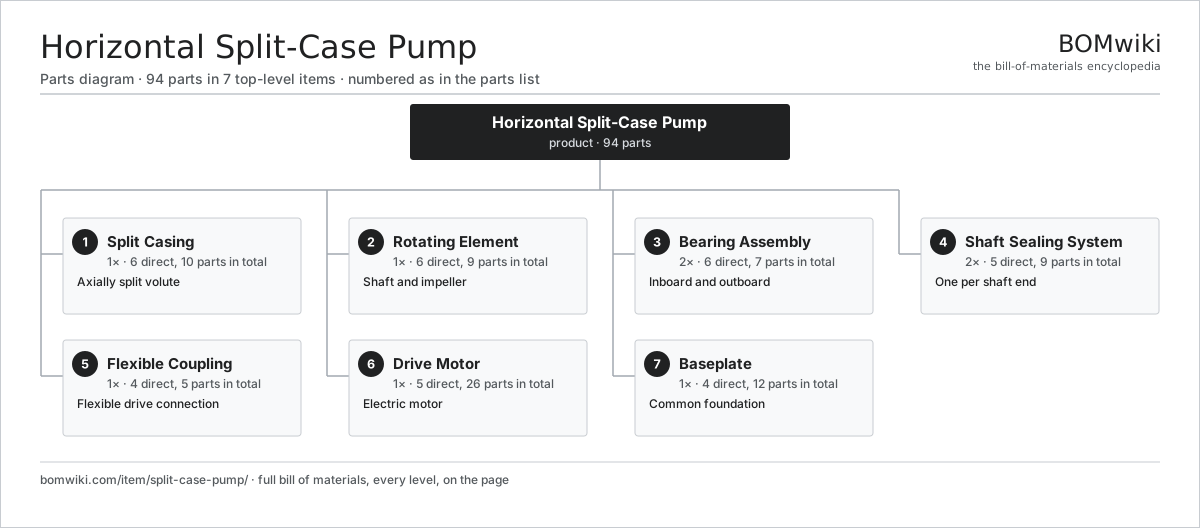
| # | Part | Qty | What it does |
|---|---|---|---|
| 1 | Split Casing 6 parts | 1× | Axially split volute |
| 2 | Rotating Element 6 parts | 1× | Shaft and impeller |
| 3 | Bearing Assembly 6 parts | 2× | Inboard and outboard |
| 4 | Shaft Sealing System 5 parts | 2× | One per shaft end |
| 5 | Flexible Coupling 4 parts | 1× | Flexible drive connection |
| 6 | Drive Motor 5 parts | 1× | Electric motor |
| 7 | Baseplate 4 parts | 1× | Common foundation |
3D model
No 3D model yet. Have a CAD file of this? Add a 3D model. STL renders right on this page; STEP, FreeCAD, and OpenSCAD sources are welcome too (openly licensed, like all 3D models on BOMwiki).
Build & assembly graph
expand / collapse · shared sub-assemblies converge · links to related products · est. labourTap an assembly to expand/collapse · tap a part to open it · use “Open page” for any node · drag to pan, scroll to zoom.
Bill of materials for Horizontal Split-Case Pump
7 top-level lines · 50 rows shown · 94 parts total · indented to 3 levels| # | Item / sub-assembly | Part no. | Qty/assy | Ext. qty | Parts | Type |
|---|---|---|---|---|---|---|
| 1 | Split Casing 6 parts | split-case-pump-casing | 1× | 1 | 10 | assembly |
| 1.1 | Lower Casing Half | split-case-pump-lower-casing | 1× | 1 | · | part |
| 1.2 | Upper Casing Half | split-case-pump-upper-casing | 1× | 1 | · | part |
| 1.3 | Split Gasket | split-case-pump-split-gasket | 1× | 1 | · | part |
| 1.4 | Casing Wear Ring | split-case-pump-casing-wear-ring | 2× | 2 | · | part |
| 1.5 | Dowel Pin | split-case-pump-dowel-pin | 4× | 4 | · | part |
| 1.6 | Fastener Set | fastener-set | 1× | 1 | · | part |
| 2 | Rotating Element 6 parts | split-case-pump-rotating-element | 1× | 1 | 9 | assembly |
| 2.1 | Double-Suction Impeller | split-case-pump-impeller | 1× | 1 | · | part |
| 2.2 | Pump Shaft | split-case-pump-shaft | 1× | 1 | · | part |
| 2.3 | Shaft Sleeve | split-case-pump-shaft-sleeve | 2× | 2 | · | part |
| 2.4 | Impeller Key | split-case-pump-impeller-key | 1× | 1 | · | part |
| 2.5 | Sleeve Nut | split-case-pump-sleeve-nut | 2× | 2 | · | part |
| 2.6 | Impeller Wear Ring | split-case-pump-impeller-wear-ring | 2× | 2 | · | part |
| 3 | Bearing Assembly 6 parts | split-case-pump-bearing-assembly | 2× | 2 | 7 | assembly |
| 3.1 | Bearing Housing | split-case-pump-bearing-housing | 1× | 2 | · | part |
| 3.2 | Ball Bearing | ball-bearing | 1× | 2 | · | part |
| 3.3 | Oil Seal | oil-seal | 2× | 4 | · | part |
| 3.4 | Bearing End Cover | split-case-pump-bearing-cover | 1× | 2 | · | part |
| 3.5 | Constant-Level Oiler | split-case-pump-oiler | 1× | 2 | · | part |
| 3.6 | Shaft Deflector | split-case-pump-deflector | 1× | 2 | · | part |
| 4 | Shaft Sealing System 5 parts | split-case-pump-sealing-system | 2× | 2 | 9 | assembly |
| 4.1 | Stuffing Box | split-case-pump-stuffing-box | 1× | 2 | · | part |
| 4.2 | Packing Ring | split-case-pump-packing-ring | 5× | 10 | · | part |
| 4.3 | Lantern Ring | split-case-pump-lantern-ring | 1× | 2 | · | part |
| 4.4 | Packing Gland | split-case-pump-gland | 1× | 2 | · | part |
| 4.5 | Seal Flush Line | split-case-pump-seal-flush-line | 1× | 2 | · | part |
| 5 | Flexible Coupling 4 parts | split-case-pump-coupling | 1× | 1 | 5 | assembly |
| 5.1 | Coupling Hub | split-case-pump-coupling-hub | 2× | 2 | · | part |
| 5.2 | Coupling Element | split-case-pump-coupling-element | 1× | 1 | · | part |
| 5.3 | Coupling Guard | split-case-pump-coupling-guard | 1× | 1 | · | part |
| 5.4 | Fastener Set | fastener-set | 1× | 1 | · | part |
| 6 | Drive Motor 5 parts | split-case-pump-driver | 1× | 1 | 26 | assembly |
| 6.1 | Stator Assembly 3 parts | stator-assembly | 1× | 1 | 3 | assembly |
| 6.1.1 | Stator Core (laminations) | stator-core | 1× | 1 | · | part |
| 6.1.2 | Copper Winding | copper-winding | 1× | 1 | · | part |
| 6.1.3 | Slot Insulation | stator-insulation | 1× | 1 | · | part |
| 6.2 | Rotor Assembly 4 parts | rotor-assembly | 1× | 1 | 19 | assembly |
| 6.2.1 | Rotor Shaft | rotor-shaft | 1× | 1 | · | part |
| 6.2.2 | Rotor Core | rotor-core | 1× | 1 | · | part |
| 6.2.3 | Neodymium Magnet | neodymium-magnet | 16× | 16 | · | part |
| 6.2.4 | Ball Bearing | ball-bearing | 1× | 1 | · | part |
| 6.3 | Motor Housing | motor-housing | 1× | 1 | · | part |
| 6.4 | Ball Bearing | ball-bearing | 2× | 2 | · | part |
| 6.5 | Wire Bundle | wire-bundle | 1× | 1 | · | part |
| 7 | Baseplate 4 parts | split-case-pump-baseplate | 1× | 1 | 12 | assembly |
| 7.1 | Base Frame | split-case-pump-base-frame | 1× | 1 | · | part |
| 7.2 | Shim Pack | split-case-pump-shim-pack | 4× | 4 | · | part |
| 7.3 | Anchor Bolt | split-case-pump-anchor-bolt | 6× | 6 | · | part |
| 7.4 | Drip Rim | split-case-pump-drip-rim | 1× | 1 | · | part |
Something wrong in this list? Report a problem with this BOM.
Related products
same domain, ranked by shared parts Air Compressor
97 parts · shares 3 with this page
Air Compressor
97 parts · shares 3 with this page
 Centrifugal Pump
66 parts · shares 3 with this page
Centrifugal Pump
66 parts · shares 3 with this page
 Gear Pump
57 parts · shares 3 with this page
Gear Pump
57 parts · shares 3 with this page
 Hydraulic Power Unit
91 parts · shares 3 with this page
Hydraulic Power Unit
91 parts · shares 3 with this page
 Peristaltic Pump
59 parts · shares 3 with this page
Peristaltic Pump
59 parts · shares 3 with this page
 Submersible Pump
84 parts · shares 3 with this page
Submersible Pump
84 parts · shares 3 with this page
Sourcing: possible vendors
Browse the supplier directory → Prices, MOQ, and lead times are algorithmic estimates, not quotes, and not claims about these companies. Company mappings are curated by keyword; est. price band $50–$50k. How estimates work| Vendor | HQ | Specialty | MOQ | Lead time |
|---|---|---|---|---|
|
🇩🇰Grundfos
grundfos.com ↗
|
Bjerringbro, DK | Pumps | 200 units | 6–12 wks |
|
🇺🇸Xylem
xylem.com ↗
|
Washington, US | Water technology | 200 units | 6–12 wks |
| flowserve.com ↗ | Irving, US | Pumps & valves | 200 units | 6–12 wks |
|
🇩🇪KSB
ksb.com ↗
|
Frankenthal, DE | Pumps & valves | 200 units | 6–12 wks |
| parker.com ↗ | Cleveland, US | Motion & fluid control | 200 units | 6–12 wks |
838-word article