Sporting Crossbow
ProductOverview
A sporting crossbow is a mechanized archery weapon with a horizontal prod (composite limb pair), a trigger assembly with safety mechanism, and mounted optical scope for hunting, sport competition, and marksmanship training. Unlike a hand-drawn recurve bow (requiring active draw force from archer), the crossbow stores energy in the Crossbow Prod at rest, and the Trigger & Safety Module releases this energy on demand with a simple finger pull.
Modern crossbows fire bolts (short, heavy arrows) at 300–500 feet per second (91–152 m/s) with kinetic energies of 80–150 joules, sufficient for clean kills on deer-sized game at 40–60 yard ranges. The mechanical advantage and ease of aiming have made crossbows the fastest-growing segment of hunting, particularly among older, female, and novice hunters who lack the draw strength or precision training required for compound or recurve bows.
Prod (Limb) Design
The Crossbow Prod are composite laminated structures similar to recurve limbs but mounted horizontally and engineered for much higher draw force (100–200 lbs vs. 40–70 lbs for a typical hunting bow). This higher energy density enables shorter bolt ranges (18–22 inches vs. 28+ inch arrows) and higher velocity (due to length-to-force ratio).
Composite architecture:
- Wood or carbon core: Provides stiffness and primary load path.
- Fiberglass laminates (upper and lower surfaces, 1–2 mm each): Distribute bending stress.
- Carbon fiber wraps (optional, high-end models): Reduce limb mass, increasing bolt speed 5–10%.
Limb stress:
- At full span (draw), each limb is deflected 12–15 inches horizontally, storing ~80–150 joules per limb (total ~160–300 joules system energy).
- Peak fiber strain ≈ 1.8–2.2%, within fiberglass safe limits.
- Limbs are much stouter than recurve limbs (shorter but thicker cross-section) to resist the buckling forces of horizontal orientation.
The Limb Mounting Brackets secure the prod to the Stock Beam at a slightly downward angle (10–15° depression) to optimize the bolt trajectory relative to the barrel axis.
String & Cocking System
The Crossbow String is a braided synthetic (Dacron, 16–32 strands, or Spectra for faster models) thicker and stronger than a bow string (withstanding 200+ lbs tension vs. 80–100 lbs for a recurve). The String Center Serving is a reinforced central wrap where the bolt nock seats, this is a high-wear area subject to repeated friction.
At rest, the string tension holds the prod limbs in their maximally deflected state. Storing this tension continuously (unlike a recurve, which is destrung after shooting) causes creep, the string gradually lengthens, reducing prod power. Crossbow owners must re-tension or replace strings every 2–5 years depending on use.
Cocking effort:
- A 150 lb prod exerts 150 lbs outward force on each limb, summing to 300 lbs total restorative force.
- Manually pulling back the string against this force requires 60–100 lbs of human effort (leveraging arm, chest, and back muscles).
- Many hunters, especially women and older adults, cannot physically cock high-power crossbows.
Solution: The Cocking Assist Device uses mechanical advantage:
- Rope cocking system: A synthetic rope attached to the Rope Hooks on the string passes through a 2–4× lever arrangement. Pulling 30–40 lbs of rope effort cocks the prod (effectively 3–4× mechanical advantage).
- Advantage: Faster, safer cocking; reduced hand/arm fatigue; enables hunting for users with limited strength.
- Disadvantage: Adds weight, takes ~15–30 seconds per shot (acceptable for hunting, slow for sport).
Some modern crossbows offer motorized cocking, but these are expensive ($2,000+) and battery-dependent.
Trigger Mechanism & Safety
The Trigger & Safety Module is a critical safety component. Unlike a bow (pulled back continuously until release), the crossbow stores energy with the string at rest, creating hazard:
- Dry fire risk: If the trigger is pulled without a bolt loaded, the prod releases against nothing, causing violent limb oscillation and potential injury to shooter (recoil shock) or bystanders (string snap).
- Accidental discharge: A loaded crossbow with the safety off is essentially a firearm.
Trigger system:
- The Sear Mechanism is a mechanical catch holding the string under tension.
- The Trigger Lever is pulled, disengaging the sear and releasing string tension.
- Two-stage triggers reduce accidental pulls: first stage (creep) provides feedback before lethal force; second stage (wall) is the actual release point.
Safety mechanisms:
- Safety lever (Safety Lever): A manual switch engaged when the crossbow is not firing, mechanically blocking trigger movement. Must be manually disengaged before each shot.
- Dry-fire inhibitor: Some models prevent trigger function unless a bolt is loaded (via a pressure pad on the arrow pass).
- String retention brackets (part of Limb Retention & Guards): Catch a broken string before it snaps back at the shooter (string breaks are rare but catastrophic).
Modern crossbows meet strict hunting regulations requiring an integrated safety, often with a bright color (orange or red) to indicate armed status.
Scope and Aiming
The Scope Rail System is a dovetail or picatinny rail mounting optical scopes, typically 3–8× magnification. Crossbow scopes differ from rifle scopes:
- Shorter eye relief (2–3 inches vs. 3–4 inches for rifles) due to lack of recoil and need for quick target acquisition at close range.
- Calibrated reticles: Many offer multiple dot patterns for different ranges (e.g., 20, 30, 40, 50 yards), eliminating need for holdover calculations.
- Large objective lens (40–50 mm): Gathers more light for low-light hunting conditions (dawn/dusk).
Accuracy at 50 yards with a quality scope and bolts is typically ±2–3 inches (5–7.6 cm), excellent for hunting. Paper tuning (like recurve bows) is less critical for crossbows because the mechanical trigger and rail-guided bolt provide more consistent release than a hand-drawn bow.
Bolt Design & Selection
Crossbow bolts (also called "quarrels") are short, heavy arrows optimized for high velocity and energy transfer:
- Length: 18–22 inches (vs. 28–32 inches for compound bow arrows). Shorter length reduces rotational inertia, allowing tighter spiral.
- Weight: 400–600 grains (26–39 grams), heavy relative to diameter, providing high kinetic energy for penetration.
- Shaft material: Carbon fiber (fast, fragile), aluminum (slower, durable), or composite (balance).
- Broadhead options:
- Mechanical broadheads: 2–4 razor blades fold on impact, deploying to 1.5–2 inch cutting diameter. Good for soft tissue; risk of incomplete opening in bone.
- Fixed broadheads: Single-piece triangular or teardrop, more durable and reliable, slightly slower (velocity loss 5–10%).
Bolt cost ranges $15–30 per unit vs. $5–10 for arrows, making crossbow shooting more expensive per shot.
Hunting Performance
Crossbows are effective hunting tools:
Advantages over recurve/compound bows:
- No draw strength required; even weak shooters can cock with rope assist.
- Faster, easier aiming; scope reticle is intuitive vs. multiple pin sight discipline.
- Shorter learning curve; novices can be effective after 2–4 practice sessions.
- Consistency; mechanical trigger and guide rail reduce shooter-induced errors.
- Can be held at full draw indefinitely (unlike compound, which tires the archer over time).
Disadvantages:
- Noise: Crossbows are LOUDER than bows (130+ dB untuned) due to prod snap and string vibration. Quality string dampening can reduce to 110–120 dB.
- Weight: 6–10 lbs is heavy to carry all day (vs. 3–5 lbs for a bow).
- Cocking time: 30–60 seconds per shot (vs. 5 seconds for a compound bow), limiting follow-up shots if a game animal flees.
- Cost: $600–2,000 for a quality crossbow + scope vs. $300–1,000 for a quality bow.
Ethical considerations:
- Regulation: Many jurisdictions restrict crossbows to specific seasons or require hunter education certification.
- Clean kills: At 40+ yard ranges with proper broadhead and placement, crossbows are effective. Beyond 60 yards, accuracy declines and wounding risk increases (most ethical hunters self-limit to 40 yard maximum).
Maintenance & Longevity
Regular care:
- Inspect prod limbs for cracks or delamination (inspect monthly if in use).
- Wax the string every 20–30 shots using crossbow string wax.
- Check trigger mechanism and safety lever function before each hunt.
- Lubricate the flight rail with dry silicone (wet oils attract dirt).
- Store in a cool, dry location, preferably de-strung (removes constant tension).
Lifespan:
- Prod limbs: 10–20 years if not cracked or damaged.
- String: 2–5 years depending on tension and use (replaced every 3 years typical).
- Trigger/sear: Essentially lifetime if kept clean.
- Scope and rail: Lifetime (rare failure unless dropped or impacted).
Cost of ownership:
- Entry crossbow: $600–900.
- Quality scope: $200–500.
- Bolts (12 pack): $150–200.
- Annual maintenance (wax, inspection): $30–50.
- String replacement (5-year interval): $100–150.
Over 20 years of seasonal use, total cost ≈ $3,000–4,000 ($150–200/year), comparable to compound bow ownership but with higher initial investment.
Regulations & Safety
Crossbow hunting is regulated by state and provincial wildlife agencies. Regulations typically specify:
- Minimum prod power (typically 125–150 lbs) to ensure clean kills.
- Broadhead minimum size (1.5–2 inches cutting diameter).
- Hunting seasons (often overlapping rifle or archery seasons, but sometimes with specific crossbow-only seasons).
- Mandatory safety devices (trigger safety, dry-fire inhibitor, string guards).
- Hunter education requirements (some regions require crossbow-specific certification).
Firearm vs. Crossbow classification: In most jurisdictions, crossbows are legally classified as "archery equipment," not firearms, despite mechanical similarity. This distinction affects hunting season overlaps (often can crossbow hunt during rifle season in some regions due to lower noise/projectile energy).
Field Use Scenario
A typical crossbow hunt:
- Setup (dawn): Scout tree stand, position at game trail, cock crossbow with rope assist, engages safety, loads bolt into flight rail.
- Wait (2–4 hours): Monitor perimeter, remain silent and still.
- Encounter (10–20 yards): Buck approaches. Disengages safety, aims scope crosshair at vital zone (behind front leg, upper third of body), breathes, squeezes trigger.
- Release: String snaps forward, prod limbs release energy, bolt accelerates to 400 ft/s in <5 milliseconds, impacts game at 20 yard range at ~60 joules kinetic energy.
- Tracking (2–30 minutes): Game flees; hunter waits 30 minutes (allowing animal to bed if not immediately fatal), then tracks blood trail and locates carcass.
Success depends on placement, broadhead sharpness, and shot distance, crossbows are forgiving in terms of technique but demanding in terms of accuracy and ethics.
Sporting Crossbow parts and their functions
8 top-level parts · 28 parts in total · full bill of materials below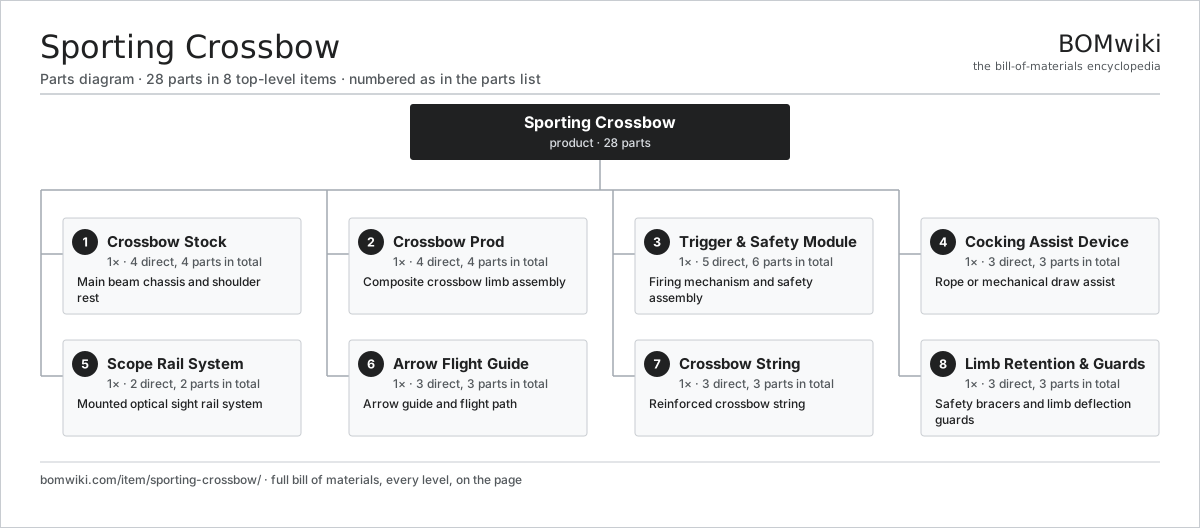
| # | Part | Qty | What it does |
|---|---|---|---|
| 1 | Crossbow Stock 4 parts | 1× | Main beam chassis and shoulder rest |
| 2 | Crossbow Prod 4 parts | 1× | Composite crossbow limb assembly |
| 3 | Trigger & Safety Module 5 parts | 1× | Firing mechanism and safety assembly |
| 4 | Cocking Assist Device 3 parts | 1× | Rope or mechanical draw assist |
| 5 | Scope Rail System 2 parts | 1× | Mounted optical sight rail system |
| 6 | Arrow Flight Guide 3 parts | 1× | Arrow guide and flight path |
| 7 | Crossbow String 3 parts | 1× | Reinforced crossbow string |
| 8 | Limb Retention & Guards 3 parts | 1× | Safety bracers and limb deflection guards |
3D model
No 3D model yet. Have a CAD file of this? Add a 3D model. STL renders right on this page; STEP, FreeCAD, and OpenSCAD sources are welcome too (openly licensed, like all 3D models on BOMwiki).
Build & assembly graph
expand / collapse · shared sub-assemblies converge · links to related products · est. labourTap an assembly to expand/collapse · tap a part to open it · use “Open page” for any node · drag to pan, scroll to zoom.
Bill of materials for Sporting Crossbow
8 top-level lines · 35 rows shown · 28 parts total · indented to 3 levels| # | Item / sub-assembly | Part no. | Qty/assy | Ext. qty | Parts | Type |
|---|---|---|---|---|---|---|
| 1 | Crossbow Stock 4 parts | sporting-crossbow-stock | 1× | 1 | 4 | assembly |
| 1.1 | Stock Beam | sporting-crossbow-stock-beam | 1× | 1 | · | part |
| 1.2 | Pistol Grip | sporting-crossbow-pistol-grip | 1× | 1 | · | part |
| 1.3 | Shoulder Butt Pad | sporting-crossbow-shoulder-pad | 1× | 1 | · | part |
| 1.4 | Fastener Set | fastener-set | 1× | 1 | · | part |
| 2 | Crossbow Prod 4 parts | sporting-crossbow-prod-limbs | 1× | 1 | 4 | assembly |
| 2.1 | Upper Prod Limb | sporting-crossbow-upper-limb | 1× | 1 | · | part |
| 2.2 | Lower Prod Limb | sporting-crossbow-lower-limb | 1× | 1 | · | part |
| 2.3 | Limb Mounting Brackets | sporting-crossbow-limb-brackets | 1× | 1 | · | part |
| 2.4 | Fastener Set | fastener-set | 1× | 1 | · | part |
| 3 | Trigger & Safety Module 5 parts | sporting-crossbow-trigger-module | 1× | 1 | 6 | assembly |
| 3.1 | Trigger Lever | sporting-crossbow-trigger-lever | 1× | 1 | · | part |
| 3.2 | Sear Mechanism | sporting-crossbow-sear | 1× | 1 | · | part |
| 3.3 | Safety Lever | sporting-crossbow-safety-lever | 1× | 1 | · | part |
| 3.4 | Coil Spring | coil-spring | 2× | 2 | · | part |
| 3.5 | Fastener Set | fastener-set | 1× | 1 | · | part |
| 4 | Cocking Assist Device 3 parts | sporting-crossbow-cocking-device | 1× | 1 | 3 | assembly |
| 4.1 | Cocking Rope | sporting-crossbow-cocking-rope | 1× | 1 | · | part |
| 4.2 | Rope Hooks | sporting-crossbow-cocking-hooks | 1× | 1 | · | part |
| 4.3 | Cocking Handle | sporting-crossbow-cocking-handle | 1× | 1 | · | part |
| 5 | Scope Rail System 2 parts | sporting-crossbow-scope-rail | 1× | 1 | 2 | assembly |
| 5.1 | Rail Mount Base | sporting-crossbow-rail-base | 1× | 1 | · | part |
| 5.2 | Scope Clamps | sporting-crossbow-rail-clamps | 1× | 1 | · | part |
| 6 | Arrow Flight Guide 3 parts | sporting-crossbow-rail-and-guide | 1× | 1 | 3 | assembly |
| 6.1 | Center Flight Rail | sporting-crossbow-flight-rail | 1× | 1 | · | part |
| 6.2 | Rail Bushings | sporting-crossbow-rail-bushings | 1× | 1 | · | part |
| 6.3 | Arrow Pass Suppressor | sporting-crossbow-arrow-pass | 1× | 1 | · | part |
| 7 | Crossbow String 3 parts | sporting-crossbow-string | 1× | 1 | 3 | assembly |
| 7.1 | String Fiber Bundle | sporting-crossbow-string-bundle | 1× | 1 | · | part |
| 7.2 | String Center Serving | sporting-crossbow-string-serving | 1× | 1 | · | part |
| 7.3 | Nocking Area | sporting-crossbow-nocking-area | 1× | 1 | · | part |
| 8 | Limb Retention & Guards 3 parts | sporting-crossbow-limb-retention | 1× | 1 | 3 | assembly |
| 8.1 | Limb Retention Bracer | sporting-crossbow-limb-bracer | 1× | 1 | · | part |
| 8.2 | String Deflection Guard | sporting-crossbow-string-deflection-guard | 1× | 1 | · | part |
| 8.3 | Fastener Set | fastener-set | 1× | 1 | · | part |
Something wrong in this list? Report a problem with this BOM.
Related products
same domain, ranked by shared parts Backpacking Stove
32 parts · shares 2 with this page
Bow Sight
72 parts · shares 2 with this page
Clay Pigeon Thrower
47 parts · shares 2 with this page
Backpacking Stove
32 parts · shares 2 with this page
Bow Sight
72 parts · shares 2 with this page
Clay Pigeon Thrower
47 parts · shares 2 with this page
 Inflatable Kayak
71 parts · shares 2 with this page
Inflatable Kayak
71 parts · shares 2 with this page
 Portable Water Filter
23 parts · shares 2 with this page
Portable Water Filter
23 parts · shares 2 with this page
Sourcing: possible vendors
Browse the supplier directory → Prices, MOQ, and lead times are algorithmic estimates, not quotes, and not claims about these companies. Company mappings are curated by keyword; est. price band $20–$2k. How estimates work| Vendor | HQ | Specialty | MOQ | Lead time |
|---|---|---|---|---|
|
🇺🇸Coleman
coleman.com ↗
|
Chicago, US | Camping gear | 1,000 units | 6–10 wks |
| thenorthface.com ↗ | Denver, US | Outdoor apparel & gear | 1,000 units | 6–10 wks |
|
🇺🇸YETI
yeti.com ↗
|
Austin, US | Coolers & drinkware | 1,000 units | 6–10 wks |
| decathlon.com ↗ | Villeneuve-d'Ascq, FR | Sporting goods | 1,000 units | 6–10 wks |
|
🇺🇸Garmin
garmin.com ↗
|
Olathe, US | GPS & wearables | 1,000 units | 6–10 wks |
1,710-word article