Fabric Spreading Table
ProductOverview
The fabric spreading table is an essential machine in garment cutting rooms, responsible for accurately laying multiple plies of fabric in a stacked formation (called a "lay") before pattern cutting. A typical trouser lay, for example, consists of 50–100 layers of fabric stacked precisely on top of each other, aligned at the same length and width. The cutting operator then places pattern templates and cuts through all 100 plies simultaneously, producing 100 identical garment pieces in a single pass.
Manual fabric spreading, performed by a skilled lay-up operator with a razor blade and hand-held spreading tools, is notoriously difficult: maintaining consistent layer alignment, tension, and cut length across dozens or hundreds of plies requires extreme focus and physical skill. Automatic spreading tables eliminate these variables: a motorized carriage glides along the table length at constant speed, automatically feeding, layering, and cutting fabric to exact specifications. Labor cost drops, defect rates fall, and production throughput increases significantly.
Spreading tables range from small manual machines (5–10 meters) suitable for job shops and alterations to massive fully automated systems (30+ meters) in high-volume manufacturing plants. The machine described here represents a mid-range industrial model typical of active garment factories.
How It Works
The spreading cycle involves four coordinated operations:
Fabric Roll Setup
The Fabric Unwind Feed begins with a large roll of fabric loaded onto the Fabric Roll Spindle Stand. Fabric rolls typically arrive from mills in widths of 90–280 cm (standard industry widths) and 50–100 meter lengths. The operator threads the fabric edge into the Motorized Spreading Carriage spreading head (cradle mechanism) and sets the width guides to align the fabric with the table centerline.
Motorized Spreading
As the operator initiates the cycle, the Carriage Drive Motor energizes, and the Motorized Spreading Carriage begins rolling along the Linear Guide Rail. Simultaneously, the Fabric Unwind Feed motor unwinds the fabric roll at a controlled speed, feeding fabric into the carriage cradle.
The Fabric Cradle Roller, typically a smooth or slightly knurled cylinder, guides and flattens the fabric as it is laid onto the table. A nip roller applies light pressure, preventing wrinkles or bubbles from forming beneath each layer. The carriage travels the full length of the table, say, 15 meters, in 30–90 seconds, laying one continuous layer of fabric.
Layer Accumulation
As the carriage returns to the start, the next layer is automatically fed and laid on top of the previous one. The process repeats 50, 100, or even 200 times, depending on the cutting plan. The Layer Counter Display displays the layer count, and the operator monitors for any wrinkles or misalignment that might disrupt subsequent layers.
For a 100-ply lay with 1 meter per second carriage speed, spreading takes approximately 25–30 minutes. Modern fully automated systems with higher speeds complete this in 10–15 minutes.
Automatic End Cutting
When the desired number of plies is reached, the operator initiates the cutter. The End Cutting Mechanism blade, positioned at the table end, descends and cuts through all 100 plies simultaneously, creating a clean squared end. The Cutter Length Stop ensures the cut is at the exact programmed length (e.g., 120 cm), maintaining lay consistency. A pneumatic or solenoid actuator retracts the blade, and the bundle is manually rolled and transferred to the cutting line.
Fabric Feed Control
The Fabric Unwind Feed must synchronize feed speed with carriage speed to maintain constant fabric tension and prevent wrinkling or slack. Modern systems use a Tension Idler Roller, a freely rotating idler roller biased by a Tension Biasing Spring, that provides feedback control. As fabric tension increases (indicating the carriage is pulling harder), the tension roller is pushed back slightly, signaling the Variable-Frequency Motor Drive (variable-frequency drive) to increase feed motor speed.
This closed-loop tension control maintains fabric flatness and consistency across the entire lay depth, critical for accurate cutting.
Carriage and Guide System
The Motorized Spreading Carriage rides on precision Linear Guide Rail elements, typically ball-bearing linear guides, constraining motion to a straight line with minimal friction. The Carriage Drive Motor, typically a servo or stepper motor, advances the carriage via a Drive Transmission Belt (timing belt or precision screw). Speed is adjustable from 10–50 meters per minute, allowing operators to slow down for thin, delicate fabrics or speed up for heavy denim.
The carriage must complete the full table length travel smoothly without vibration or jerking, which could disturb previously laid plies. Precision ground bearings and timing belts ensure smooth, consistent motion at all speeds.
Table Structure
The Main Table Frame is typically welded structural steel, with main longitudinal beams running the full table length (10–30 m) and cross-bracing beams at regular intervals (every 1–2 m) preventing lateral deflection. The Work Surface Decking is a replaceable plywood or composite sheet with a low-friction coating (polyethylene or phenolic), allowing fabric to glide smoothly.
The table must be perfectly level (grade <1 mm over 10 m) to prevent fabric from sliding sideways or accumulating thickness variations. Installation includes laser leveling and shim adjustment.
Control Interface
The Control Panel include:
- Speed dial: Adjusts carriage speed from 10–50 m/min.
- Layer counter: Displays current layer count, with automatic stop option at a preset number (e.g., auto-stop after 100 plies).
- Length preset: Dial or numeric input setting the cut length in meters or centimeters.
- Start/Stop buttons: Operator initiates spreading and cutter cycles.
Some advanced systems integrate with cutting room software (Gerber, Lectra), automatically adjusting spreading speed, lay length, and layer count based on the cutting plan, eliminating manual input and reducing setup time.
Safety Features
Spreading tables are hazardous: moving carriages can pinch fingers; rotating rollers can catch clothing. Modern machines include:
- Emergency stop (E-stop): Large red button on the carriage and at table ends for instant shutdown.
- Carriage guards: Physical barriers around moving components.
- Audible warnings: Beepers signal carriage motion.
- Interlocks: Cutter cannot operate if carriage is in motion.
Operators wear appropriate protective gear (no loose clothing, hair tied back) and follow strict safety protocols to avoid injury.
Applications
High-volume apparel manufacturing: Trouser, shirt, and jacket cutting-room operations in factories producing 10,000+ garments per week.
Knitwear production: T-shirt and sweater cutting, where consistency in ply count and alignment is critical for quality.
Uniform and workwear: Consistent production of identical pieces for police, military, and industrial apparel.
Automotive textiles: Interior upholstery and trim cutting, where precision and repeatability are paramount.
Comparison to Manual Spreading
A skilled lay-up operator can manually spread 20–30 plies per hour, with high defect rates (wrinkles, misalignment). An automatic spreading table completes 100+ plies per hour with near-zero defects. Over a year of production, the machine pays for itself through eliminated labor costs and defect reduction alone.
Maintenance
Daily: Inspect carriage wheels and guide rails for lint or fabric debris; check cradle rollers for worn or flat spots.
Weekly: Lubricate linear rail guide blocks; verify layer counter accuracy; test emergency stop button functionality.
Monthly: Replace top surface decking if worn or torn; inspect belt drive tension; check fabric roll spindle bearings.
Quarterly: Professional inspection of all bearings and seals; replace worn cradle roller if striping or build-up occurs.
Annually: Complete machine overhaul by manufacturer; replace all seals, bearings, and worn components; laser-level table surface.
Properly maintained tables operate reliably for 15–20 years, with service intervals extending to 20,000+ operating hours. The sealed gearbox and modular design allow rapid component replacement without full shutdown.
Fabric Spreading Table parts and their functions
7 top-level parts · 76 parts in total · full bill of materials below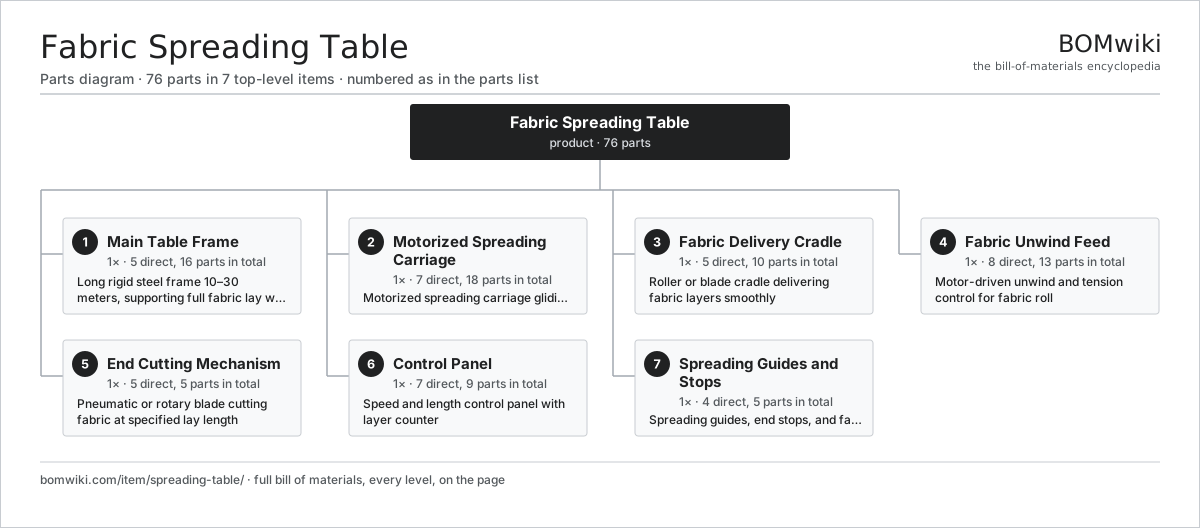
| # | Part | Qty | What it does |
|---|---|---|---|
| 1 | Main Table Frame 5 parts | 1× | Long rigid steel frame 10–30 meters, supporting full fabric lay width |
| 2 | Motorized Spreading Carriage 7 parts | 1× | Motorized spreading carriage gliding along length on linear guides |
| 3 | Fabric Delivery Cradle 5 parts | 1× | Roller or blade cradle delivering fabric layers smoothly |
| 4 | Fabric Unwind Feed 8 parts | 1× | Motor-driven unwind and tension control for fabric roll |
| 5 | End Cutting Mechanism 5 parts | 1× | Pneumatic or rotary blade cutting fabric at specified lay length |
| 6 | Control Panel 7 parts | 1× | Speed and length control panel with layer counter |
| 7 | Spreading Guides and Stops 4 parts | 1× | Spreading guides, end stops, and fabric positioning rulers |
3D model
No 3D model yet. Have a CAD file of this? Add a 3D model. STL renders right on this page; STEP, FreeCAD, and OpenSCAD sources are welcome too (openly licensed, like all 3D models on BOMwiki).
Build & assembly graph
expand / collapse · shared sub-assemblies converge · links to related products · est. labourTap an assembly to expand/collapse · tap a part to open it · use “Open page” for any node · drag to pan, scroll to zoom.
Bill of materials for Fabric Spreading Table
7 top-level lines · 48 rows shown · 76 parts total · indented to 3 levels| # | Item / sub-assembly | Part no. | Qty/assy | Ext. qty | Parts | Type |
|---|---|---|---|---|---|---|
| 1 | Main Table Frame 5 parts | spreading-table-frame | 1× | 1 | 16 | assembly |
| 1.1 | Longitudinal Main Beam | spreading-table-length-beam | 2× | 2 | · | part |
| 1.2 | Cross-Bracing Beam | spreading-table-width-beam | 4× | 4 | · | part |
| 1.3 | Work Surface Decking | spreading-table-top-surface | 1× | 1 | · | part |
| 1.4 | Corner Reinforcement Gusset | spreading-table-corner-brace | 8× | 8 | · | part |
| 1.5 | Fastener Set | fastener-set | 1× | 1 | · | part |
| 2 | Motorized Spreading Carriage 7 parts | spreading-table-carriage | 1× | 1 | 18 | assembly |
| 2.1 | Carriage Chassis | spreading-table-carriage-frame | 1× | 1 | · | part |
| 2.2 | Carriage Wheel | spreading-table-carriage-wheel | 4× | 4 | · | part |
| 2.3 | Carriage Drive Motor | spreading-table-motor-drive | 1× | 1 | · | part |
| 2.4 | Linear Guide Rail | spreading-table-linear-rail | 2× | 2 | · | part |
| 2.5 | Drive Transmission Belt | spreading-table-belt-drive | 1× | 1 | · | part |
| 2.6 | Ball Bearing | ball-bearing | 8× | 8 | · | part |
| 2.7 | Fastener Set | fastener-set | 1× | 1 | · | part |
| 3 | Fabric Delivery Cradle 5 parts | spreading-table-fabric-cradle | 1× | 1 | 10 | assembly |
| 3.1 | Fabric Cradle Roller | spreading-table-cradle-roller | 2× | 2 | · | part |
| 3.2 | Smoothing Blade | spreading-table-cradle-blade | 1× | 1 | · | part |
| 3.3 | Roller Support Bearing | spreading-table-cradle-bearing | 4× | 4 | · | part |
| 3.4 | Nip Roller Pressure Spring | spreading-table-cradle-spring | 2× | 2 | · | part |
| 3.5 | Fastener Set | fastener-set | 1× | 1 | · | part |
| 4 | Fabric Unwind Feed 8 parts | spreading-table-feed-system | 1× | 1 | 13 | assembly |
| 4.1 | Fabric Roll Spindle Stand | spreading-table-roll-stand | 1× | 1 | · | part |
| 4.2 | Tension Idler Roller | spreading-table-tension-roller | 1× | 1 | · | part |
| 4.3 | Tension Biasing Spring | spreading-table-tension-spring | 2× | 2 | · | part |
| 4.4 | Fabric Feed Motor | spreading-table-feed-motor | 1× | 1 | · | part |
| 4.5 | Drive Pulley | spreading-table-drive-pulley | 2× | 2 | · | part |
| 4.6 | Drive Belt | drive-belt | 1× | 1 | · | part |
| 4.7 | Ball Bearing | ball-bearing | 4× | 4 | · | part |
| 4.8 | Fastener Set | fastener-set | 1× | 1 | · | part |
| 5 | End Cutting Mechanism 5 parts | spreading-table-end-cutter | 1× | 1 | 5 | assembly |
| 5.1 | Cutting Blade | spreading-table-cutter-blade | 1× | 1 | · | part |
| 5.2 | Cutter Actuator Solenoid | spreading-table-cutter-solenoid | 1× | 1 | · | part |
| 5.3 | Cutter Length Stop | spreading-table-cutter-guide | 1× | 1 | · | part |
| 5.4 | Pneumatic Cutting Cylinder | spreading-table-air-cylinder | 1× | 1 | · | part |
| 5.5 | Fastener Set | fastener-set | 1× | 1 | · | part |
| 6 | Control Panel 7 parts | spreading-table-controls | 1× | 1 | 9 | assembly |
| 6.1 | Control Panel Enclosure | spreading-table-control-box | 1× | 1 | · | part |
| 6.2 | Relay | relay | 1× | 1 | · | part |
| 6.3 | Variable-Frequency Motor Drive | spreading-table-motor-controller | 1× | 1 | · | part |
| 6.4 | Layer Counter Display | spreading-table-counter | 1× | 1 | · | part |
| 6.5 | Length Preset Control | spreading-table-length-preset | 1× | 1 | · | part |
| 6.6 | Connector | connector | 3× | 3 | · | part |
| 6.7 | Fastener Set | fastener-set | 1× | 1 | · | part |
| 7 | Spreading Guides and Stops 4 parts | spreading-table-accessories | 1× | 1 | 5 | assembly |
| 7.1 | Side Spreading Guide | spreading-table-side-guide | 2× | 2 | · | part |
| 7.2 | Table End Stop | spreading-table-end-stop | 1× | 1 | · | part |
| 7.3 | Width Measurement Ruler | spreading-table-width-ruler | 1× | 1 | · | part |
| 7.4 | Fastener Set | fastener-set | 1× | 1 | · | part |
Something wrong in this list? Report a problem with this BOM.
Sourcing: possible vendors
Browse the supplier directory → Prices, MOQ, and lead times are algorithmic estimates, not quotes, and not claims about these companies. Company mappings are curated by keyword; est. price band $10k–$1M. How estimates work| Vendor | HQ | Specialty | MOQ | Lead time |
|---|---|---|---|---|
|
🇨🇭Rieter
rieter.com ↗
|
Winterthur, CH | Spinning machinery | 10 units | 14–24 wks |
| truetzschler.com ↗ | Mönchengladbach, DE | Textile machinery | 10 units | 14–24 wks |
|
🇧🇪Picanol
picanol.be ↗
|
Ypres, BE | Weaving machines | 10 units | 14–24 wks |
| karlmayer.com ↗ | Obertshausen, DE | Warp knitting machines | 10 units | 14–24 wks |
|
🇨🇭Saurer
saurer.com ↗
|
Arbon, CH | Spinning & embroidery | 10 units | 14–24 wks |
1,285-word article