Spring Coiling Machine
ProductOverview
The spring coiling machine is an automated production line device that winds wire into helical springs at high speeds, widely used in automotive, appliance, and mechanical fastening industries. These machines convert a continuous spool of wire into precisely dimensioned springs via a multi-axis motion system that controls wire feed rate, spindle rotation, pitch advancement, and cutoff timing. Modern machines use stepper motors and PLC logic to achieve repeatable geometry and enable rapid changeover between spring specifications.
The typical configuration processes wire diameters from 0.3 mm (fine springs for electronics) to 4.0 mm (heavy-duty compression springs). Production rates range from 100 to 300 springs per minute depending on wire size and spring length. The wire feed system unwinds coil stock under constant tension, the coiling head wraps the wire into the desired helix, the pitch cam advances the coil axially to set spring pitch, and the cutoff mechanism severs each finished spring. Optional heat-setting equipment stress-relieves springs to ensure consistent elastic properties.
How it works
The machine operates on a synchronized spindle-based motion cycle. The wire payoff spool (held by a brake solenoid) is fed through dual-grooved pressure rollers driven by a stepper motor. A dancer arm tension sensor maintains constant wire tension by modulating the brake and roller grip independently of spool deceleration. This ensures the wire feeds at a precise, programmable rate into the coiling head.
The coiling head consists of a high-speed spindle shaft (typically 500–3000 rpm) onto which a hardened mandrel is mounted. As the spindle rotates, three finger cams (eccentrically mounted on a servo-driven phase ring) guide the incoming wire around the rotating mandrel in a helical wrap. Each revolution of the spindle produces one complete coil turn. The pitch screw, synchronized to the spindle via a ball bearing drive, advances the wire feed point axially with each spindle rotation, controlling the spacing between coil turns (the pitch).
Once the target number of turns is reached (detected by an position sensor), the cutter solenoid fires, driving a hardened blade into the wire. Simultaneously, compressed air from a timed directional valve propels the ejector finger, deflecting the finished spring into a collection chute. The cycle then repeats: the finger-cam servo resets phase, and the wire feed motor meters the next length of wire into position.
The control panel houses the PLC logic, stepper drivers, a 7-inch HMI touchscreen, and relay banks. Operators program spring ID (inner diameter), OD (outer diameter), pitch, free length, and material type; the PLC calculates the required wire feed length, spindle speed, pitch servo position, and cutter timing automatically.
For high-carbon steel wire and alloy springs, optional heat setting is critical. Springs are conveyed through an electric heating chamber on a perforated mesh belt at setpoint temperature (typically 200–600°C depending on grade) for 2–5 minutes. This stress-relieves residual coiling stress, improves elastic recovery (reduced permanent set), and stabilizes the spring rate. An extraction fan exhausts fumes and regulates chamber pressure.
The machine frame is a precision-cast ductile iron structure that rigidly supports the spindle on four deep-groove ball bearings, eliminating runout and chatter. Elastomer isolation feet decouple the machine from the factory floor, reducing noise and protecting adjacent equipment. The lubrication system, a gear pump recirculating coolant from a 100 L tank, continuously sprays the mandrel and coiling zone via air-atomized nozzles. This cools the mandrel (which heats from friction at high speeds), lubricates the wire for smoother feed, and extends mandrel and blade life.
Setup and changeover
Changing spring specifications involves updating the HMI parameters and mechanically swapping the mandrel to match the target spring OD. For major wire diameter shifts (e.g., 0.5 mm to 2.0 mm), the pressure roller grooves must also be changed. Most modern machines carry a small inventory of mandrels and roller pairs to minimize downtime.
Quality considerations
Spring quality depends on consistent wire tension, precise pitch control, and adequate heat setting. A loose or drifting tension sensor leads to variable spring rates and permanent set issues. Worn cutter blades produce burrs and ragged ends, requiring frequent blade changes. High-speed operation (>250 springs/min) on fine wire (0.3–0.5 mm) demands aggressive coolant flow to prevent mandrel galling.
Spring Coiling Machine parts and their functions
8 top-level parts · 46 parts in total · full bill of materials below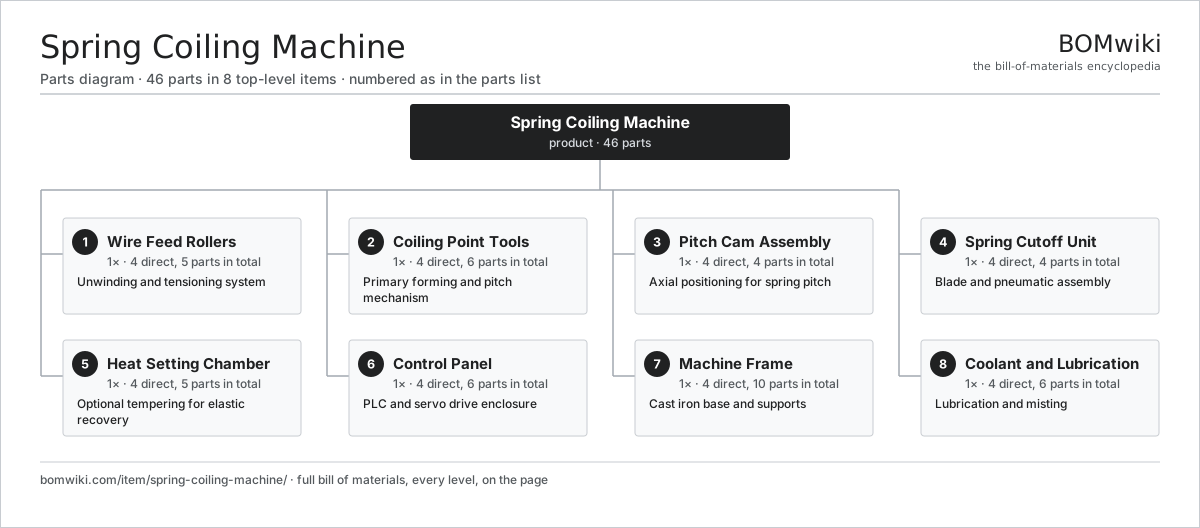
| # | Part | Qty | What it does |
|---|---|---|---|
| 1 | Wire Feed Rollers 4 parts | 1× | Unwinding and tensioning system |
| 2 | Coiling Point Tools 4 parts | 1× | Primary forming and pitch mechanism |
| 3 | Pitch Cam Assembly 4 parts | 1× | Axial positioning for spring pitch |
| 4 | Spring Cutoff Unit 4 parts | 1× | Blade and pneumatic assembly |
| 5 | Heat Setting Chamber 4 parts | 1× | Optional tempering for elastic recovery |
| 6 | Control Panel 4 parts | 1× | PLC and servo drive enclosure |
| 7 | Machine Frame 4 parts | 1× | Cast iron base and supports |
| 8 | Coolant and Lubrication 4 parts | 1× | Lubrication and misting |
3D model
No 3D model yet. Have a CAD file of this? Add a 3D model. STL renders right on this page; STEP, FreeCAD, and OpenSCAD sources are welcome too (openly licensed, like all 3D models on BOMwiki).
Build & assembly graph
expand / collapse · shared sub-assemblies converge · links to related products · est. labourTap an assembly to expand/collapse · tap a part to open it · use “Open page” for any node · drag to pan, scroll to zoom.
Bill of materials for Spring Coiling Machine
8 top-level lines · 40 rows shown · 46 parts total · indented to 3 levels| # | Item / sub-assembly | Part no. | Qty/assy | Ext. qty | Parts | Type |
|---|---|---|---|---|---|---|
| 1 | Wire Feed Rollers 4 parts | spring-coiling-machine-wire-feed | 1× | 1 | 5 | assembly |
| 1.1 | Wire Feed Stepper Motor | spring-coiling-machine-wire-motor | 1× | 1 | · | part |
| 1.2 | Pressure Roller Pair | spring-coiling-machine-feed-rollers | 2× | 2 | · | part |
| 1.3 | Dancer Arm Tension Sensor | spring-coiling-machine-dancer-arm | 1× | 1 | · | part |
| 1.4 | Brake Hold Solenoid | spring-coiling-machine-brake-solenoid | 1× | 1 | · | part |
| 2 | Coiling Point Tools 4 parts | spring-coiling-machine-coiling-head | 1× | 1 | 6 | assembly |
| 2.1 | High-Speed Spindle Shaft | spring-coiling-machine-main-spindle | 1× | 1 | · | part |
| 2.2 | Coiling Mandrel | spring-coiling-machine-mandrel | 1× | 1 | · | part |
| 2.3 | Follower Finger Cam | spring-coiling-machine-finger-cam | 3× | 3 | · | part |
| 2.4 | Cam Phase Stepper | spring-coiling-machine-cam-servo | 1× | 1 | · | part |
| 3 | Pitch Cam Assembly 4 parts | spring-coiling-machine-pitch-cam | 1× | 1 | 4 | assembly |
| 3.1 | Pitch Control Leadscrew | spring-coiling-machine-pitch-screw | 1× | 1 | · | part |
| 3.2 | Anti-Backlash Pitch Nut | spring-coiling-machine-pitch-nut | 1× | 1 | · | part |
| 3.3 | Ball Screw | ball-screw | 1× | 1 | · | part |
| 3.4 | Encoder | encoder | 1× | 1 | · | part |
| 4 | Spring Cutoff Unit 4 parts | spring-coiling-machine-cutoff | 1× | 1 | 4 | assembly |
| 4.1 | Hardened Shear Blade | spring-coiling-machine-cutoff-blade | 1× | 1 | · | part |
| 4.2 | Pneumatic Cutter Actuator | spring-coiling-machine-cutter-motor | 1× | 1 | · | part |
| 4.3 | Directional Control Solenoid Valve | spring-coiling-machine-air-valve | 1× | 1 | · | part |
| 4.4 | Spring Ejector Finger | spring-coiling-machine-kick-arm | 1× | 1 | · | part |
| 5 | Heat Setting Chamber 4 parts | spring-coiling-machine-heat-setting | 1× | 1 | 5 | assembly |
| 5.1 | Heating Element | heating-element | 2× | 2 | · | part |
| 5.2 | PID Heating Controller | spring-coiling-machine-heating-control | 1× | 1 | · | part |
| 5.3 | Stainless Mesh Conveyor | spring-coiling-machine-conveyor-belt | 1× | 1 | · | part |
| 5.4 | Thermal Exhaust Blower | spring-coiling-machine-exhaust-fan | 1× | 1 | · | part |
| 6 | Control Panel 4 parts | spring-coiling-machine-control-panel | 1× | 1 | 6 | assembly |
| 6.1 | Microcontroller | mcu | 1× | 1 | · | part |
| 6.2 | LCD Panel | lcd-panel | 1× | 1 | · | part |
| 6.3 | Relay | relay | 3× | 3 | · | part |
| 6.4 | Power Supply | power-supply | 1× | 1 | · | part |
| 7 | Machine Frame 4 parts | spring-coiling-machine-frame | 1× | 1 | 10 | assembly |
| 7.1 | Ductile Iron Machine Base | spring-coiling-machine-base-casting | 1× | 1 | · | part |
| 7.2 | Deep-Groove Ball Bearing | spring-coiling-machine-spindle-bearing | 4× | 4 | · | part |
| 7.3 | Fastener Set | fastener-set | 1× | 1 | · | part |
| 7.4 | Elastomer Isolation Foot | spring-coiling-machine-vibration-mount | 4× | 4 | · | part |
| 8 | Coolant and Lubrication 4 parts | spring-coiling-machine-coolant-system | 1× | 1 | 6 | assembly |
| 8.1 | Gear Pump Coolant Drive | spring-coiling-machine-coolant-pump | 1× | 1 | · | part |
| 8.2 | Coolant Reservoir and Strainer | spring-coiling-machine-filter | 1× | 1 | · | part |
| 8.3 | Air-Assist Mist Nozzle | spring-coiling-machine-mist-nozzle | 3× | 3 | · | part |
| 8.4 | O-Ring Set | oring-set | 1× | 1 | · | part |
Something wrong in this list? Report a problem with this BOM.
Related products
same domain, ranked by shared parts Industrial Quilting Machine
1,090 parts · shares 2 with this page
 Rope Making Machine
308 parts · shares 2 with this page
FDY Filament Spinning Line
679 parts · shares 2 with this page
 Industrial Steam Press
133 parts · shares 2 with this page
Sourcing: possible vendors
Browse the supplier directory → Prices, MOQ, and lead times are algorithmic estimates, not quotes, and not claims about these companies. Company mappings are curated by keyword; est. price band $10k–$1M. How estimates work| Vendor | HQ | Specialty | MOQ | Lead time |
|---|---|---|---|---|
|
🇨🇭Rieter
rieter.com ↗
|
Winterthur, CH | Spinning machinery | 10 units | 14–24 wks |
| truetzschler.com ↗ | Mönchengladbach, DE | Textile machinery | 10 units | 14–24 wks |
|
🇧🇪Picanol
picanol.be ↗
|
Ypres, BE | Weaving machines | 10 units | 14–24 wks |
| karlmayer.com ↗ | Obertshausen, DE | Warp knitting machines | 10 units | 14–24 wks |
|
🇨🇭Saurer
saurer.com ↗
|
Arbon, CH | Spinning & embroidery | 10 units | 14–24 wks |
896-word article