Stage Barricade
ProductOverview
The stage barricade is a modular foldable barrier system designed for temporary audience separation at concerts, festivals, and outdoor events. Each Frame Section is a steel A-frame panel (2.4 m wide, 1.2 m high) that folds flat for transport, then unfolds on-site and is interlocked with adjacent sections via Link Pin removable pins. The barrier is rated for 300 kg distributed lateral push (typical crowd pressure at a music festival) and provides a robust, visible boundary between stage and audience. Unlike rope or lightweight plastic barriers, the steel tread plate surface creates a visual and psychological boundary that audiences instinctively respect, reducing incidences of stage rushing. Multiple sections are rapidly interlocked (one minute per section), forming continuous lines that can run 20–60 meters around a stage perimeter or festival area. When the event ends, sections are unlinked, folded, and stacked flat for transport, a full 20-section barrier fits onto a single flatbed trailer.
Frame and folding mechanism
The Frame Section is a welded steel A-frame structure. Two steel tubes (40 × 40 × 2 mm wall) form the left and right legs of the A-frame, angled inward to meet at the top. A horizontal bottom spreader bar (same profile) connects the legs at the base, forming the classical A-frame shape. Hinge Assembly heavy-duty stainless steel piano hinges (100 mm length) are mounted vertically on the left and right vertical edges of the frame. When the hinge pins are engaged, the section stands rigidly in A-frame configuration. To fold, operators release the hinge pins or rotate them, allowing the two legs to fold inward, collapsing the A-frame to a 0.2 m thick sandwich. The hinge design uses a continuous barrel (piano hinge), distributing the bending moment across 100 mm rather than concentrating load at a single point, extending service life.
Corner Bracket steel gusset plates are welded at all frame intersections (top apex, where the two A-legs meet; bottom corners, where legs meet the spreader bar). These gussets prevent the frame from racking (skewing sideways) under lateral load and improve overall rigidity. The gussets are typically triangular (150 × 150 × 3 mm steel plate) and are either welded to all surfaces or bolted for field assembly.
Surface and load distribution
The Tread Plate Surface is a steel or aluminum tread plate panel (3 mm thickness, embossed with a diamond or line pattern to provide grip). The tread plate infills the A-frame face, creating a solid barrier. The plate is secured to the frame perimeter via bolts and angle brackets, transferring any lateral audience pressure from the plate to the frame and then to the ground-contact legs. The embossed pattern provides visual texture and improves grip for performers or crew moving along the barrier exterior.
Load testing demonstrates that a single barricade section withstands 300 kg distributed lateral push (e.g., 25 people each leaning with 12 kg force) without permanent deformation. The A-frame geometry is naturally stiff; the inward-angled legs create a triangular load path that efficiently transfers lateral loads to the base, where the weight of the section and the friction of the leg bottoms resist tipping.
Interlocking and pinning
Adjacent Frame Section units are joined via Link Pin stainless steel pins. Each section has eye holes drilled in the top and bottom horizontal members on its left and right sides. When two sections are positioned side-by-side, the pins are inserted through mating eye holes, creating a mechanical connection. A typical pin is 12 mm diameter stainless steel rod, 100 mm long, with a head on one end (preventing full insertion) and a threaded end on the other (accepting a clip or nut). A spring clip or cotter pin retains the threaded end, preventing accidental withdrawal.
Inserting a pin takes approximately 10 seconds per joint; a typical installation with 10 sections requires insertion of approximately 18 pins (top and bottom of each interior joint). Total assembly time for a 20-section barrier (12 m length): 2–3 minutes for a two-person crew. The pin coupling is designed for durability: stainless steel resists corrosion, and the mechanical fit is loose enough to allow insertion without force but tight enough to prevent side-to-side play once seated.
On-site deployment
Setting up a 20-section barrier (approximately 48 m perimeter) requires the following workflow: (1) Unload and unfold each section on the ground, laying it flat in the A-frame open position. (2) Position sections end-to-end in the desired layout (straight lines, curves, or corners). (3) Align the left and right eye holes of adjacent sections and insert the Link Pin pins, top first, then bottom. (4) Install spring clips or cotter pins to retain the pin ends. (5) Visually inspect the entire line to verify all pins are seated and no gaps exist. Typical deployment time for a trained 4-person crew: 15–20 minutes.
Once deployed, the barrier requires no active maintenance during the event; it stands independently without tethers or guy-lines. The Rubber Foot Pad elastomer pads on the leg bottoms protect stage flooring (especially important if the stage is a finished wood floor or polished concrete) and reduce vibration transmission.
Access and emergency egress
A Gate Section is a hinged opening (approximately 0.9 m wide) integrated into one of the barricade sections, permitting controlled passage for performers, equipment, or emergency personnel. The gate swings inward and is held closed via a simple latch or chain loop. In the event of an emergency, the gate can be opened in seconds, providing rapid egress. Some venues prefer to have the gate permanently open and staffed with a crew member who controls access, preventing audience members from walking onto stage while allowing performers freedom of movement.
Transport and storage
Once the event ends, sections are unlinked (pin removal, approximately 1 minute per section), folded (approximately 30 seconds per section), and stacked flat. A single section in folded state measures 2.4 m × 0.2 m × height (approximately 0.1 m when lying flat), requiring approximately 0.05 cubic meters of storage. Twenty sections require 1 cubic meter of storage space. A standard flatbed trailer (3 m × 6 m deck) can accommodate approximately 80–100 folded sections, representing 2–3 complete barrier systems.
Maintenance and corrosion protection
The Paint Finish is a two-part epoxy applied post-assembly, providing rust protection and aesthetic appeal. Standard colors are galvanized silver, bright red, white, or black; custom colors can be powder-coated (lead time 4–6 weeks). The epoxy coating achieves 300+ micron dry film thickness and protects the steel for 10+ years in typical outdoor conditions. In salt-fog environments (coastal venues), additional protection (hot-dip galvanizing or stainless steel fasteners) is recommended.
Annual maintenance: inspect all welds for cracks; visible cracks indicate stress and the section should be removed from service for re-welding. Check all Hinge Assembly pivot pins and bolts for tightness; hand-tighten any loose fasteners. Inspect the Paint Finish for chips or rust; touch up with spray epoxy or brush-coat as needed. Check the Rubber Foot Pad adhesion; if pads are peeling, remove old pads, clean the steel surface, and apply new adhesive-backed pads.
The barricade system has a typical operational lifespan of 15+ years with proper maintenance. Wear occurs primarily at the hinge pivots (from repeated folding) and at the pin eye holes (from corrosion around the pin). Hinges can be replaced in the field (6 bolts per hinge, approximately 30 minutes per section). Eye holes that become enlarged or corroded can be bushed (a new oversized hole drilled and a steel bushing installed) or the entire top rail can be replaced if damage is extensive.
Customization and applications
Height: sections are typically 1.2 m high, suitable for standing audience separation. Lower barriers (0.8 m) are available for VIP areas or venues where lower visual obstruction is preferred. Higher barriers (1.5–1.8 m) can be configured for very large crowds or high-energy events (mosh pits).
Gate integration: multiple gate sections can be distributed throughout a long barrier line, allowing distributed access points rather than a single entry/exit.
Branding: sections can be painted with sponsor logos or event names (applying vinyl decals to the tread plate surface); decals are applied post-manufacture and can be removed when the section is repainted.
Stacking legs: some vendors offer removable foot pads that convert ground-contact legs into nesting legs (allow sections to interlock when stacked), reducing storage footprint even further.
Modular lengths: some manufacturers offer 1.2 m wide sections (half the standard width), permitting tighter curves or corner configurations without gaps.
Safety considerations
The Frame Section is designed to resist tipping or collapse under normal crowd loads (300 kg distributed push represents very high pressure; most events never approach this limit). However, the section is not designed to resist impact loads (e.g., a vehicle collision) or sustained loads from rigging (hanging speakers or lighting from the barricade is not permitted). For applications where the barrier must support weight, an independent structure (stage scaffolding, truss system) should be used.
The tread plate surface provides grip for crew members walking along the barrier exterior, but it should not be used as a climbing surface by audience members. Guardrail or rope should be added if crew members regularly need to access the area behind the barrier.
The Link Pin pins must be fully inserted and retained; loose or partially inserted pins can fall out under vibration, eliminating the connection between sections. A simple checklist (walk the barrier perimeter and verify each pin is seated) should be performed before allowing audience entry.
Stage Barricade parts and their functions
8 top-level parts · 67 parts in total · full bill of materials below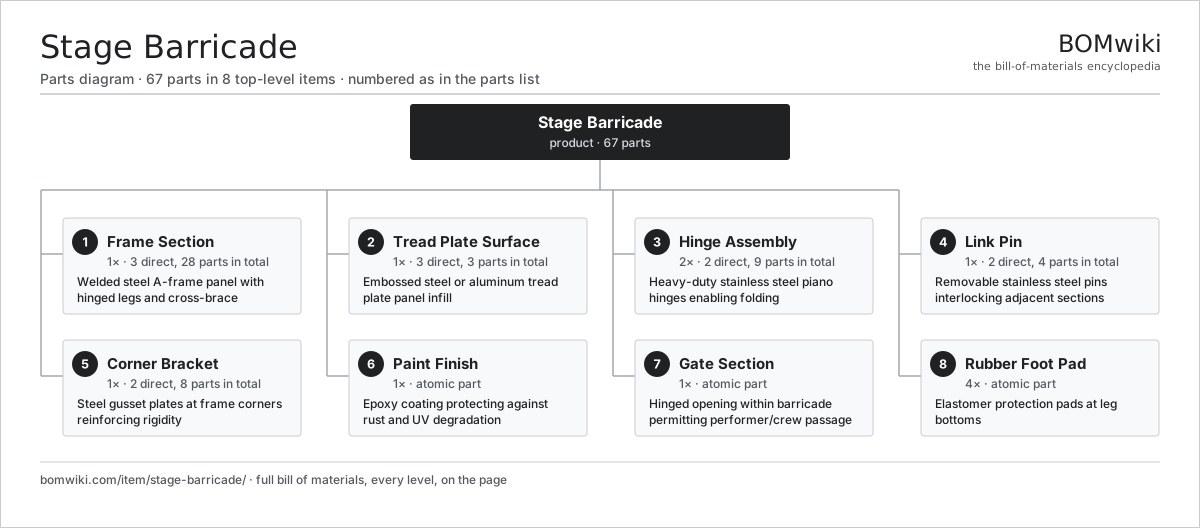
| # | Part | Qty | What it does |
|---|---|---|---|
| 1 | Frame Section 3 parts | 1× | Welded steel A-frame panel with hinged legs and cross-brace |
| 2 | Tread Plate Surface 3 parts | 1× | Embossed steel or aluminum tread plate panel infill |
| 3 | Hinge Assembly 2 parts | 2× | Heavy-duty stainless steel piano hinges enabling folding |
| 4 | Link Pin 2 parts | 1× | Removable stainless steel pins interlocking adjacent sections |
| 5 | Corner Bracket 2 parts | 1× | Steel gusset plates at frame corners reinforcing rigidity |
| 6 | Paint Finish | 1× | Epoxy coating protecting against rust and UV degradation |
| 7 | Gate Section | 1× | Hinged opening within barricade permitting performer/crew passage |
| 8 | Rubber Foot Pad | 4× | Elastomer protection pads at leg bottoms |
3D model
No 3D model yet. Have a CAD file of this? Add a 3D model. STL renders right on this page; STEP, FreeCAD, and OpenSCAD sources are welcome too (openly licensed, like all 3D models on BOMwiki).
Build & assembly graph
expand / collapse · shared sub-assemblies converge · links to related products · est. labourTap an assembly to expand/collapse · tap a part to open it · use “Open page” for any node · drag to pan, scroll to zoom.
Bill of materials for Stage Barricade
8 top-level lines · 22 rows shown · 67 parts total · indented to 3 levels| # | Item / sub-assembly | Part no. | Qty/assy | Ext. qty | Parts | Type |
|---|---|---|---|---|---|---|
| 1 | Frame Section 3 parts | stage-barricade-frame-section | 1× | 1 | 28 | assembly |
| 1.1 | Motor Housing | motor-housing | 8× | 8 | · | part |
| 1.2 | Hinge Assembly 2 parts | stage-barricade-hinge-assembly | 2× | 2 | 9 | assembly |
| 1.2.1 | Fastener Set | fastener-set | 8× | 16 | · | part |
| 1.2.2 | Connector | connector | 1× | 2 | · | part |
| 1.3 | Fastener Set | fastener-set | 2× | 2 | · | part |
| 2 | Tread Plate Surface 3 parts | stage-barricade-tread-plate-surface | 1× | 1 | 3 | assembly |
| 2.1 | Sheet Metal Panel | sheet-panel | 1× | 1 | · | part |
| 2.2 | Fastener Set | fastener-set | 1× | 1 | · | part |
| 2.3 | Paint Finish | stage-barricade-paint-finish | 1× | 1 | · | part |
| 3 | Hinge Assembly 2 parts | stage-barricade-hinge-assembly | 2× | 2 | 9 | assembly |
| 3.1 | Fastener Set | fastener-set | 8× | 16 | · | part |
| 3.2 | Connector | connector | 1× | 2 | · | part |
| 4 | Link Pin 2 parts | stage-barricade-link-pin | 1× | 1 | 4 | assembly |
| 4.1 | Fastener Set | fastener-set | 2× | 2 | · | part |
| 4.2 | Connector | connector | 2× | 2 | · | part |
| 5 | Corner Bracket 2 parts | stage-barricade-corner-bracket | 1× | 1 | 8 | assembly |
| 5.1 | Sheet Metal Panel | sheet-panel | 4× | 4 | · | part |
| 5.2 | Fastener Set | fastener-set | 4× | 4 | · | part |
| 6 | Paint Finish | stage-barricade-paint-finish | 1× | 1 | · | part |
| 7 | Gate Section | stage-barricade-gate-section | 1× | 1 | · | part |
| 8 | Rubber Foot Pad | stage-barricade-rubber-foot-pad | 4× | 4 | · | part |
Something wrong in this list? Report a problem with this BOM.
Related products
same domain, ranked by shared parts Air Dancer
46 parts · shares 2 with this page
Air Dancer
46 parts · shares 2 with this page
 Crowd Barrier
113 parts · shares 2 with this page
Electric Strike
23 parts · shares 2 with this page
Crowd Barrier
113 parts · shares 2 with this page
Electric Strike
23 parts · shares 2 with this page
 Exhibition Booth System
91 parts · shares 2 with this page
Frame Marquee Tent
113 parts · shares 2 with this page
Inflatable Arch
54 parts · shares 2 with this page
Exhibition Booth System
91 parts · shares 2 with this page
Frame Marquee Tent
113 parts · shares 2 with this page
Inflatable Arch
54 parts · shares 2 with this page
Sourcing: possible vendors
Browse the supplier directory → Prices, MOQ, and lead times are algorithmic estimates, not quotes, and not claims about these companies. Company mappings are curated by keyword; est. price band $50–$10k. How estimates work| Vendor | HQ | Specialty | MOQ | Lead time |
|---|---|---|---|---|
| assaabloy.com ↗ | Stockholm, SE | Locks & access | 1,000 units | 8–12 wks |
|
🇺🇸Allegion
allegion.com ↗
|
Dublin, US | Security products (Schlage) | 1,000 units | 8–12 wks |
| dormakaba.com ↗ | Rümlang, CH | Access & door systems | 1,000 units | 8–12 wks |
| honeywell.com ↗ | Charlotte, US | Building & safety tech | 1,000 units | 8–12 wks |
| hikvision.com ↗ | Hangzhou, CN | Surveillance & security | 1,000 units | 8–12 wks |
1,656-word article