Portable Star Tracker
ProductOverview
A star tracker is the minimalist's answer to telescope guiding. Instead of a full equatorial mount with two axes and heavy counterweights, it distills the essential insight: point at the north celestial pole and rotate at sidereal rate, and sky motion stops. A small motorized wedge holds a camera lens, tracks the stars all night on a single battery, and fits in a bag. The result is ideal for wide-field astrophotography, Milky Way panoramas, meteor streaks, satellite trails, and star fields, where you want to gather light for minutes or hours without field rotation.
The wedge body tilts at the observer's latitude, with the RA drive mechanism spinning at exactly sidereal rate. The low-power motor is powered by a rechargeable battery, making the tracker truly portable. Unlike telescope mounts that require precise optical alignment, a tracker's setup is simpler: aim at Polaris with the polar scope, tighten the friction ball head to secure the camera, and expose.
The tracker shines for wide-angle lenses (14 mm to 50 mm), where even slight field rotation is invisible. A 24 mm f/2 lens on a full-frame camera captures a 65-degree field; after two hours of tracking, the rotation at the image corners is less than one degree, acceptable for most uses. For longer exposures or narrower focal lengths, dedicated guiding becomes necessary, but for casual deep-sky imaging, the tracker's simplicity and low cost are unbeatable.
How it works
Starlight from a wide-angle lens is collected and focused by the camera sensor. To prevent trails, the motor must turn the RA mechanism at exactly Earth's rotation rate, one complete turn per sidereal day, or about 0.25 revolutions per hour (15 degrees per hour).
The DC motor runs continuously at low voltage, consuming under 2 watts. A reduction gearbox inside the motor case steps down the rotation by a factor of 100–200, depending on the motor speed. The output shaft couples to a worm gear that drives a larger worm wheel. This gearing arrangement gives high mechanical advantage and inherent locking, the worm cannot be back-driven by the wheel, so the mount holds position without slip even when powered off.
The ball head sits atop the RA drive. A spherical ball rotates in a socket, and a friction ring clamps it in place. The observer can tilt and pan the ball freely before tightening, then locks the camera in position. As the RA drive rotates, the ball turns with it, and the camera follows the celestial motion.
Polar alignment is the critical setup step. The RA axis must point at the north celestial pole, or the tracker will cause field rotation. Most trackers include a simple eyepiece-sized scope aligned with the RA axis. The observer looks through it and sees Polaris (or whichever pole star matches the hemisphere) near the center. Adjusting the wedge angle and rotating the tracker until Polaris is centered ensures correct alignment. In the southern hemisphere, the same ritual applies to the south celestial pole using Sigma Octantis.
The rechargeable battery stores enough energy for a full night's observing, typically 4–8 hours on a full charge. The speed controller uses a simple PWM regulator to maintain steady motor voltage, keeping sidereal rate constant even as the battery voltage droops. Some advanced designs include a potentiometer for fine-tuning rate, useful if you want to deliberately introduce slow motion for timelapse effects.
Unlike a guiding camera that issues corrective pulses, the tracker has no closed-loop feedback. You cannot dynamically correct for polar misalignment or atmospheric drift. Instead, the polar alignment must be precise. A one-degree error in polar alignment accumulates as a half-minute of trail over a 30-minute exposure on a wide-angle lens, but is often invisible to the eye. Careful setup is the tracker's price for simplicity.
Portable Star Tracker parts and their functions
10 top-level parts · 26 parts in total · full bill of materials below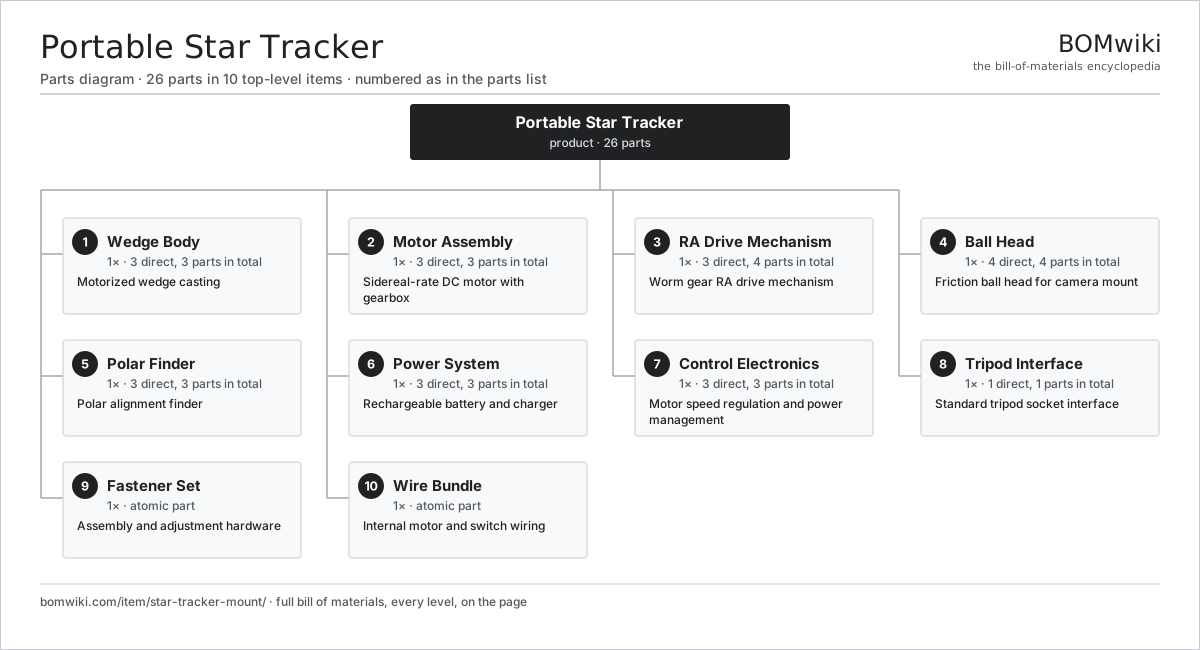
| # | Part | Qty | What it does |
|---|---|---|---|
| 1 | Wedge Body 3 parts | 1× | Motorized wedge casting |
| 2 | Motor Assembly 3 parts | 1× | Sidereal-rate DC motor with gearbox |
| 3 | RA Drive Mechanism 3 parts | 1× | Worm gear RA drive mechanism |
| 4 | Ball Head 4 parts | 1× | Friction ball head for camera mount |
| 5 | Polar Finder 3 parts | 1× | Polar alignment finder |
| 6 | Power System 3 parts | 1× | Rechargeable battery and charger |
| 7 | Control Electronics 3 parts | 1× | Motor speed regulation and power management |
| 8 | Tripod Interface 1 parts | 1× | Standard tripod socket interface |
| 9 | Fastener Set | 1× | Assembly and adjustment hardware |
| 10 | Wire Bundle | 1× | Internal motor and switch wiring |
3D model
No 3D model yet. Have a CAD file of this? Add a 3D model. STL renders right on this page; STEP, FreeCAD, and OpenSCAD sources are welcome too (openly licensed, like all 3D models on BOMwiki).
Build & assembly graph
expand / collapse · shared sub-assemblies converge · links to related products · est. labourTap an assembly to expand/collapse · tap a part to open it · use “Open page” for any node · drag to pan, scroll to zoom.
Bill of materials for Portable Star Tracker
10 top-level lines · 33 rows shown · 26 parts total · indented to 3 levels| # | Item / sub-assembly | Part no. | Qty/assy | Ext. qty | Parts | Type |
|---|---|---|---|---|---|---|
| 1 | Wedge Body 3 parts | star-tracker-mount-body | 1× | 1 | 3 | assembly |
| 1.1 | Wedge Case | star-tracker-mount-wedge-case | 1× | 1 | · | part |
| 1.2 | Angle Spacer Set | star-tracker-mount-angle-spacers | 1× | 1 | · | part |
| 1.3 | Base Plate | star-tracker-mount-base-plate | 1× | 1 | · | part |
| 2 | Motor Assembly 3 parts | star-tracker-mount-motor | 1× | 1 | 3 | assembly |
| 2.1 | Motor Core | star-tracker-mount-motor-core | 1× | 1 | · | part |
| 2.2 | Motor Gearbox | star-tracker-mount-gearbox | 1× | 1 | · | part |
| 2.3 | Motor Coupling | star-tracker-mount-motor-coupling | 1× | 1 | · | part |
| 3 | RA Drive Mechanism 3 parts | star-tracker-mount-ra-drive | 1× | 1 | 4 | assembly |
| 3.1 | RA Worm Gear | star-tracker-mount-ra-worm | 1× | 1 | · | part |
| 3.2 | RA Gear Wheel | star-tracker-mount-ra-gear-wheel | 1× | 1 | · | part |
| 3.3 | Ball Bearing | ball-bearing | 2× | 2 | · | part |
| 4 | Ball Head 4 parts | star-tracker-mount-ball-head | 1× | 1 | 4 | assembly |
| 4.1 | Ball Socket | star-tracker-mount-ball-socket | 1× | 1 | · | part |
| 4.2 | Ball Sphere | star-tracker-mount-ball-sphere | 1× | 1 | · | part |
| 4.3 | Friction Ring | star-tracker-mount-ball-friction-ring | 1× | 1 | · | part |
| 4.4 | Camera Shoe | star-tracker-mount-camera-shoe | 1× | 1 | · | part |
| 5 | Polar Finder 3 parts | star-tracker-mount-polar-scope | 1× | 1 | 3 | assembly |
| 5.1 | Polar Lens | star-tracker-mount-polar-lens | 1× | 1 | · | part |
| 5.2 | Polar Reticle | star-tracker-mount-polar-reticle | 1× | 1 | · | part |
| 5.3 | Polar Scope Tube | star-tracker-mount-polar-tube | 1× | 1 | · | part |
| 6 | Power System 3 parts | star-tracker-mount-battery-system | 1× | 1 | 3 | assembly |
| 6.1 | Battery Pack | star-tracker-mount-battery-pack | 1× | 1 | · | part |
| 6.2 | Battery Contact Block | star-tracker-mount-battery-contacts | 1× | 1 | · | part |
| 6.3 | Charging Port | star-tracker-mount-charge-port | 1× | 1 | · | part |
| 7 | Control Electronics 3 parts | star-tracker-mount-control-board | 1× | 1 | 3 | assembly |
| 7.1 | Speed Adjustment Pot | star-tracker-mount-speed-potentiometer | 1× | 1 | · | part |
| 7.2 | PWM Speed Controller | star-tracker-mount-pwm-controller | 1× | 1 | · | part |
| 7.3 | Power Switch | star-tracker-mount-power-switch | 1× | 1 | · | part |
| 8 | Tripod Interface 1 parts | star-tracker-mount-tripod-adapter | 1× | 1 | 1 | assembly |
| 8.1 | Tripod Socket Screw | star-tracker-mount-tripod-screw | 1× | 1 | · | part |
| 9 | Fastener Set | fastener-set | 1× | 1 | · | part |
| 10 | Wire Bundle | wire-bundle | 1× | 1 | · | part |
Something wrong in this list? Report a problem with this BOM.
Related products
same domain, ranked by shared parts Camera Gimbal Stabilizer
177 parts · shares 2 with this page
Camera Gimbal Stabilizer
177 parts · shares 2 with this page
 Camera Jib Crane
67 parts · shares 2 with this page
Camera Jib Crane
67 parts · shares 2 with this page
 Camera Motion Control Rig
210 parts · shares 2 with this page
Camera Motion Control Rig
210 parts · shares 2 with this page
 Computerized GoTo Telescope
320 parts · shares 2 with this page
Computerized GoTo Telescope
320 parts · shares 2 with this page
 Digital Cinema Projector
383 parts · shares 2 with this page
Digital Cinema Projector
383 parts · shares 2 with this page
 Digital Microscope
88 parts · shares 2 with this page
Digital Microscope
88 parts · shares 2 with this page
Sourcing: possible vendors
Browse the supplier directory → Prices, MOQ, and lead times are algorithmic estimates, not quotes, and not claims about these companies. Company mappings are curated by keyword; est. price band $100–$8k. How estimates work| Vendor | HQ | Specialty | MOQ | Lead time |
|---|---|---|---|---|
|
🇯🇵Canon
canon.com ↗
|
Tokyo, JP | Imaging & optics | 500 units | 10–16 wks |
|
🇯🇵Nikon
nikon.com ↗
|
Tokyo, JP | Imaging & optics | 500 units | 10–16 wks |
|
🇩🇪ZEISS
zeiss.com ↗
|
Oberkochen, DE | Optics & optoelectronics | 500 units | 10–16 wks |
| leica-camera.com ↗ | Wetzlar, DE | Cameras & optics | 500 units | 10–16 wks |
| flir.com ↗ | Wilsonville, US | Thermal imaging | 500 units | 10–16 wks |
755-word article