Stereo Microscope
ProductOverview
A stereo microscope delivers three-dimensional, real-time visualization at low to moderate magnification (0.65–4.6×), making it indispensable for surgical procedures, jewelry inspection, PCB assembly, and specimen preparation. Unlike a compound microscope, which uses a single high-magnification optical axis, a stereo microscope maintains two separate optical paths (left eye and right eye) that converge to a common sample. This binocular configuration provides true stereo depth perception: the brain fuses slightly offset images from each eye, creating a vivid 3D percept. The zoom design allows the operator to change magnification without swapping objectives, and the long working distance (100–175 mm) leaves space for hands or instruments to manipulate the sample.
The Stereo Optical Head contains dual synchronized zoom lenses that maintain magnification parity between left and right paths. Light from the Illumination System is routed coaxially (down the optical axis) or obliquely to illuminate the sample. The Focus Assembly positions the entire optical head vertically via rack-and-pinion coarse focus and differential-screw fine focus, keeping the sample in sharp focus across the working distance. The Sample Stage Assembly holds the sample and can be rotated for convenient orientation. The articulating Microscope Stand with ball joints allows the operator to swing the microscope over the sample and adjust the angle, while the weighted Weighted Base provides stability. The Eyepiece Pair Assembly deliver magnified images to each eye with enough field of view to see the full sample area without excessive head movement.
How it works
The two parallel optical paths create lateral eye separation (baseline ~65 mm, matching typical human interpupillary distance). Each path passes through an Common Objective Lens that forms a real image magnified 0.65–4.6× and transmitted up through the synchronized Synchronized Zoom Body to the eyepieces. Because the left and right images are laterally offset and from slightly different angles, the brain computes depth from the disparity, no more computation is needed than looking at a real 3D object. This is vastly more intuitive and reliable than monocular depth cues (shadows, perspective) used in 2D imaging.
The long working distance is key to hands-free surgery and assembly. For a 4× magnification (0.87 mm depth of field), there is still 100 mm of clear space between the objective and sample, allowing a surgeon's hands, scalpels, or assembly tools to move freely.
The Illumination System uses a coaxial LED ring that bounces light off the sample surface. At low magnification, the entire sample face is uniformly lit. As magnification increases, the depth of field (the thickness of the sample layer that appears in focus) shrinks: at 0.65×, it might be 30 mm; at 4.6×, it narrows to ~4 mm. The operator uses the Focus Assembly to position this thin in-focus plane where detail is to be examined.
Magnification is changed by rotating the Zoom Drive Knob knob, which mechanically couples the left and right zoom lenses so they always move together, preserving magnification equality.
Applications
Surgical microscopes are essential for ophthalmic, otologic, and neurosurgery, where magnification and 3D visualization are critical to precision. Dental practitioners use stereo scopes for root canal treatment and implant placement. Electronics manufacturers employ them for PCB assembly, soldering QFP and BGA packages, and rework. Jewelers and gemologists use them for detailed inspection and cutting. Laboratory technicians use them for specimen dissection, fine manipulation, and preparation. Entomologists and biologists examine small organisms and tissues in 3D. Watch and clock repairers rely on stereo scopes to service intricate mechanisms.
Stereo Microscope parts and their functions
8 top-level parts · 32 parts in total · full bill of materials below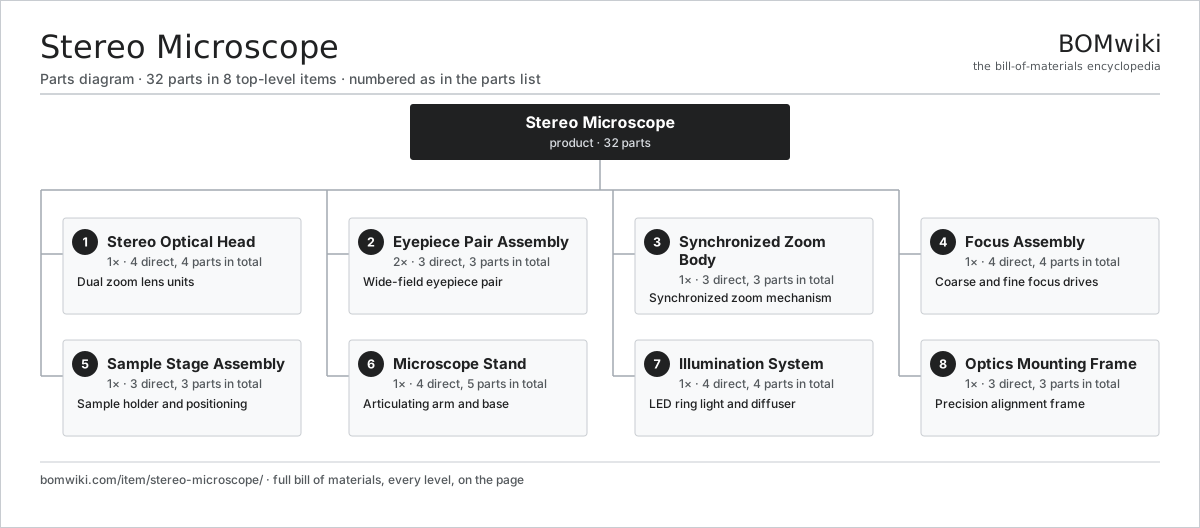
| # | Part | Qty | What it does |
|---|---|---|---|
| 1 | Stereo Optical Head 4 parts | 1× | Dual zoom lens units |
| 2 | Eyepiece Pair Assembly 3 parts | 2× | Wide-field eyepiece pair |
| 3 | Synchronized Zoom Body 3 parts | 1× | Synchronized zoom mechanism |
| 4 | Focus Assembly 4 parts | 1× | Coarse and fine focus drives |
| 5 | Sample Stage Assembly 3 parts | 1× | Sample holder and positioning |
| 6 | Microscope Stand 4 parts | 1× | Articulating arm and base |
| 7 | Illumination System 4 parts | 1× | LED ring light and diffuser |
| 8 | Optics Mounting Frame 3 parts | 1× | Precision alignment frame |
3D model
No 3D model yet. Have a CAD file of this? Add a 3D model. STL renders right on this page; STEP, FreeCAD, and OpenSCAD sources are welcome too (openly licensed, like all 3D models on BOMwiki).
Build & assembly graph
expand / collapse · shared sub-assemblies converge · links to related products · est. labourTap an assembly to expand/collapse · tap a part to open it · use “Open page” for any node · drag to pan, scroll to zoom.
Bill of materials for Stereo Microscope
8 top-level lines · 36 rows shown · 32 parts total · indented to 3 levels| # | Item / sub-assembly | Part no. | Qty/assy | Ext. qty | Parts | Type |
|---|---|---|---|---|---|---|
| 1 | Stereo Optical Head 4 parts | stereo-microscope-optical-head | 1× | 1 | 4 | assembly |
| 1.1 | Left Zoom Lens Unit | stereo-microscope-left-zoom | 1× | 1 | · | part |
| 1.2 | Right Zoom Lens Unit | stereo-microscope-right-zoom | 1× | 1 | · | part |
| 1.3 | Common Objective Lens | stereo-microscope-objective-lens | 1× | 1 | · | part |
| 1.4 | Beam Combiner Optics | stereo-microscope-beam-combiner | 1× | 1 | · | part |
| 2 | Eyepiece Pair Assembly 3 parts | stereo-microscope-eyepieces | 2× | 2 | 3 | assembly |
| 2.1 | Left Eyepiece | stereo-microscope-left-eyepiece | 1× | 2 | · | part |
| 2.2 | Right Eyepiece | stereo-microscope-right-eyepiece | 1× | 2 | · | part |
| 2.3 | Eyepiece Tube Mount | stereo-microscope-eyepiece-mount | 1× | 2 | · | part |
| 3 | Synchronized Zoom Body 3 parts | stereo-microscope-zoom-body | 1× | 1 | 3 | assembly |
| 3.1 | Zoom Drive Knob | stereo-microscope-zoom-drive | 1× | 1 | · | part |
| 3.2 | Zoom Coupling Mechanism | stereo-microscope-zoom-coupling | 1× | 1 | · | part |
| 3.3 | Magnification Scale | stereo-microscope-magnification-scale | 1× | 1 | · | part |
| 4 | Focus Assembly 4 parts | stereo-microscope-focus-mechanism | 1× | 1 | 4 | assembly |
| 4.1 | Coarse Focus Knob | stereo-microscope-coarse-focus-knob | 1× | 1 | · | part |
| 4.2 | Fine Focus Knob | stereo-microscope-fine-focus-knob | 1× | 1 | · | part |
| 4.3 | Focus Rack / Pinion | stereo-microscope-focus-rack | 1× | 1 | · | part |
| 4.4 | Fine-Focus Differential Screw | stereo-microscope-focus-pinion | 1× | 1 | · | part |
| 5 | Sample Stage Assembly 3 parts | stereo-microscope-stage | 1× | 1 | 3 | assembly |
| 5.1 | Stage Plate | stereo-microscope-stage-plate | 1× | 1 | · | part |
| 5.2 | Slide Clamp Assembly | stereo-microscope-slide-clamp | 1× | 1 | · | part |
| 5.3 | Rotation Bearing | stereo-microscope-rotation-bearing | 1× | 1 | · | part |
| 6 | Microscope Stand 4 parts | stereo-microscope-stand | 1× | 1 | 5 | assembly |
| 6.1 | Articulating Arm | stereo-microscope-arm | 1× | 1 | · | part |
| 6.2 | Ball Joint / Bearing | stereo-microscope-ball-joints | 2× | 2 | · | part |
| 6.3 | Weighted Base | stereo-microscope-base-weight | 1× | 1 | · | part |
| 6.4 | Fixed Column | stereo-microscope-column | 1× | 1 | · | part |
| 7 | Illumination System 4 parts | stereo-microscope-illumination | 1× | 1 | 4 | assembly |
| 7.1 | LED Ring Light | stereo-microscope-led-ring | 1× | 1 | · | part |
| 7.2 | LED Brightness Controller | stereo-microscope-led-driver | 1× | 1 | · | part |
| 7.3 | Diffusion Dome | stereo-microscope-light-diffuser | 1× | 1 | · | part |
| 7.4 | Light Guide Fiber or Optics | stereo-microscope-light-guide | 1× | 1 | · | part |
| 8 | Optics Mounting Frame 3 parts | stereo-microscope-optics-mount | 1× | 1 | 3 | assembly |
| 8.1 | Mount Frame | stereo-microscope-mount-frame | 1× | 1 | · | part |
| 8.2 | Optical Component Holders | stereo-microscope-component-holders | 1× | 1 | · | part |
| 8.3 | Fastener Set | fastener-set | 1× | 1 | · | part |
Something wrong in this list? Report a problem with this BOM.
Used in 1 assembly
Sourcing: possible vendors
Browse the supplier directory → Prices, MOQ, and lead times are algorithmic estimates, not quotes, and not claims about these companies. Company mappings are curated by keyword; est. price band $100–$8k. How estimates work| Vendor | HQ | Specialty | MOQ | Lead time |
|---|---|---|---|---|
|
🇯🇵Canon
canon.com ↗
|
Tokyo, JP | Imaging & optics | 500 units | 10–16 wks |
|
🇯🇵Nikon
nikon.com ↗
|
Tokyo, JP | Imaging & optics | 500 units | 10–16 wks |
|
🇩🇪ZEISS
zeiss.com ↗
|
Oberkochen, DE | Optics & optoelectronics | 500 units | 10–16 wks |
| leica-camera.com ↗ | Wetzlar, DE | Cameras & optics | 500 units | 10–16 wks |
| flir.com ↗ | Wilsonville, US | Thermal imaging | 500 units | 10–16 wks |
601-word article