Straddle Carrier
ProductOverview
The straddle carrier is a heavy-duty portal-frame vehicle designed to lift and transport containers across port yards, logistics terminals, and industrial storage areas. Unlike reach stackers or terminal tractors that move containers via a tractor-trailer configuration, the straddle carrier straddles the container with a rigid frame and hoists it vertically using dual hydraulic cylinders before traveling at moderate speed. This configuration allows the operator to load from the container stack without a separate spotting tractor, improving yard efficiency in space-constrained environments.
Straddle carriers dominate operations at smaller to mid-sized container terminals and inland depots where land is at a premium. The operator controls the entire stacking and retrieval sequence from a single cab positioned above the container, providing excellent visibility of all four corners during engagement and lift. The spreader bar twists to lock into container corner castings, preventing any load shift during hoisting or travel.
How It Works
The straddle carrier begins operation with the engine running at idle, warming hydraulic fluid in the reservoir. The operator steers the vehicle over a container using the hydraulic steering system, which articulates the front axle through a double-acting cylinder. The rear axle (or both axles on some models) provides driven traction, while engine power feeds both the main hydraulic pump and the propulsion drivetrain via a torque converter.
Once positioned, the operator engages the Spreader Bar, lowering it through the mast until the four Twist-Lock Connectors engage the corner castings of the container. A manual or semi-automatic twisting mechanism rotates each lock 90 degrees, securing the load. The operator then opens the main Control Valve, directing high-pressure fluid from the Main Hydraulic Pump into both Lift Cylinders simultaneously.
The cylinders extend at equal rates, rising approximately 1.5 meters and lifting the container clear of the ground or adjacent stacks. Pressure sensors monitor load distribution, and relief valves prevent over-pressurization. The Rear Differential allows smooth turning as the machine moves at walking speed (3–5 km/h under load) through the yard to the destination stack location.
At the stack, the operator reverses the control valve, allowing the cylinders to retract slowly and lower the container onto the supporting structure. The twist-locks automatically disengage as the spreader bar rises, and the vehicle withdraws.
Subsystems
Chassis and Frame
The Chassis Frame is a welded steel box-section portal structure, typically spanning 2.5–3.5 meters side-to-side to fit over a 40-foot container. The Main Structural Beams form the primary vertical load paths, while Crossmembers provide lateral bracing and mounting bosses for the Hoisting System and all weight distribution. The Floor Plate serves as the engine and component mounting surface.
Hoisting System
The Hoisting System is the mechanical heart. The Mast Structure is a rigid vertical member, often with internal guideways for the Pulley Block and limit stops. Twin Lift Cylinders (typically 10–15 cm bore) extend together to raise the spreader bar. Load feedback from Pressure Sensor inputs to the operator display ensures safe limits are not exceeded. The Pulley Block mechanically distributes forces and routes the hydraulic lines cleanly.
Spreader Bar and Engagement
The Spreader Bar is a rigid or articulated beam fitted with four Twist-Lock Connectors. On rigid models, the entire bar is fixed to the mast. On articulated models, Pin Assemblies allow the outboard ends of the spreader to tilt and level automatically during hoisting, which is gentler on older containers. The twist-locks engage standard ISO container corner castings and are either manual twists or semi-automatic rotary actuators.
Power and Drivetrain
The Diesel Engine is a turbocharged industrial diesel engine producing 200–300 kW. The Fuel System includes a large tank (400–600 liters) ensuring multi-hour yard operation. The Engine Block integrates the block, head, and valve train; the Cooling Radiator and Alternator complete the engine accessory package.
Power is transmitted through the Drivetrain: the Torque Converter decouples the engine from the Transmission, a multi-speed automatic gearbox providing forward, reverse, and neutral. The Rear Axle Assembly and Rear Differential deliver torque to both rear wheels.
Steering
The Steering System is entirely hydraulic. The operator turns the Steering Wheel, which actuates a control spool directing low-flow steering pressure from the Steering Pump into the Steering Cylinder. This pushes and pulls the front axle kingpin via the Steering Linkage. Turning radius under full lock is typically 8–12 meters.
Wheels and Suspension
Four Wheel Unit (one per axle corner) support the gross vehicle weight. Each wheel-unit includes a Wheel Assembly (typically 24.00 R49 or larger), axle-mounted Axle Hub, Ball Bearing set for smooth rotation, and either air-suspension bags or Suspension Spring leaf springs for load leveling. Drum brakes or disc brakes provide stopping force, with Brake Drum as the friction surface.
Operator Cab
The Operator Cab is an enclosed structure mounted on the portal frame above the container, offering 360-degree visibility and protection from weather. The Cab Frame is welded steel tubing; the Windshield and Side Windows are laminated or tempered safety glass. The Seat Assembly is an air-suspended operator seat with armrest controls. The Dashboard displays engine revolutions, load pressure, fuel level, and coolant temperature. Climate control via the Heater and AC Unit unit maintains comfort in hot or cold yard conditions.
Hydraulic System
The Hydraulic System is the control backbone. The Main Hydraulic Pump (typically variable-displacement) is engine-driven and delivers flow at up to 250 bar. The Hydraulic Reservoir holds 500–1000 liters of ISO VG 46 hydraulic oil with integral return filtration. The Control Valve is a proportional or spool valve that distributes pump flow between the lift Lift Cylinders and steering functions. An Accumulator (nitrogen-charged bladder type) dampens pressure spikes. The Hoses and Fittings are SAE-rated steel-braid hoses with ISO-port couplings throughout.
Performance and Operational Notes
Straddle carriers are most efficient in yards with moderate-height stacks (4–6 tiers for 40-foot containers). Lifting height is limited, typically 1.5 to 2 meters, so they excel at near-ground staging but not extreme racking. Fuel consumption is approximately 25–35 liters per hour under typical yard duty, with diesel engines offering excellent low-speed torque and reliability.
The machine is rugged and forgiving of rough terrain, with wide tires and low ground pressure compared to trackers. Maintenance is straightforward: regular oil changes on engine and hydraulics, filter replacement, seal inspection, and tire care. The simplicity of the design compared to reach stackers makes straddle carriers popular in developing markets and smaller operations where capital equipment budgets are tighter.
Modern straddle carriers increasingly integrate telematics modules and load-monitoring systems, feeding data to terminal operating systems. This enables electronic proof-of-load documentation and yard optimization algorithms that reduce empty travel and congestion.
Straddle Carrier parts and their functions
9 top-level parts · 122 parts in total · full bill of materials below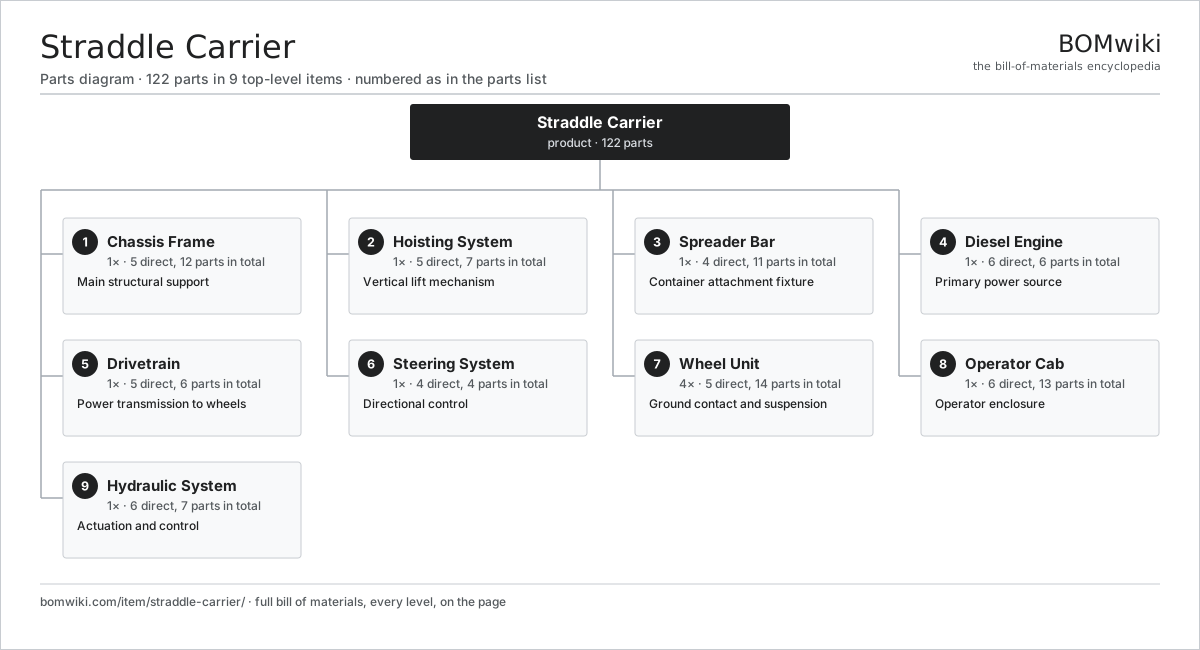
| # | Part | Qty | What it does |
|---|---|---|---|
| 1 | Chassis Frame 5 parts | 1× | Main structural support |
| 2 | Hoisting System 5 parts | 1× | Vertical lift mechanism |
| 3 | Spreader Bar 4 parts | 1× | Container attachment fixture |
| 4 | Diesel Engine 6 parts | 1× | Primary power source |
| 5 | Drivetrain 5 parts | 1× | Power transmission to wheels |
| 6 | Steering System 4 parts | 1× | Directional control |
| 7 | Wheel Unit 5 parts | 4× | Ground contact and suspension |
| 8 | Operator Cab 6 parts | 1× | Operator enclosure |
| 9 | Hydraulic System 6 parts | 1× | Actuation and control |
3D model
No 3D model yet. Have a CAD file of this? Add a 3D model. STL renders right on this page; STEP, FreeCAD, and OpenSCAD sources are welcome too (openly licensed, like all 3D models on BOMwiki).
Build & assembly graph
expand / collapse · shared sub-assemblies converge · links to related products · est. labourTap an assembly to expand/collapse · tap a part to open it · use “Open page” for any node · drag to pan, scroll to zoom.
Bill of materials for Straddle Carrier
9 top-level lines · 65 rows shown · 122 parts total · indented to 3 levels| # | Item / sub-assembly | Part no. | Qty/assy | Ext. qty | Parts | Type |
|---|---|---|---|---|---|---|
| 1 | Chassis Frame 5 parts | straddle-carrier-chassis-frame | 1× | 1 | 12 | assembly |
| 1.1 | Main Structural Beams | straddle-carrier-main-beams | 2× | 2 | · | part |
| 1.2 | Crossmembers | straddle-carrier-crossmembers | 3× | 3 | · | part |
| 1.3 | Floor Plate | straddle-carrier-floor-plate | 1× | 1 | · | part |
| 1.4 | Fastener Set | fastener-set | 4× | 4 | · | part |
| 1.5 | Sheet Metal Panel | sheet-panel | 2× | 2 | · | part |
| 2 | Hoisting System 5 parts | straddle-carrier-hoisting-system | 1× | 1 | 7 | assembly |
| 2.1 | Mast Structure | straddle-carrier-mast-structure | 1× | 1 | · | part |
| 2.2 | Lift Cylinders | straddle-carrier-lift-cylinders | 2× | 2 | · | part |
| 2.3 | Pulley Block | straddle-carrier-pulley-block | 1× | 1 | · | part |
| 2.4 | Pressure Sensor | pressure-sensor | 1× | 1 | · | part |
| 2.5 | O-Ring Set | oring-set | 2× | 2 | · | part |
| 3 | Spreader Bar 4 parts | straddle-carrier-spreader-bar | 1× | 1 | 11 | assembly |
| 3.1 | Spreader Beam | straddle-carrier-spreader-beam | 1× | 1 | · | part |
| 3.2 | Twist-Lock Connectors | straddle-carrier-twist-locks | 4× | 4 | · | part |
| 3.3 | Pin Assemblies | straddle-carrier-pin-assemblies | 4× | 4 | · | part |
| 3.4 | Fastener Set | fastener-set | 2× | 2 | · | part |
| 4 | Diesel Engine 6 parts | straddle-carrier-diesel-engine | 1× | 1 | 6 | assembly |
| 4.1 | Engine Block | straddle-carrier-engine-block | 1× | 1 | · | part |
| 4.2 | Fuel System | straddle-carrier-fuel-system | 1× | 1 | · | part |
| 4.3 | Cooling Radiator | straddle-carrier-cooling-radiator | 1× | 1 | · | part |
| 4.4 | Alternator | straddle-carrier-alternator | 1× | 1 | · | part |
| 4.5 | Radiator | radiator | 1× | 1 | · | part |
| 4.6 | Blower Motor | blower-motor | 1× | 1 | · | part |
| 5 | Drivetrain 5 parts | straddle-carrier-drivetrain | 1× | 1 | 6 | assembly |
| 5.1 | Transmission | straddle-carrier-transmission | 1× | 1 | · | part |
| 5.2 | Torque Converter | straddle-carrier-torque-converter | 1× | 1 | · | part |
| 5.3 | Rear Axle Assembly | straddle-carrier-rear-axle | 1× | 1 | · | part |
| 5.4 | Rear Differential | straddle-carrier-rear-differential | 1× | 1 | · | part |
| 5.5 | Helical Gear Pair | gear-pair | 2× | 2 | · | part |
| 6 | Steering System 4 parts | straddle-carrier-steering-system | 1× | 1 | 4 | assembly |
| 6.1 | Steering Wheel | straddle-carrier-steering-wheel | 1× | 1 | · | part |
| 6.2 | Steering Pump | straddle-carrier-steering-pump | 1× | 1 | · | part |
| 6.3 | Steering Cylinder | straddle-carrier-steering-cylinder | 1× | 1 | · | part |
| 6.4 | Steering Linkage | straddle-carrier-steering-linkage | 1× | 1 | · | part |
| 7 | Wheel Unit 5 parts | straddle-carrier-wheel-units | 4× | 4 | 14 | assembly |
| 7.1 | Wheel Assembly 5 parts | wheel-assembly | 1× | 4 | 9 | assembly |
| 7.1.1 | Alloy Wheel | alloy-wheel | 1× | 4 | · | part |
| 7.1.2 | Tire | tire | 1× | 4 | · | part |
| 7.1.3 | TPMS Sensor | tpms-sensor | 1× | 4 | · | part |
| 7.1.4 | Lug Nut | lug-nut | 5× | 20 | · | part |
| 7.1.5 | Valve Stem | valve-stem | 1× | 4 | · | part |
| 7.2 | Axle Hub | straddle-carrier-axle-hub | 1× | 4 | · | part |
| 7.3 | Suspension Spring | straddle-carrier-suspension-spring | 1× | 4 | · | part |
| 7.4 | Brake Drum | straddle-carrier-brake-drum | 1× | 4 | · | part |
| 7.5 | Ball Bearing | ball-bearing | 2× | 8 | · | part |
| 8 | Operator Cab 6 parts | straddle-carrier-cab | 1× | 1 | 13 | assembly |
| 8.1 | Cab Frame | straddle-carrier-cab-frame | 1× | 1 | · | part |
| 8.2 | Windshield | straddle-carrier-windshield | 1× | 1 | · | part |
| 8.3 | Side Windows | straddle-carrier-side-windows | 2× | 2 | · | part |
| 8.4 | Seat Assembly 5 parts | seat-assembly | 1× | 1 | 7 | assembly |
| 8.4.1 | Seat Frame | seat-frame | 1× | 1 | · | part |
| 8.4.2 | Seat Foam | seat-foam | 2× | 2 | · | part |
| 8.4.3 | Seat Cover | seat-cover | 1× | 1 | · | part |
| 8.4.4 | Seat Motor | seat-motor | 2× | 2 | · | part |
| 8.4.5 | Seat Heater Mat | seat-heater | 1× | 1 | · | part |
| 8.5 | Dashboard | straddle-carrier-dashboard | 1× | 1 | · | part |
| 8.6 | Heater and AC Unit | straddle-carrier-heater-ac | 1× | 1 | · | part |
| 9 | Hydraulic System 6 parts | straddle-carrier-hydraulic-system | 1× | 1 | 7 | assembly |
| 9.1 | Main Hydraulic Pump | straddle-carrier-main-pump | 1× | 1 | · | part |
| 9.2 | Hydraulic Reservoir | straddle-carrier-main-tank | 1× | 1 | · | part |
| 9.3 | Control Valve | straddle-carrier-control-valve | 1× | 1 | · | part |
| 9.4 | Hoses and Fittings | straddle-carrier-hoses-fittings | 1× | 1 | · | part |
| 9.5 | Accumulator | straddle-carrier-accumulator | 1× | 1 | · | part |
| 9.6 | Pressure Sensor | pressure-sensor | 2× | 2 | · | part |
Something wrong in this list? Report a problem with this BOM.
Related products
same domain, ranked by shared parts Telehandler
349 parts · shares 14 with this page
Telehandler
349 parts · shares 14 with this page
 Forklift
4,153 parts · shares 14 with this page
Forklift
4,153 parts · shares 14 with this page
 Reach Stacker
71 parts · shares 11 with this page
Reach Stacker
71 parts · shares 11 with this page
 Terminal Tractor
72 parts · shares 9 with this page
Jib Crane
124 parts · shares 6 with this page
Terminal Tractor
72 parts · shares 9 with this page
Jib Crane
124 parts · shares 6 with this page
 Articulated Forklift
2,417 parts · shares 3 with this page
Articulated Forklift
2,417 parts · shares 3 with this page
Sourcing: possible vendors
Browse the supplier directory → Prices, MOQ, and lead times are algorithmic estimates, not quotes, and not claims about these companies. Company mappings are curated by keyword; est. price band $2k–$300k. How estimates work| Vendor | HQ | Specialty | MOQ | Lead time |
|---|---|---|---|---|
| toyota-industries.com ↗ | Kariya, JP | Forklifts & logistics | 20 units | 10–16 wks |
| kiongroup.com ↗ | Frankfurt, DE | Forklifts (Linde, STILL) | 20 units | 10–16 wks |
| jungheinrich.com ↗ | Hamburg, DE | Warehouse trucks | 20 units | 10–16 wks |
| crown.com ↗ | New Bremen, US | Forklifts | 20 units | 10–16 wks |
|
🇨🇳Hangcha
hcforklift.com ↗
|
Hangzhou, CN | Forklifts & material handling | 20 units | 10–16 wks |
1,232-word article