Sugar Mill Roller
ProductOverview
The sugar mill roller is the first mechanical stage in cane processing, applying massive crushing force to extract raw juice from fresh sugarcane. Traditional three-roller designs use grooved cast iron cylinders rotating at 120 rpm to progressively compress the fibrous stalk, forcing cell juice through perforated bottom plates into collection trays. The two-stage crushing, primary and backup, maximizes fiber compression while minimizing losses. Modern mills achieve 85–95% juice recovery through precise nip-pressure control and sealed operation to reduce oxidation.
How it Works
Sugarcane enters the feed chute and passes between the main roller and backup roller. The helical grooves cut progressively deeper into the cane as it advances, expelling juice downward through the bottom collection plate. The second roller pair (if fitted) re-compresses bagasse (exhausted fiber) to extract remaining juice. Hydraulic cylinders maintain constant nip pressure (typically 800 kN) by monitoring load and adjusting piston position via a proportional pressure-control valve. An accumulator absorbs shock from irregular cane diameter, preventing sudden load spikes.
The electric motor drives the main shaft through a helical gearbox at 15:1 reduction. A flexible coupling accommodates minor misalignment while transmitting full torque. Dual tapered roller bearings in each Headstock Assembly support radial and thrust loads. Oil seals prevent juice contamination and bearing lubrication loss.
Expressed juice flows through Juice Collection Tray trays into a common manifold, where screens remove coarse bagasse fiber before sending it downstream to heating and filtration stages. Control System sensors track nip pressure and hydraulic temperature; high pressure triggers alarm or auto-shutdown to protect machinery.
Design Notes
Grooved cylinders are preferred over smooth rolls because helical fluting grips cane and limits slippage. The groove pattern is typically 6 mm pitch with 45° helix angle. Cast iron is chosen for strength and machinability; backup rollers are softer (lower carbon) to minimize wear on primary rolls.
Juice collection tray design is critical: any dead spots encourage microbial growth or oxidative browning. Modern designs use full-width trays sloped continuously toward a single outlet manifold. Drainage channels are sized to handle peak flow (3–4 m³/min for a 60-tph mill) without splashing or backup.
Hydraulic systems on larger mills use proportional valves to modulate nip pressure dynamically, responding to real-time load feedback. Older mills used fixed relief valves. Accumulators are essential on mills >30 tph to smooth shock loading from knots or hard cane nodes.
The gearbox is a major cost item and a common failure point if overloaded. Selection is critical: undersized gearboxes overheat; oversized units waste energy. Most designs use helical gears (quieter than spur) with <1.5 mm backlash for smooth torque transmission.
Typical Process Chain
Raw cane → Sugar Mill Roller → clarification/heating → Vacuum Pan → Sugar Centrifugal → bagging. Juice temperatures rise 5–8 °C during crushing due to friction. Immediate heating to 65–75 °C after milling reduces microbial growth and improves downstream crystallization.
Sugar Mill Roller parts and their functions
7 top-level parts · 45 parts in total · full bill of materials below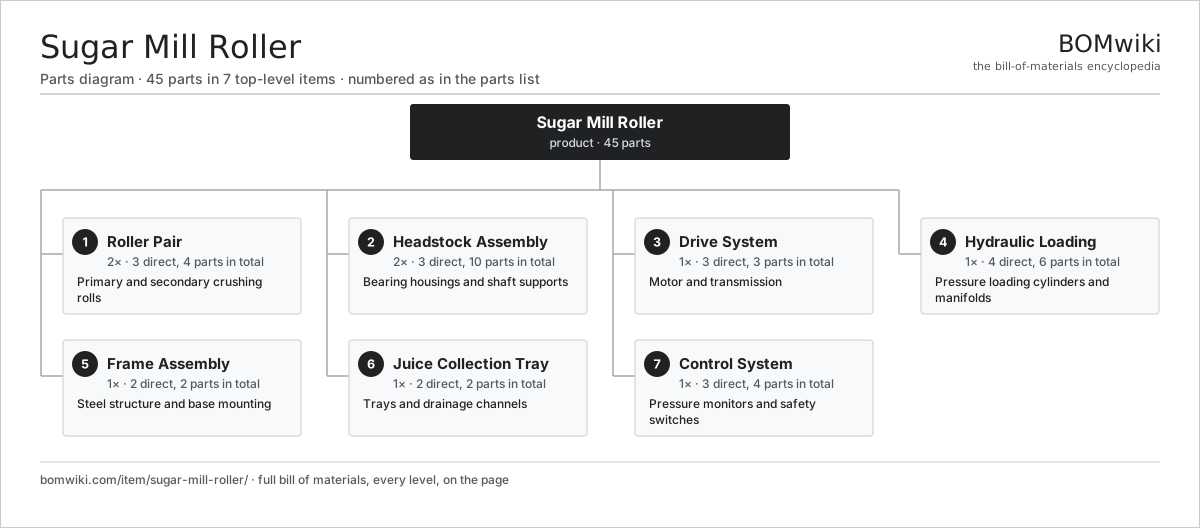
| # | Part | Qty | What it does |
|---|---|---|---|
| 1 | Roller Pair 3 parts | 2× | Primary and secondary crushing rolls |
| 2 | Headstock Assembly 3 parts | 2× | Bearing housings and shaft supports |
| 3 | Drive System 3 parts | 1× | Motor and transmission |
| 4 | Hydraulic Loading 4 parts | 1× | Pressure loading cylinders and manifolds |
| 5 | Frame Assembly 2 parts | 1× | Steel structure and base mounting |
| 6 | Juice Collection Tray 2 parts | 1× | Trays and drainage channels |
| 7 | Control System 3 parts | 1× | Pressure monitors and safety switches |
3D model
No 3D model yet. Have a CAD file of this? Add a 3D model. STL renders right on this page; STEP, FreeCAD, and OpenSCAD sources are welcome too (openly licensed, like all 3D models on BOMwiki).
Build & assembly graph
expand / collapse · shared sub-assemblies converge · links to related products · est. labourTap an assembly to expand/collapse · tap a part to open it · use “Open page” for any node · drag to pan, scroll to zoom.
Bill of materials for Sugar Mill Roller
7 top-level lines · 27 rows shown · 45 parts total · indented to 3 levels| # | Item / sub-assembly | Part no. | Qty/assy | Ext. qty | Parts | Type |
|---|---|---|---|---|---|---|
| 1 | Roller Pair 3 parts | sugar-mill-roller-roller-pair | 2× | 2 | 4 | assembly |
| 1.1 | Main Roller | sugar-mill-roller-main-roll | 1× | 2 | · | part |
| 1.2 | Backup Roller | sugar-mill-roller-backup-roll | 1× | 2 | · | part |
| 1.3 | Gear Coupling | sugar-mill-roller-gear-coupling | 2× | 4 | · | part |
| 2 | Headstock Assembly 3 parts | sugar-mill-roller-headstock | 2× | 2 | 10 | assembly |
| 2.1 | Ball Bearing | ball-bearing | 4× | 8 | · | part |
| 2.2 | Bearing Housing | sugar-mill-roller-bearing-housing | 2× | 4 | · | part |
| 2.3 | Oil Seal | oil-seal | 4× | 8 | · | part |
| 3 | Drive System 3 parts | sugar-mill-roller-drive-system | 1× | 1 | 3 | assembly |
| 3.1 | Blower Motor | blower-motor | 1× | 1 | · | part |
| 3.2 | Gearbox | sugar-mill-roller-gearbox | 1× | 1 | · | part |
| 3.3 | Flexible Coupling | sugar-mill-roller-flex-coupling | 1× | 1 | · | part |
| 4 | Hydraulic Loading 4 parts | sugar-mill-roller-hydraulic-system | 1× | 1 | 6 | assembly |
| 4.1 | Hydraulic Cylinders | sugar-mill-roller-hydraulic-cylinders | 2× | 2 | · | part |
| 4.2 | Proportional Valve | sugar-mill-roller-proportional-valve | 1× | 1 | · | part |
| 4.3 | Hydraulic Accumulator | sugar-mill-roller-accumulator | 1× | 1 | · | part |
| 4.4 | Pressure Sensor | pressure-sensor | 2× | 2 | · | part |
| 5 | Frame Assembly 2 parts | sugar-mill-roller-frame | 1× | 1 | 2 | assembly |
| 5.1 | Main Frame | sugar-mill-roller-main-frame | 1× | 1 | · | part |
| 5.2 | Baseplate | sugar-mill-roller-baseplate | 1× | 1 | · | part |
| 6 | Juice Collection Tray 2 parts | sugar-mill-roller-juice-collection | 1× | 1 | 2 | assembly |
| 6.1 | Main Collection Tray | sugar-mill-roller-main-tray | 1× | 1 | · | part |
| 6.2 | Drainage Channel | sugar-mill-roller-drainage-channel | 1× | 1 | · | part |
| 7 | Control System 3 parts | sugar-mill-roller-controls | 1× | 1 | 4 | assembly |
| 7.1 | Pressure Sensor | pressure-sensor | 1× | 1 | · | part |
| 7.2 | Temperature Sensor | sugar-mill-roller-temperature-sensor | 1× | 1 | · | part |
| 7.3 | Pressure Gauge | sugar-mill-roller-pressure-gauge | 2× | 2 | · | part |
Something wrong in this list? Report a problem with this BOM.
Related products
same domain, ranked by shared parts Chocolate Enrober
470 parts · shares 3 with this page
Spiral Freezer
179 parts · shares 3 with this page
Chocolate Enrober
470 parts · shares 3 with this page
Spiral Freezer
179 parts · shares 3 with this page
 Ice Cream Batch Freezer
99 parts · shares 2 with this page
Ice Cream Batch Freezer
99 parts · shares 2 with this page
 Industrial Smokehouse
267 parts · shares 2 with this page
Industrial Tunnel Oven
147 parts · shares 2 with this page
Industrial Smokehouse
267 parts · shares 2 with this page
Industrial Tunnel Oven
147 parts · shares 2 with this page
Sourcing: possible vendors
Browse the supplier directory → Prices, MOQ, and lead times are algorithmic estimates, not quotes, and not claims about these companies. Company mappings are curated by keyword; est. price band $1k–$500k. How estimates work| Vendor | HQ | Specialty | MOQ | Lead time |
|---|---|---|---|---|
| gea.com ↗ | Düsseldorf, DE | Process technology | 20 units | 12–20 wks |
| buhlergroup.com ↗ | Uzwil, CH | Food & materials processing | 20 units | 12–20 wks |
| tetrapak.com ↗ | Pully, CH | Food packaging & processing | 20 units | 12–20 wks |
| jbtc.com ↗ | Chicago, US | Food processing equipment | 20 units | 12–20 wks |
| alfalaval.com ↗ | Lund, SE | Heat transfer & separation | 20 units | 12–20 wks |
493-word article