Surimi Line
ProductOverview
Surimi is mechanically refined fish tissue transformed into a stable gel base for imitation seafood (crab, scallop, shrimp analogues) and other value-added products. The surimi processing line is an integrated multi-stage system that accepts whole fish, fish frames, or pre-filleted scrap and systematically removes fat, bone, and water while preserving the muscle protein structure necessary for gel formation. Starting with raw whole or filleted fish, the line progresses through a twin-screw deboner that grinds tissue and separates large bone, a high-shear refiner that further reduces particle size, rotary screens that eliminate remaining mineral and fat, a dewatering press that concentrates the protein, and a final cryogenic mixer that stabilizes the product at sub-zero temperature. The output is a shelf-stable white or pale gray surimi concentrate (sometimes called "surimi block" when formed and frozen) that can be stored for months and later thawed, mixed with binders and flavorings, and formed into imitation shellfish products.
Surimi manufacturing is fundamentally a protein recovery and concentration process. Unlike fresh fillet, surimi tolerates refreezing and thawing without severe quality loss, enabling global trade in a commodity intermediate. Japan, China, and the United States are the largest producers and consumers of surimi. Industrial-scale surimi lines are engineered to run continuously or in long 8–12 hour campaigns, processing 500–1500 kg/hour of raw fish or scrap into 350–1000 kg/hour of finished surimi. The economic value lies in converting low-cost fish frames (bone-in byproducts from filleting) and undersized whole fish into a premium protein concentrate.
How it works
Raw fish (whole or pre-cut) is fed into the twin-screw deboner hopper. The deboner consists of two hardened alloy screws rotating at 200–400 rpm inside a stainless steel barrel perforated with 2.5 mm holes. As the screws turn, they propel fish tissue forward while simultaneously grinding it against the barrel walls. Muscle fibers are sheared and separated; small bone fragments and fat globules are forced through the perforations and fall into a separate collection tank as a dense paste (called "frame refuse" or "deboner discharge"). This separation exploits the different mechanical properties of muscle (soft, deformable) versus bone (hard, brittle) under shear stress.
The muscle-rich discharge from the deboner (85–90% protein, 30–40% moisture) flows directly into the high-shear refiner. The refiner is a rotor-stator mill where a hardened steel rotor (1500–3000 rpm) with fine grooves or micro-beads rotates against a stationary stator liner. The intense shear stress further grinds muscle fibers and breaks down any remaining bone particles to sub-100-micron size. A cooling jacket circulates 4°C chilled water around the chamber, preventing protein denaturation from frictional heat (muscle proteins are thermally fragile; exceeding 15°C can cause permanent gel-forming capacity loss).
The refined slurry (now bright white, resembling heavy cream) exits the refiner and passes through a rotating drum screen. The drum is a stainless steel cylinder (0.5–1.5 mm perforations) rotating at 20–40 rpm. Liquid protein passes through the perforations into the underflow; bone dust, fat droplets, and other solids > 1.5 mm remain and are conveyed to a separate discharge. The underflow (protein concentrate, 70–75% moisture) is collected and pumped into the dewatering press.
The horizontal screw press applies mechanical force to reduce moisture. Twin flights in a tapered screw compel the surimi paste toward a small exit orifice, creating back-pressure that squeezes free water out through slotted barrel walls. A vacuum pump mounted on the barrel provides 0.3 MPa suction on the perforated surface, further extracting water. By the press outlet, surimi moisture has dropped to 60–65% and density has increased from 1.0 to 1.1 kg/L.
The dewatered surimi is then dropped into a large batch mixer, typically a vertical vessel with ribbon or paddle blades rotating at 20–60 rpm. At this stage, specialized ingredients (cryoprotectants such as sorbitol, wheat starch, or egg white; salt for gel enhancement) are added. The operator initiates liquid nitrogen injection via solenoid valve; the -196°C cryogenic liquid rapidly cools the entire batch from 4°C to -18°C within 3–5 minutes. Cryogenic freezing instantaneously arrests enzyme activity and prevents oxidation, extending shelf life to 10–12 months under frozen storage. The final product is discharged onto a conveyor, formed into blocks or vacuum-packed, and sent to the freezing tunnel.
Key assemblies
Twin-screw deboner: The deboner is the primary workhorse, responsible for 70–80% of bone removal efficiency. The screws are specially designed with progressive pitch (larger thread spacing at the inlet, reducing toward the exit) to control material residence time and shear intensity. Typical deboners operate at 200–400 rpm with a 5–7 minute residence time per pass. Some surimi lines employ two deboners in series to improve bone removal to 99%.
High-shear refiner: The refiner concentrates muscle proteins through intense mechanical energy. Bead-mill variants (filled with 5–8 mm ceramic or yttria-stabilized zirconia beads) can achieve even finer grinding and are preferred in premium operations. A 3–7 kW motor driving a 3000 rpm rotor can add 150–200 kWh of energy per tonne of surimi, a significant contribution to processing cost. Cooling is critical; most refiners operate with dual cooling loops (primary chilled water loop + secondary ice-water emergency loop) to guard against thermal runaway.
Rotary screen system: The drum screen is a passive size-classifier offering minimal energy input but high reliability. Some modern lines replace the rotary drum with a vibratory screen deck or hydrocyclone, which can achieve higher solid-liquid separation speed with lower water retention. Regardless of screening method, all surimi lines must remove bone to < 100 microns to meet consumer acceptance and food safety standards.
Dewatering press: The screw press is the core dewatering technology; some lines add a second centrifuge step after pressing for further moisture reduction to 55–58%. The tapered cone at the press outlet is critical; when worn, back-pressure drops and dewatering efficiency plummets. Cone replacement is a scheduled maintenance task every 18–24 months.
Cryogenic injection system: Liquid nitrogen is purchased in bulk (500–2000 L tanks) and transferred via insulated lines to the mixer. The injector solenoid metering the LN2 flow into the mixer is typically a high-flow ball valve rated for -196°C. Cryogenic systems are essential for commercial surimi production; mechanical freezing (blast freezer) is 2–3 times slower and consumes more electrical energy than liquid nitrogen quench.
Controls and monitoring: Industrial surimi lines log flow rate (kg/min) at each stage, motor speed and current draw (for fault detection), hydraulic pressures, and outlet temperatures. This data enables real-time yield calculation and energy tracking. Some processors integrate a HACCP (Hazard Analysis Critical Control Point) framework, with temperature and pressure setpoints as critical control points.
Yield and economics
Raw fish (whole or frames) typically contains 18–22% protein (rest is water, fat, bone, skin). After deboning and refining, surimi contains 65–75% moisture and 8–12% protein by weight. On a dry-matter basis, surimi represents 70–85% protein recovery from raw fish. The economic equation is: (surimi yield % × surimi sale price) − (raw material cost + processing cost) = margin. At typical 2024 prices: low-cost fish frames cost $0.15–0.25/kg, surimi sells for $1.50–2.50/kg, and processing costs (energy, labor, cryogenic) are $0.20–0.40/kg. This yields a 30–60% margin for well-optimized operations.
Small species (herring, capelin) yield 50–60% surimi by weight; larger species (pollock, hake) yield 70–80% due to lower skeletal mass ratio. Geographic sourcing matters: cold-water species (Atlantic pollock, Alaskan Walleye Pollock) produce superior gel strength and are preferred for high-end applications.
Maintenance and operational notes
The deboner screw is the highest-wear component, lasting 3000–6000 operating hours before barrel and screw replacement is economical. Bone particle contamination accelerates wear; some processors use a magnet or metal detector at the raw material intake to remove tramp iron before the deboner.
The refiner rotor and stator are also wearing parts; replacement every 2000–4000 hours is typical. Thermal events (uncontrolled temperature rise above 15°C) can permanently degrade gel-forming capability; all modern lines employ redundant cooling and automatic shutoff if outlet temperature exceeds setpoint.
Cryogenic supply is a logistical constraint; facilities must have regular LN2 delivery (weekly or thrice-weekly trucks) to maintain continuous operation. Some large processors invest in on-site liquid nitrogen generation using air separation units, eliminating supply dependency.
Integration and variants
Batch surimi lines process 50–200 kg per cycle (10–30 minute runs), suitable for small processors or R&D. Continuous lines (feed rate 500+ kg/h) require all stages to be in steady-state balance, demanding precise flow and pressure control. Hybrid systems (deboner + refiner continuous, mixer batch) are common in mid-scale facilities.
Some surimi lines integrate a secondary gel-forming stage, where the cryogenically stabilized surimi is immediately passed through a high-temperature steam chamber (80–90°C) to initiate gel network formation, then quenched to sub-zero for storage. This eliminates downstream gelation and shipping bulk water.
Surimi Line parts and their functions
8 top-level parts · 77 parts in total · full bill of materials below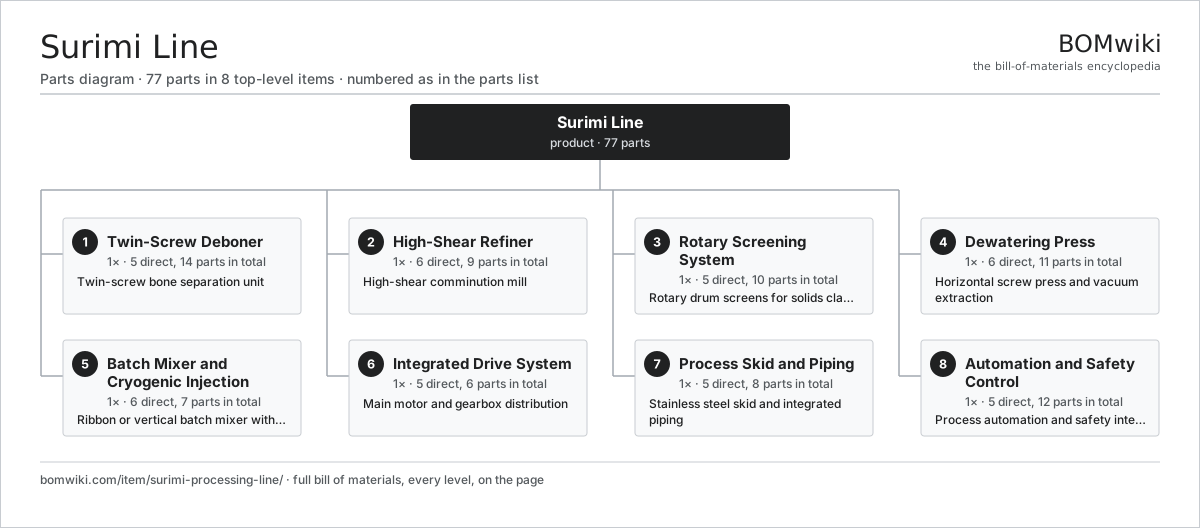
| # | Part | Qty | What it does |
|---|---|---|---|
| 1 | Twin-Screw Deboner 5 parts | 1× | Twin-screw bone separation unit |
| 2 | High-Shear Refiner 6 parts | 1× | High-shear comminution mill |
| 3 | Rotary Screening System 5 parts | 1× | Rotary drum screens for solids classification |
| 4 | Dewatering Press 6 parts | 1× | Horizontal screw press and vacuum extraction |
| 5 | Batch Mixer and Cryogenic Injection 6 parts | 1× | Ribbon or vertical batch mixer with cryogenic injection |
| 6 | Integrated Drive System 5 parts | 1× | Main motor and gearbox distribution |
| 7 | Process Skid and Piping 5 parts | 1× | Stainless steel skid and integrated piping |
| 8 | Automation and Safety Control 5 parts | 1× | Process automation and safety interlocks |
3D model
No 3D model yet. Have a CAD file of this? Add a 3D model. STL renders right on this page; STEP, FreeCAD, and OpenSCAD sources are welcome too (openly licensed, like all 3D models on BOMwiki).
Build & assembly graph
expand / collapse · shared sub-assemblies converge · links to related products · est. labourTap an assembly to expand/collapse · tap a part to open it · use “Open page” for any node · drag to pan, scroll to zoom.
Bill of materials for Surimi Line
8 top-level lines · 51 rows shown · 77 parts total · indented to 3 levels| # | Item / sub-assembly | Part no. | Qty/assy | Ext. qty | Parts | Type |
|---|---|---|---|---|---|---|
| 1 | Twin-Screw Deboner 5 parts | surimi-processing-line-deboner | 1× | 1 | 14 | assembly |
| 1.1 | Twin Deboning Screw | surimi-processing-line-deboner-screws | 2× | 2 | · | part |
| 1.2 | Perforated Barrel | surimi-processing-line-deboner-casing | 1× | 1 | · | part |
| 1.3 | Ball Bearing | ball-bearing | 8× | 8 | · | part |
| 1.4 | Deboner Drive Motor | surimi-processing-line-deboner-motor | 1× | 1 | · | part |
| 1.5 | Fastener Set | fastener-set | 2× | 2 | · | part |
| 2 | High-Shear Refiner 6 parts | surimi-processing-line-refiner | 1× | 1 | 9 | assembly |
| 2.1 | Grinding Chamber | surimi-processing-line-refiner-chamber | 1× | 1 | · | part |
| 2.2 | High-Speed Rotor | surimi-processing-line-refiner-rotor | 1× | 1 | · | part |
| 2.3 | Stator Ring | surimi-processing-line-refiner-stator | 1× | 1 | · | part |
| 2.4 | Refiner Motor | surimi-processing-line-refiner-motor | 1× | 1 | · | part |
| 2.5 | Ball Bearing | ball-bearing | 4× | 4 | · | part |
| 2.6 | Cooling Jacket | cooling-jacket | 1× | 1 | · | part |
| 3 | Rotary Screening System 5 parts | surimi-processing-line-screening | 1× | 1 | 10 | assembly |
| 3.1 | Perforated Screen Drum | surimi-processing-line-screen-drum | 1× | 1 | · | part |
| 3.2 | Screen Drive Motor | surimi-processing-line-screen-motor | 1× | 1 | · | part |
| 3.3 | Collection Trough | surimi-processing-line-screen-trough | 1× | 1 | · | part |
| 3.4 | Ball Bearing | ball-bearing | 6× | 6 | · | part |
| 3.5 | Fastener Set | fastener-set | 1× | 1 | · | part |
| 4 | Dewatering Press 6 parts | surimi-processing-line-dewatering | 1× | 1 | 11 | assembly |
| 4.1 | Dewatering Screw | surimi-processing-line-press-screw | 1× | 1 | · | part |
| 4.2 | Press Barrel | surimi-processing-line-press-barrel | 1× | 1 | · | part |
| 4.3 | Press Motor | surimi-processing-line-press-motor | 1× | 1 | · | part |
| 4.4 | Exit Cone Restrictor | surimi-processing-line-press-cone | 1× | 1 | · | part |
| 4.5 | Vacuum Extraction Pump | surimi-processing-line-vacuum-pump | 1× | 1 | · | part |
| 4.6 | Ball Bearing | ball-bearing | 6× | 6 | · | part |
| 5 | Batch Mixer and Cryogenic Injection 6 parts | surimi-processing-line-mixer | 1× | 1 | 7 | assembly |
| 5.1 | Mixer Tank | surimi-processing-line-mixer-vessel | 1× | 1 | · | part |
| 5.2 | Mixer Blade Assembly | surimi-processing-line-mixer-blade | 1× | 1 | · | part |
| 5.3 | Mixer Drive Motor | surimi-processing-line-mixer-motor | 1× | 1 | · | part |
| 5.4 | Cryogenic Injector Solenoid | surimi-processing-line-ln2-injector | 1× | 1 | · | part |
| 5.5 | Cryogenic Transfer Line | surimi-processing-line-cryogenic-line | 1× | 1 | · | part |
| 5.6 | Ball Bearing | ball-bearing | 2× | 2 | · | part |
| 6 | Integrated Drive System 5 parts | surimi-processing-line-drive-system | 1× | 1 | 6 | assembly |
| 6.1 | Main Drive Motor | surimi-processing-line-main-motor | 1× | 1 | · | part |
| 6.2 | Distribution Gearbox | surimi-processing-line-distribution-gearbox | 1× | 1 | · | part |
| 6.3 | VFD Control Panel | surimi-processing-line-vfd-array | 1× | 1 | · | part |
| 6.4 | Vibration Isolation Base | surimi-processing-line-motor-mount | 1× | 1 | · | part |
| 6.5 | Flexible Coupling | surimi-processing-line-coupling | 2× | 2 | · | part |
| 7 | Process Skid and Piping 5 parts | surimi-processing-line-frame | 1× | 1 | 8 | assembly |
| 7.1 | Structural Frame | surimi-processing-line-frame-structure | 1× | 1 | · | part |
| 7.2 | Fluid Manifold Block | surimi-processing-line-piping-manifold | 1× | 1 | · | part |
| 7.3 | Drain Sump and Sieve | surimi-processing-line-drain-sump | 1× | 1 | · | part |
| 7.4 | Fastener Set | fastener-set | 3× | 3 | · | part |
| 7.5 | Sheet Metal Panel | sheet-panel | 2× | 2 | · | part |
| 8 | Automation and Safety Control 5 parts | surimi-processing-line-controls | 1× | 1 | 12 | assembly |
| 8.1 | Master PLC | surimi-processing-line-plc-master | 1× | 1 | · | part |
| 8.2 | HMI Touchscreen | surimi-processing-line-hmi-touchscreen | 1× | 1 | · | part |
| 8.3 | Flow Meter | surimi-processing-line-flow-meter | 3× | 3 | · | part |
| 8.4 | Pressure Sensor | pressure-sensor | 6× | 6 | · | part |
| 8.5 | Control Cabinet | surimi-processing-line-cabinet | 1× | 1 | · | part |
Something wrong in this list? Report a problem with this BOM.
Related products
same domain, ranked by shared parts Bakery Deck Oven
44 parts · shares 2 with this page
Beverage Carbonator
95 parts · shares 2 with this page
Blood Coagulator/Dryer
38 parts · shares 2 with this page
Brine Chilling System
239 parts · shares 2 with this page
Bakery Deck Oven
44 parts · shares 2 with this page
Beverage Carbonator
95 parts · shares 2 with this page
Blood Coagulator/Dryer
38 parts · shares 2 with this page
Brine Chilling System
239 parts · shares 2 with this page
 Colloid Mill
212 parts · shares 2 with this page
Colloid Mill
212 parts · shares 2 with this page
Sourcing: possible vendors
Browse the supplier directory → Prices, MOQ, and lead times are algorithmic estimates, not quotes, and not claims about these companies. Company mappings are curated by keyword; est. price band $1k–$500k. How estimates work| Vendor | HQ | Specialty | MOQ | Lead time |
|---|---|---|---|---|
| gea.com ↗ | Düsseldorf, DE | Process technology | 20 units | 12–20 wks |
| buhlergroup.com ↗ | Uzwil, CH | Food & materials processing | 20 units | 12–20 wks |
| tetrapak.com ↗ | Pully, CH | Food packaging & processing | 20 units | 12–20 wks |
| jbtc.com ↗ | Chicago, US | Food processing equipment | 20 units | 12–20 wks |
| alfalaval.com ↗ | Lund, SE | Heat transfer & separation | 20 units | 12–20 wks |
1,537-word article