Prism Pole with Prism
ProductOverview
A survey prism pole is a telescoping carbon fiber rod with a corner-cube retroreflector mounted at the top, designed as the target for electronic distance measurement instruments (total stations, GNSS rovers). When a total station fires an infrared laser at the prism pole, the three corner-cube prisms reflect the beam directly back to the instrument with minimal angular error, enabling accurate distance measurement and point positioning. The pole incorporates spirit levels at multiple positions to ensure vertical plumbness during measurement, a weighted ground shoe for stability, and a comfortable foam grip for hand-holding over extended sessions. The standard ⅝ inch ball socket coupling allows quick attachment/detachment of the prism head and compatibility with most surveying equipment.
Prism poles are consumable items in survey practice, field teams often carry 2–4 poles to allow parallel measurement workflows or rapid setup at multiple points. The corner-cube prisms themselves are durable but can be damaged by improper handling; protective shrouds and carrying cases reduce field damage.
How it works
The retroreflector array is a composite mount holding three 25 mm corner-cube prisms in precise geometric alignment. A corner cube consists of three mutually perpendicular faces meeting at a point; any light ray entering the cube, regardless of angle (within a wide solid angle), is reflected directly back parallel to the incident direction. This retroreflection property is exact for ideal cubes; real prisms have manufacturing tolerances (typically ±30 arcseconds in angular deviation).
When a Total Station or GNSS RTK Rover is sighted on the pole, the infrared laser beam enters the prism array and is reflected back. The instrument's receiver detects the return signal's phase and time delay, computing distance as c × Δt / 2 (light-speed × round-trip time / 2). The pole's prism design ensures the return signal is strong and coaxial, maximizing rangefinding accuracy.
The spirit levels (bull's-eye for rough plumbness, linear tube for precision) are checked by the pole operator or a second observer to verify the pole is standing truly vertical. Any tilt error (e.g., ±2°) translates to a height error at the prism, which corrupts the 3D coordinate if not corrected. For instance, a 2° tilt over a 2 m pole introduces a 7 cm horizontal error in the prism position.
The weighted shoe provides a stable footprint on soft ground, uneven terrain, or gravel. For precise work on hard surfaces (concrete, asphalt), the shoe is often removed and the pole is held by hand, guided by the levels.
Retroreflector optical design
The three corner cubes are oriented with a specific geometry: typically, two cubes face the front/left, one cube faces the back/right, creating a composite return solid angle of >60° (any ray entering within this cone is retroreflected). The cubes are separated by ~2–3 cm to reduce internal reflections and ghosting.
Infrared light (780–900 nm) from the EDM laser is efficiently reflected by glass; borosilicate corner cubes have >95% reflectivity in the infrared band. The protective plastic cap covers the cubes, reducing dust contamination and rain ingress, but remains optically transparent to the laser wavelength (or has small apertures aligned with the prism faces).
Return signal strength decays as the fourth power of distance: at 1000 m, the signal is 10,000× weaker than at 100 m. Nevertheless, prism poles can be reliably sighted up to 5 km with modern total station EDM (30 mW infrared lasers, sensitive receivers). Reflectorless mode (natural surface measurement) requires much closer range (500 m) and lower accuracy because uncontrolled surface reflectivity reduces signal strength.
Pole construction and telescoping mechanism
The three-section carbon fiber shaft provides low weight (1.2 kg) while remaining rigid. Carbon fiber has high stiffness-to-weight ratio; a 4 m fiberglass pole of equivalent diameter would weigh 2.5–3 kg. The sections are sized as concentric tubes:
- Main section: 44 mm OD.
- Middle section: 35 mm OD (slides inside main).
- Extension: 28 mm OD (slides inside middle).
Each section overlaps ~150 mm when fully extended, providing bending rigidity. Twist-lock collars with friction rings secure each section at discrete heights (every 0.5 m), preventing accidental collapse under load. A single operation (twist the collar) engages the locking mechanism; release requires an equal counter-twist.
When fully extended (4.0 m), the pole natural resonance frequency is ~1.5 Hz, low enough that walking or vibrations from nearby machinery excite oscillations. Operators damp these by hand, or wait 2–3 seconds for vibration decay before requesting the total station measurement.
Plumbness verification and accuracy
The circular spirit level mounted at mid-pole (2 m height) provides a quick visual check: the air bubble is centered when the pole is vertical to within ±2°. The linear (tube) spirit level, aligned with the pole axis, provides finer plumbness: the bubble is centered when the pole is vertical to within ±0.5°, equivalent to ±17 mm error over 4 m.
Field practice:
- Setup: Pole holder stands vertically, holding the foam grip, and centers the bull's-eye bubble.
- Fine leveling: Observer watching from the side confirms the linear level bubble is centered.
- Measurement: Total station takes the shot; if plumbness error is suspected (bubble off-center), measurement is rejected and the pole is re-leveled.
For fast stakeout work (construction), plumbness to ±2° (≈70 mm error over 4 m) is often acceptable; the stakeout tolerance is typically ±100 mm anyway. For precision surveys or deformation monitoring, plumbness must be verified to ±0.5°.
Prism pole in total station workflow
Typical traverse or radiation survey:
- Setup at backsight: Pole is held vertically at a known point (benchmark). Total station measures distance and angle; the prism height is noted (e.g., 1.5 m above ground).
- Move to next point: Pole is transferred to an unknown point. Total station measures distance and angles. Using backsight and foresight observations, the processor computes the point's 3D coordinates.
- Traverse progression: Pole leapfrogs across the survey area, visiting dozens or hundreds of points. Rapid plumbness checks (bubble verification) and tight prism handling (avoid dropping or hitting the prism) ensure data quality.
For machine guidance (GPS-free grade control):
- Pole is set vertically at design points while the total station tracks angles and distances.
- Machine operator watches the design point on a laser-guided indicator or receives real-time coordinate feedback on a display, and adjusts position until aligned with the pole.
- Prism pole thus acts as a mobile benchmark for real-time site control.
Practical considerations
Prism care: Corner cubes are fragile; impacts can fracture glass or shift cube geometry. Most field teams replace prisms annually or when accuracy tests fail (reflectivity drop >10%).
Pole maintenance: Carbon fiber is inert and doesn't corrode, but UV radiation can weaken the resin matrix over years. Storage in shade extends pole life; abrasions on the tube exterior are cosmetic unless deep cracks penetrate the shell.
Coupling cleanliness: The ⅸ inch ball socket coupling should be cleaned regularly; dirt or sand can jam the quick-release mechanism. WD-40 or silicone spray keeps the coupling smooth.
Weather: Rain reduces prism reflectivity slightly (~2–3% loss); in heavy rain or snow, prism surfaces should be wiped dry before measurement. Thermal expansion of the pole is negligible but can be an issue in extreme temperature swings (−30 to +70 °C) if the pole length is used for precise distance calculation (rarely done, distance is measured independently by EDM).
Weight and fatigue: While the pole is light (3.5 kg assembled), holding it vertical for 30+ minutes can fatigue the operator. Field teams rotate who holds the pole, or use a tripod-mounted pole bracket for very long static measurements.
Integration with GNSS and other systems
Modern prism poles are increasingly used with GNSS RTK rovers. The RTK antenna has a different height than the EDM prism; survey software allows the operator to specify both prism and antenna heights, computing separate coordinates for each. For integrated workflows, the same pole can carry both a corner-cube prism (for total station cross-verification) and an RTK antenna adapter, with careful geometric registration between the two.
Prism Pole with Prism parts and their functions
6 top-level parts · 23 parts in total · full bill of materials below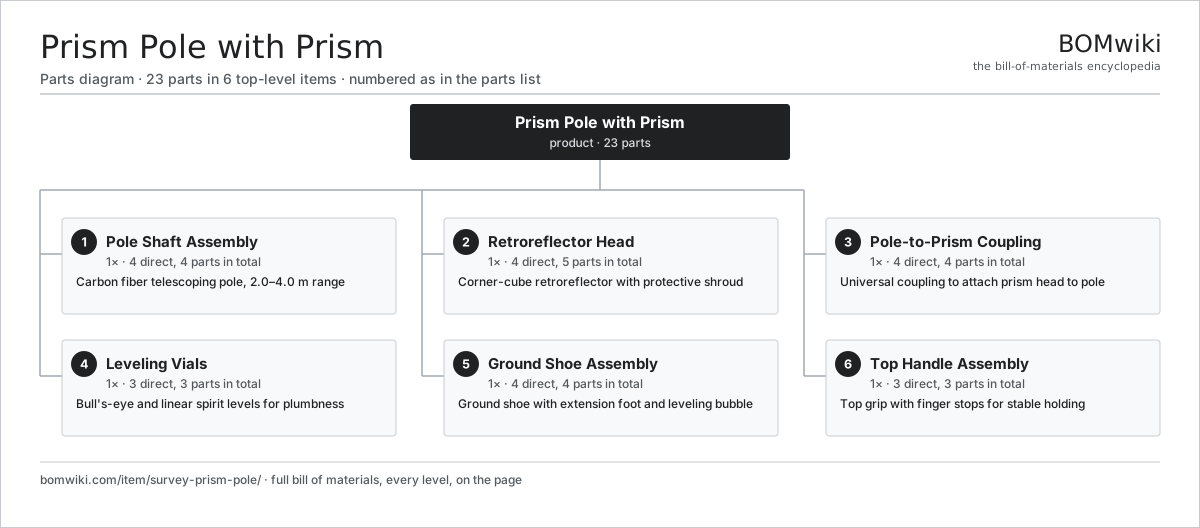
| # | Part | Qty | What it does |
|---|---|---|---|
| 1 | Pole Shaft Assembly 4 parts | 1× | Carbon fiber telescoping pole, 2.0–4.0 m range |
| 2 | Retroreflector Head 4 parts | 1× | Corner-cube retroreflector with protective shroud |
| 3 | Pole-to-Prism Coupling 4 parts | 1× | Universal coupling to attach prism head to pole |
| 4 | Leveling Vials 3 parts | 1× | Bull's-eye and linear spirit levels for plumbness |
| 5 | Ground Shoe Assembly 4 parts | 1× | Ground shoe with extension foot and leveling bubble |
| 6 | Top Handle Assembly 3 parts | 1× | Top grip with finger stops for stable holding |
3D model
No 3D model yet. Have a CAD file of this? Add a 3D model. STL renders right on this page; STEP, FreeCAD, and OpenSCAD sources are welcome too (openly licensed, like all 3D models on BOMwiki).
Build & assembly graph
expand / collapse · shared sub-assemblies converge · links to related products · est. labourTap an assembly to expand/collapse · tap a part to open it · use “Open page” for any node · drag to pan, scroll to zoom.
Bill of materials for Prism Pole with Prism
6 top-level lines · 28 rows shown · 23 parts total · indented to 3 levels| # | Item / sub-assembly | Part no. | Qty/assy | Ext. qty | Parts | Type |
|---|---|---|---|---|---|---|
| 1 | Pole Shaft Assembly 4 parts | survey-prism-pole-shaft | 1× | 1 | 4 | assembly |
| 1.1 | Main Tube Section | survey-prism-pole-tube-1 | 1× | 1 | · | part |
| 1.2 | Middle Tube Section | survey-prism-pole-tube-2 | 1× | 1 | · | part |
| 1.3 | Extension Tube | survey-prism-pole-tube-3 | 1× | 1 | · | part |
| 1.4 | Twist-Lock Collar | survey-prism-pole-sleeve | 1× | 1 | · | part |
| 2 | Retroreflector Head 4 parts | survey-prism-pole-prism | 1× | 1 | 5 | assembly |
| 2.1 | Corner-Cube Prism Set | survey-prism-pole-corner-cubes | 1× | 1 | · | part |
| 2.2 | Prism Mount Block | survey-prism-pole-prism-body | 1× | 1 | · | part |
| 2.3 | Protective Shroud | survey-prism-pole-shroud | 1× | 1 | · | part |
| 2.4 | Coil Spring | coil-spring | 2× | 2 | · | part |
| 3 | Pole-to-Prism Coupling 4 parts | survey-prism-pole-adapter | 1× | 1 | 4 | assembly |
| 3.1 | Pole Socket | survey-prism-pole-female-socket | 1× | 1 | · | part |
| 3.2 | Prism Mount Plug | survey-prism-pole-male-plug | 1× | 1 | · | part |
| 3.3 | Friction Collar | survey-prism-pole-collar | 1× | 1 | · | part |
| 3.4 | Fastener Set | fastener-set | 1× | 1 | · | part |
| 4 | Leveling Vials 3 parts | survey-prism-pole-levels | 1× | 1 | 3 | assembly |
| 4.1 | Circular Spirit Level | survey-prism-pole-bulls-eye | 1× | 1 | · | part |
| 4.2 | Tube Spirit Level | survey-prism-pole-linear-level | 1× | 1 | · | part |
| 4.3 | SMD Passive (R/C/L) | smd-passives | 1× | 1 | · | part |
| 5 | Ground Shoe Assembly 4 parts | survey-prism-pole-base | 1× | 1 | 4 | assembly |
| 5.1 | Base Plate | survey-prism-pole-shoe | 1× | 1 | · | part |
| 5.2 | Base Spirit Level | survey-prism-pole-foot-bubble | 1× | 1 | · | part |
| 5.3 | Foot Rod | survey-prism-pole-foot-rod | 1× | 1 | · | part |
| 5.4 | Fastener Set | fastener-set | 1× | 1 | · | part |
| 6 | Top Handle Assembly 3 parts | survey-prism-pole-handle | 1× | 1 | 3 | assembly |
| 6.1 | Foam Grip | survey-prism-pole-grip-sleeve | 1× | 1 | · | part |
| 6.2 | Handle Ring | survey-prism-pole-handle-ring | 1× | 1 | · | part |
| 6.3 | Shoulder Strap | survey-prism-pole-strap | 1× | 1 | · | part |
Something wrong in this list? Report a problem with this BOM.
Related products
same domain, ranked by shared parts Analytical Balance
54 parts · shares 1 with this page
Analytical Balance
54 parts · shares 1 with this page
 Digital Theodolite
26 parts · shares 1 with this page
Digital/Bar-Code Level
28 parts · shares 1 with this page
Digital Theodolite
26 parts · shares 1 with this page
Digital/Bar-Code Level
28 parts · shares 1 with this page
 Fatigue Testing Rig
412 parts · shares 1 with this page
Fatigue Testing Rig
412 parts · shares 1 with this page
 Fume Hood
113 parts · shares 1 with this page
Laser Detector Receiver
22 parts · shares 1 with this page
Fume Hood
113 parts · shares 1 with this page
Laser Detector Receiver
22 parts · shares 1 with this page
Sourcing: possible vendors
Browse the supplier directory → Prices, MOQ, and lead times are algorithmic estimates, not quotes, and not claims about these companies. Company mappings are curated by keyword; est. price band $1k–$500k. How estimates work| Vendor | HQ | Specialty | MOQ | Lead time |
|---|---|---|---|---|
| thermofisher.com ↗ | Waltham, US | Lab instruments | 100 units | 10–18 wks |
|
🇺🇸Agilent
agilent.com ↗
|
Santa Clara, US | Analytical instruments | 100 units | 10–18 wks |
|
🇺🇸Bruker
bruker.com ↗
|
Billerica, US | Scientific instruments | 100 units | 10–18 wks |
|
🇯🇵Shimadzu
shimadzu.com ↗
|
Kyoto, JP | Analytical instruments | 100 units | 10–18 wks |
|
🇺🇸Waters
waters.com ↗
|
Milford, US | Chromatography & MS | 100 units | 10–18 wks |
1,411-word article