Automatic Surveying Level
ProductOverview
An automatic level answers one question precisely: how much higher is point B than point A? The surveyor sets the instrument roughly midway between the two, sights a graduated staff held vertically on each point in turn, and subtracts the readings. Everything in the instrument exists to make the line of sight truly horizontal at the moment of each reading, that is the entire measurement principle, and a good level holds it to ±1 mm over a kilometre of double-run leveling.
"Automatic" refers to the Pendulum Compensator. Older dumpy levels required the operator to centre a sensitive tube bubble before every single sighting; the automatic level needs only rough leveling on its circular bubble, after which a gravity pendulum inside the optical path takes out the residual tilt, continuously, on every pointing, with no operator action.
The telescope
The Telescope is an internal-focusing design. The Objective Lens forms an image of the staff; focusing from 0.3 m to infinity is done not by extending the tube but by sliding the negative Internal Focusing Lens inside it, driven through a rack-and-pinion Helical Gear Pair from the Focus Knob. The tube therefore stays sealed against dust and rain, important on a machine that lives on construction sites.
The image is read against the Reticle Plate, etched with the main horizontal crosshair and two shorter stadia lines above and below it. The stadia lines subtend a fixed 1:100 angle: if they intercept 0.485 m of staff, the staff is 48.5 m away, giving distance as a free by-product of every height reading. The Eyepiece Group presents all this at 30× with a dioptre adjustment, and the Peep Sight on top gets the staff into the field of view before fine pointing.
The compensator
Between objective and reticle hangs the heart of the instrument. The Compensator Prism rides in a Prism Carrier suspended on four crossed Suspension Wires, metallic flexure tapes with effectively zero friction. If the telescope is tilted within the ±15 arcminute working range, the pendulum hangs plumb regardless, and the geometry of the prism path is arranged so that the ray entering horizontally is always the one delivered to the crosshair. Setting accuracy is around ±0.3 arcseconds, equivalent to under 0.1 mm at 50 m.
An undamped pendulum would swing for many seconds after every touch, so a copper Damper Vane on the carrier moves through the field of two Neodymium Magnet blocks; eddy currents brake the swing and the image settles in well under a second. The Pendulum Limit Stop confines travel and protects the wires from transport shock. A quick field check, the "tap test", is to nudge the instrument and watch the crosshair return to the same staff reading.
Leveling up
The Leveling Base follows the classic tribrach pattern: three Footscrew spindles between a Trivet Plate on the tripod head and a sprung Spring Plate that keeps the stack free of play, with a central Tripod Thread Bush for the tripod's 5/8-11 clamp screw. The operator centres the Bubble Vial, a bullseye vial of 10 arcminutes per 2 mm, using two footscrews then the third, watching it through the Bubble Viewing Prism from the eyepiece end. Once the bubble is anywhere inside its circle, the compensator does the rest. The Vial Adjusting Screws re-square the vial during periodic calibration against a reversed reading.
Pointing and angles
Horizontal pointing uses an endless Horizontal Tangent Drive: a Friction Clutch lets the operator swing the telescope by hand onto the staff, then either Tangent Knob (one each side) drives fine motion through reduction gearing on the vertical-axis Ball Bearing, no clamp to lock first. Beneath the telescope, the Graduated Circle can be zeroed on any direction and read through the Circle Window against the Index Mark, good to about a degree, coarse, but enough to set out right angles for building lines without a theodolite.
Field practice
Accuracy comes from procedure as much as hardware. Sight distances are kept equal (within about 5 m) between backsight and foresight so that any residual collimation error and earth curvature cancel; runs are closed back onto a known benchmark, and a misclosure beyond about 2 mm × √km sends the crew back out. The Housing Shell is sealed to IP54 with an O-Ring Set on knobs and joints, and the Eyepiece Cover Plate hides the reticle capstans that a service shop uses to correct collimation after the two-peg test.
Automatic Surveying Level parts and their functions
8 top-level parts · 43 parts in total · full bill of materials below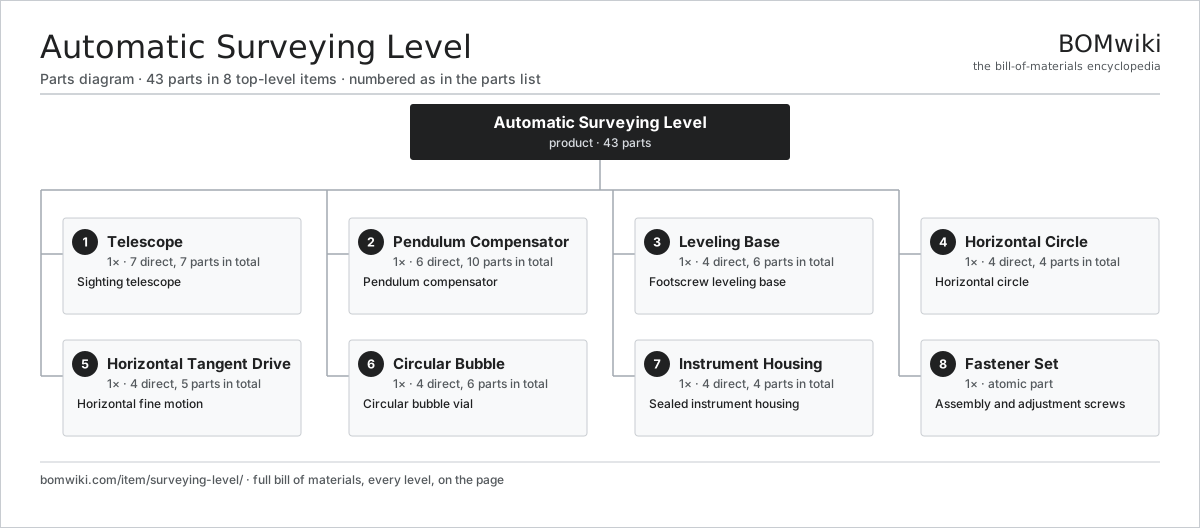
| # | Part | Qty | What it does |
|---|---|---|---|
| 1 | Telescope 7 parts | 1× | Sighting telescope |
| 2 | Pendulum Compensator 6 parts | 1× | Pendulum compensator |
| 3 | Leveling Base 4 parts | 1× | Footscrew leveling base |
| 4 | Horizontal Circle 4 parts | 1× | Horizontal circle |
| 5 | Horizontal Tangent Drive 4 parts | 1× | Horizontal fine motion |
| 6 | Circular Bubble 4 parts | 1× | Circular bubble vial |
| 7 | Instrument Housing 4 parts | 1× | Sealed instrument housing |
| 8 | Fastener Set | 1× | Assembly and adjustment screws |
3D model
No 3D model yet. Have a CAD file of this? Add a 3D model. STL renders right on this page; STEP, FreeCAD, and OpenSCAD sources are welcome too (openly licensed, like all 3D models on BOMwiki).
Build & assembly graph
expand / collapse · shared sub-assemblies converge · links to related products · est. labourTap an assembly to expand/collapse · tap a part to open it · use “Open page” for any node · drag to pan, scroll to zoom.
Bill of materials for Automatic Surveying Level
8 top-level lines · 41 rows shown · 43 parts total · indented to 3 levels| # | Item / sub-assembly | Part no. | Qty/assy | Ext. qty | Parts | Type |
|---|---|---|---|---|---|---|
| 1 | Telescope 7 parts | surveying-level-telescope | 1× | 1 | 7 | assembly |
| 1.1 | Objective Lens | surveying-level-objective-lens | 1× | 1 | · | part |
| 1.2 | Internal Focusing Lens | surveying-level-focusing-lens | 1× | 1 | · | part |
| 1.3 | Focus Knob | surveying-level-focus-knob | 1× | 1 | · | part |
| 1.4 | Helical Gear Pair | gear-pair | 1× | 1 | · | part |
| 1.5 | Reticle Plate | surveying-level-reticle-plate | 1× | 1 | · | part |
| 1.6 | Eyepiece Group | surveying-level-eyepiece-group | 1× | 1 | · | part |
| 1.7 | Peep Sight | surveying-level-peep-sight | 1× | 1 | · | part |
| 2 | Pendulum Compensator 6 parts | surveying-level-compensator | 1× | 1 | 10 | assembly |
| 2.1 | Compensator Prism | surveying-level-compensator-prism | 1× | 1 | · | part |
| 2.2 | Prism Carrier | surveying-level-prism-carrier | 1× | 1 | · | part |
| 2.3 | Suspension Wires | surveying-level-suspension-wires | 4× | 4 | · | part |
| 2.4 | Damper Vane | surveying-level-damper-vane | 1× | 1 | · | part |
| 2.5 | Neodymium Magnet | neodymium-magnet | 2× | 2 | · | part |
| 2.6 | Pendulum Limit Stop | surveying-level-limit-stop | 1× | 1 | · | part |
| 3 | Leveling Base 4 parts | surveying-level-leveling-base | 1× | 1 | 6 | assembly |
| 3.1 | Footscrew | surveying-level-footscrew | 3× | 3 | · | part |
| 3.2 | Trivet Plate | surveying-level-trivet-plate | 1× | 1 | · | part |
| 3.3 | Spring Plate | surveying-level-spring-plate | 1× | 1 | · | part |
| 3.4 | Tripod Thread Bush | surveying-level-tripod-bush | 1× | 1 | · | part |
| 4 | Horizontal Circle 4 parts | surveying-level-circle | 1× | 1 | 4 | assembly |
| 4.1 | Graduated Circle | surveying-level-graduated-circle | 1× | 1 | · | part |
| 4.2 | Circle Window | surveying-level-circle-window | 1× | 1 | · | part |
| 4.3 | Index Mark | surveying-level-index-mark | 1× | 1 | · | part |
| 4.4 | Circle Cover | surveying-level-circle-cover | 1× | 1 | · | part |
| 5 | Horizontal Tangent Drive 4 parts | surveying-level-tangent-drive | 1× | 1 | 5 | assembly |
| 5.1 | Tangent Knob | surveying-level-tangent-knob | 2× | 2 | · | part |
| 5.2 | Friction Clutch | surveying-level-friction-clutch | 1× | 1 | · | part |
| 5.3 | Helical Gear Pair | gear-pair | 1× | 1 | · | part |
| 5.4 | Ball Bearing | ball-bearing | 1× | 1 | · | part |
| 6 | Circular Bubble 4 parts | surveying-level-bubble | 1× | 1 | 6 | assembly |
| 6.1 | Bubble Vial | surveying-level-bubble-vial | 1× | 1 | · | part |
| 6.2 | Vial Mount | surveying-level-vial-mount | 1× | 1 | · | part |
| 6.3 | Bubble Viewing Prism | surveying-level-bubble-prism | 1× | 1 | · | part |
| 6.4 | Vial Adjusting Screws | surveying-level-vial-adjust-screws | 3× | 3 | · | part |
| 7 | Instrument Housing 4 parts | surveying-level-housing | 1× | 1 | 4 | assembly |
| 7.1 | Housing Shell | surveying-level-housing-shell | 1× | 1 | · | part |
| 7.2 | Eyepiece Cover Plate | surveying-level-eyepiece-cover | 1× | 1 | · | part |
| 7.3 | O-Ring Set | oring-set | 1× | 1 | · | part |
| 7.4 | Fastener Set | fastener-set | 1× | 1 | · | part |
| 8 | Fastener Set | fastener-set | 1× | 1 | · | part |
Something wrong in this list? Report a problem with this BOM.
Related products
same domain, ranked by shared parts Industrial 3D Scanner
149 parts · shares 4 with this page
Industrial 3D Scanner
149 parts · shares 4 with this page
 Rotary Laser Level
236 parts · shares 4 with this page
Rotary Laser Level
236 parts · shares 4 with this page
 Computerized GoTo Telescope
320 parts · shares 3 with this page
Computerized GoTo Telescope
320 parts · shares 3 with this page
 Digital Microscope
88 parts · shares 3 with this page
Digital Microscope
88 parts · shares 3 with this page
 DSLR Camera
553 parts · shares 3 with this page
DSLR Camera
553 parts · shares 3 with this page
 Slide Projector
182 parts · shares 3 with this page
Slide Projector
182 parts · shares 3 with this page
Sourcing: possible vendors
Browse the supplier directory → Prices, MOQ, and lead times are algorithmic estimates, not quotes, and not claims about these companies. Company mappings are curated by keyword; est. price band $100–$8k. How estimates work| Vendor | HQ | Specialty | MOQ | Lead time |
|---|---|---|---|---|
|
🇯🇵Canon
canon.com ↗
|
Tokyo, JP | Imaging & optics | 500 units | 10–16 wks |
|
🇯🇵Nikon
nikon.com ↗
|
Tokyo, JP | Imaging & optics | 500 units | 10–16 wks |
|
🇩🇪ZEISS
zeiss.com ↗
|
Oberkochen, DE | Optics & optoelectronics | 500 units | 10–16 wks |
| leica-camera.com ↗ | Wetzlar, DE | Cameras & optics | 500 units | 10–16 wks |
| flir.com ↗ | Wilsonville, US | Thermal imaging | 500 units | 10–16 wks |
802-word article